
Demand for GPU packaging substrates soars, Nvidia Blackwell's path to barbaric expansion
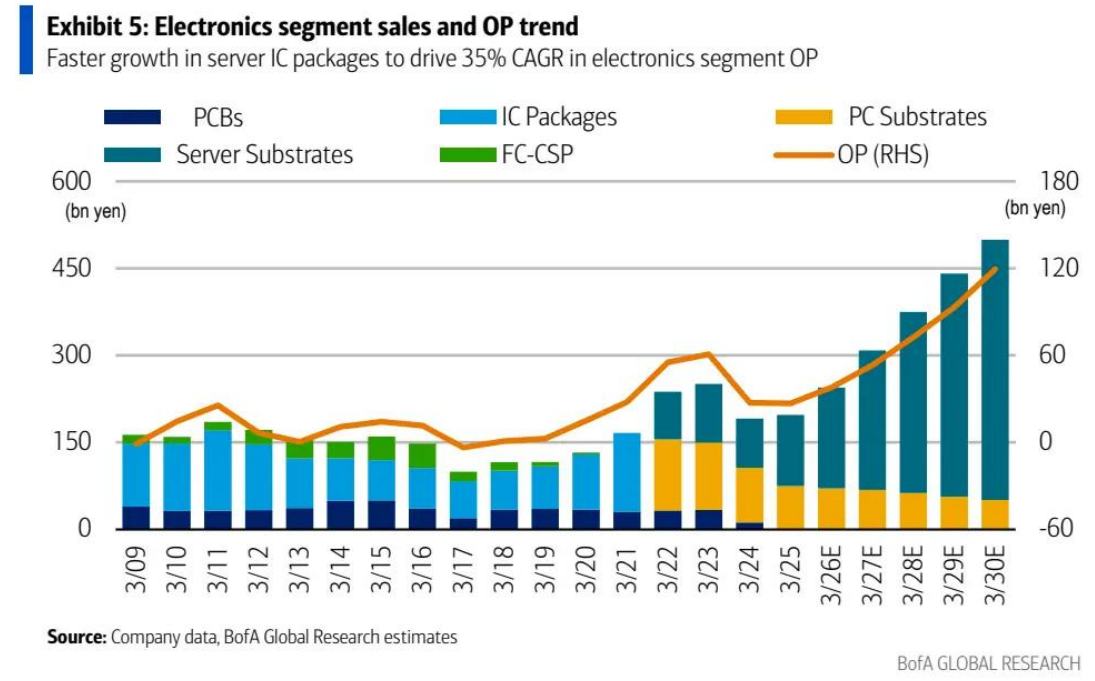
The Zhitong Finance App learned that according to a recent research report released by Wall Street investment giant Bank of America (Bank of America), the compound operating profit growth rate (CAGR) of the electronic component business under Ibiden, a semiconductor packaging equipment leader headquartered in Japan, can reach 35% over the next five years, and the EPS expectations up to the 2028 fiscal year have been drastically raised. The main logic is that demand for GPU packaging substrates (that is, ABF advanced packaging substrates) provided by IBDEN to expand AI chip production capacity continues to explode. Drive ABF volume and price together to increase dramatically.
According to Bank of America research data, Ibiden, the leader in packaging equipment, is drastically expanding production (expected to increase production capacity by 60-70% in 2024-26), and is expected to seize ASIC's historic accelerated expansion opportunities. It is expected that starting in 2026, it will supply ABF substrates to AI ASIC super customers such as Google, Microsoft, and Meta's self-developed AI ASIC chip packages.
The Bank of America analyst team's extremely optimistic expectations for a significant expansion in Ibiden's valuation and demand fundamentals mean that Nvidia's Blackwell series AI chip/AI server rack product shipments will begin a so-called “super growth cycle” in the second half of the year — Blackwell series AI chips include Blackwell architecture AI GPUs and AI GPUs based on Nvidia's most advanced architecture, Blackwell Ultra. For example, the Blackwell architecture dual DIE+8-HBM3E or the next generation HBM system, the 12-HBM4 CowOS advanced package, requires at least 14 layers of ABF and a large effective area.
According to information, chip industry chain research data from Wall Street institutions such as Bank of America and Morgan Stanley shows that since the second quarter of this year, after Blackwell architecture AI GPU products and GB200 NVL72 AI server racks entered a trajectory of accelerated growth in shipments exceeding expectations, as Blackwell Ultra architecture products achieve mass production, the Blackwell series AI GPU products/AI server rack products are expected to move towards a more barbaric “path of rapid increase in global shipments and AI computing power demand” starting in the second half of this year.
Why is the ABF package substrate firmly bound to the AI chip package?
AI ASICs such as Nvidia's Blackwell series dual-die AI GPUs and Google TPU are striving to firmly “bundle” more high-power chips, higher HBM stacks, and tens of thousands of high-speed I/Os through TSMC's CoVOS advanced package, which is inseparable from ABF packaging with high level attributes - this advanced packaging substrate must simultaneously achieve ultra-fine lines, low dielectric power, high heat resistance, and low warpage. Currently, the only material system that meets these demanding indicators and has been verified by large-scale mass production is ABF advanced packaging.
For example, in order for the Blackwell-B200 to stack two large GPU dies with a maximum 12-high HBM4 stack and connect to the silicon interlayer, the number of I/Os compared to Hopper increases by 145%, and must rely on ABF advanced packaging substrates with 10-14 layers of arbitrary layer interconnection (mSAP process) to meet impedance and crosstalk requirements. Blackwell-B200's high-speed SerDes spacing is far less than 35 µm, and the number of wiring layers reaches more than 14 layers. ABF advanced packaging substrates can stably achieve 8/8 µm or even 5/5 µm line width/line spacing using the mSAP/SAP process, while traditional BT substrates are optimally only 15/15 µm.
Electrical and thermal performance also determine that advanced packaging systems for high-performance AI chips are inseparable from ABF packaging substrates. ABF resin has a low dielectric constant (Dk=3.5), low loss, heat resistance Tg greater than 200 °C, and can support package heat dissipation greater than 1 kW. High-rise stacked Blackwell-HBM modules must rely on this material characteristic to ensure high efficiency, integrity and reliability of data transmission.
ABF package substrate and AI computing power requirements
Ibiden is in the top advanced packaging equipment echelon where both technology and customers dominate, and Blackwell's production capacity climbing is strongly coupled with its large-scale line expansion progress. The manufacture and shipment of Blackwell/AI ASICs can be described as highly dependent on ABF. The Bank of America research report shows that due to strong demand for AI computing power, the pace of mass shipment of Blackwell series AI GPUs and AI server racks was drastically ahead of schedule, demand for AI ASIC chips led by Google TPU unexpectedly soared, and global ABF packaging substrate production capacity was “grabbed” on a large scale.
Anthropic, a generative AI leader with the title of “OpenAI rival,” predicts that by 2027, the AI big model will be able to automate almost all white-collar jobs, so the AI computing power demand brought by the inference side can be called a “sea of stars”, which is expected to drive the AI computing power infrastructure market to continue to show exponential growth. “AI inference systems” are also the largest source of future revenue for Nvidia.
As ChatGPT became popular around the world and the big video model of Sora Wensheng became popular, superimposing the unparalleled performance of Nvidia, the “seller” in the AI field, for many consecutive quarters, it means that human society has entered the AI era. At the Nvidia performance conference at the end of May, Hwang In-hoon was extremely optimistic that the Blackwell series would set the strongest AI chip sales record in history, driving the AI computing power infrastructure market to “show exponential growth.”
In the latest report, the Bank of America analysis team drastically raised the profit forecast and target share price of ABF packaging substrate core supplier iBiden within 12 months. Bank of America said that Nvidia AI GPUs still account for about 80% + of the iBiden ABF packaging substrate, but AI ASIC (mainly AI ASIC of major cloud computing giants) is expected to approach 20% by 2030.
Bank of America said that ASIC leaders such as Nvidia and Broadcom have locked down advanced packaging production lines for Ibiden and a few Chinese Taiwanese packaging equipment manufacturers. In particular, Ibiden has continued to expand production significantly since the end of 2024, which just shows that Nvidia, its largest ABF packaging substrate customer, has strong confidence in the explosive growth in shipments of Blackwell series products and has given clear long-term quantitative orders to the supply chain.
The strong demand for GPU substrates also confirms that Nvidia Blackwell series GPUs (B200/GB200 and subsequent Blackwell Ultra B300) shipments and the installed capacity of Nvidia's Blackwell AI server clusters are rapidly expanding, and substrate manufacturers are being forced to expand advanced ABF production capacity ahead of schedule to match their shipping pace.
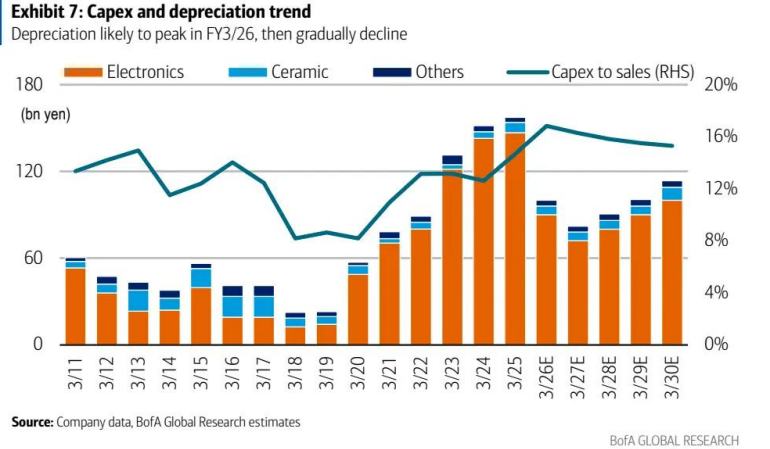
The Bank of America analysis team said that AI ASICs for hyperscale AI data centers (such as Google TPU, Amazon AWS's Trainium, etc.) are expected to enter the growth stage of ABF packaging substrates at the same level as Nvidia's Blackwell series products from 2026. According to the Bank of America report, Ibiden has added an unprecedented 60-70% ABF package substrate production capacity at two new plants in Gifu and Ono in Japan to meet the strong growth demand for high-end GPUs and ASICs at the same time.
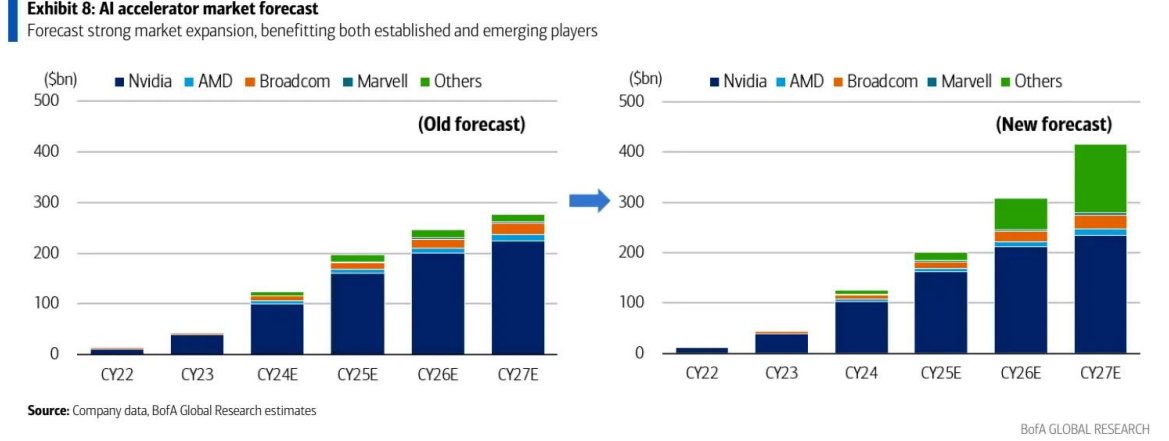
According to the Bank of America's analysis team's latest forecast data, AI chip market sales, including GPUs, ASICs, and other XPUs, will grow from just $126 billion in 2024 to more than 400 billion US dollars in 2027, and to at least 650 billion US dollars by 2030. Although Nvidia's AI GPUs dominate the market with close to 80%, Bank of America predicts that the ASIC ecosystem based on customization, high performance, and low cost features will account for nearly 20% of the market by 2030.