
- PREMIUM
- LIVE QUOTES
- INSTITUTIONS
 Index Options


 State Street
 CME Group
 Nasdaq
 Cboe
Cboe TradingView
 Wall Street Journal
The British stock market is in deep trouble: FTSE 100 rose 7% to bottom Europe, and it is difficult for the Labor Party to overcome multiple pressures
The Zhitong Finance App learned that the Labor Party came to power with an overwhelming advantage in the election a year ago. Although it brought political stability and investment opportunities to Britain, its domestic stock market is still in deep trouble. Stock investor returns have continued to weaken since the new administration led by Kiel Stammer took office: the FTSE 100 index rose by only 7%, in stark contrast to the 17% to 27% increase in the German, Spanish, and Italian benchmark indices during the same period.
What is even more worrisome is that the current growth momentum is already weak — the market lacks confidence that the Labour Party can stimulate economic growth without increasing fiscal pressure, and expectations of raising taxes or expanding government borrowing continue to heat up, further prolonging the pressure cycle on the British bond market. Combined with the Central Bank of England's cautious approach to cutting interest rates, it is difficult for investors to resolve their doubts about the outlook for the UK economy and stock market.
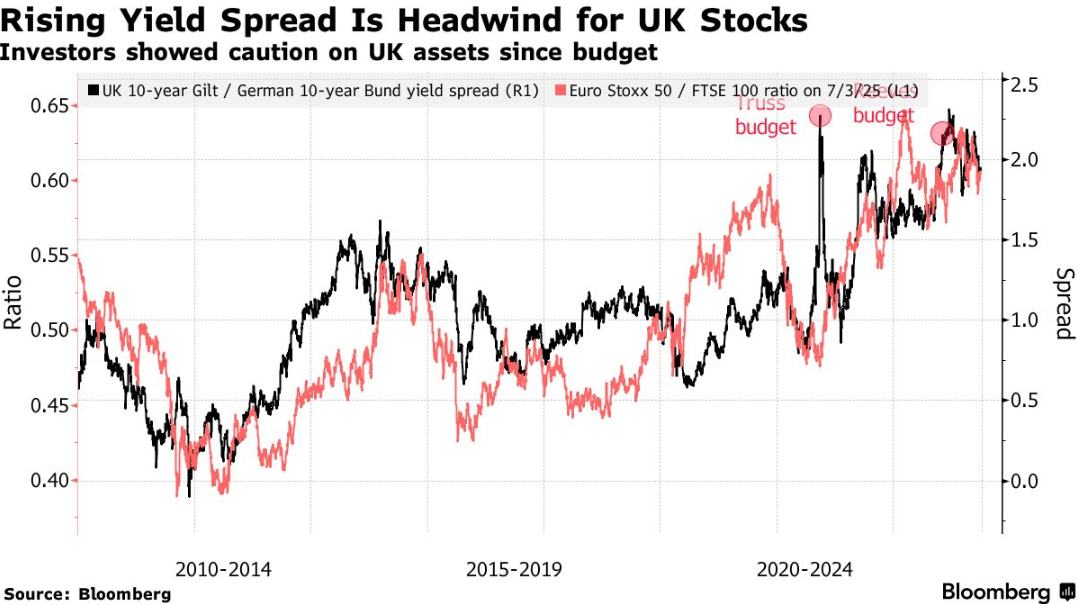
Figure 1
Thomas Schusler, co-head of global equities at the DWS Group under Deutsche Bank, stated: “The government has limited room to operate, and fiscal capacity and investor tolerance are constrained.” Although the valuation of the UK stock market has recovered this year, the starting point is low: the price-earnings ratio of the London FTSE 350 Index rose to 13 times from 11.4 times at the beginning of the year, and is still discounted by about 35% compared to the MSCI Global Index, making it one of the cheapest stock markets in developed markets.
However, further upward valuations are dependent on improved profit growth, and high borrowing costs are becoming a key obstacle — the market expects the Bank of England to cut interest rates only three times in the next year, and interest rates will remain at 3.5%, double the expected interest rate in the Eurozone.
Florian Ilbo, macro director of Longao Investment Management in Geneva, analyzed: “Under huge financial uncertainty, the British market narrative revolves around interest rates.” He emphasized increased political and economic uncertainty, and pointed out that the London stock market rally “appears weak due to rising yields and lacks support for valuation expansion”.
The “asymmetric risk environment” created by the Bank of England is particularly difficult: long-term interest rates have a downward bottom line but no clear upper limit. “If global economic growth does not deteriorate significantly, this structure will continue to suppress UK assets”.
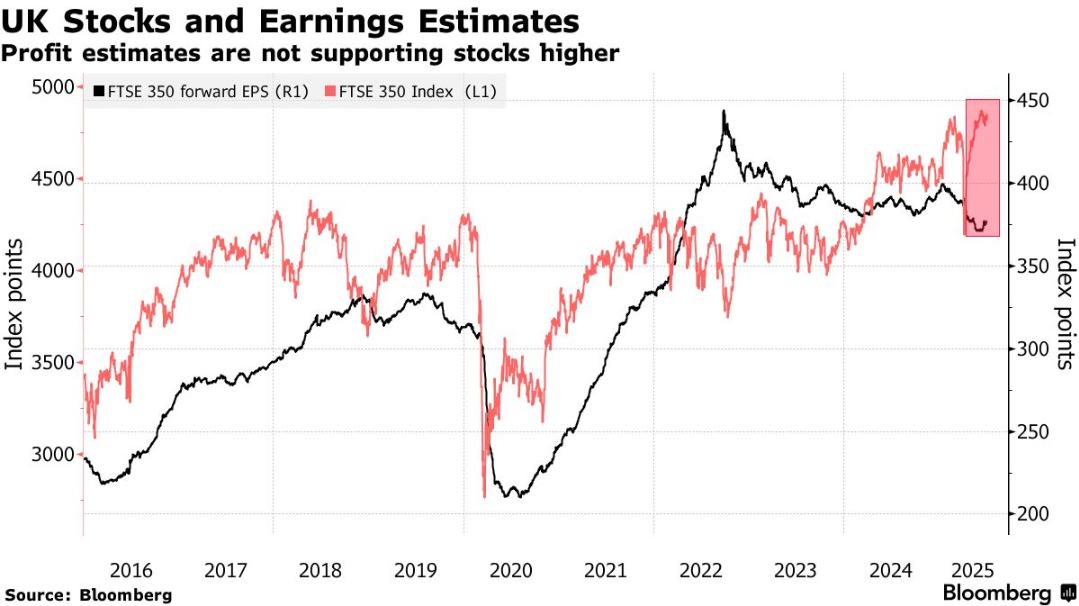
Figure 2
This pressure affects both large international stocks in the FTSE 100 Index as well as local small and medium capitalization stocks. The upcoming earnings season will be a key window for testing whether companies can break through interest rate headwinds. Furthermore, the sharp appreciation of the pound may become the focus of earnings meetings — about 75% of FTSE's 100 constituent shares come from overseas, and the pound has appreciated 9.3% against the US dollar this year.
Bloomberg industry research strategist Laurent Duyer and Kaidi Meng pointed out that the FTSE 100 index's valuation has limited room to rise. According to its fair value model, the market has included the Bank of England's interest rate cut expectations three times (price-earnings ratio of 12.7 times in the first half of 2026), and this valuation is based on a slight increase in the historical level of $70 per barrel of Brent crude oil. As the FTSE index accounts for a high share of US revenue, a stronger pound may further squeeze small-cap returns.
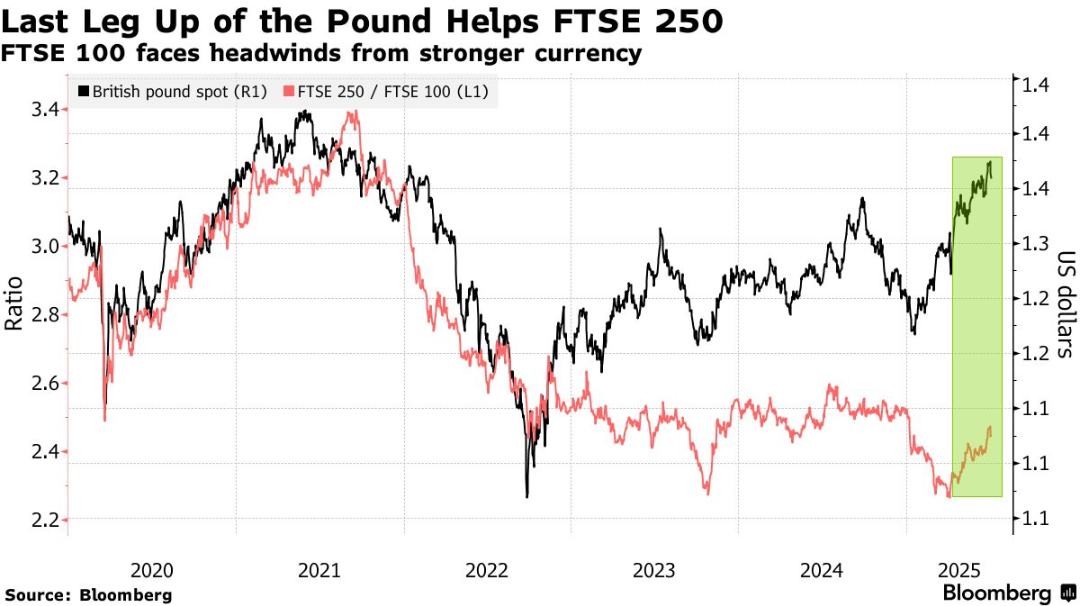
Figure 3
In addition to interest rate and exchange rate challenges, the UK market also faces problems such as insufficient liquidity, excessive regulation, and low willingness of local investors to allocate stocks. The size of the UK stock market continues to shrink as more companies consider relocating their listings — the downturn in the IPO market is worsening, as there was news this week that AstraZeneca, London's largest market capitalization company, is evaluating going public in the US.
Institutional investors' attitude continues to be lukewarm: According to the Bank of America fund manager survey in June, global investors reduced their net holdings of UK assets by 4%, the same as in May; the Citigroup strategist team (led by Beata Manti) also downgraded the UK's rating from “increase” to “neutral”, pointing out that “the UK used to be an effective geopolitical risk hedging tool, but currently profit growth is weak and valuations are no longer extremely cheap.”