
- PREMIUM
- LIVE QUOTES
- INSTITUTIONS
 Index Options


 State Street
 CME Group
 Nasdaq
 Cboe
Cboe TradingView
 Wall Street Journal
Expectations of “small non-farmers” upset interest rate cuts are heating up again! US ADP unexpectedly declined by 33,000 in June, showing negative growth for the first time in more than two years
The Zhitong Finance App learned that the number of people employed in private companies in the US fell for the first time in more than two years in June, mainly affected by the decline in service jobs. This sign may raise market concerns about the accelerated slowdown in the labor market.
According to data released by the ADP Research Institute on Wednesday, the number of employed people increased by 29,000 in May after the revisions, while the number of people employed in the private sector decreased by 33,000 in June. None of the economists previously surveyed anticipated negative growth.
ADP chief economist Nela Richardson said in a statement: “Although corporate layoffs are still rare, employers are wary of new hires and are unwilling to fill the vacancies of former employees, which led to a contraction in employment last month.”
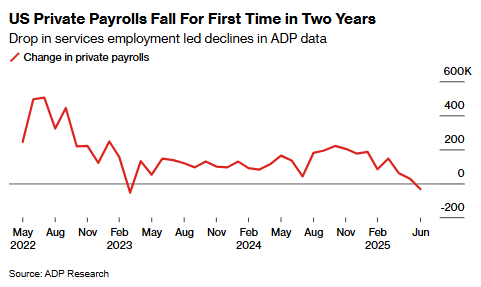
It should be noted that the ADP report's predictive accuracy of subsequent official non-farm payrolls data has always been unstable, and the market usually pays more attention to authoritative reports from the US Department of Labor. For example, the weak ADP data for May deviates significantly from the official employment data released later that week. The official non-farm payrolls report to be released on Thursday is expected to show that the employment growth rate in June may hit a four-month low, and the unemployment rate may rise slightly to 4.3%.
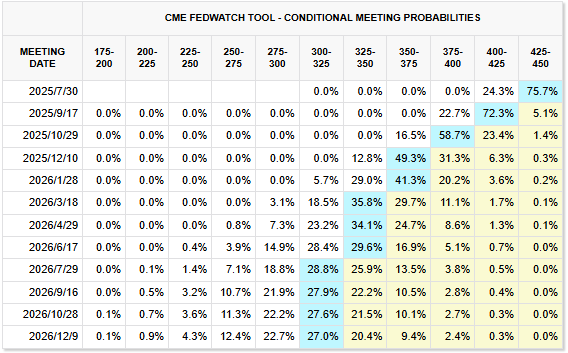
After the data was released, US Treasury yields fell in response, stock index futures declined, and the dollar's rise narrowed. Traders have increased their bets that the Federal Reserve will cut interest rates at least twice before the end of 2025. The probability of betting on cutting interest rates three times also increased sharply once again after ADP employment data was released. In addition, interest rate futures market trading data also showed that the probability of traders betting that the Federal Reserve would cut interest rates by 25 basis points in July increased from 20.7% to 24.3%.
Carl Weinberg, chief economist at High Frequency Economics, said, “The ADP data is far below market expectations, and the negative employment growth is shocking. Whether this report is accurate or not, traders and investors will see this as a negative sign for today's market.”
50 Park Investments' Adam Sarhan) pointed out, “This is the first time in recent months that the US job market has experienced a disappointing contraction. Considering the continued decline in unemployment and strong job market performance, the current situation is indeed worrying.”
Weinberg also warned that companies may use “more aggressive layoff measures” to deal with rising costs caused by tariffs. “This may only be the tip of the iceberg, but it may also be a false alarm.”
The service sector has become the hardest hit area for employment
As the impact of the Trump administration's trade policies continues to ferment, employers are adopting more prudent employment strategies and redoubling efforts to control costs. Companies are making efforts to adjust the size of their employees to adapt to the current economic slowdown.
The number of people employed in the service sector fell by 66,000 in June, mainly due to job cuts in professional and commercial services, healthcare, and education. However, there has been an increase in employment in manufacturing, construction, and mining. The number of people employed in small and medium-sized enterprises has generally declined.
In terms of geography, the Midwest and West, respectively, reduced jobs by 24,000 and 20,000, while the Northeast dropped slightly by 3,000, and the South alone achieved a net increase of 13,000. In terms of enterprise size, large enterprises with more than 500 people bucked the trend and hired 30,000 more people, while small and micro enterprises with less than 20 people lost 29,000 jobs.
According to the ADP report, the average employment growth rate for the three months to May has slowed to 18,700, a new low since the beginning of the pandemic. Other data shows that the re-employment cycle for the unemployed is being extended, and statistics from the headhunting company Challenger, Gray & Christmas show that the recruitment scale of companies in June was the second lowest level since records began in 2004.
According to data from the US Economic Council, the percentage of consumers who think “employment opportunities are sufficient” fell to its lowest point in more than four years in June.
Despite signs of slowing down, Federal Reserve Chairman Powell has repeatedly emphasized that the labor market remains stable. In view of the need to observe the impact of tariffs on inflation, Federal Reserve officials have kept interest rates unchanged this year.
According to a report released jointly by ADP and the Stanford Digital Economy Lab, wage growth has cooled down. Salaries for job-hopping employees rose 6.8% year over year, while retained workers rose 4.4% year over year. The report's data covers more than 25 million US private sector employees.