
The silicon photon revolution is poised to begin, and the “Age of Light” is coming soon! The AI computing power industry chain is entering a new round of “bull market curve”
The Zhitong Finance App learned that European financial giant BNP PARIBAS (BNP PARIBAS) recently released a research report showing that the wave of “silicon photon technology” dominated by global chip giants such as Nvidia, TSMC, and Broadcom is about to evolve into an unprecedented revolution in history — the “silicon photon revolution” that will sweep the entire AI computing power industry chain — this also means that CPO and optical I/O technology routes will soon accelerate penetration from cutting-edge laboratories to global applications. The upcoming “silicon photon revolution” can be described as a major potential catalyst for the global AI computing power industry chain covering devices such as AI chips, HBM, and Ethernet switches. The “long-term bull market narrative” logic can be described as being greatly strengthened, which is expected to push the industry towards a new round of raging “bull market curves.”
In order to curb the exponential rise in AI data center power consumption, reduce operating costs, and greatly improve the computing power efficiency of each AI rack unit, co-packaged optics (CPO) was proposed as a large-scale horizontal expansion interconnection solution — the “AI chip hegemon” Nvidia has included it in the roadmap. For example, the Nvidia InfiniBand Quantum-X switch is expected to be launched in the second half of 2025, and the Nvidia Spectrum-X Ethernet Switch is expected to be launched in the second half of 2026, all incorporating silicon photonic technology.
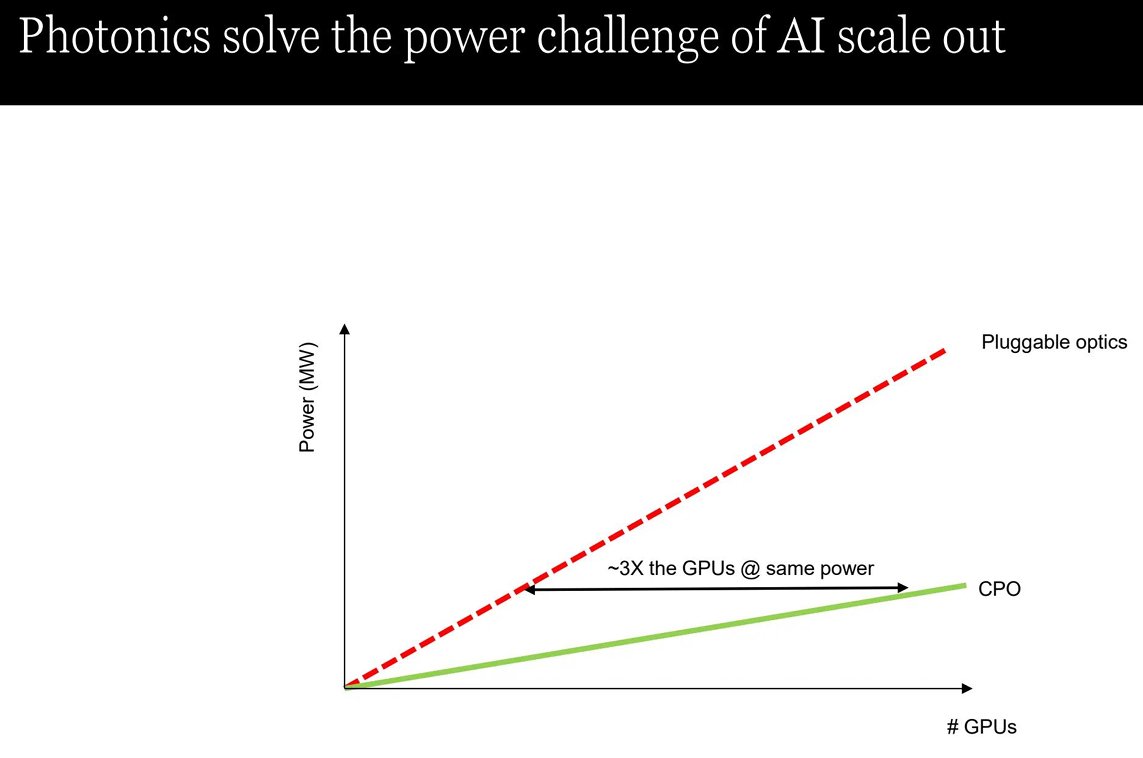
By integrating and packaging the optical signal transmitter and receiving end closer to the switching chip, CPO is expected to reverse the exponential rise in power consumption of optical interconnect devices such as Ethernet switches. According to Nvidia's prediction data, compared with traditional pluggable optical modules, using a CPO package can triple the number of processors (XPUs) deployed such as GPU/CPU/AI ASICs under the same power consumption. In addition to CPO, optical I/O (Optical I/O, OIO for short) further expands the scope of application of silicon photons from switching chips to processor chips such as GPU-GPUs, CPU-GPUs, and CPU-ASICs, which is expected to further reduce energy consumption per bit. Bank France and Pakistan expect to see photonic neural networks and quantum photonics technology in the future to further expand the scope of application of optical solutions.
A team of analysts at BNP Paribas said that the global optical communication data center interconnection market based on “silicon photonics” technology (including CPO and optical I/O technology routes) is expected to grow rapidly at a compound annual growth rate (CAGR) of more than 80% from 2028 to 2033. The agency's market size is expected to be close to 2.5 billion US dollars by 2033, and the vast majority of these markets are expected to be optical I/O. According to calculation data from Bank France and Pakistan, CPO penetration is expected to accelerate in the medium term, but from the perspective of silicon photonics technology routes and long-term investment, the optical I/O market will be even broader. The agency expects that by 2033, in a single large data center, the future demand for optical I/O modules will eventually reach 2 to 7 times the number of CPO modules of the same size (calculated by the number of data centers per unit).
Overall, Bank France and Pakistan's analysis team is very optimistic about the investment prospects of Nvidia, TSMC, and the world's major optical network hardware vendors (Broadcom, Lumentum, Coherent, Fabrinet, Marvell), and believes that the “silicon photon revolution” is expected to become a potential major catalyst for these chip giants, driving their stock prices into a continuous upward trajectory. At the same time, the agency believes that silicon wafer manufacturer Soitec (SOI) on the material side and Dutch semiconductor equipment giant BE Semiconductor on the silicon photonic equipment side will also benefit greatly from the “silicon photon revolution” that is about to sweep the world.
Two important paths for silicon photonics technology: CPO and optical I/O
Moore's law approaching the limit has largely caused the performance enhancement of traditional electronic chips to slow down, and silicon photon-based chip packaging technology provides a performance enhancement scheme based on optical technology, which accelerates the expansion of chip performance when nano-process technology is limited. Silicon photonics technology is a technology that integrates optical components such as laser devices with silicon-based integrated circuits. It uses optical rather than electrical signals to achieve high-speed data transmission, longer transmission distance, and low power consumption. Furthermore, compared to ordinary electrical signal chips, silicon photonic chips can also provide much lower latency.
As ChatGPT became popular around the world and the big video model of Sora Wensheng became popular, superimposing the unparalleled performance of Nvidia, the “seller” in the AI field, for many consecutive quarters, it means that human society has entered the AI era. At the same time, the growing demand for AI computing power brings huge demand for optical interconnection, so silicon photonic technology has considerable potential in high-bandwidth, low-power application scenarios such as high-speed data communication and data center interconnection. As the penetration rate of cloud-based AI computing power services and ChatGPT generative AI applications based on AI training/inference computing power systems increases, demand for AI computing power surges, silicon photonics technology will play an increasingly important role.
At the Nvidia performance conference at the end of May, Hwang In-hoon was extremely optimistic that the Blackwell series would set the strongest AI chip sales record in history, driving the AI computing power infrastructure market to “show exponential growth.” “Today, every country sees AI at the core of the next industrial revolution — an emerging industry that continuously produces intelligence and critical infrastructure for every economy in the world,” Hwang In-hoon said in a performance discussion with analysts.
The demand for AI computing power brought about by the inference side can be called a “sea of stars”, which is expected to drive the AI computing power infrastructure market to continue to show exponential growth. “AI inference systems” are also the largest source of future revenue for Nvidia Hwang.
In the silicon photonics technology landscape, “co-packaged optics (CPO)” and “optical I/O (optical I/O)” do form two complementary but very different routes: the former prioritizes the power consumption and panel density bottlenecks of rack-level switching ASIC interfaces, while the latter uses optical transceivers as cores and positions them as next-generation off-chip buses between computing chips such as CPU/GPU/NPU.
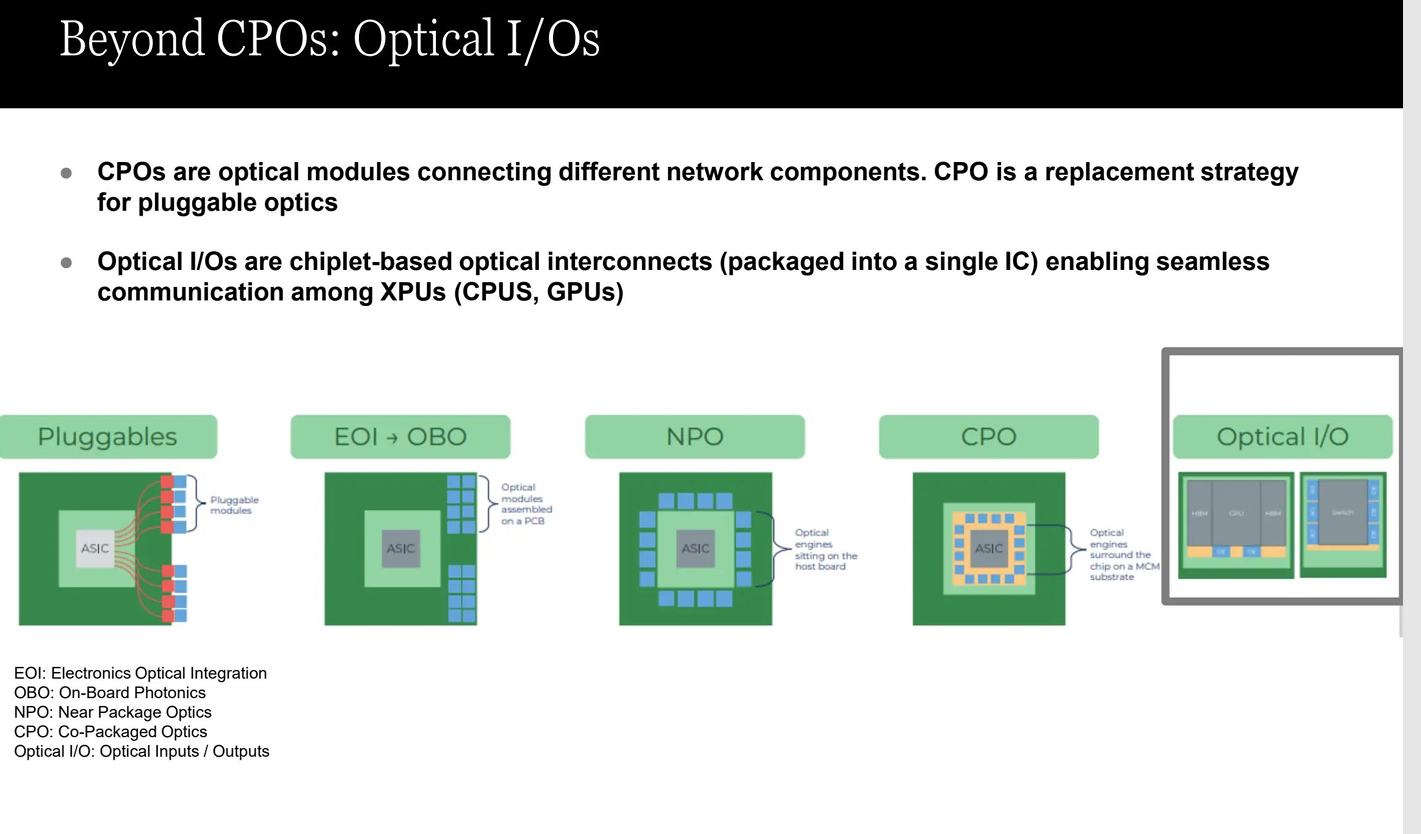
Simply put, CPO technology mainly targets immediate power/efficiency density bottlenecks in high-performance network switching ASICs such as Nvidia InfiniBand and Broadcom Ethernet switch chips, while optical I/O targets future bandwidth, energy efficiency, and chip pinwall challenges for heterogeneous computing. From the perspective of advanced packaging, the possibility of CPO and optical I/O being integrated into one package system is very high. Advanced 2.5D/3D packages (CoWoS, InFO, EMIB, etc.) allow the simultaneous placement of an exchange ASIC+CPO optical engine and several computational cores with optical I/O within a large system-level package (SiP) to form a heterogeneous advanced package “sealed with different domains and thermal zone isolation” — so the two routes evolve independently and are highly complementary at the chip packaging system level.
According to the Bank France and Pakistan analysis team, the scale of optical I/O will become the mainstream route for silicon photonics technology, and the future market size will be much larger than CPO. According to Bank France and Pakistan's forecast data, the optical I/O market is only 38 million US dollars in 2022. It is expected to expand to 137 million US dollars in 2028 and 2.6 billion US dollars in 2033, which means that the CAGR is as high as 80% in 2028-2033. Bank France and Pakistan anticipates that the optical I/O requirements for a single data center will eventually be 2-7 times that of the CPO.

Judging from the silicon photonics technology routes of chip manufacturing giants such as TSMC, Intel, and Samsung Electronics, CPO and optical I/O showed a gradual integration. Ultimately. When silicon photons mature, “same system partition packaging” is expected to become the mainstream form of CPO and optical I/O.
2025-2027: Separate packaging will be promoted as the mainstream technology route, and chips based on CPO advanced packaging are expected to be mass-produced and applied on a large scale in Nvidia and Broadcom's high-performance switching equipment; optical I/O is still in the pilot phase of core PoC and early HPC accelerator cards; 2028-2030: Heterogeneous SiP on the same board, such as TSMC and Intel Foundry, may conduct heterogeneous testing, and then provide system-level advanced package chip products (COWos-SR, EMIB+) that support both CPO optical engines and OIO cores on a small scale COUPE composite); after 2030, it is expected that the performance level will continue to complement each other and coexist in the same advanced packaging system for a long time at the system level.

Nvidia, TSMC, and Broadcom lead the “silicon photon revolution”
The silicon photons-driven optical interconnect market is entering a period of rapid growth. According to Yole Intelligence's forecast, the “data communication optics” (mainly covering co-packaged optics and optical I/O) market size will grow from about 38 million US dollars in 2022 to about 137 million US dollars in 2028, and then jump to about 2.6 billion US dollars in 2033. This means a CAGR of approximately 24% during the period from 2022 to 2028, and growth will accelerate to over 80% per year during 2028-2033. The latter stage of this explosive growth was mainly driven by the volume of optical I/O products.
In fact, Yole predicts that the optical I/O market for AI/ML high-performance accelerators will reach about $2.3 billion by 2033, significantly larger than the CPO market for network interconnection during the same period (approximately $287 million). In other words, the share of optical I/O in the overall optical data communication market will increase year by year, and Nvidia, TSMC, and Broadcom will most likely be the biggest winners in the CPO and optical I/O superwave.
As a leader in AI computing, Nvidia is pioneering the integration of silicon photonic technology into its high-performance network products (Spectrum-X, Quantum-X switches) and is investing in startups (such as Ayar Labs) to improve the ecosystem. The cutting-edge layout in the fields of silicon photonic interconnection technology routes — CPO and optical I/O, will lay a major foundation for further improving the scalability and energy efficiency of the Nvidia AI GPU cluster, and will eventually continue to consolidate its absolute leading edge in the AI infrastructure market. As demand for AI computing power grows exponentially, institutions such as Bank France and Pakistan expect silicon photonic technology to become a key selling point for Nvidia's data center solutions, bringing them large-scale additional revenue and differentiation advantages.
Bank France and Pakistan maintain a positive outlook for Nvidia, believing that its leading position in the silicon photonics field will be one of the most important potential catalysts for stock prices (currently mainly the major expansion of AI-related businesses and the improvement of data center energy efficiency).
After leading the FinFET era of chip manufacturing and driving the 2nm GAA era, TSMC is expected to lead silicon photonic chip manufacturing technology and become a leader in silicon photonic chip manufacturing. Using its advanced technology and packaging capabilities, TSMC pioneered the launch of silicon photonic platforms (such as COUPE) and attracted cooperation from major customers such as Nvidia, AMD, and Apple, firmly maintaining its dominant position in the silicon photonic chip foundry process. With the gradual implementation of CPO and OIO technology routes, TSMC is expected to open up new “super growth points” in silicon photonic wafer-level foundry and advanced chip chip packaging business.
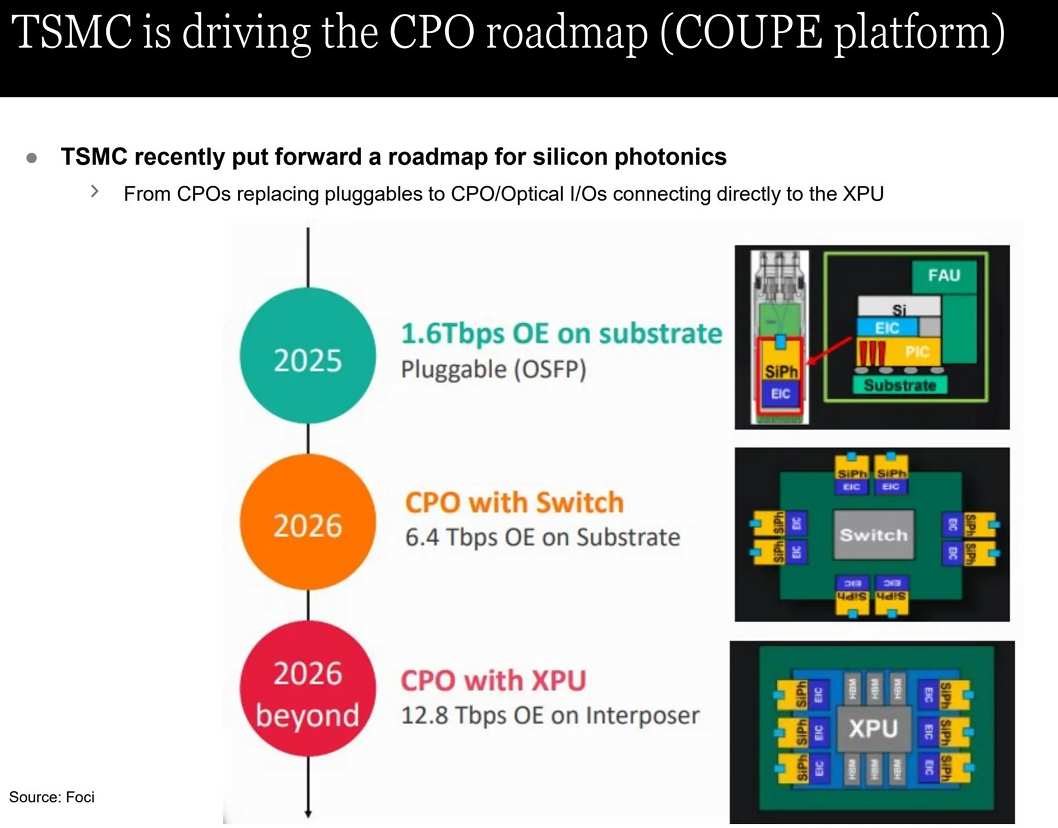
Investment institutions such as Bank France and Pakistan generally expect that TSMC will further launch a standardized silicon photonic process platform, lower the industry entry threshold, and thereby expand the silicon photon market cake. This will strengthen TSMC's near-monopoly position in the field of high-performance computing and optical communication chip manufacturing, and support strong growth in medium- to long-term performance.
On the one hand, Broadcom is developing its own CPO high-performance switching chip solutions (combined with its Tomahawk series flagship switch chip products), and on the other hand, accumulating technology in the field of optical interconnection through mergers and acquisitions (previously acquired optical module manufacturer Brocade). Broadcom has an extensive global cloud vendor customer base and mature switch ASIC business. Introducing CPO will greatly enhance the competitiveness of its switching system products.
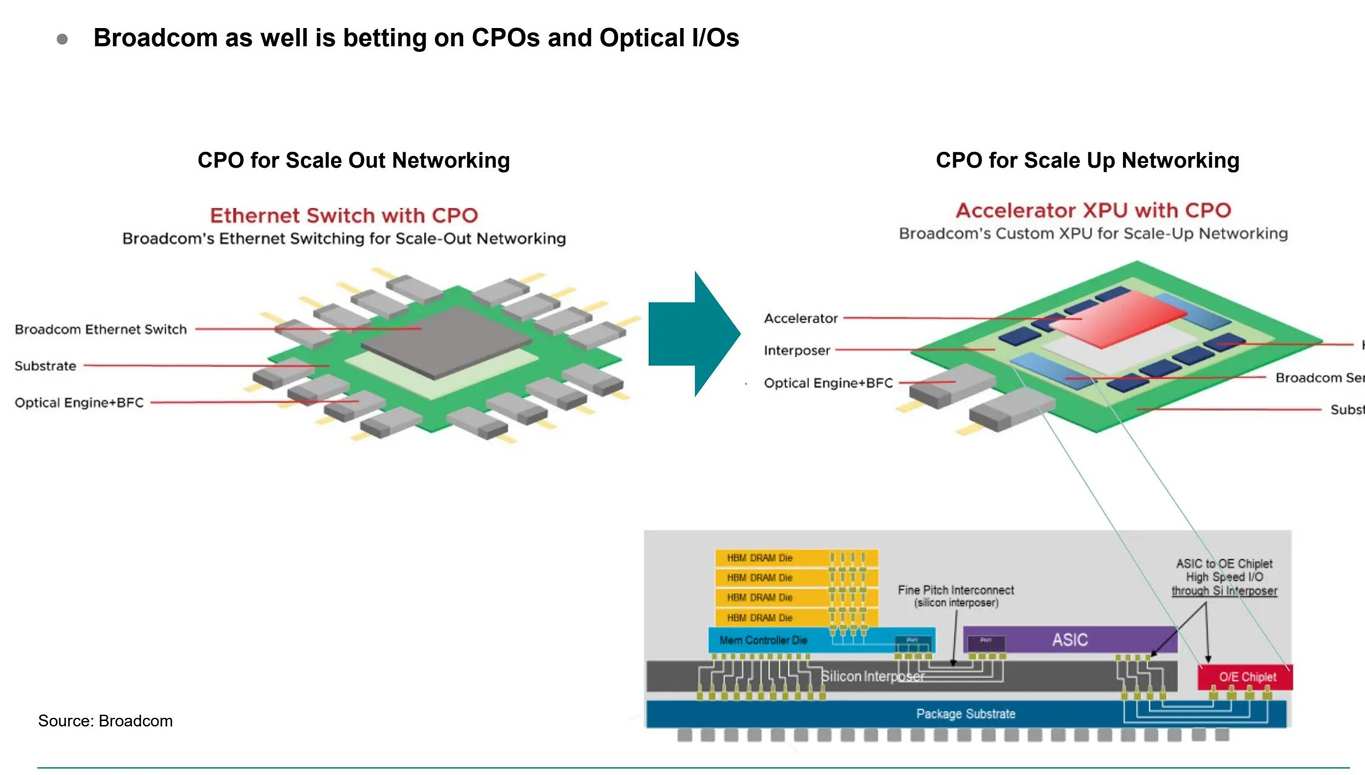
Well-known investment institutions such as Bank France and Pakistan generally expect Broadcom to integrate silicon photonic interfaces in next-generation switching platforms to meet the needs of hyperscale data center customers for high-bandwidth, low-power switches. This will drive Broadcom's high-end switch chip shipments to increase its share in the cloud data center market. Bank France and Pakistan's analysis team has a positive outlook on Broadcom's performance and stock price prospects. Like TSMC and Nvidia, its active investment in silicon photons is expected to become a new “super growth point.”