
IDC: The market size of IT solutions in China's banking industry is 71.305 billion yuan in 2024, up 2.9% year-on-year
Zhitong Finance App learned that the “China Banking Industry IT Solution Market Share 2024” report released by IDC shows that in 2024, China's banking IT solutions market size was 71.305 billion yuan, compared with 69.296 billion yuan in 2023, an increase of 2.9% over the previous year. IDC predicts that China's banking IT solutions market will reach 103,939 billion yuan by 2029, with a compound annual growth rate (CAGR) of 7.8% compared with 2024.
In 2024, the business development environment of China's banking industry is full of challenges, and the IT investment budget for the banking industry has been reduced. According to the data, the scale of IT investment in China's banking industry reached RMB 169.315 billion in 2024, an increase of 3.6% compared with RMB 163,398 billion in 2023, and is expected to reach RMB 266.227 billion in 2028. Although the size of the IT solutions market in China's banking sector showed growth, it continued to slow down compared to the 2023 growth rate.
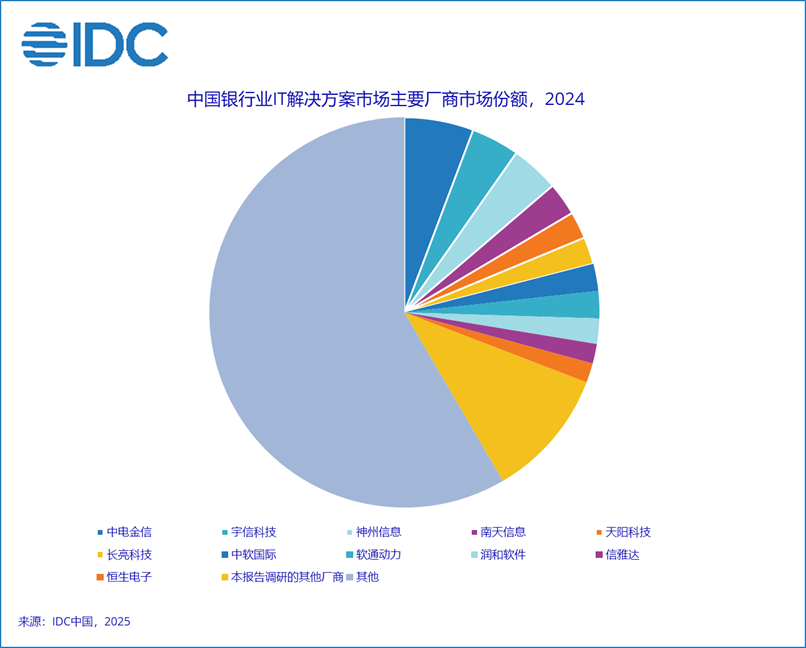
The market pattern of IT solutions in China's banking industry in 2024 is shown in the following figure:
IDC research found that in 2024, the Chinese banking IT solutions market showed the following characteristics:
Commercial banks' demand for cost reduction and efficiency has increased markedly. Back-office management projects have basically stopped because it is difficult to directly enable business growth in the short term, and front-office experience projects only receive careful investment when they can clearly improve marketing indicators or control efficiency. At the same time, commercial banks are paying more attention to investment in policy-related projects (such as IT transformation and adaptation, regulatory compliance, risk management) and investment in AI models.
Independent IT innovation is still the main theme of commercial banks. A large number of commercial banks have completed transformation by launching cloud-native distributed cloud platforms and updating software and hardware such as databases, operating systems, and middleware, which has also brought a large number of opportunities for application layer transformation and restructuring. Among them, the distributed transformation of the core systems of large commercial banks has basically been completed, and the distributed transformation of peripheral systems such as credit systems, payment and clearing systems closely linked to the core systems is progressing at an accelerated pace. Furthermore, in 2024, agricultural credit reform is also accelerating the establishment of agricultural commercial banks, a unified legal entity at the local and municipal levels, laying the foundation for deepening the reform of the agricultural credit system throughout the province. In the process, it has also brought opportunities for autonomous upgrading and transformation of many systems.
In 2024, commercial banks will pay more attention to deep cultivation of existing customers and optimization of internal operation and management costs, focusing on customer experience and doing fine management and personalized cultivation around the entire customer life cycle, thus driving business growth. This is also the direction commercial banks focus on and invest in
In 2024, there is an urgent need for autonomous transformation and adaptation of financial market business systems (especially capital business). Major banks such as ICBC and CCB have invested heavily and have already carried out initial self-research. On the technical service provider side, domestic manufacturers have made breakthroughs in some segments through mergers and acquisitions in the past few years. Especially in the capital business field, there is still a gap between domestic solutions and leading foreign products, but a phased breakthrough has been achieved through a combination strategy of self-development+mergers and acquisition+autonomous adaptation. In the next 3-5 years, domestic systems are expected to achieve greater autonomy and control in key areas such as transaction management and risk control.
The AI big model is also an important market hot spot this year, and it has also brought many driving forces to the increase in the size of the solution market. IDC predicts that by 2025, 65% of financial institutions will use AI big model platforms/tools to enhance the digital intelligence capabilities of their financial services. IDC believes that for ISVs, the engineering service capabilities of large models should be improved to ensure the stability, security and controllability of generative AI applications in the financial industry.
Si Erxun, China's financial industry research manager, said that in 2024, China's banking IT solutions market will be the main themes of reducing costs and increasing efficiency, independent innovation, and harnessing the trend with wisdom. The market environment is more varied and complex, and the overall revenue growth of the banking industry is under pressure. The solution market size continues to grow but the growth rate continues to slow down. In 2024, domestic demand is weak, incremental space is shrinking, and refined operation of existing customers has become an important feature of the current development of the banking industry. At the same time, AI-driven smart management has become a necessary option for commercial banks. Many manufacturers are building AI capabilities that match their genes to better seize market opportunities.
Gao Fei, director of IDC China's financial industry research, said that the rapid advancement of big models in the banking industry has brought new challenges and market opportunities to application-level IT solution vendors. Whether manufacturers can make full use of the professional know-how accumulated in vertical segmentation to build “business logic+AI”, whether they can rapidly improve full-stack AI engineering capabilities in data, models, application development, etc., and whether to achieve a transition from traditional product delivery to continuous operation in a business model guided by business value will be an important determining factor in determining the future pattern of this racetrack.