
We Think Bliss GVS Pharma (NSE:BLISSGVS) Can Stay On Top Of Its Debt
Legendary fund manager Li Lu (who Charlie Munger backed) once said, 'The biggest investment risk is not the volatility of prices, but whether you will suffer a permanent loss of capital.' When we think about how risky a company is, we always like to look at its use of debt, since debt overload can lead to ruin. We note that Bliss GVS Pharma Limited (NSE:BLISSGVS) does have debt on its balance sheet. But the real question is whether this debt is making the company risky.
When Is Debt Dangerous?
Debt is a tool to help businesses grow, but if a business is incapable of paying off its lenders, then it exists at their mercy. Ultimately, if the company can't fulfill its legal obligations to repay debt, shareholders could walk away with nothing. However, a more usual (but still expensive) situation is where a company must dilute shareholders at a cheap share price simply to get debt under control. Of course, debt can be an important tool in businesses, particularly capital heavy businesses. The first step when considering a company's debt levels is to consider its cash and debt together.
How Much Debt Does Bliss GVS Pharma Carry?
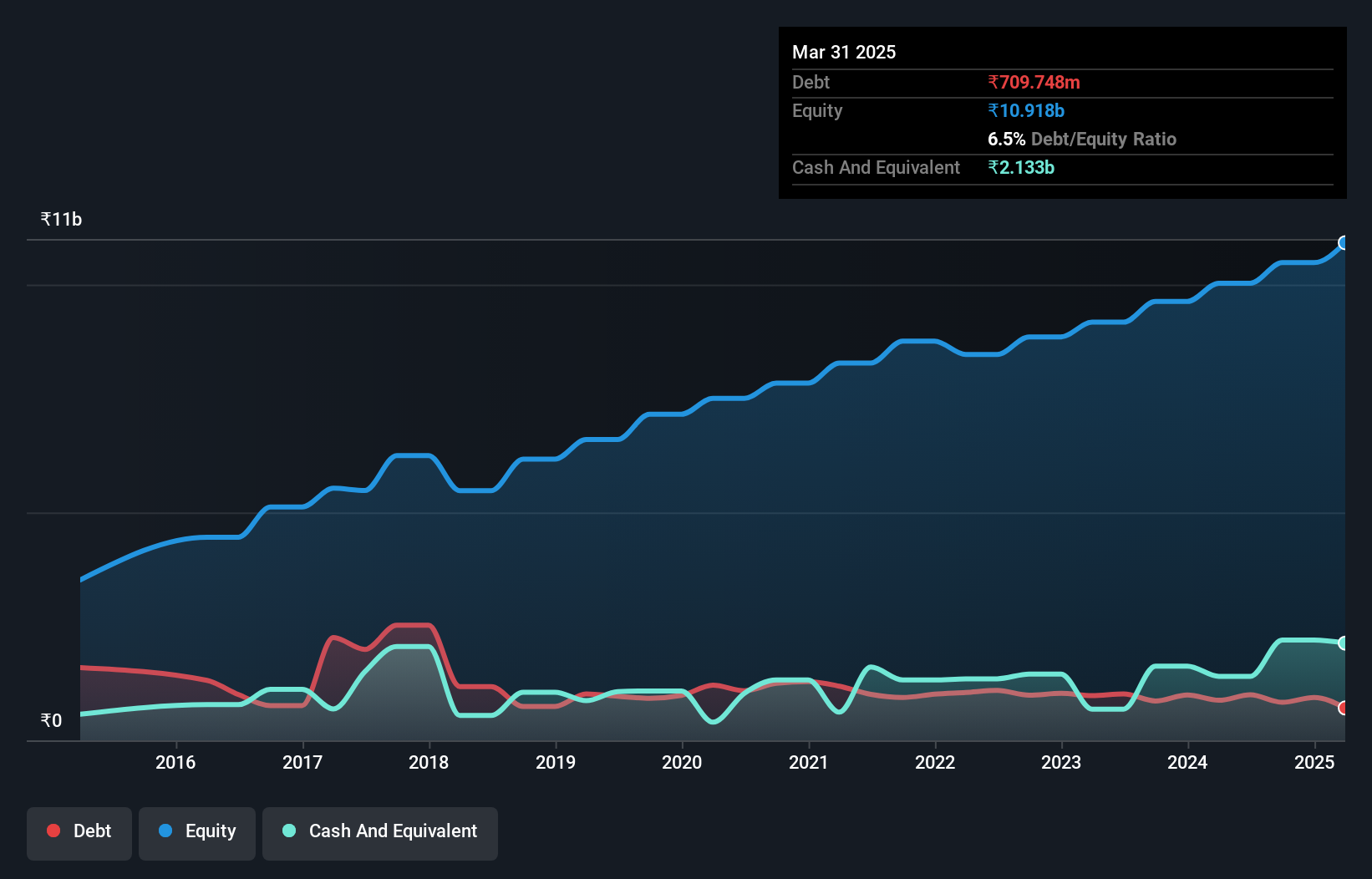
The image below, which you can click on for greater detail, shows that Bliss GVS Pharma had debt of ₹709.7m at the end of March 2025, a reduction from ₹878.1m over a year. However, it does have ₹2.13b in cash offsetting this, leading to net cash of ₹1.42b.
How Healthy Is Bliss GVS Pharma's Balance Sheet?
According to the last reported balance sheet, Bliss GVS Pharma had liabilities of ₹1.72b due within 12 months, and liabilities of ₹372.8m due beyond 12 months. Offsetting these obligations, it had cash of ₹2.13b as well as receivables valued at ₹4.42b due within 12 months. So it can boast ₹4.46b more liquid assets than total liabilities.
This surplus suggests that Bliss GVS Pharma is using debt in a way that is appears to be both safe and conservative. Due to its strong net asset position, it is not likely to face issues with its lenders. Simply put, the fact that Bliss GVS Pharma has more cash than debt is arguably a good indication that it can manage its debt safely.
See our latest analysis for Bliss GVS Pharma
It is just as well that Bliss GVS Pharma's load is not too heavy, because its EBIT was down 22% over the last year. Falling earnings (if the trend continues) could eventually make even modest debt quite risky. The balance sheet is clearly the area to focus on when you are analysing debt. But it is Bliss GVS Pharma's earnings that will influence how the balance sheet holds up in the future. So when considering debt, it's definitely worth looking at the earnings trend. Click here for an interactive snapshot.
Finally, a company can only pay off debt with cold hard cash, not accounting profits. Bliss GVS Pharma may have net cash on the balance sheet, but it is still interesting to look at how well the business converts its earnings before interest and tax (EBIT) to free cash flow, because that will influence both its need for, and its capacity to manage debt. Looking at the most recent three years, Bliss GVS Pharma recorded free cash flow of 30% of its EBIT, which is weaker than we'd expect. That's not great, when it comes to paying down debt.
Summing Up
While it is always sensible to investigate a company's debt, in this case Bliss GVS Pharma has ₹1.42b in net cash and a decent-looking balance sheet. So we don't have any problem with Bliss GVS Pharma's use of debt. There's no doubt that we learn most about debt from the balance sheet. However, not all investment risk resides within the balance sheet - far from it. For example - Bliss GVS Pharma has 1 warning sign we think you should be aware of.
When all is said and done, sometimes its easier to focus on companies that don't even need debt. Readers can access a list of growth stocks with zero net debt 100% free, right now.
Have feedback on this article? Concerned about the content? Get in touch with us directly. Alternatively, email editorial-team (at) simplywallst.com.
This article by Simply Wall St is general in nature. We provide commentary based on historical data and analyst forecasts only using an unbiased methodology and our articles are not intended to be financial advice. It does not constitute a recommendation to buy or sell any stock, and does not take account of your objectives, or your financial situation. We aim to bring you long-term focused analysis driven by fundamental data. Note that our analysis may not factor in the latest price-sensitive company announcements or qualitative material. Simply Wall St has no position in any stocks mentioned.