
- PREMIUM
- LIVE QUOTES
- INSTITUTIONS
 Index Options


 State Street
 CME Group
 Nasdaq
 Cboe
Cboe TradingView
 Wall Street Journal
Tele2's (STO:TEL2 B) Dividend Will Be Reduced To SEK3.15
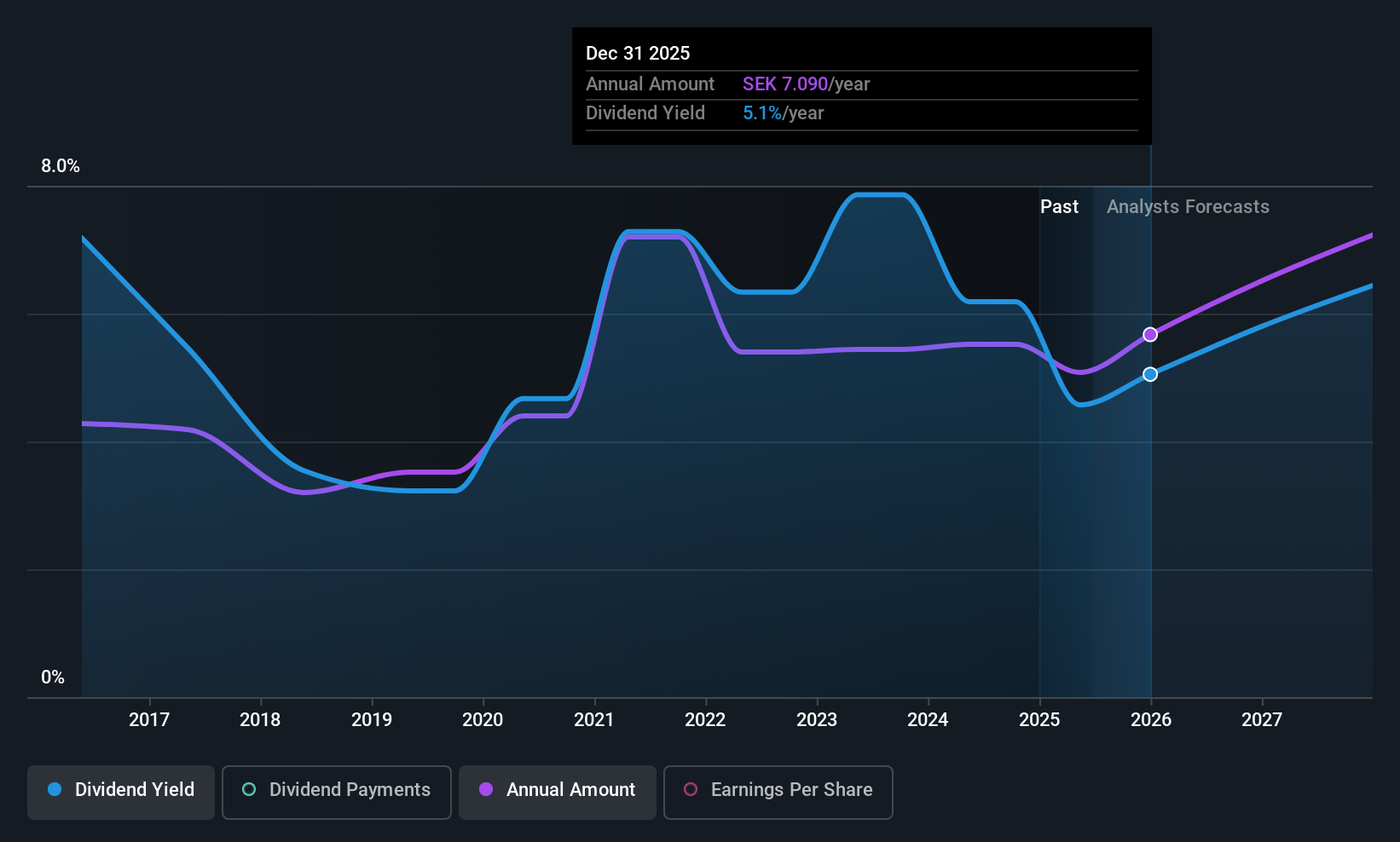
Tele2 AB (publ) (STO:TEL2 B) is reducing its dividend from last year's comparable payment to SEK3.15 on the 15th of October. However, the dividend yield of 4.5% is still a decent boost to shareholder returns.
Tele2's Payment Could Potentially Have Solid Earnings Coverage
We like to see robust dividend yields, but that doesn't matter if the payment isn't sustainable. Before making this announcement, Tele2's dividend was higher than its profits, but the free cash flows quite comfortably covered it. Healthy cash flows are always a positive sign, especially when they quite easily cover the dividend.
EPS is set to grow by 36.9% over the next year. Assuming the dividend continues along recent trends, our estimates say the payout ratio could reach 86% - on the higher side, but we wouldn't necessarily say this is unsustainable.
See our latest analysis for Tele2
Dividend Volatility
The company's dividend history has been marked by instability, with at least one cut in the last 10 years. Since 2015, the annual payment back then was SEK4.85, compared to the most recent full-year payment of SEK6.35. This implies that the company grew its distributions at a yearly rate of about 2.7% over that duration. Modest growth in the dividend is good to see, but we think this is offset by historical cuts to the payments. It is hard to live on a dividend income if the company's earnings are not consistent.
Tele2 May Have Challenges Growing The Dividend
With a relatively unstable dividend, it's even more important to evaluate if earnings per share is growing, which could point to a growing dividend in the future. Tele2 has seen EPS rising for the last five years, at 9.8% per annum. However, the company isn't reinvesting a lot back into the business, so we would expect the growth rate to slow down somewhat in the future.
In Summary
In summary, dividends being cut isn't ideal, however it can bring the payment into a more sustainable range. In the past, the payments have been unstable, but over the short term the dividend could be reliable, with the company generating enough cash to cover it. We would probably look elsewhere for an income investment.
Investors generally tend to favour companies with a consistent, stable dividend policy as opposed to those operating an irregular one. Still, investors need to consider a host of other factors, apart from dividend payments, when analysing a company. For instance, we've picked out 2 warning signs for Tele2 that investors should take into consideration. If you are a dividend investor, you might also want to look at our curated list of high yield dividend stocks.
Have feedback on this article? Concerned about the content? Get in touch with us directly. Alternatively, email editorial-team (at) simplywallst.com.
This article by Simply Wall St is general in nature. We provide commentary based on historical data and analyst forecasts only using an unbiased methodology and our articles are not intended to be financial advice. It does not constitute a recommendation to buy or sell any stock, and does not take account of your objectives, or your financial situation. We aim to bring you long-term focused analysis driven by fundamental data. Note that our analysis may not factor in the latest price-sensitive company announcements or qualitative material. Simply Wall St has no position in any stocks mentioned.