
- PREMIUM
- LIVE QUOTES
- INSTITUTIONS
 Index Options


 State Street
 CME Group
 Nasdaq
 Cboe
Cboe TradingView
 Wall Street Journal
Meet the US stock “Three Witch Day” again! The $6.5 trillion option expires or causes sharp fluctuations
The Zhitong Finance App learned that investors are preparing for US options with a nominal value of 6.5 trillion US dollars due to expire this Friday, which may cause the stock market to fluctuate more drastically again.
Each quarter, several different types of exchange derivatives contracts expire simultaneously on the same day. This phenomenon is known as “triple witching (triple witching)” among market observers. Although the market does not expect sharp fluctuations on Friday, the stock market may once again face the risk of sudden fluctuations after this day.
Since the beginning of May, intraday fluctuations in the US stock market have been relatively moderate, partly due to the “nailing effect” brought about by the large number of put options exchanges established at the beginning of the year. The so-called “pinning effect (pinning)” means that when the expiration date of an option is approaching, the stock price tends to close near the execution price of an option with a large volume of trading volume. At the time, the possibility that the S&P 500 index would rebound close to its all-time high seemed very slim. Rocky Fishman, founder of research firm Asym 500 LLC, said these deals helped maintain stability in the market.
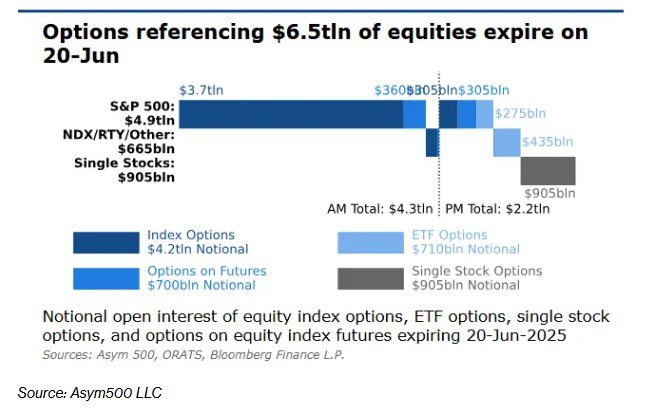
At the beginning of April this year, at a time when tariffs caused sharp market fluctuations, many pessimistic investors bought hedging tools for the stock market decline and funded these protective positions by selling bullish options slightly above the current level of the S&P 500 index (5981 points). Rocky Fishman said, “We have been dealing with the tariff crisis over the past few months. At the time, many people thought the 6,000 point level was difficult to reach, so they sold call options in this region to raise funds for their protective options in other locations.” He said in a recent report that Friday's option expiration date was “one of the largest in history.”
The actions taken by market makers and brokers to hedge their positions will also have a significant impact on the stock market and further feed back to the overall market. Rocky Fishman pointed out that since the beginning of May, despite the turbulent situation in the Middle East and ongoing tariff negotiations, market performance has been stable, partly due to market makers' hedging operations. He believes that the market is in a so-called “positive gamma (positive gamma)” state, that is, market participants tend to sell when they rise and buy when they fall, thereby suppressing fluctuations.
Matthew Thompson, co-investment manager at Little Harbor Advisors, said that in contrast, during the tariff crisis in early April, many intermediaries were forced to sell stocks when the market fell and were forced to make up when the market rebounded, further exacerbating market fluctuations.
Matthew Thompson said he is closely monitoring option expiration events such as the “Three Witches Day” because this helps the stock ETFs he manages take tactical positions to cope with changes in volatility. “Our main focus is on market makers and how they can hedge all risk exposures,” he said.
According to a study by Citigroup strategists Vishal Vivek and Stuart Kaiser, quarterly “Three Witch Days” usually do not cause more fluctuations compared to monthly option expiration dates. However, the strategist recently mentioned in a report to clients that Friday's Three Witch Day has “special significance.”
According to Citi estimates, $5.8 trillion in nominal open equity options will expire on Friday, including $4.2 trillion in index options, $708 billion in US ETF options, and $819 billion in individual stock options. The higher data proposed by Rocky Fishman — around $6.5 trillion — also includes the nominal value of stock index futures options, which also expire on Friday.