
- PREMIUM
- LIVE QUOTES
- INSTITUTIONS
 Index Options


 State Street
 CME Group
 Nasdaq
 Cboe
Cboe TradingView
 Wall Street Journal
The “Buffett effect” is powerful! Japanese retail investors “follow the trend” and buy stocks of major trading companies
The Zhitong Finance App learned that Japanese retail investors have begun to invest in trading company stocks, and these companies have received strong support from Berkshire Hathaway (BRK.A.US). Legendary investor Warren Buffett values these companies' strong business models and rich shareholder returns.
Investment demand from Japanese personal savings accounts (NISA for short) has expanded to various trading companies, and has become popular investment targets along with well-known companies such as Nippon Telegraph and Telephone Company, Japan Tobacco Company, and Mitsubishi UFJ Financial Group. Mitsubishi Corporation is one of Japan's largest trading companies and ranked third for the first time since March in retail assets under the Tax-Free Savings Program. This ranking data comes from SBI Securities, and Rakuten Securities's ranking shows that the company has ranked fourth since April.
Thanks to the support of retail investors, trading company stocks have been outperforming the market since US President Trump implemented the “Liberation Day” tariff policy on April 2, although there is still uncertainty about the impact of these policies on trade.
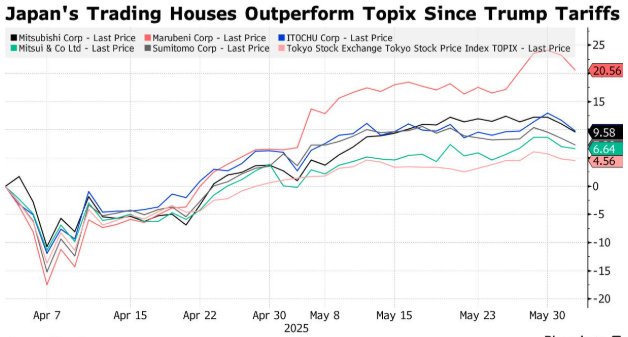
At Berkshire Hathaway's annual conference, Buffett stated that he expected his company to hold these shares for 50 years or more. Since then, Japanese trading companies' stock prices have risen accordingly. The stock prices of Mitsubishi Corporation, Mitsui & Co., Sumitomo Mitsui, ITOCHU Corporation, and Marubeni Corp. all increased by more than 3%.
Naomi Kurimoto, an employee of SBI Securities's investment market research department, said, “Many retail investors think their value investing style fits Warren Buffett's style because that's how Buffett invests. They tend to follow his lead — 'If Buffett is buying, then I'll buy'.” She also said that the appearance of Buffett's name in the report would increase page views driven by retail investors.
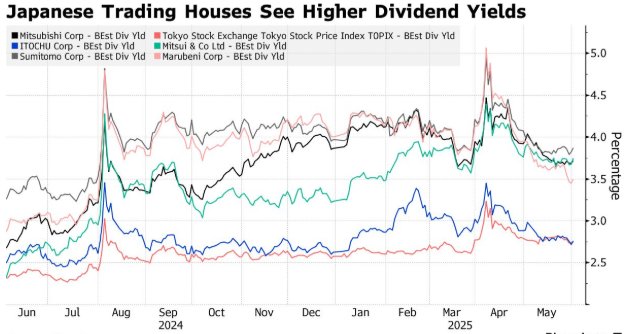
Japan's top five trading companies have all issued cautious earnings forecasts for this year and set aside hundreds of millions of dollars to deal with tariff uncertainty. Despite these concerns, these companies are actively seeking to increase their dividends. Mitsubishi Corporation, Mitsui & Co., Sumitomo Corporation, and Marubeni Corp. all expected 12-month dividend yields of more than 3.5%, exceeding the 2.7% average estimated by the 2025 annual benchmark index (TSE Index). Although ITOCHU Corporation expects a 12-month dividend yield of 2.66%, like the other four companies, it has doubled its dividend payments over the past five years.
The industries favored by the NISA program have the following characteristics: even if earnings growth or stock prices are not expected to rise rapidly, the risk of dividend cuts is relatively low. Yusuke Maeyama, a researcher at the NLI Institute, said, “Among high-dividend stocks, trading companies may also have an additional advantage with strong expectations of future dividend growth.”
Corporate governance reforms also play an important role in influencing individual investors' stock selection process. The Tokyo Stock Exchange is planning to encourage companies to split their shares, a move that will make it easier for retail investors to participate in trading. Because the Tokyo Stock Exchange trades in units of one unit per 100 shares, the stock split will reduce the minimum investment amount.
Although Buffett's influence has boosted the stock prices of trading companies, these companies themselves have also made efforts to expand their shareholder base over the past year. Prior to the introduction of the revised NISA system at the end of 2023, Mitsubishi Corporation carried out a 3-to-1 stock split, reducing the minimum investment amount. Mitsui & Co., Ltd. also carried out a stock split at the end of June last year, cutting the minimum investment amount in half.
Kazuhiro Sasaki, head of research at Phillip Securities Japan, said, “Through initiatives such as the NISA program, trading companies will benefit from increased retail investor participation because 'they are expected to obtain medium- to long-term shareholders', which helps establish a more stable shareholder group'.” But he also added that on the other hand, there may be some disadvantages, such as providing services to hundreds of investor accounts and handling larger shareholders' meetings, which would be more burdensome.
According to data compiled by the Japan Securities and Exchange Association, the total amount of new purchases of individual investment accounts (NISA accounts) of all financial institutions under increased investment amounts in 2024 was about 12.5 trillion yen (about US$87.4 billion). By the end of 2024, the total number of NISA accounts was 25.6 million. Among securities companies, Rakuten Securities has the largest number of accounts, with 6 million, followed by SBI Securities with 5.36 million.
Strategy analysts at HSBC, including Herard van der Linde, said that any capital investment from domestic investors will have a positive impact on the Japanese stock market, and even just transferring 1 percentage point of capital from cash to domestic stocks “will bring 220 billion US dollars into the stock market.”