
- PREMIUM
- LIVE QUOTES
- INSTITUTIONS
 Index Options


 State Street
 CME Group
 Nasdaq
 Cboe
Cboe TradingView
 Wall Street Journal
Goldman Sachs: Why is the impact of tariffs on US inflation one-off?
The Zhitong Finance App learned that Goldman Sachs expects tariffs to have a one-time impact on the US domestic price level, causing the core personal consumption expenditure (PCE) inflation rate to rebound to 3.6% later this year and then fall back next year. However, memories of soaring inflation during the pandemic, as well as the University of Michigan's inflation expectations exceeding the peak of the pandemic, have led some to worry that this year's rebound in inflation may last longer.
The main reason Goldman Sachs is less worried is that the US economy is expected to weaken this year, the growth rate is far below potential levels, and the unemployment rate will rise slightly.
Furthermore, Goldman Sachs believes that the upcoming rebound in inflation is less threatening than in the 2021-2022 period because cumulative inflation has been much smaller, labor market tension is much lower, forward-looking wage indicators have continued to decline until now, and household spending capacity is no longer rising due to fiscal transfers. Even in earlier extreme periods, high inflation was ultimately not as deeply rooted psychologically as many feared at the time, and inflation and inflation expectations gradually normalized without recession.
Other than tariffs, other recent inflation-related news is actually slightly weak. Therefore, Goldman Sachs believes that once the impact of tariffs subsides and inflation slows down, the Federal Open Market Committee (FOMC) is still expected to finally implement some final normalized interest rate cuts. If, contrary to Goldman Sachs's expectations, tariffs on specific countries rise back to prohibitive levels, causing shortages or tariff escalations to continue until 2026, Goldman Sachs is more concerned that tariff-induced inflation will continue for longer.
Why Goldman Sachs expects tariffs to only give a one-time boost to inflation
As the tariff rate greatly exceeded expectations on the inauguration day, and some inflation expectations survey indicators surpassed the peak of the pandemic, whether tariffs will trigger a continued surge in inflation has become a more intriguing question than it initially seemed.
Goldman Sachs predicts that tariffs will increase consumer prices by about 2% over the next year and a half, exceeding the deflationary forces that have been at play for the past few years. As a result, Goldman Sachs expects the core PCE inflation rate to accelerate by about 1 percentage point to peak at 3.6% in December, but as the one-time impetus of tariffs on price levels disappears from the year-on-year calculation, the inflation rate will fall back in 2026. But is this year's rebound likely to last longer?
The same issues dominated the macroeconomic debate in late 2021 and 2022. At the time, short-term inflation expectations rose sharply, and companies sometimes seemed a bit too adapted to the high inflation environment, although long-term expectations remained stable. Supply shocks ended and shortages subsided longer than expected, but once they were over, it turned out that high inflation was not as deeply rooted psychologically as many feared, and inflation and inflation expectations gradually normalized without recession.
According to some commentators, two aspects of the current situation are more worrisome.
First, the price and wage setting standards may be less firmly anchored at the 2% target, because the US has just experienced a spike in inflation.
Second, the University of Michigan's inflation expectations have risen even more than in 2022, and this time, long-term expectations have also risen sharply, even though tariffs haven't even significantly boosted consumer prices.
These are all legitimate concerns, although technical details exaggerate the increase in the University of Michigan survey, while other survey metrics and implied market inflation compensation did not rise significantly over the next year (Chart 1).
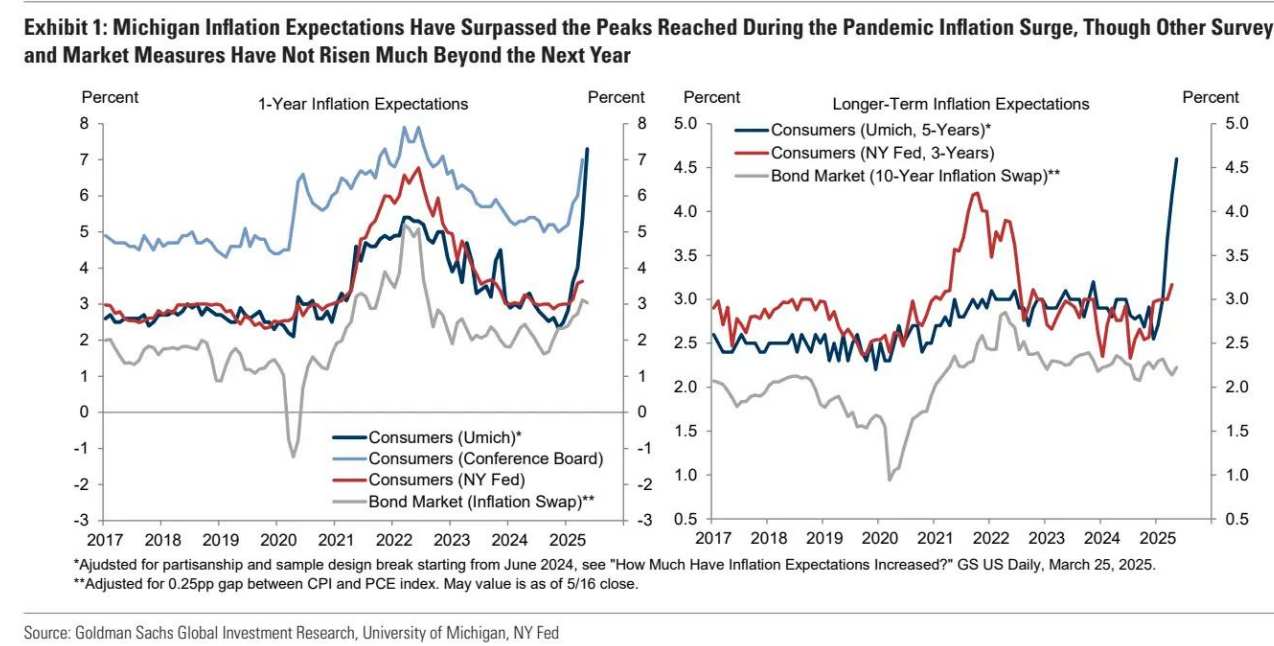
As can be seen from the chart, the University of Michigan's inflation expectations have surpassed the peak when inflation soared during the pandemic, although other surveys and market indicators did not rise significantly after the next year.
(Chart content: The chart on the left shows survey data from different institutions on consumer inflation expectations for 1 year from 2017 to 2025; the chart on the right shows 10-year inflation swaps in the bond market and consumer inflation expectations for 3 and 5 years during the same period. (Note: Adjusted for partisan tendencies and sample design; there is a 0.25 percentage point gap between the CPI and PCE indices; May figures end at the close of May 16)
Despite these concerns, Goldman Sachs believes the current situation is less worrisome than the 2022 panic. The main reason is that Goldman Sachs expects the economy to weaken this year. GDP growth is only 1%, which is half of Goldman Sachs's estimated potential growth rate. The unemployment rate will rise slightly to 4.5%. Goldman Sachs is skeptical about the prospects for long-term high inflation under mediocre economic performance.
Compared to the 2022 environment, there are also three key differences that make Goldman Sachs less worried today:
First and foremost, the upcoming rebound in inflation is likely to be far less extreme than the previous surge (Chart 2). This is reassuring, because high inflation is a risk of becoming psychologically entrenched and normalized in price and wage settings, which should be directly proportional to the height, breadth, and duration of inflationary bursts experienced by consumers, workers, and businesses.
Chart 2: Goldman Sachs expects the upcoming inflation rebound to be far less extreme than 2022, which means it has far less risk of becoming psychologically ingrained in price and wage settings
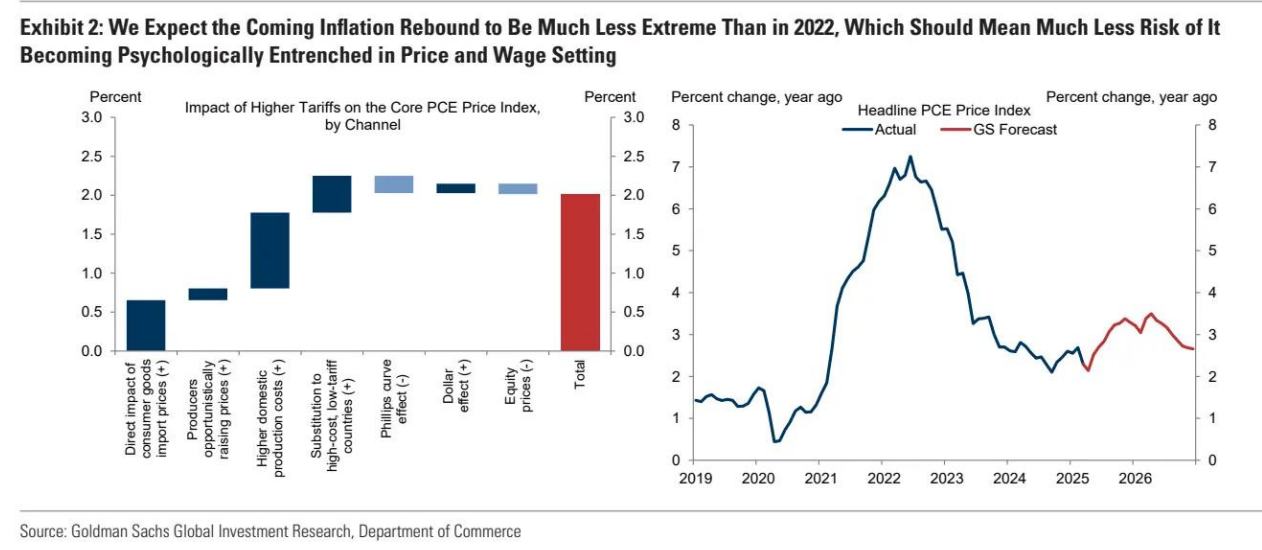
(Chart content: The chart on the left shows the year-on-year changes in the actual overall PCE price index and Goldman Sachs forecast for 2019-2026; the chart on the right shows changes in the core PCE inflation rate during the same period)
Second, the labor market in 2022 was the tightest in US history, providing ready fuel for the wage-price feedback cycle, and now the labor market is in a more normal balance (Chart 3 left). Accelerated wage growth will be a critical intermediate step in the continuation of high inflation, but so far, as the trade war unfolds, concerns about the outlook seem to have outweighed the boost from higher inflation expectations. Goldman Sachs's leading wage survey indicator (which combines survey questions from businesses and households about future wage growth expectations) has declined further to 2.9%, a level likely in line with below-target inflation (Chart 3, right).
Chart 3: The labor market was at its most tense in history in 2022 and is now in a more normal balance. So far, wage pressure has eased further as the trade war begins
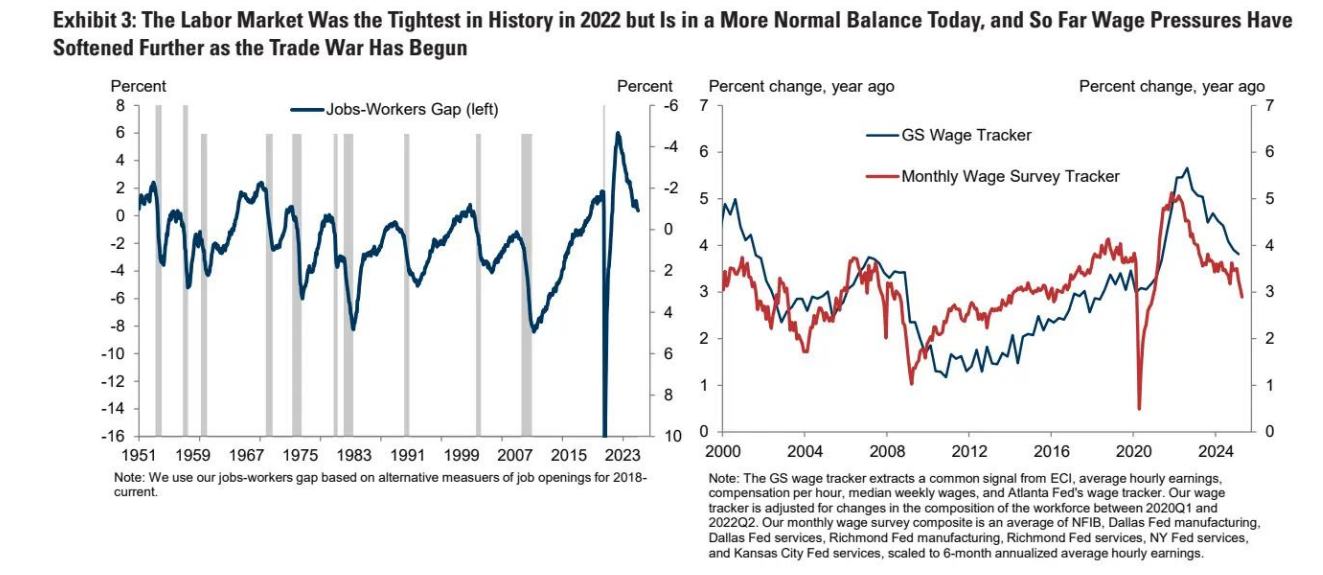
(Chart content: The figure on the left shows the job - worker gap from 1951 to 2023; the chart on the right shows the year-on-year changes in Goldman Sachs wage tracking metrics and monthly wage survey tracking metrics from 2000-2024)
Third, a few years ago, due to financial transfers due to the pandemic, consumers had more disposable income than usual, but due to epidemic restrictions, there were fewer things they could spend than usual. This unusual environment may also be fueling the spread of inflation — many companies heard that other companies raised prices more than usual, and tried to raise prices more drastically on their own, and were surprised to find that their sales were less affected than expected. By contrast, today there is little reason for companies to expect such a gentle response from consumers and may be more cautious about increasing prices over cost increases.
Other than tariffs, other recent inflation news is actually slightly weak. In particular, Goldman Sachs's latest monthly inflation monitoring shows that potential inflation trend indicators continue to be flat, with new tenant rents rising only 1.4% over the past year (Chart 4), indicating a further slowdown in the largest and most cyclical categories to a rate that is likely to be in line with below-target inflation.
Chart 4: With the exception of tariffs, inflation news is weak — in particular, the leading alternative data indicator for new tenant rents rose only 1.4% over the past year
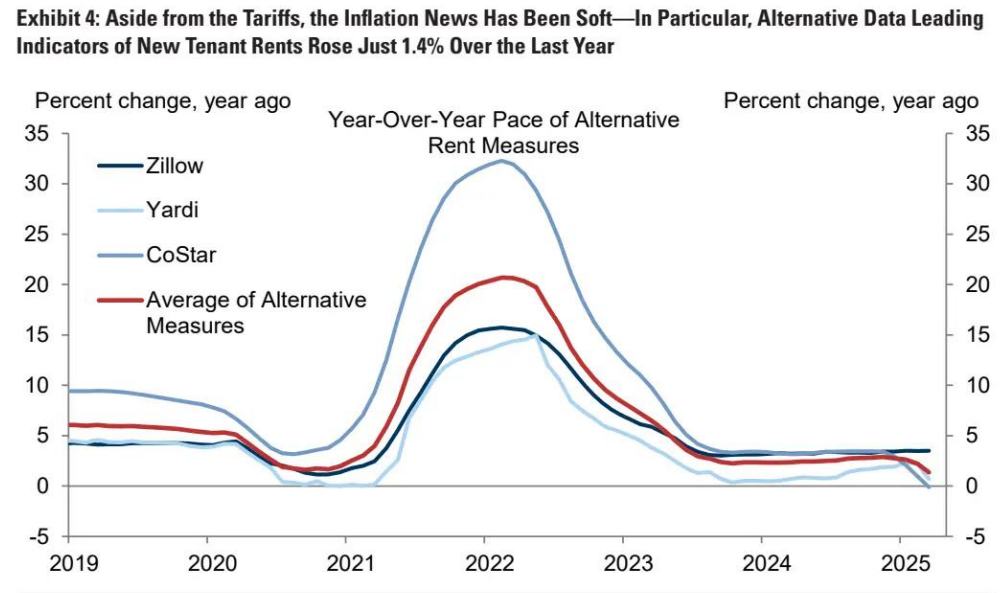
(Chart content: Shows the year-on-year changes and average levels of alternative rent indicators of institutions such as Zillow, Yardi, and CoStar in 2019-2025. The specific values are not fully presented due to format restrictions)
Therefore, Goldman Sachs believes that once the impact of tariffs subsides and inflation slows down, the FOMC is still expected to implement some final normalized interest rate cuts. Goldman Sachs expects the biggest impact of tariffs to be seen in the May-August inflation report and has tentatively cut interest rates for the first time in December, although it is difficult to determine how much evidence the tariff push has subsided before resuming interest rate cuts.
What could make a tariff-driven rebound in inflation more dangerous?
The easiest lesson from the 2021-2022 experience is that more extreme and ongoing supply shocks than initially anticipated are causing shortages and ultimately leading to more extreme and sustained inflation. The US and China recently suspended the most extreme tariffs, which could lead to production disruptions, supply chain issues, and shortages. But if, contrary to Goldman Sachs's expectations, tariffs on specific countries rise back to prohibitive rates, or if tariff escalation continues until 2026, Goldman Sachs is more concerned that high inflation will last longer. (merrickle)