
- PREMIUM
- LIVE QUOTES
- INSTITUTIONS
 Index Options


 State Street
 CME Group
 Nasdaq
 Cboe
Cboe TradingView
 Wall Street Journal
Japan's largest business lobbying group wins another 5% + salary increase! But the central bank may not necessarily shift to a stance of raising interest rates
The Zhitong Finance App learned that Japan's largest business lobbying group said that employees of its member companies have won promises of more than 5% salary increases for two consecutive years, indicating that in the context of increasing labor shortages, Japanese companies' wages are still rising. For the Bank of Japan, corporate wage growth and inflation are the most important reference data for the central bank's monetary policy path. As inflation continues to rise above the 2% target for many months and corporate salary increases at a rate of 5% + for two consecutive years, the market's expectations for the Bank of Japan's interest rate hike are once again heating up.
However, although employee wages continue to rise, Japanese business associations such as the Japan Federation of Business Associations insist that consumer prices (that is, the CPI index) are rising faster than wages, and the actual income of Japanese residents is still stagnating. Therefore, the Japanese business community generally calls on the Bank of Japan to adopt steady policies and measures to support the continued growth of actual wages in Japan under a stable 2% inflation rate.
According to a preliminary summary released by the Japan Federation of Business Organizations (Keidanren) on Thursday, the average salary increase of 5.38% for a total of 620,000 employees of 97 major Japanese companies under the federation's labor negotiations this spring was 5.38%. Although slightly lower than last year's 5.58%, it is still more than double the average salary increase of the past 20 years (about 2.3%).
According to statistics, the Japan Economic Federation represents more than 1,500 Japanese companies and plans to release the final data report on the salary negotiations of large Japanese companies at the end of July, and separately publish a salary survey report covering the vast majority of Japanese small and medium-sized enterprises.
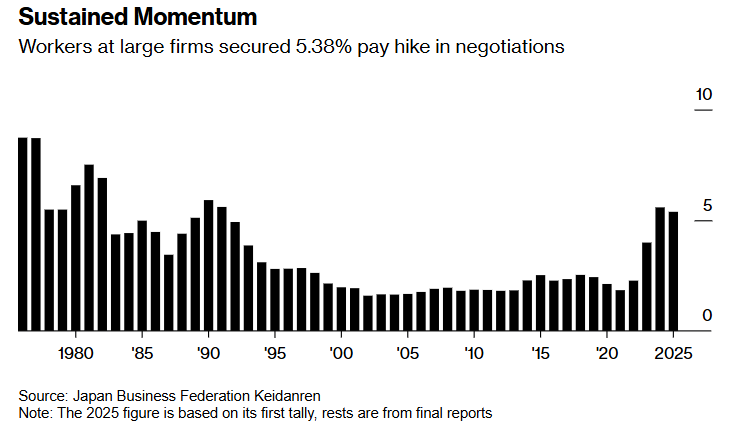
The trend of salary increases continues - employees of large Japanese companies received 5.38% salary increases during negotiations (note: 2025 data is a preliminary summary; the rest is the final report)
This data further confirms signs of a generally strong increase in labor wages in Japan. Earlier trade union surveys had shown that wages recorded the highest level of increase in decades for two consecutive years. This is a rare benefit for the Japanese government and Bank of Japan policymakers seeking to maintain the momentum of economic growth at a time when global risks are heating up.
On the same day, the Federation of Economic and Social Affairs submitted a preliminary statistical report to Prime Minister Shi Fa Mao at the policy meeting. The whole meeting discussed topics such as raising the minimum wage and increasing productivity.
According to the survey report, the overall 2 salary increases in 11 of Japan's 17 industries were higher than last year. Among them, the transportation, electronics, and chemical industries led wage increases, while traditional manufacturing industries such as automobiles and steel saw relatively moderate increases.
The key factor driving wage increases is Japan's long-standing sharp labor shortage. Japan's unemployment rate has remained below 3% for four consecutive years, making it one of the lowest unemployment rates in developed countries. A recent survey by Teikoku Databank (Teikoku Databank), Japan's largest credit reporting agency, found that more than 50% of Japanese companies are facing a very serious shortage of regular employees.
Companies are also responding positively to the rising cost of living for employees. The data forecast to be released on Friday shows that Japan's inflation has been at or above the 2% target anchored by the Bank of Japan for three consecutive years, and the core CPI index after excluding fresh food is expected to rise to 3.4%, a new high in two years.
Since consumer prices have been rising faster than wages in Japan for a long time, actual income has stagnated, curtailing Japanese consumer spending and hindering the formation of a virtuous economic cycle.
Nitta Hideshi, director of the Labor Policy Bureau under the Japan Economic Federation, said, “We hope that actual wages can rise at the same time as productivity increases, but the reality is that prices are still too high. We hope that the Bank of Japan and other government agencies will adopt appropriate monetary policy measures to maintain a continuous increase in real wages under a stable 2% inflation.”
Looking ahead to the future of the Japanese labor market, Nitta pointed out that wage growth is likely to maintain a continuous upward trajectory, but it largely depends on the overall economic situation in Japan. One of the main risks is the negative impact of the US tariff policy on the profits of Japanese companies; in particular, Japanese automobile exports to the US face 25% tariffs, and about 8% of Japanese company employees work for companies related to this industry.
Furthermore, for the Bank of Japan, the recent sharp rise in yield on Japanese treasury bonds, especially the sharp rise in the yield on long-term treasury bonds of 10 years or more, is also curtailing the Bank of Japan's interest rate hike policy space. On Thursday, the yield on Japan's 40-year treasury bonds rose 6 basis points to 3.675%, hitting the highest level since issuance began in 2007.
Recently, the yield on Japanese treasury bonds with a ten-year term or more has climbed to a multi-year high, putting pressure on bank and corporate borrowing costs and the sustainability of government debt. This has in fact narrowed the room for the Bank of Japan to further raise and reduce interest rates. Higher long-term treasury bond yields, on the one hand, have “done some austerity work” for the central bank. On the other hand, if the long-term yield rises out of control, it may push up government interest expenses and impact the valuation of financial system debt holdings, causing the Bank of Japan to drastically delay or slow down the pace of interest rate hikes and debt reduction.