
If hedge funds offer sky-high salaries to “rob talent”, will yen interest rate transactions be popular?
The Zhitong Finance App learned that the battle for talent in the yen exchange rate field is intensifying. After the biggest market fluctuation over the years caused extensive losses, banks and hedge funds are rushing to buy experienced traders. Some market participants offered multi-million dollar salary packages to attract yen interest rate traders, after a sudden sell-off triggered by Trump pushed Japanese bond yields to 20-year highs. This round of new recruitment builds on the recruitment boom that began before the central bank began raising interest rates last year.
Industry companies have had a very rapid turnover in recent weeks: BlueCrest Capital Management's Harimoto will join Modular Asset Management as a portfolio manager to help it expand its business in Japan. Ron Choy also moved from BlueCrest to Chicago's BalyAsny Asset Management, where he previously received a salary package of about $30 million. Capula Investment Management and Dymon Asia Capital have drawn experienced derivatives traders from Deutsche Bank and Barclays Bank, respectively.
Yoshiki Kumazawa, director of headhunting company Morgan McKinley, said, “Hedge funds are still eager to hire yen interest rate traders. For traders with a good track record, supply is not keeping up with demand.”
More steps may be in the works: some experienced traders, whose expertise includes the yen exchange rate, have been approached by several potential employers in recent months. In a recent move, Capula Investment hired Deutsche Bank's Masahiko Maihara, while Singapore-based Dymon Asia Capital hired Barclays's Shumei Kameyama. Both companies have years of experience in trading derivatives contracts linked to the yen exchange rate.
Banks are also looking for talent. Marcus Yuki Sato moved from Deutsche Bank to the Tokyo office in March of this year to sell yen interest rate products to hedge funds and other international clients. In January of this year, the British bank recruited senior yen interest rate trader Yoichi Takemura from US hedge fund company Garda Capital Partners LP. Bank of America has hired Shuya Sakamoto, Barclays head of yen swap trading, to a senior position in its Japanese securities division.
The demand for talent is so great that some hedge funds are willing to give traders who lost their jobs during the August turmoil a second chance. Yosuke Motegi recently began working as a portfolio manager at Hong Kong-based Polymer Capital Management and met his mentor Chiga Murayama at BlueCrest. Both left Michael Platt's private investment company after the turmoil in August last year.
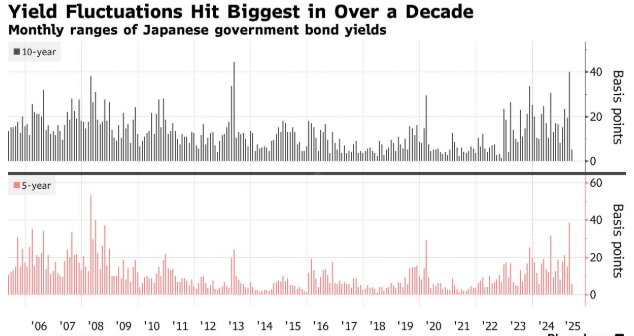
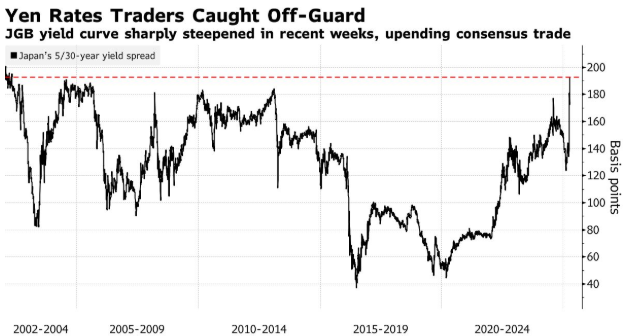
After the yen exchange market experienced the biggest fluctuation in years, the demand for skilled traders increased. Entering mid-March, market participants generally bet that the yield curve will flatten as the Bank of Japan continues to raise interest rates. After the US introduced so-called equal tariffs and investors speculated that the Japanese authorities would announce an additional budget to offset the impact of the tariffs, the yield curve steeped sharply, and most of these bonds suffered losses.
Traders are concerned that additional government spending could add to Japan's already heavy debt burden. By mid-April, the premium required by investors to hold Japanese 30-year treasury bonds and 5-year treasury bonds had increased to the highest level since May 2002.
A trader at a buyer's company described the chaos and panic in the trading floor. He said that the Japanese treasury yield curve continued to steep last month. The trend was very frightening, and market participants were forced to reduce risks and exacerbated the price drop. Huge price fluctuations have led to the departure of a number of companies, including New York-based ExodusPoint Capital Management.
This is the second major test since the Bank of Japan began raising interest rates last year. In August of last year, the yen spread trading quickly closed, causing a shock wave to the global market.
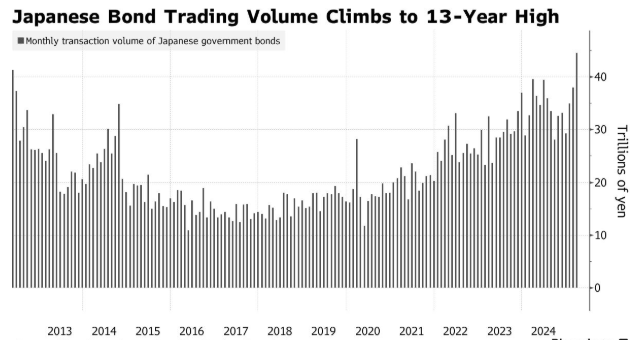
There is reason to believe that there may be more turbulence in the future. First, it's unclear how Trump's tariff policy will evolve, and these risks could trigger further fluctuations. Furthermore, capital transfers from the US may lead to more capital flows to the Japanese coast, which will help stimulate trading activity.
Jimmy Lim, Chief Investment Officer at Modular Asset Management, said: “As an Asian expert, Japan is a core market. Trading opportunities will continue to increase.” He added that the driving factors include a recovery in inflation, a possible interest rate hike by the Bank of Japan, and geopolitical dynamics.
Higher long-term bond yields will prompt Japanese participants — such as life insurance companies, pension companies, and regional banks — to consider investing in domestic bonds rather than US bonds. The need to finance fiscal and defense spending is also increasing. Lim said both would make the relative value deal more profitable, adding that modularization will continue to expand its business in Japan as the right talent becomes available.
Relative value transactions may include bets on the shape of yield curves, basis trading that pairs bets on cash bonds with futures, and positions aimed at profiting when currencies, interest rates, and stocks fluctuate. Morgan McKinley's Kumazawa said the market was “highly volatile and polarized between winners and losers.” However, “there is no sign that investment interest is waning.”