
- PREMIUM
- LIVE QUOTES
- INSTITUTIONS
 Index Options


 State Street
 CME Group
 Nasdaq
 Cboe
Cboe TradingView
 Wall Street Journal
Nvidia (NVDA.US) stock price approaches the AI era, valuation depression, and multiple risks have become “roadblocks” to bottoming out
The Zhitong Finance App learned that although NVDA.US (NVDA.US) stock price has fallen to the lowest valuation range in the artificial intelligence (AI) development cycle, successive risk events have discouraged investors from “absorbing the dips” strategy. This global AI chip leader is mired in a vortex where geopolitics and industrial cycles are superimposed.
Last week, the US Department of Commerce imposed a ban on Nvidia's sale of H20 chips to China, directly opening up a multi-billion dollar market gap. This product line originally targeted China's AI computing power needs, but now it has become the sword of Damocles hanging over financial reports. What makes the market even more uneasy is that this move has heightened concerns that the AI investment cycle may peak early, especially against the backdrop of the escalating trade war casting a shadow over overall economic growth prospects.
In terms of numbers, Nvidia's 22x price-earnings ratio is already significantly discounted compared to its long-term average, and the 24% drop during the year was even double that of the Nasdaq 100 Index. However, Krishna Chintalapalli (Krishna Chintalapalli), head of technology at Parnassus Investments, warned: “The current valuation seems reasonable; in fact, it is a mystery.”
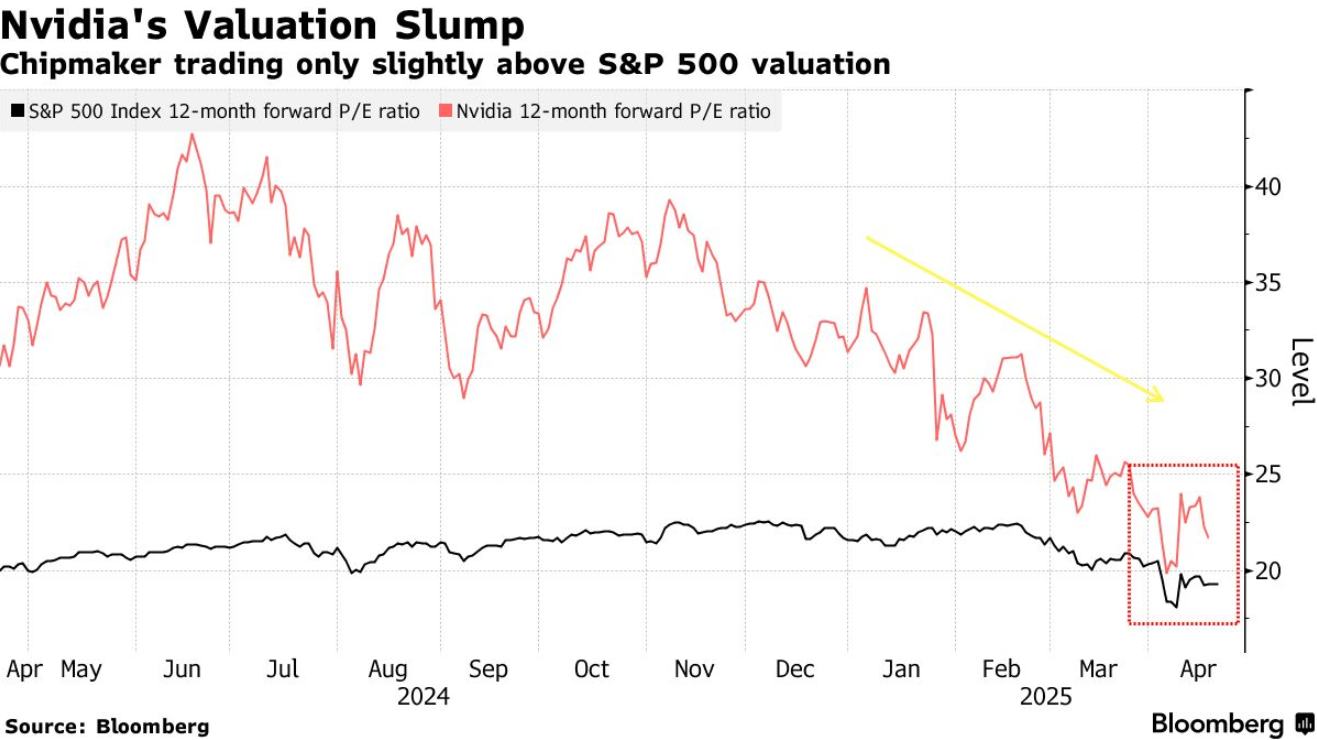
He stressed that in order to accurately predict stock price trends, it is necessary to simultaneously bet on multiple variables such as tariff trends, China's science and technology policy, and the investment pace of large technology companies, and “the combination of these factors is creating unprecedented uncertainty.”
Since Nvidia's growth rate is expected to far exceed the overall level of the market, Nvidia's revenue is expected to grow 57% this year, while the S&P 500's revenue growth rate for the same period is only 4.7%. However, its stock price has been weak recently, and this phenomenon is worthy of investors' attention.
However, Nvidia's growth is largely due to so-called “hyperscale enterprises” — including Microsoft (MSFT.US), Google (GOOGL.US), Amazon (AMZN.US), and Meta Platforms Inc. (META.US), all of which are important Nvidia customers, which have invested tens of billions of dollars to build artificial intelligence infrastructure.
Although these tech giants have spent tens of billions of dollars on AI infrastructure, “their profit margins could collapse at any time due to increased competition.” Chintarapali pointed out, “What's more difficult is that in the context of high tariffs, you can't control the pace of their investment at all.”
Strangely enough, the specter of tariffs has instead made Nvidia seem alternative and safe among its chip peers. According to Bloomberg industry research, Nvidia, which focuses on AI accelerators, was the least affected by tariffs, while peers targeting consumer electronics, automobiles, etc. will face an indirect impact on the demand side.
However, ASML.US (ASML.US)'s earnings warning threw cold water on the market: the extent of the impact of tariffs on the global supply chain is “difficult to quantify”, even leading chip equipment companies confess. Furthermore, TSM.US confirmed its prospects, implying that demand for artificial intelligence-related chips remains strong, although analysts pointed out that the tariff issue remains a key uncertain factor.
Daniel Flax (Daniel Flax), an analyst at Lubomai, said: “In the foreseeable future, political factors will continue to be an important part of the investment landscape, and the landscape will continue to evolve. This will have an impact on many companies, including Nvidia, but I think Nvidia will continue to execute and innovate, and continue to drive growth. Looking at the 12-month or 18-month time span, I think Nvidia's stock price looks quite attractive.”
Over the long term, analysts are generally optimistic. Nearly 90% of analysts recommend buying Nvidia shares, according to Bloomberg tracking data. Furthermore, although Nvidia's stock price is currently more than 60% below analysts' average target price, its implied return has been at a high level over the past few years. Investors who have been bullish on Nvidia for a long time see the recent weak stock price as a good buying opportunity.
In the short term, “This news has removed a lot of suspense, making H20 chip-related stocks more attractive now than before,” Ivana Delevska (Ivana Delevska), chief investment officer at SPEAR Invest, said on Wednesday after Nvidia's stock price initially fell due to news of the H20 chip ban. She added that in the long run, Nvidia's inability to enter the Chinese market would certainly be a negative factor.
Shana Sissel shares this view, arguing that the current valuation marks an excellent time to buy, especially before Nvidia releases earnings at the end of May. She expects the report to show signs that Chinese consumers are buying ahead of time in anticipation of tariffs. “I think Nvidia stock is very attractive right now. I've always been optimistic about it, and I'm still optimistic about the future.” she said.
Overall, this long and short confrontation over Nvidia is essentially a stress test for the resilience of the AI industry. When the technological revolution is faced with a geopolitical game, the market is waiting for the key variable that can break the balance — perhaps the speed at which China's AI chips break through, or maybe the next wave of the White House's tariff stick.