
- PREMIUM
- LIVE QUOTES
- INSTITUTIONS
 Index Options


 State Street
 CME Group
 Nasdaq
 Cboe
Cboe TradingView
 Wall Street Journal
Where will gold go after breaking through the $3,300 mark? Saxo Bank is bullish to $3,500
The Zhitong Finance App learned that since this year, spot gold prices have risen sharply by 25%, hitting the 2025 target of 3,300 US dollars set by Saxo Bank ahead of time. This raises a question: Where will the price of gold go next?
As can be clearly seen, the strong performance of gold is largely driven by the weakening of the US dollar. The most obvious is the weakening of the US dollar against the euro, yen, and Swiss franc, leading investors in these regions and countries to obtain more moderate gold returns, while in India, it is reasonable for investors to increase their investment in gold to hedge against the weakness of the local currency.
Gold returns in different currencies
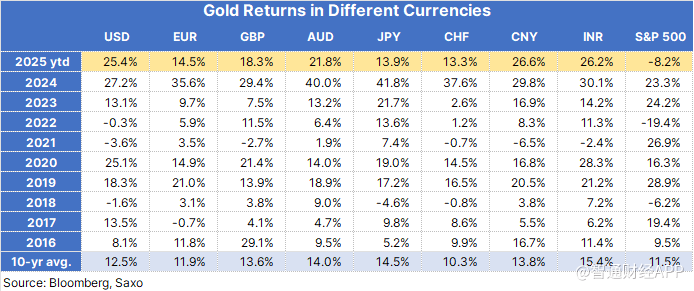
Ole Hansen, head of commodity strategy at Saxo Bank, said that in the past two years, potential demand from major central banks, combined with the Federal Reserve's interest rate cuts, growing concerns about rising government debt, and the imposition of sanctions, export controls, tariffs and investment restrictions by governments have all increased the appeal of gold. Recently, the imposition of tariffs by the United States triggered the risk of recession and inflation, and also provided additional support for gold. Notably, gold and other precious metals are politically neutral, are recognized around the world, and are not bound by any country's credit rating. This is an important reason why investors — whether private investors, institutional investors, or central bank investors — continue to switch to gold even at record gold prices.
Saxo Bank believes that in the short to medium term, factors such as increased global economic tension, risk of stagflation (falling employment rate, slowing economic growth and rising inflation), and weakening US dollar may continue to support the price of gold, and also support silver to a certain extent, because silver is relatively cheap after the sharp fall in early April. Furthermore, the market is currently actively preparing for the Fed to cut interest rates further this year. Currently, the market expects the Fed to cut interest rates by more than 75 basis points before the end of the year, and demand for gold from major central banks and high-net-worth individuals (especially in Asia) continues to grow. They hope to reduce or hedge their exposure to US Treasury bonds and the US dollar.
Although the price of gold has broken through the $3,300 mark and reached another record high, silver has yet to reach the high of $34.90 in October 2024. In particular, within a few days after US President Trump launched the tariff campaign on April 3, this semi-industrial metal plummeted 18%. However, Saxo Bank found that in the past three years, even during a period where record purchases of gold were supported by major central banks, the average gold-to-silver ratio was around 85.
Spot gold to bullion ratio trend
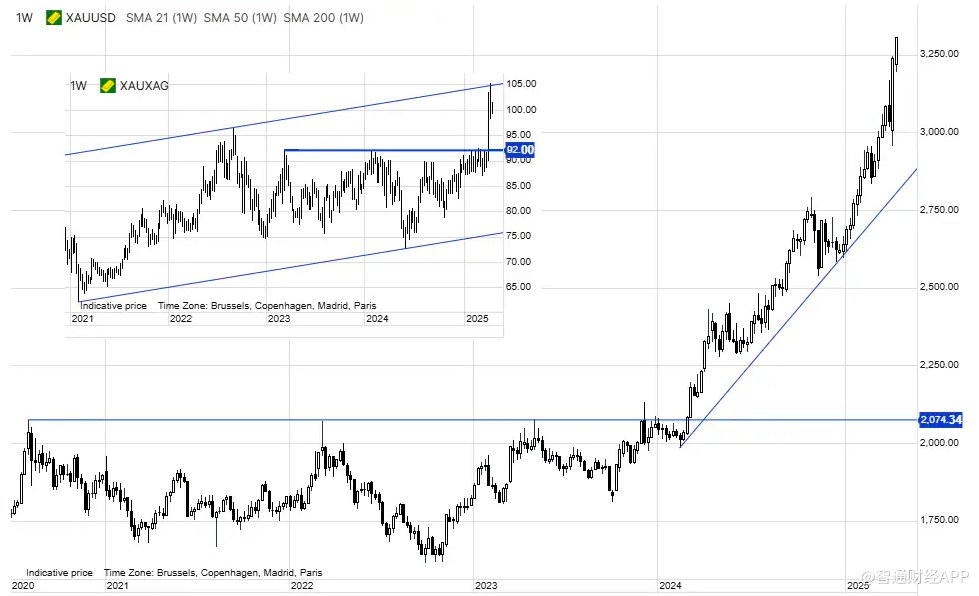
Overall, Saxo Bank raised its 2025 gold price forecast to $3,500 per ounce, and given silver's industrial exposure and current concerns about the recession, the metal's performance may be difficult to surpass gold by as much as previously predicted. Based on the bullion ratio falling back from the current 100 to 90, Saxo Bank expects silver to eventually rise to $40.
Saxo Bank also listed several major factors supporting the price of gold:
US federal funds rate expectations: Market participants pay close attention to the interest rate expectations set by the Federal Reserve, as this will greatly affect the attractiveness of gold. Currently, the futures market is digesting the possibility that the Federal Reserve will cut interest rates by 75-100 basis points before the end of the year, which means that monetary policy will be more relaxed. Lower interest rates lower the opportunity cost of holding gold without paying interest, thereby supporting the price of gold.
Demand to invest in “paper gold” through futures and exchange-traded funds (ETFs): Demand for gold-backed financial products depends on technical market factors such as price momentum and macroeconomic indicators. Furthermore, for ETF investors, the cost of holding gold is also a key factor, and prospects for lower financing costs and concerns about a recession are boosting demand. Currently, the known gold ETF holdings are 2,773 tons, up 269 tons from May last year, but still far below the 2020 record high of 3,453 tons.
US inflation expectations are rising: investors often use gold as a hedge against inflation. Recently, the real yield on the US Treasury yield curve (nominal yield minus inflation expectations) has continued to decline, indicating that people are increasingly worried about future inflation. As inflation expectations rise, the real return on fixed-income assets falls, increasing the relative appeal of gold.
Geopolitical risk: Global instability often prompts investors to turn to safe-haven assets such as gold. The recent correlation between defense stocks and gold shows that as geopolitical tension intensifies, investors see gold as a safe haven, thereby supporting the price of gold. Furthermore, the current trade war has heightened geopolitical tension and increased downside risks to economic growth.
In the context of getting rid of dependence on the US dollar, major central banks have strong demand for gold: more and more central banks are diversifying their foreign exchange reserves, reducing their dependence on the US dollar, and switching to gold. In the past three years up to 2024, major central banks purchased more than 1,000 tons of gold each year, and this trend appears to continue in 2025 and beyond, thus supporting the price of gold.