
- PREMIUM
- LIVE QUOTES
- INSTITUTIONS
 Index Options


 State Street
 CME Group
 Nasdaq
 Cboe
Cboe TradingView
 Wall Street Journal
Beishui Trends | Beishui Trading sold a net sale of 4,033 billion, Beishui reduced its Hong Kong stock holdings throughout the day, sold off Prosperity Fund (02,800) over HK$15.1 billion
The Zhitong Finance App learned that on April 10, the Hong Kong Stock Exchange had a net sale of HK$4,033 billion, of which the Hong Kong Stock Connect (Shanghai) transaction had a net sale of HK$5.67 billion and the Hong Kong Stock Connect (Shenzhen) transaction had a net purchase of HK$1,637 billion.
The individual stocks that Beishui Net bought the most were Xiaomi Group- (01810), Alibaba-W (09988), and Meituan-W (03690). The individual stocks sold the most by Beishui Net were Yingfu Fund (02800), Hang Seng China Enterprise (02828), and Southern Hang Seng Technology (03033).
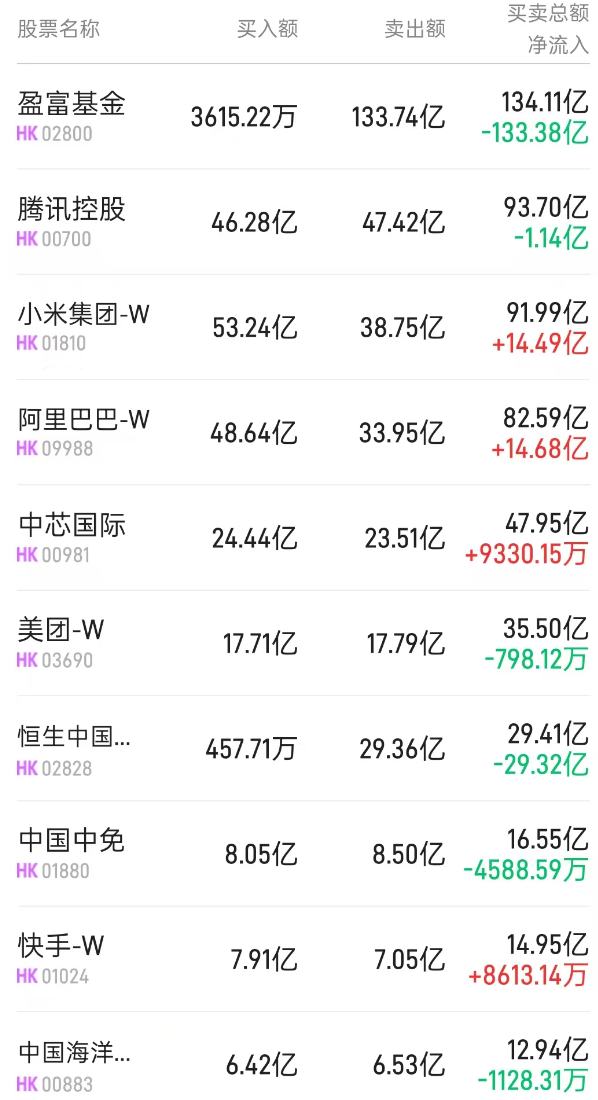

Hong Kong Stock Connect (Shanghai) active trading stocks
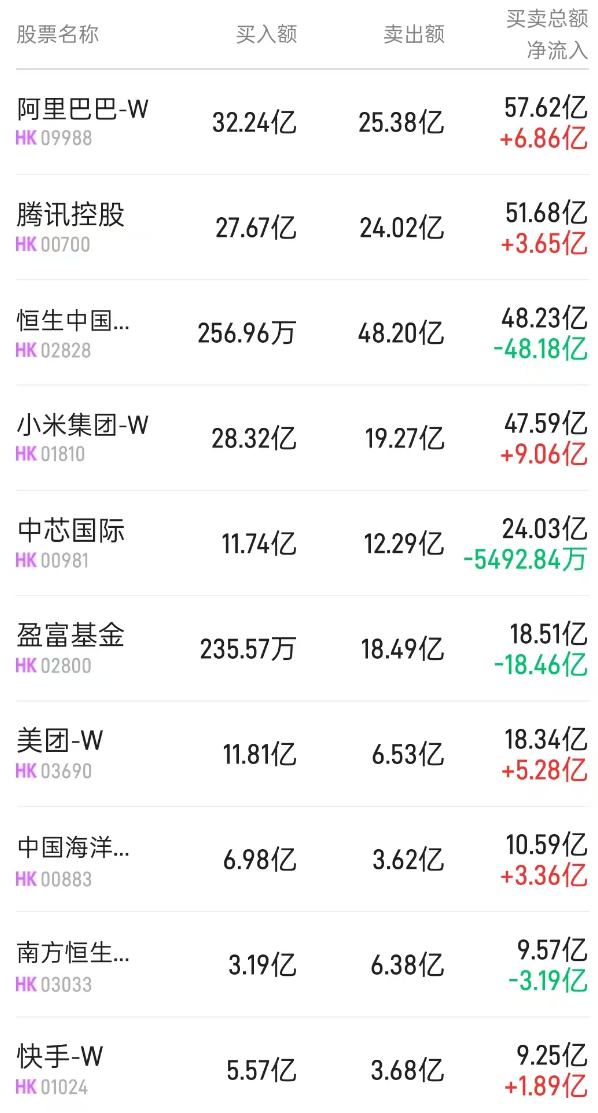
Hong Kong Stock Connect (Shenzhen) active trading stocks
Xiaomi Group-W (01810) received a net purchase of HK$2.354 billion. According to the news, following the announcement by the Xiaomi Group on March 25 that it plans to place 800 million shares to raise about HK$42.5 billion, Xiaomi once again sold bonds to the outside world to raise capital. According to the prospectus application, the current bond issuance scale is no more than 20 billion yuan. Xiaomi Communications, the main issuer of this bond, is a core subsidiary of the Xiaomi Group that sells smart phones, Internet of Things (IoT) and consumer products, and provides Internet services.
Beishui continues to add Cangke Network shares. Alibaba-W (09988), Meituan-W (03690), Kuaishou-W (01024), and Tencent (00700) received net purchases of HK$2.154 billion, $519 million, 275 million and HK$250 million respectively. According to the news, Bank of China International published a research report that the leading Chinese Internet shares covered by it, such as JD Group, Meituan, Alibaba, and Tencent Holdings, have limited revenue in the US, and most of the revenue of related companies comes from e-commerce, advertising, games, and takeout in China. Considering potential consumer stimulus policies and productivity increases brought about by increased application of artificial intelligence technology, BOCI recommended the Internet service industry and preferred Tencent.
CNOOC (00883) received a net purchase of HK$324 million. According to the news, Morgan Stanley released a research report saying that when international oil prices are measured at market value, Brent oil forecasts for the 2025 and 2026 fiscal years will drop to 65 and 62 US dollars per barrel, respectively. The long-term oil price is expected to be 55 US dollars. The bank said that based on falling oil prices, CNOOC's total revenue forecasts for the 2025 and 2026 fiscal years will be cut by 10% and 7% respectively; overall profit forecasts will be reduced by 15% and 13%, respectively. However, the bank also expects that CNOOC will continue to lead the “three barrels of oil” in terms of cost control.
Beishui reduced its Hong Kong stock ETF holdings throughout the day, and Yingfu Fund (02800), Hang Seng China (02828), and Southern Hang Seng Technology (03033) were net sold at HK$15.184 billion, $7.749 billion, and HK$3.194 billion respectively. According to the news, US President Trump said on the 9th local time that he has authorized countries that do not take retaliatory action to suspend tariffs for 90 days. Huaxi Securities previously pointed out that due to the previous rise in Hong Kong stocks, there has been a recent rise in valuations. It is necessary to absorb valuations and combine the influence of peripheral and objective factors, so the short-term pressure on the Hong Kong stock market needs to be digested. China Galaxy Securities said that in the short term, investors' risk appetite will decline, leading to a correction in stock market valuations. In the medium to long term, the performance of the stock market depends on the results of each country's tariff negotiations and the implementation of tariffs.
In addition, SMIC (00981) received a net purchase of HK$38.37 million, while China Free (01880) had a net sale of HK$45.88 million.