
- PREMIUM
- LIVE QUOTES
- INSTITUTIONS
 Index Options


 State Street
 CME Group
 Nasdaq
 Cboe
Cboe TradingView
 Wall Street Journal
The stock price rose 20 cm against the market during the day. Why did Rongchang Biotech (09995) become a “financial darling”?
Recently, external environmental shocks have intensified and spread to the pharmaceutical sector. On April 9, the Hang Seng Healthcare Index (800804) fell by more than 7% in early trading after news broke that “the US will impose tariffs on pharmaceuticals,” but then the index did not continue to decline but continued to rise and became popular in the afternoon.
Among them, one of the drivers of sentiment in the pharmaceutical sector was Rongchang Biotech (09995), which boosted more than 15 points within half an hour of early trading.
The Zhitong Finance App observed that although Rongchang Biotech was affected by negative sentiment across the market when it opened on April 9, bottoming out twice within 10 minutes, and the biggest drop reached 10.23%, after bottoming out, Rongchang Biotech's stock price quickly rebounded ahead of the index, pulled the stock price from deep water to the 0 axis in 20 minutes, and raised the stock price strongly to a maximum of 5.33% after the next 10 minutes.
Although Rongchang Biotech's on-market chip differences widened and the stock price fell again under the influence of market shocks, Rongchang Biotech's stock price once again rose strongly underwater in the afternoon, and once again raised the increase from 0 to a maximum of 11.19% within 20 minutes.
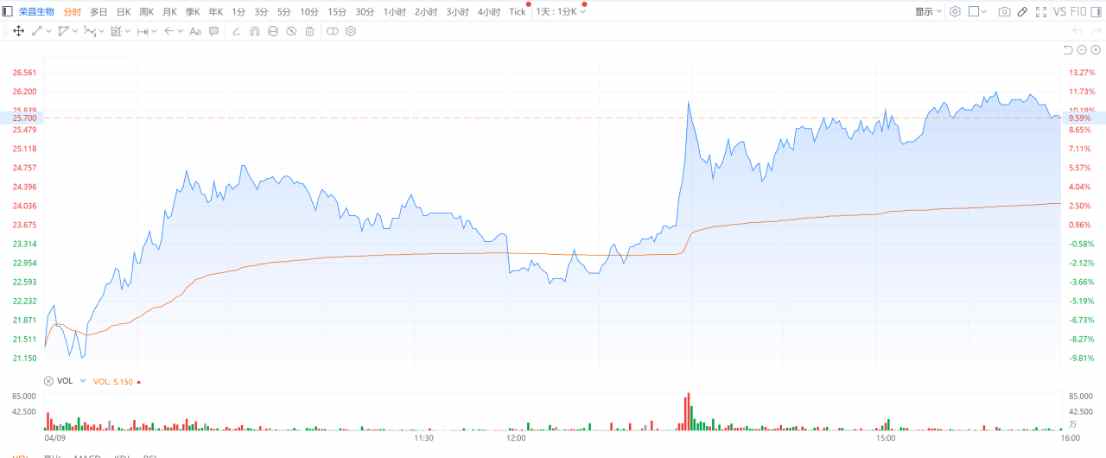
The reason why Rongchang Biotech was able to reverse the market and achieve a joint capital increase of nearly 20% during the day is that a new round of “autonomous and controllable major cycle” has now begun, and innovative biological drugs have become one of the main directions within the cycle.
Why did Rongchang Biotech become a “financial darling”?
On April 8, Rongchang Biotech announced the results of a phase III study on telitacicept (RC18, trade name: Taiai®) for the treatment of systemic myasthenia gravis (GmG) in the form of an oral report at the American Academy of Neurology (AAN) annual meeting.
Research results showed that titacip continued to significantly improve the clinical status of patients with systemic myasthenia gravis, and was safe and tolerated: after 4 weeks of treatment with teitacept, MG-ADL and QMG scores improved markedly compared to placebo.
Specifically, in terms of MG-ADL indicators for evaluating the effects of MG patients' symptoms on quality of daily life, the MG-ADL score was 5.74 points lower than the baseline and 0.91 points lower than the placebo group; the proportion of patients with an MG-ADL score improvement of at least 3 points was as high as 98.1%, far higher than 12% of the placebo group, indicating significant clinically significant improvements after patients received taitacept.
Furthermore, in terms of the QMG index for evaluating the strength and endurance of patients' whole body muscle groups, the QMG score was 8.66 points lower than the baseline and 2.27 points lower than the placebo group; the proportion of patients with a QMG score of at least 5 points improved by 87%, far higher than 16% in the placebo group, indicating that the patient's condition decreased significantly after receiving treatment.
Furthermore, the study results also showed a continuous improvement trend, that is, over time, the tetraciprin MG-ADL and QMG scores continued to decline, and the improvement peaked at week 24.
In terms of safety, the overall safe tolerability of taitacip treatment was comparable to the overall incidence of adverse events (AEs) in the placebo group, and the incidence of AEs infections was lower than in the placebo group (45.6% vs. 59.6%).
Looking at the competitive market, current targeted therapy for myasthenia gravis can be divided into targeting B-cell pathways, complement C5 inhibitors, and neonatal receptor FcRN antagonists. Among them, both complement C5 and FcRN targeted therapy have had sufficient clinical research evidence. Judging from previous clinical data, FcRN targeted therapy with MG has better clinical benefits. Of the 5 MG treatment products currently on the market, they are all complement C5 inhibitors or neonatal receptor FcRN antagonists developed by MNC in a multinational country.
With significant improvement data from nearly 100% of patients, Rongchang Biotech has now confirmed its excellent efficacy in GMG treatment for the first time, and also marks a major breakthrough in the field of neuroimmunity in China's innovative drugs.
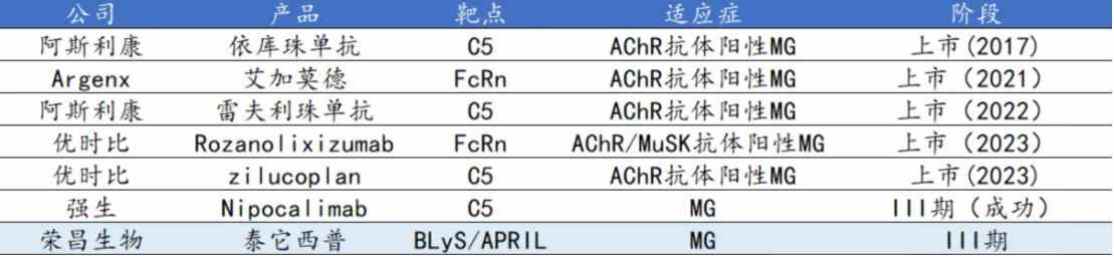
From a market perspective, at present, the marketing application for titacipr to treat generalized myasthenia gravis was accepted by the CDE in October last year and is expected to be approved for domestic marketing in the second quarter of this year. According to Frost & Sullivan, there are about 1.2 million MG patients worldwide, including 220,000 in China. The global market size is estimated at US$7.24 billion in 2030.
Take Argenx's Agalimod, which was previously marketed globally, as an example. The drug achieved sales of 1.2 billion US dollars in 2 years with only MG indications; AstraZeneca also achieved sales of US$1,965 billion and US$2,965 billion in 2022 and 2023, respectively, with levrizumab.
In the current context where the global pharmaceutical industry is being disrupted by external factors, the marketing of domestically produced Taytacip can significantly improve domestic autonomy and controllability in the treatment of systemic myasthenia gravis, thereby also bringing obvious emotional premiums and value revaluation to Rongchang Biotech.
Has the “true innovation” pharmaceutical company value revaluation window reached?
Following the review and approval of the “Whole-Chain Implementation Plan to Support the Development of Innovative Drugs”, which was widely discussed and anticipated last year, the domestic policy side once again stepped up this year, clearly supporting the development of domestically produced innovative drugs.
For example, in the “Opinions on Improving the Drug Price Formation Mechanism (Draft for Comments)” circulating in the industry in February of this year, the “price stratification+initial price+price protection” strategy proposed was widely interpreted as a strong support for innovation at the source; in March of this year, the “Report on the Work of the Government” first proposed optimizing drug collection policies, improving drug price formation mechanisms, formulating an innovative drug catalogue, and supporting the development of innovative drugs; Recently, the “Plan for Further Optimizing Drug Collection Policies (Draft for Comments)” was launched, revising the previous “only low price” strategy for collecting “only low prices”, which is also significantly beneficial OK Innovative medicine.
In fact, in recent years, strong support for the development of domestically produced innovative drugs has achieved remarkable results. The data shows that in the five years from 2019 to 2024, the number of innovative drugs marketed in China increased from 51 in 2019 to 93, and the proportion of innovative drugs produced in China increased significantly.
However, the R&D system of the Chinese pharmaceutical industry is relatively scattered, and the problem of popular target siphoning still exists. There is an urgent need to further improve the R&D capabilities of “source innovation” and “true innovation” drugs such as FIC/BIC. This may also be one of the reasons for selecting ADC R&D targets for this funding.
The Zhitong Finance App learned that in recent years, innovative domestic pharmaceutical companies have been at the forefront of the world in innovative research and development of antibody-conjugated drugs (ADCs). According to the data, new ADC drugs made in China currently account for about 40% of the global pipeline, and out of the 30 pharmaceutical companies with the highest number of ADC drug developers in the world, Chinese pharmaceutical companies dominate 14, accounting for nearly half, indicating that innovative Chinese pharmaceutical companies have become core participants in global ADC research and development.
At the same time, domestic ADC drug candidate targets are relatively more concentrated. 65.8% of clinical-stage ADC drug candidates are concentrated in the TOP 10 targets, which is higher than the global TOP 10 target concentration. Among them, on the four targets of HER2, TROP2, CLDN18.2, and EGFR, the number of ADC drug candidates developed by Chinese pharmaceutical companies accounted for 63.6%, 76.5%, 85.7%, and 30.8% of the number of global pipelines, respectively. In recent years, out of 19 BD transactions in the ADC sector with a total value of more than 1.5 billion US dollars, the transfer party was a Chinese pharmaceutical company, accounting for 8 projects, highlighting the ability of domestically produced ADC innovative drugs to develop.
Looking at it so far, what is shown in the ADC field is only the tip of the iceberg of innovative drugs in China. According to the data, by the end of 2024, the total number of active innovative drugs developed by Chinese companies had reached 3,575, surpassing the US to become number one in the world. Currently, most innovative drugs are still in clinical phase I, accounting for 58%.
In other words, as MNC takes a heavy stock of innovative drugs in China in the future and shifts the focus of introduction to early research pipelines with higher levels of innovation, pipeline varieties and innovative pharmaceutical companies with “source innovation” and “true innovation” values will all face revaluation. And this process of revaluation is expected to be further accelerated in the current secondary market, which favors innovation and autonomy and control.