
- PREMIUM
- LIVE QUOTES
- INSTITUTIONS
 Index Options


 State Street
 CME Group
 Nasdaq
 Cboe
Cboe TradingView
 Wall Street Journal
Is it too late for the S&P 500 Index to enter a new high?
The Zhitong Finance App learned that the S&P 500 index reached a new closing high for the first time in nearly four weeks on Tuesday. This strong performance has many investors thinking about a key question: is it too late to enter the market?
After two consecutive years of impressive gains, investors are understandably hesitant about whether the time is right to enter the market. After all, there is a saying on Wall Street: “Trees don't grow to the sky”, which means that the market will never rise unilaterally, and there will always be times to pull back.
From an investment psychology perspective, a new high in the stock market usually has a significant impact on investor sentiment. However, judging from historical data, it is actually quite common for the stock market to reach new highs. According to data provided by Ryan Detrick, chief market strategist at Carson Group, the S&P 500 index has reached a new high every three weeks on average since its inception in its modern form in 1957.
This doesn't mean that the stock market won't experience a long period of decline. Bear markets exist, but they are relatively rare. In contrast, investors who hold coins for a long time and wait for the market to recover tend to miss out on a large number of upward opportunities.
Detrick said on social networking platform X: “Investors often ask us if we should buy when the stock market hits a record high? My opinion is, don't be afraid of new highs. According to the data, there is a 71% chance that the S&P 500 index will continue to rise within 12 months after reaching a record high, with an average increase of 8.3%, which is basically in line with normal market returns.”
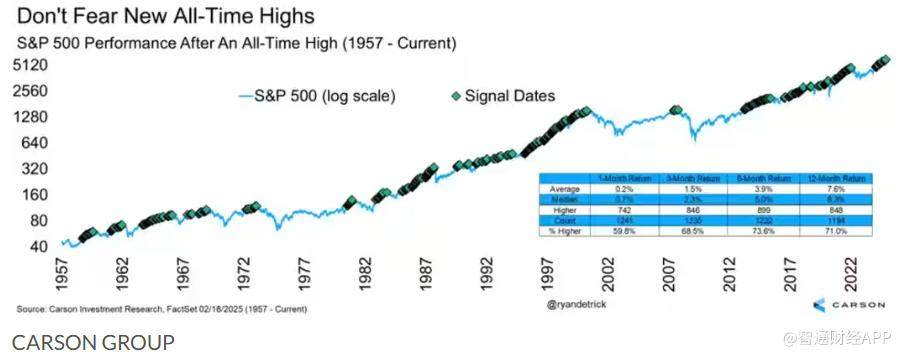
Of course, the market doesn't always work this way. For example, the S&P 500 index hit an all-time high of 4,796.56 points on January 3, 2022, but then fell all the way down, eventually falling into a bear market in October of that year, with the biggest drop of 25%. This adjustment also caused the market to take more than two years to break through its historical high again at the time.
However, it is worth noting that the bear market is only a “special case” of the market, not the “norm.” From a long-term perspective, the overall trend of the stock market is upward. In particular, since the recovery after the 2008 financial crisis, US stocks have been on an upward trend for a long time.
Although historical data supports long-term shareholding, investors still need to pay attention to some of the risks that the current market may face. In recent months, new potential threats have emerged in the market, and these risks are particularly critical in the current context of overvalued markets. One is the risk of high valuation. The valuation of US large-cap stocks is close to historical highs. Once market sentiment changes, high valuations may trigger adjustments. Another factor is seasonality. According to Detrick's analysis, the first quarter of the US presidential election cycle is usually one of the weakest periods in the four-year cycle, which may have a certain impact on market trends.
For investors who are still on the sidelines, whether they should enter the market now depends on individual investment goals and risk tolerance. Judging from historical experience, a record high in the stock market does not mean that the rally is over; on the contrary, it is often a normal phenomenon where the market continues to rise. For long-term investors, blindly waiting for a market pullback may be a missed opportunity.