
- PREMIUM
- LIVE QUOTES
- INSTITUTIONS
 Index Options


 State Street
 CME Group
 Nasdaq
 Cboe
Cboe TradingView
 Wall Street Journal
Nissan Chemical (TSE:4021) Seems To Use Debt Quite Sensibly
David Iben put it well when he said, 'Volatility is not a risk we care about. What we care about is avoiding the permanent loss of capital.' When we think about how risky a company is, we always like to look at its use of debt, since debt overload can lead to ruin. Importantly, Nissan Chemical Corporation (TSE:4021) does carry debt. But the more important question is: how much risk is that debt creating?
Why Does Debt Bring Risk?
Debt is a tool to help businesses grow, but if a business is incapable of paying off its lenders, then it exists at their mercy. Ultimately, if the company can't fulfill its legal obligations to repay debt, shareholders could walk away with nothing. However, a more frequent (but still costly) occurrence is where a company must issue shares at bargain-basement prices, permanently diluting shareholders, just to shore up its balance sheet. Of course, the upside of debt is that it often represents cheap capital, especially when it replaces dilution in a company with the ability to reinvest at high rates of return. When we examine debt levels, we first consider both cash and debt levels, together.
See our latest analysis for Nissan Chemical
How Much Debt Does Nissan Chemical Carry?
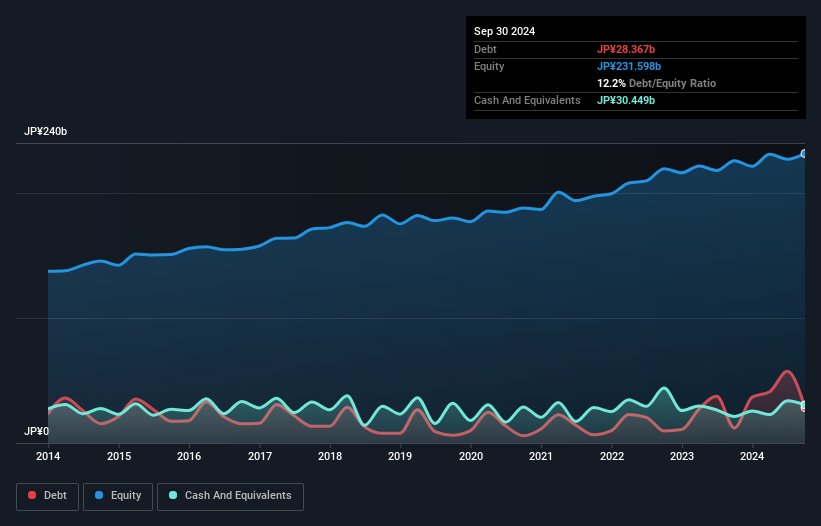
You can click the graphic below for the historical numbers, but it shows that as of September 2024 Nissan Chemical had JP¥28.4b of debt, an increase on JP¥12.0b, over one year. However, it does have JP¥30.4b in cash offsetting this, leading to net cash of JP¥2.08b.
How Healthy Is Nissan Chemical's Balance Sheet?
Zooming in on the latest balance sheet data, we can see that Nissan Chemical had liabilities of JP¥64.0b due within 12 months and liabilities of JP¥15.8b due beyond that. Offsetting these obligations, it had cash of JP¥30.4b as well as receivables valued at JP¥72.3b due within 12 months. So it actually has JP¥23.0b more liquid assets than total liabilities.
This surplus suggests that Nissan Chemical has a conservative balance sheet, and could probably eliminate its debt without much difficulty. Simply put, the fact that Nissan Chemical has more cash than debt is arguably a good indication that it can manage its debt safely.
Fortunately, Nissan Chemical grew its EBIT by 8.8% in the last year, making that debt load look even more manageable. When analysing debt levels, the balance sheet is the obvious place to start. But it is future earnings, more than anything, that will determine Nissan Chemical's ability to maintain a healthy balance sheet going forward. So if you want to see what the professionals think, you might find this free report on analyst profit forecasts to be interesting.
Finally, while the tax-man may adore accounting profits, lenders only accept cold hard cash. Nissan Chemical may have net cash on the balance sheet, but it is still interesting to look at how well the business converts its earnings before interest and tax (EBIT) to free cash flow, because that will influence both its need for, and its capacity to manage debt. In the last three years, Nissan Chemical's free cash flow amounted to 43% of its EBIT, less than we'd expect. That's not great, when it comes to paying down debt.
Summing Up
While it is always sensible to investigate a company's debt, in this case Nissan Chemical has JP¥2.08b in net cash and a decent-looking balance sheet. On top of that, it increased its EBIT by 8.8% in the last twelve months. So we are not troubled with Nissan Chemical's debt use. Another positive for shareholders is that it pays dividends. So if you like receiving those dividend payments, check Nissan Chemical's dividend history, without delay!
Of course, if you're the type of investor who prefers buying stocks without the burden of debt, then don't hesitate to discover our exclusive list of net cash growth stocks, today.
Have feedback on this article? Concerned about the content? Get in touch with us directly. Alternatively, email editorial-team (at) simplywallst.com.
This article by Simply Wall St is general in nature. We provide commentary based on historical data and analyst forecasts only using an unbiased methodology and our articles are not intended to be financial advice. It does not constitute a recommendation to buy or sell any stock, and does not take account of your objectives, or your financial situation. We aim to bring you long-term focused analysis driven by fundamental data. Note that our analysis may not factor in the latest price-sensitive company announcements or qualitative material. Simply Wall St has no position in any stocks mentioned.