
- PREMIUM
- LIVE QUOTES
- INSTITUTIONS
 Index Options


 State Street
 CME Group
 Nasdaq
 Cboe
Cboe TradingView
 Wall Street Journal
Investing in ETFs: Liquidity is Key
ETFs and stocks are alike in many ways. However, you cannot evaluate the liquidity of ETFs the same way you evaluate stocks.
This is because shares of stocks are closed—new shares cannot be created freely. On the other hand, ETF shares can be created or withdrawn from the market at any time. This, undoubtedly, increases the liquidity of ETFs.
Takeaways
- A highly liquid security enables you to trade quickly, even in a volatile market.
- The liquidity of an ETF and a stock should be evaluated differently.
- An investor can look at the bid-ask spread, market price, and underlying asset to determine how liquid an ETF is.
Why is liquidity important?
Liquidity is the ability to buy or sell a security quickly. When the market is volatile, an investor can make a quick trading decision without worrying that the order may take time to fill.
In stock trading, there is a limited pool of shares in the market. If you place a market order to sell 1,000 shares, your order will not be filled completely (it may be filled in partial) if there are not enough orders available for you to buy 1,000 shares.
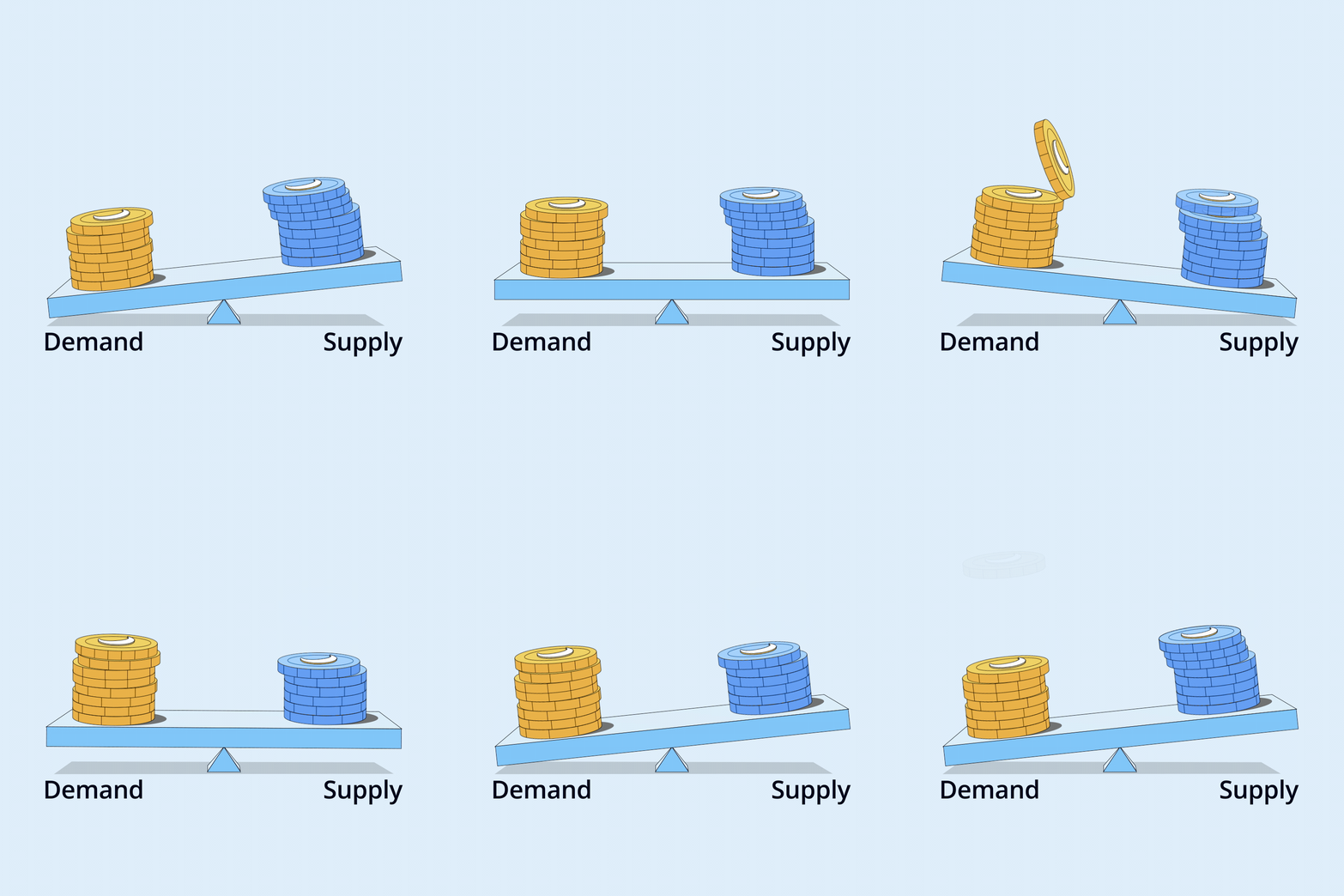
Things are different in ETF trading—the shares are not fixed. With the intervention of market makers, new shares will be created when there are more buy orders (demands) than sell orders (supply) in the market. Conversely, market makers buy shares from the market when there are more sell orders than buy orders. In this way, the demands and supply of an ETF are balanced, increasing its liquidity and keeping the market price close to the NAV.
How do you evaluate the liquidity of an ETF?
We can look at the trading volume of a stock to see how liquid it is. However, it’s more reliable to observe other factors of an ETF since its shares are not closed.
Bid-ask spread
The bid is the price at which a buyer is willing to buy. If you place a limit order to buy an ETF at a specified price, your order becomes the latest bid.
Correspondingly, the ask is the price at which a seller is willing to sell. If you place a limit order to sell an ETF at a specified price, your order becomes the latest ask.
The difference between the bid and ask is called the spread. Generally speaking, the smaller the spread, the higher the liquidity.
Market price & NAV
An ETF’s net asset value (NAV) is how much it is actually worth. An ETF would create more shares or buy back more shares from the market to balance the demands and supply, thus keeping the market price close to its NAV.
Overall, a liquid ETF trades at a price close to its NAV.
Underlying assets
Shares of underlying assets are bought and sold to balance the demands and supply of an ETF. If the underlying assets are not liquid, shares of an ETF won’t be adjusted in time. The ETF may trade at a discount or premium to the NAV.
In sum, the more liquid the underlying assets are, the more liquid an ETF is.
What if you’re trading an illiquid ETF?
When the ask-bid spread is wide, a market order may end up filling at an unexpected price. On the contrary, a limit order enables you to have some control over the filling price. It will only fill at the specified price or better.
You can choose to place a limit order to trade your shares.
Interested in learning more about ETFs? Join our ETFs Group in Webull community!
What's More
-Try it out on paper trading on our latest mobile version
-Take a quiz on our latest mobile version to evaluate your technique