
Durable Goods Orders
What are Durable Goods Orders?
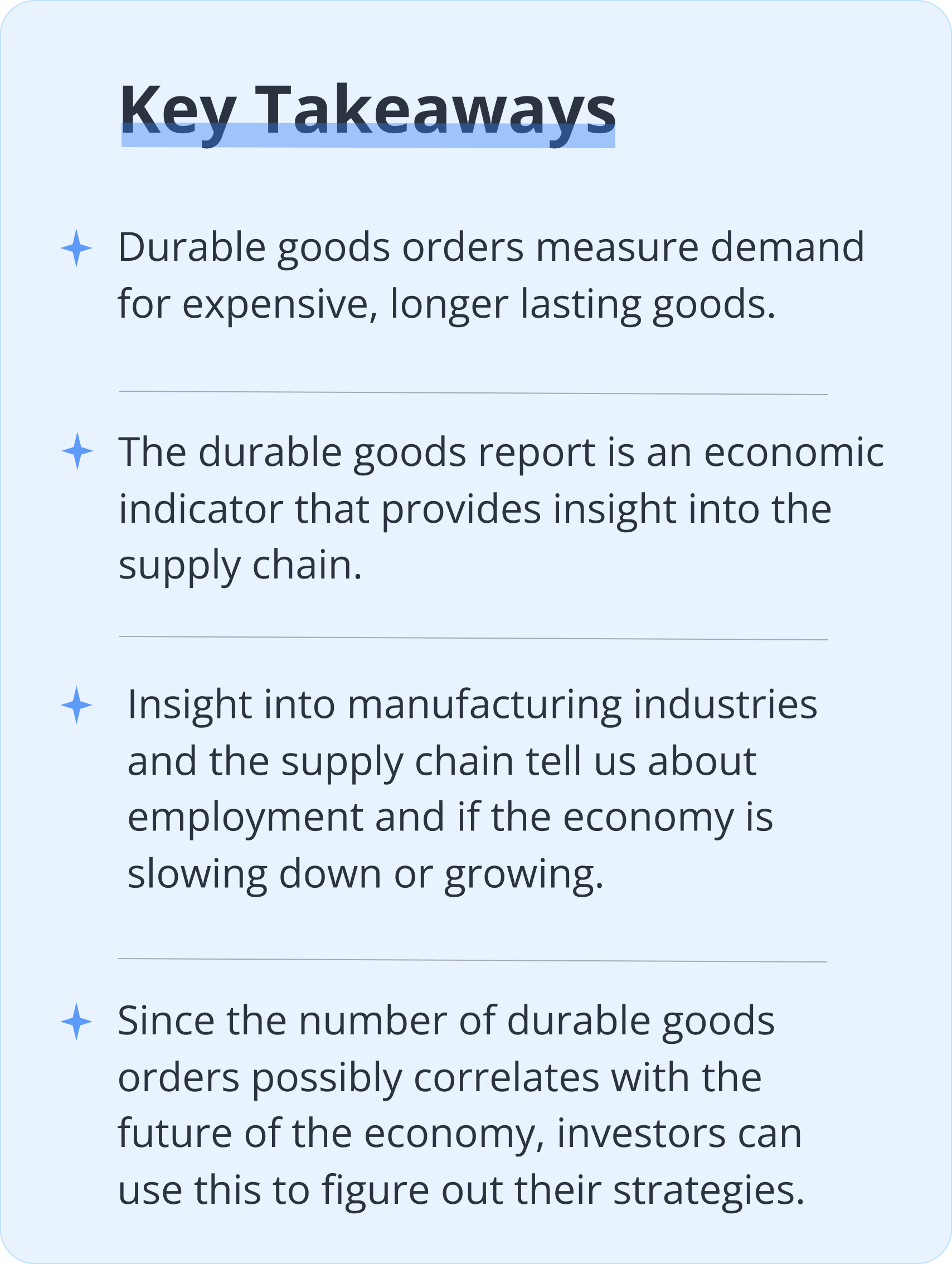
Durable goods orders, reflected in the durable goods report, measure industrial activity and demand for durable goods. Durable goods are considered goods that will last a minimum of three years, and are typically expensive and purchased infrequently. Goods such as raw steel, machinery and industrial equipment, computers, airplanes, and tanks are examples of durable goods.
The U.S. Census Bureau conducts monthly surveys and releases both an advance report on durable goods as well as data on the inventory, orders, and shipments of manufacturers. The double release is done to reflect how the value of new orders has changed.
There are often volatile swings within the durable goods report due to variance in orders per month. One month may have a huge downswing because of a cancelled contract, while another month may have a drastic upswing because a large number of orders were placed at once.
It is generally recommended to look at data from over a period of time to counteract potential volatility. For example, the December 2022 durable goods orders showed a 5.6% increase in orders, up from a 1.7% decrease in November, and much higher than the 1.2% increase in December 2021.
Impacts on the Market
The durable goods report is useful for understanding the state and earnings of industries such as transportation, machinery, and technology. Due to the high cost of durable goods, high demand for them indicates that businesses are investing in the future. This investment typically means that the economy is expected to rise, and consumer demand and spending will be high.
More orders of durable goods can also impact employment rates. Durable goods orders are a window to the supply chain, and more orders means more employees are needed at every stage of production and delivery to meet the demand. Conversely, lower demand for durable goods means that manufacturers have a lower volume of orders to fulfill, and thus they need fewer workers. Fewer orders are likely due to other participants in the economy trying to limit their spending. Overall, this generally indicates that the economy is slowing down and contracting.
How Should Investors React?
The durable goods report has a lot of data that can be useful for investors. The number of orders indicates the strength of the economy, but more importantly for investors, it indicates the direction of the economy.
If higher orders mean a strong economy, and lower orders mean a weak economy, observing durable goods orders can help investors determine their strategies. In a time of high orders when businesses are expecting the economy to expand, this could be the time to be more aggressive when investing and take on higher risk. In a time of low orders when the economy is contacting, it may be best to approach investing with caution and carefully consider your risk tolerance.
It is important for investors to keep in mind the volatility of durable goods. It is generally recommended to consider multiple months of reports rather than a single month to get a broader idea of the demand for durable goods. Because the reports are volatile, it is also smart to look into the factors that are influencing the demand reflected in the reports. Demand also varies by industry, so investors may also look to see if one industry is declining while another is growing. Knowing if a specific industry is on the rise can also help investors decide where to focus their investments.
The Bottom Line
Durable goods orders are the economic indicator that provides the most insight on manufacturing and the supply chain. More orders mean more workers, and higher employment rates historically coincide with expanding economies. Knowing if businesses are planning on investing in durable goods, and which industries are being invested in, can help investors understand earnings and make decisions. Since durable goods are meant for the long term, they can be used to gauge the expected earnings of businesses in the future, which can also guide investment decisions.