
What Is the Impact of Intraday Volatility?
When investors purchase a leveraged ETF, they seek magnified exposure to an asset class or sector. The amount of exposure an investor obtains on the day he or she buys a daily leveraged fund is a function of how much the fund's price has changed since the prior day's market close.
An investor must buy the fund at a price equal to the prior day's closing NAV in order to expect a return equal to the funds stated daily objective (e.g., +/-200%, +/- 300%) on that day. In volatile markets, when prices are fluctuating rapidly, it may be challenging to obtain an exact targeted exposure level.
Now let’s explore the impact of intraday volatility on the exposure level that can be obtained by an individual investor through leveraged ETFs on the day of purchase.
Intraday Volatility
The amount of exposure offered by a daily leveraged fund intraday may be higher or lower than the stated daily objective depending on the movement of the target index away from its value at the end of the prior trading day. After a move in the index that is favorable to the fund - either up for a Bull Fund or down for a Bear Fund - the amount of exposure that an investor can obtain will be less than the daily stated objective. In essence, they have already missed out on some of the fund's positive returns on that day.
Conversely, if the value of the index moves in a direction that is unfavorable to the fund - either down for a Bull Fund or up for a Bear Fund - the amount of exposure that an investor can obtain will be greater than the daily stated objective.
On days when market fluctuation is minimal, the intraday changes to exposure levels are small. However, on days when there is substantial fluctuation in the value of the benchmark index, the intraday changes to exposure levels could be greater. Daily leveraged ETFs are intended to be used as short-term trading vehicles.
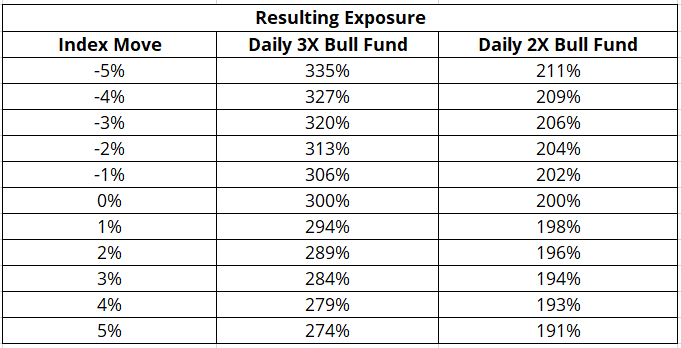
The table below shows examples of how, for a Daily 3X Bull Fund and Daily 2X Bull Fund, a decline in the target index results in increased exposure, and a gain in the target index results in decreased exposure.
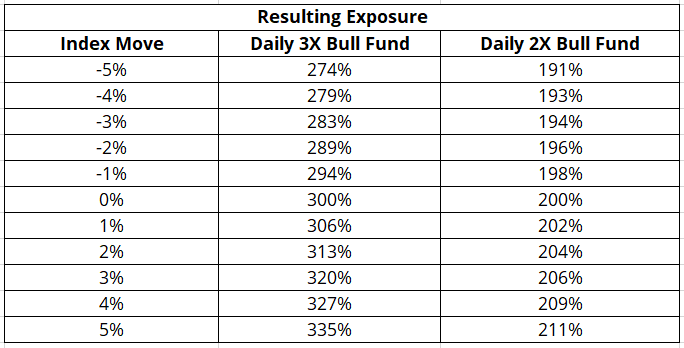
The table below shows how, for a Daily 3X Bear Fund and Daily 2X Bear Fund, a decline in the target index results in decreased exposure, and a gain in the target index results in increased exposure.
Let’s walk through four examples to see how intraday movements can impact shareholders' exposure levels for a Daily 3X Bull and Daily 3X Bear Funds. Hypothetical examples do not reflect the impact of expenses, such as commission charges and taxes, which would lower the results shown.
*The following examples have been simplified to help illustrate the primary point being made in this section. These scenarios assume that the fund price and index movements are exactly in synch. This is not realistic as all exchange-traded funds will typically trade at a premium or discount. Please understand that in real life, after taking into account the actual premiums and discounts, the movements illustrated in these scenarios would be different (the magnitude of which will be dependent upon the amount of the premium or discount), and therefore the exposure levels and return figures will be impacted.
Scenario #1: 3X Bull Fund Purchased at an Increased Exposure Level
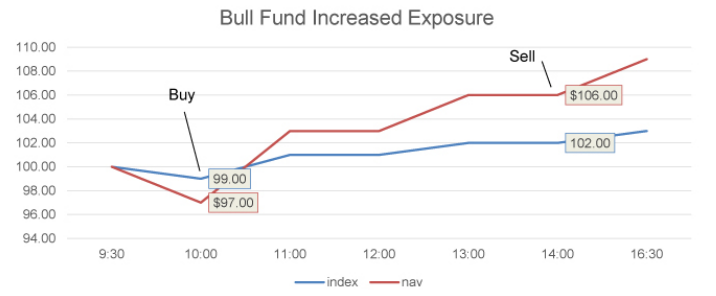
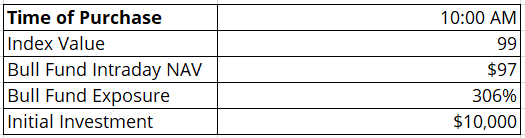
The index, which closed the previous night at $100, decreases to $99 by 10:00 AM. An investor that purchases the fund at this point would obtain exposure to the index in the amount of 306%, not 300%.
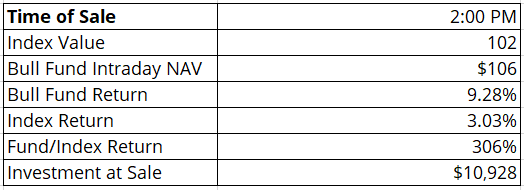
After the purchase, the Index moves from 99 to 102 (3.03% return) at 2:00 PM, at which point the investor sells.
During this same period, the Bull Fund's intraday NAV rises from $97 to $106, a gain of 9.28%, which is 306% of the Index move.
Scenario #2: 3X Bull Fund Purchased at a Decreased Exposure level
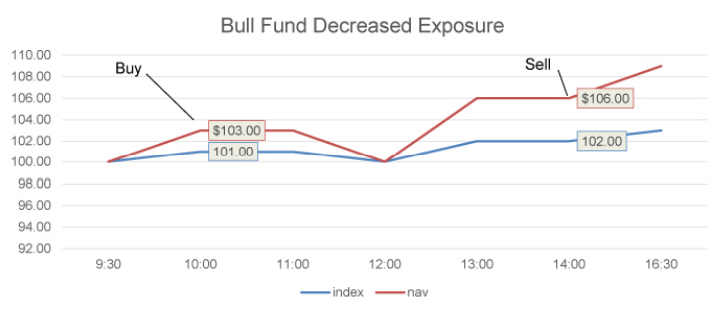
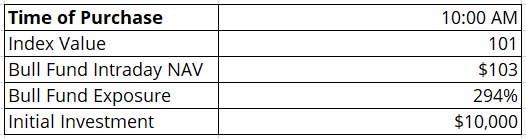
In the first 1/2 hour of the trading day, the index gained 1% (moved from 100 to 101). An investor that purchases the fund at this point, at an intraday NAV of $103, would obtain exposure to the index in the amount of 294%, not 300%.
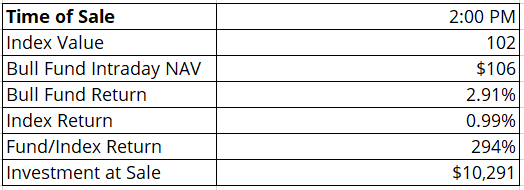
After the purchase, the index moves from 101 to 102 (0.99% return) at 2:00 PM, at which point the investor sells.
During this same period, the Bull Fund’s intraday NAV increases to $106, a gain of 2.91%, which is 294% of the index move.
Scenario #3: 3X Bear Fund Purchased at an Increased Exposure Level
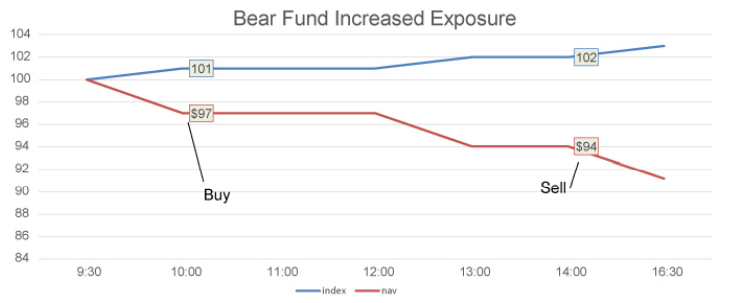
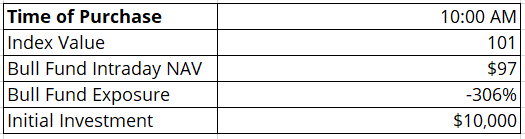
In the first 1/2 hour of the trading day, the index gained 1% (moved from 100 to 101). An investor that purchases the fund at this point, at an intraday NAV of $97, would obtain inverse exposure to the index in the amount of 306%, not 300%.
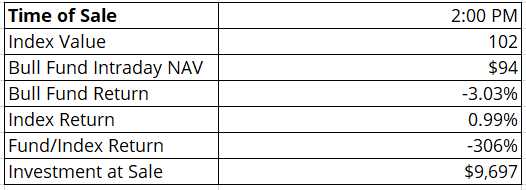
After the purchase, the index moves from 101 to 102 (.99% return) at 2:00 PM, at which point the investor sells.
During this same period, the Bear Fund’s intraday NAV decreases to $94, a loss of -3.03%, which is -306% of the index move.
Scenario #4: 3X Bear Fund Purchased at a Decreased Exposure Level
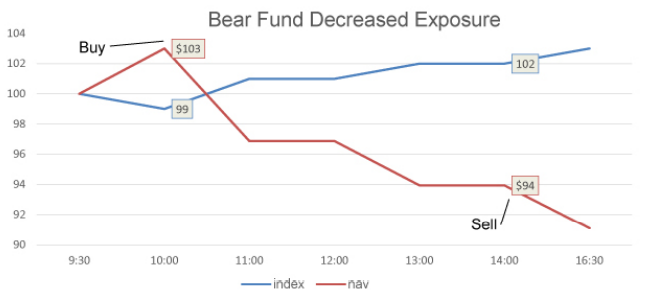
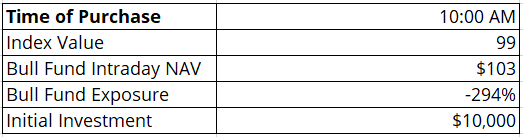
In the first 1/2 hour of the trading day, the index has lost 1% (moved from 100 to 99). An investor that purchases the fund at this point, at an intraday NAV of $103, would obtain inverse exposure to the index in the amount of 294%, not 300%.
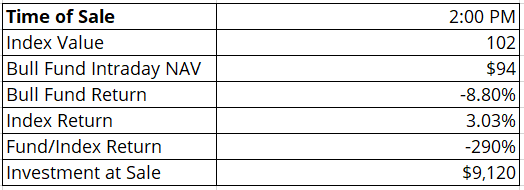
After the purchase, the index moves from 99 to 102 (3.03% return) at 2:00 PM, at which point the investor sells.
During this same period, the Bear Fund's intraday NAV drops from $103 to $94, a loss of -8.8%, which is 294% of the index move.
How to Monitor Intraday NAV Values (iNAV)
There is a way for investors to monitor the difference between the current market value of a leveraged ETF and its most recently calculated closing NAV in order to determine the exposure levels at the time of purchase. The best way to understand an ETF's intraday market value is to monitor a data point known as the "iNAV."
The iNAV is calculated by various data providers and can be accessed in real time (roughly every 15 seconds) throughout the trading day. The iNAV is a very good indication of what a fund's actual NAV would be if it were calculated at that point in time.
It is not the price at which you can purchase the instrument; it is only used as a reference for the investment's underlying value. In many cases, the ETF will actually trade at a premium or discount to the NAV due to various factors, including supply and demand, and expectations.
The iNAV can be accessed on various data systems and websites by typing "A[ETF symbol]-IV" into the quote request field. For example, to find the iNAV for the Direxion Daily Technology Bull 3X Shares (TECL), type ATECL-IV.
Investors can compare the iNAV of an ETF to its most recently calculated NAV and calculate their expected exposure level prior to purchasing the fund. This will help set performance expectations properly.
To sum up, if an investor purchases shares of a leveraged ETF during the day at any value other than the fund's prior day closing NAV, the level of exposure will be different than the fund's stated daily goal. The amount of this difference will depend on the magnitude of the movement of the index. If the movement is in favor of the fund, the level of exposure will be less than the fund's stated daily exposure target. If the movement is not in favor of the fund, the level of exposure will be greater than the fund's stated daily exposure target.
Once the investor has made a purchase, the level of exposure is set until he or she sells that position or until the next portfolio rebalance at the end of the day. Investors should monitor iNAV and understand exposure levels at the time of purchase.