
Perps vs Traditional Futures – What’s the Difference?
Expiration
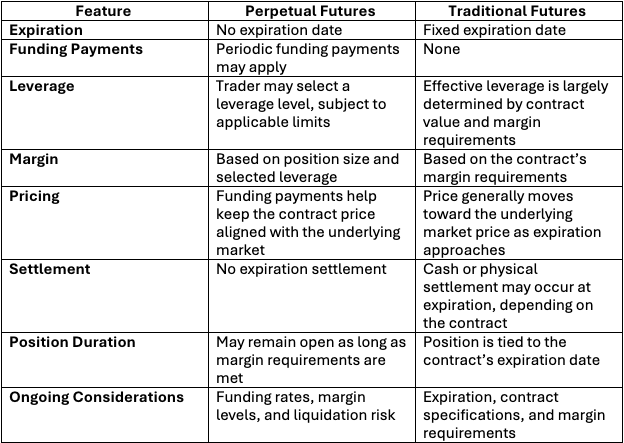
One of the most apparent differences is that perpetual futures do not have an expiration date.
A perpetual futures position can generally remain open as long as applicable margin requirements are met and the position is not otherwise closed or liquidated.
Traditional futures, on the other hand, have a specific expiration date. This means a traditional futures position is tied to a defined contract period, while a perpetual futures position is not.
Funding Payments
Perpetual futures use funding payments to help keep the contract price aligned with the price of the underlying asset.
Funding payments are periodically exchanged between traders holding long and short positions. Depending on the funding rate and the direction of your position, you may either pay or receive funding payments.
Traditional futures generally do not use this type of funding mechanism. Instead, the contract price typically moves toward the underlying market (spot) price as the contract approaches expiration.
Contract Pricing
Both perpetual and traditional futures prices can differ from the current price of the underlying asset.
With perpetual futures, funding payments help encourage the contract price to remain aligned with the underlying market over time.
Traditional futures prices can reflect factors such as the amount of time remaining until expiration, interest rates, storage or carrying costs, and market expectations. These factors may cause a traditional futures contract to trade above or below the current underlying market price.
Margin and Leverage
Both perpetual and traditional futures can provide greater market exposure than the amount of capital deposited, but the way leverage is applied can differ between the two products.
With traditional futures, leverage is generally built into the contract through the contract’s notional value and margin requirements. Each contract represents a specified amount of the underlying asset, while the exchange sets the maintenance margin requirements needed to maintain a position. As a result, the effective leverage of a traditional futures position is largely determined by the contract specifications and the amount of margin required, rather than selected directly by the trader.
For example, if a traditional futures contract provides exposure to $100,000 worth of an underlying asset and requires $10,000 of initial margin, the position has an effective leverage ratio of approximately 10:1. The trader may not choose a separate leverage setting, but the contract’s margin requirements determine how much exposure is created relative to the capital committed.
Perpetual futures allow the trader to choose a preferred leverage level when opening a position, subject to the applicable limits and risk controls. A trader may choose lower leverage, which lowers their overall exposure. This in turn leaves more room for the position to absorb losses before approaching liquidation. A trader may also choose higher leverage, which increases their exposure but leaves less room for losses. The selected leverage determines the amount of exposure, or position size, the trader can take in the underlying asset for a given amount of margin.
For example, a trader opening a $10,000 perpetual futures position may choose 2x leverage, requiring approximately $5,000 in initial margin, or 10x leverage, requiring approximately $1,000 in initial margin, before considering fees, funding, and other requirements. The higher-leverage position uses less initial margin but generally has less room to absorb adverse price movements before approaching liquidation.
Margin is the collateral used to open and maintain a perpetual futures position. Leverage determines how much exposure or position size you can take in the underlying relative to the margin you provide.
While leverage can increase potential gains, it can also magnify losses. Choosing lower leverage does not eliminate market risk, and choosing higher leverage means that relatively small price movements can have a larger impact on the margin supporting a position.
Settlement
Traditional futures contracts have defined settlement terms when they expire. Depending on the contract, settlement may involve a cash payment or delivery of the underlying asset.
Perpetual futures do not have an expiration date, so they never expire. Positions remain open until they are closed, liquidated, or otherwise terminated under the applicable contract rules.
Ongoing Costs and Position Management
Because perpetual futures can remain open indefinitely, funding payments may become an important consideration when holding a position for an extended period. Funding may either increase the cost of maintaining a position or result in payments being received, depending on market conditions.
Traditional futures do not have periodic funding payments of this type, but traders may encounter other considerations when maintaining exposure, including differences in pricing between contract months and the costs associated with rolling positions.
Traditional futures may also require more attention to the contract’s fixed specifications, including its notional value, margin requirements, tick size, and expiration date. Perpetual futures may provide more control over the amount of leverage used, but traders still need to monitor funding rates, margin levels, and liquidation risk.
Key Takeaways
Perpetual futures do not expire and use funding payments to help keep their prices aligned with the underlying market. They may also allow traders to select their preferred leverage level, subject to platform limits and risk controls. The selected leverage determines how much exposure or position size a trader can take in the underlying for a given amount of margin. This allows positions to remain open without having to roll into a new contract.
Traditional futures have defined expiration dates and do not typically use perpetual-style funding payments. Leverage is generally embedded in the contract through its notional value and required margin, so the effective leverage is determined largely by the contract specifications. Traders who want to maintain exposure beyond expiration may need to move their position into a later-dated contract.
Both products involve leverage, margin requirements, market risk, and the potential for substantial losses. Before trading, it is important to understand the specific contract terms, margin requirements, settlement process, leverage settings, and risks associated with the product.
Perps vs Traditional Futures – What’s the Difference?
Perpetual futures, or “perps,” and traditional futures let you trade an underlying asset’s price movements without purchasing the asset directly. Both allow long and short positions, offer leverage, and carry liquidation risk.
The main differences involve expiration dates, funding payments, and how collateral supports your position.
Expiration Dates and Rollovers
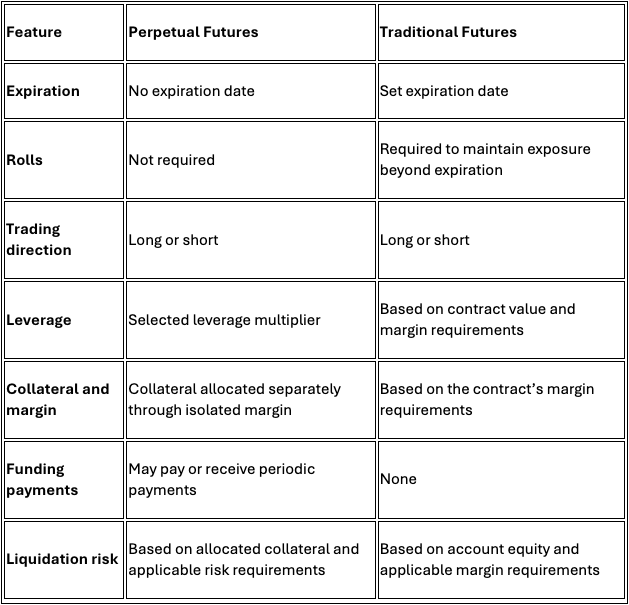
Traditional futures have a set expiration date. To maintain exposure beyond that date, traders generally close their expiring position and open a new contract, a process known as “rolling.” Depending on the contract, positions held through expiration may settle in cash or involve physical delivery.
Perpetual futures have no expiration date, removing the need for rollovers. You can keep a position open as long as you continue to have sufficient collateral to avoid liquidation.
As perps do not require ownership of the underlying or have a notice date, there is also no risk of physical delivery.
Leverage and Notional Value
Both products allow you to control a larger position with less capital than the position’s total (notional) value. Gains and losses are based on the full position size, so leverage magnifies both.
With perps, you select a leverage multiplier. Multiplying the futures buying power used by that multiplier determines your position’s notional value.
Example: Using $200 in futures buying power at 5x leverage gives you $1,000 in notional value.
A 10% price move in your favor produces a $100 gain
A 10% move against you produces a $100 loss, excluding fees and funding payments.
With traditional futures, leverage is built into the relationship between the contract’s specifications and its margin requirements. The contract size or multiplier determines its notional value at the current market price, while margin requirements determine how much capital you must provide to open the position.
Collateral and Liquidation
Collateral is the cash committed to support your position. For perps using isolated margin, you allocate collateral to each position separately. That allocation helps determine the position’s estimated liquidation price.
Example: You have $1,000 in your account and allocate $200 to a perp position. The remaining $800 is not automatically used to support that position or determine its liquidation price.
Your estimated liquidation price indicates the underlying asset price at which your position may be automatically closed. Higher leverage generally brings this price closer to your entry price, meaning a smaller move against your position could trigger liquidation.
Traditional futures are subject to specified margin requirements, and liquidation may occur if account equity falls below the required level. For perps using isolated margin, the key reference is a position-specific estimated liquidation price that reflects the collateral and leverage dedicated to that position, along with applicable exchange risk requirements.
Funding Payments
Perps use funding payments to help keep the contract’s price aligned with its underlying asset. These payments are exchanged between traders holding long and short positions and are not fees charged or collected by Webull.
When the funding rate is positive, long positions pay short positions. When it is negative, short positions pay long positions. A zero rate means no payments.
Funding payments are scheduled every eight hours at 12:00 AM, 8:00 AM, and 4:00 PM ET. They can increase or reduce the overall return from holding a position.
Traditional futures do not use these periodic funding payments. Their pricing instead reflects factors such as the time remaining until expiration and the cost of carrying the underlying asset. The contract and underlying (spot) price will naturally converge approaching expiration.
Key Differences at a Glance
Ongoing Position Management
Both products require ongoing attention to position size, collateral, and market conditions. Changes in price or exchange risk requirements can affect your ability to maintain a position, so monitoring remains important for as long as it is open.
With perps, there is no expiration date to manage or contract to roll over. Instead, monitor your estimated liquidation price, the collateral allocated to each position, and applicable funding payments. Funding costs can accumulate across multiple periods and reduce your overall return, even when the market moves in your favor. With isolated margin, unallocated account funds are not automatically used to support a position.
With traditional futures, monitor your account equity against applicable margin requirements and keep track of approaching expiration dates. If you want to maintain exposure beyond expiration, you generally need to close the expiring position and open a later-dated contract. Otherwise, understand the contract’s settlement or delivery requirements.
For both products, market volatility and trading interruptions may affect your ability to adjust or close positions. Regularly reviewing your positions can help you understand changes in your risk, but it does not eliminate the possibility of losses or liquidation.