
Long or Short - Perps
What Is a Long Position?
A Long position is used when you expect the price of the underlying asset to increase.
After opening a long position:
- If the asset's price rises, your position generally gains value.
- If the asset's price falls, your position generally loses value.
For example, suppose Bitcoin is trading at $100,000 and you believe its price will increase. You open a long position in BTCPERP with $500 in market exposure.
If Bitcoin rises by 10%, your position will gain approximately $50.
If Bitcoin falls by 10%, your position will lose approximately $50.
The greater the favorable price movement, the greater the potential gain. However, a larger move in the opposite direction can also result in a larger loss.
What Is a Short Position?
A Short position is used when you expect the price of the underlying asset to decrease.
After opening a short position:
- If the asset's price falls, your position generally gains value.
- If the asset's price rises, your position generally loses value.
Suppose Bitcoin is again trading at $100,000, but this time you believe its price will decline. You open a short position in BTCPERP with $500 in market exposure.
If Bitcoin falls by 10%, your position will gain approximately $50.
If Bitcoin rises by 10%, your position will lose approximately $50.
A short position therefore allows you to take a position based on an expectation that the asset price will move lower.
Long vs. Short at a Glance
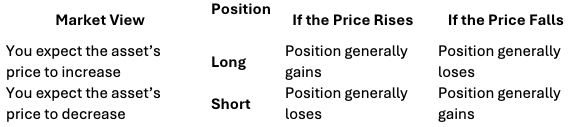
The direction of your position determines which market movement is favorable to you.
How Profit and Loss Are Calculated
Your profit or loss is based on the size of your Perps position and the movement of the underlying market.
A simplified calculation is:
Position Size (Notional) × Percentage Price Movement = Approximate Gain or Loss
For example, with a $1,000 position, a 5% movement in the underlying market would represent approximately a $50 change in the value of the position.
For a long position:
5% increase → approximately $50 gain
5% decrease → approximately $50 loss
For a short position, the result is reversed:
5% decrease → approximately $50 gain
5% increase → approximately $50 loss
These simplified examples exclude trading fees and funding payments.
Long and Short Positions Can Use Leverage
Both long and short Perps positions can use leverage.
Leverage allows you to obtain market exposure greater than the futures buying power required to open the position.
For example:
$100 in futures buying power at 5x leverage = $500 in market exposure
If you open a long position, that $500 exposure benefits when the underlying price rises and loses value when it falls.
If you open a short position, that $500 exposure benefits when the underlying price falls and loses value when it rises.
Because gains and losses are based on the total position size, leverage can magnify the effect of price movements in either direction.
Example: Choosing Between Long and Short
Imagine Bitcoin is currently trading at $100,000.
You expect Bitcoin to rise
You open a Long $500 BTCPERP position.
Bitcoin rises to $110,000, a 10% increase.
Your position gains approximately:
$500 × 10% = $50
You expect Bitcoin to fall
Instead, you open a Short $500 BTCPERP position.
Bitcoin falls to $90,000, a 10% decrease.
Your position gains approximately:
$500 × 10% = $50
In both cases, the position can potentially profit when the market moves in the direction you anticipated. If the market moves in the opposite direction, the position will instead experience a loss.
You Can Close a Position Without Switching Sides
Opening a long or short position does not mean you have to maintain that market view indefinitely.
If you have an existing position, you can close some or all of it to realize your gain or loss.
For example, if you have an open Long position and decide you no longer want that exposure, you can close the position. Closing a long position is different from intentionally establishing a new short position.
Similarly, closing an existing Short position does not necessarily mean you are taking a bullish view. You may simply be exiting your existing position.
What Happens If the Market Moves Against You?
Whether you are long or short, your position can lose value if the market moves in the opposite direction.
For a long position, a falling market produces losses.
For a short position, a rising market produces losses.
If the asset’s price continues to move against your position, you may be subject to partial or full liquidation.
Leverage can increase this risk because it magnifies the effect of market movements relative to the funds committed to the position.
Funding Payments Can Differ by Position Direction
While your Perps position remains open, you may also pay or receive funding payments.
Funding payments occur periodically and depend on factors including the applicable funding rate and whether you hold a long or short position.
Depending on the funding rate:
- Long positions may pay short positions.
- Short positions may pay long positions.
The direction of these payments can change as market conditions and the funding rate change.
Funding payments are separate from the profit or loss generated by movements in the underlying asset's price.
Key Takeaway
Perpetual futures allow you to trade based on either direction of the market:
Long when you believe the underlying asset will increase in value.
Short when you believe the underlying asset will decrease in value.
Both positions can use leverage, and both are exposed to losses if the market moves against your position. As perps have no traditional expiration date, you can maintain exposure on either side of the market if you have sufficient collateral to avoid liquidation.