
How to Roll Over Your 401(k)
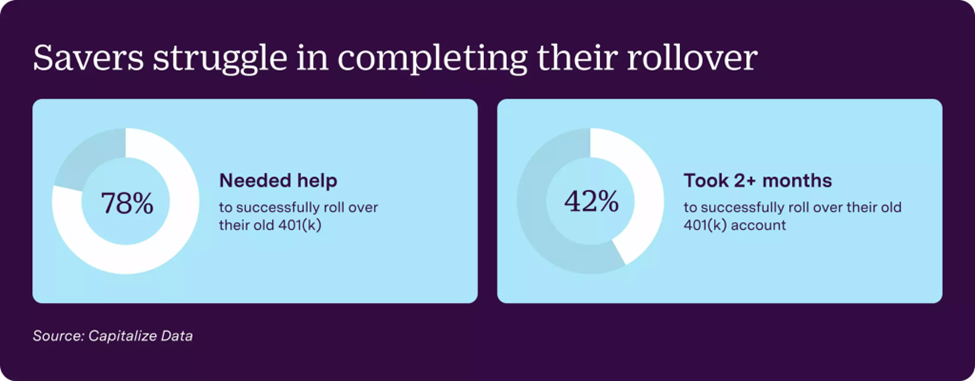
Only 22% of savers are able to complete a rollover without help. Learn how to rollover your 401(k) with this guide.
Source: https://www.hicapitalize.com/resources/why-401k-rollovers-remain-outdated-white-paper/
Now that you’ve found your old 401(k), you’re making great progress on your road to retirement. Transferring, or rolling over, your savings to an Individual Retirement Account (IRA) can help you simplify your strategy by consolidating your funds into an account you control.
If you’re wondering how to roll over your 401(k), you’re not alone. A recent survey by Capitalize indicates that only 22% of savers are able to complete a rollover without help. While the rollover process can vary between financial institutions, the good news is that there are some common, simple steps to follow to set you up for success. Let’s dive in and walk through them so you can confidently roll over your 401(k).
Step 1: Decide Where to Move Your Money
If you’ve found your old 401(k) account, your first step in the rollover process is choosing an IRA provider to move your savings over to. One of the biggest benefits of rolling over to an IRA is the ability to choose a financial institution of your choice, like Webull.
When evaluating IRA providers, it can be helpful to compare the investment options, fees, and account types offered by the brokerage. For instance, some providers will offer options trading, or crypto holdings while others have more traditional offerings. Providers may charge a fee for each trade you make, and can also charge an account management fee. Finally, brokerages can offer self-directed IRAs, or automated IRAs (also known as “robo IRAs”). Hands-off traders can benefit from the latter, where those inclined towards a more active approach in their retirement savings may prefer a self-directed account.
Step 2: Open Your New IRA Account
Once you’ve chosen your IRA provider, it’s time to open your new account if you don’t already have one. Navigate to the provider’s website and locate their account opening page to start the process. Brokerages like Webull offer a streamlined account opening journey, making this one of the more simple steps to navigate.
One important note: make sure to open an IRA account with the same tax status as the 401(k) you intend to roll over. For instance, if you have a traditional (pre-tax) 401(k), you’ll want to open a traditional IRA. If you have a Roth (after-tax) 401(k), make sure you open a Roth IRA.
Rolling over into an IRA with a dissimilar tax status can create an unintended tax consequence. It may be helpful to consult a financial advisor or use a service like Capitalize to ensure you open the proper account type for your rollover.
After you’ve opened your account, check your new IRA provider’s website for specific rollover instructions that you’re 401(k) provider will need to initiate your transfer. These typically contain your IRA provider’s address and check-related instructions. If you’re having trouble finding these details, reach out to your IRA provider’s customer service team to clarify.
Step 3: Initiate the Transfer
Now that you have an IRA account ready for your transfer, you’ll want to contact your 401(k) provider to start your rollover. This is typically easiest to do by calling your 401(k) provider. It can be helpful to have an old 401(k) statement in hand to verify your identity, but can also be done with other personal details, like your social security number.
Your 401(k) provider will need the account number of your new IRA, along with the IRA provider’s mailing address and any other check-related instructions that you gathered in the previous step.
Be sure to tell your 401(k) provider that you would like to do a direct rollover – where your 401(k) provider sends the funds directly to your Webull IRA. This enables a smoother transfer than an indirect rollover – where your 401(k) provider would send you a check to forward to your new IRA provider. Indirect rollovers require the funds to be deposited into your new IRA within 60 days, and failing to do so can subject you to taxes and penalties from the IRS.
Step 4: Invest Your Funds
You’re so close to finishing your rollover! Once your IRA provider receives the check from your old 401(k) provider, you should see the funds in your new account. The time it takes for these funds can vary between providers, but you can typically expect them to arrive within one to two weeks.
After you see the funds in your IRA, the last step is to make sure they are invested appropriately. This step is important and can be often overlooked. If your funds aren’t invested, then you’ll potentially miss out on earning returns and growing your retirement savings. If you’ve chosen a managed IRA, this is usually done automatically.
Final Thoughts
Rollovers can be intimidating, leaving many savers to require help in completing their rollover. While the process can vary from provider to provider, there are four basic steps to follow to complete your rollover: deciding where to move your money, opening up an IRA account, initiating the transfer, and investing the funds once they arrive in your account. After reading this guide, you should have a good understanding of what’s required to confidently transfer your old 401(k) savings into an IRA.
If you find yourself needing additional help or support, consider using Capitalize to handle your 401(k) rollover for you. Capitalize is the industry’s first platform for digital retirement account transfers, and works with leading financial institutions like Webull to seamlessly roll over your retirement savings.
QUIZ
What percentage of savers are able to complete a rollover without help?
- 12%
- 22%
- 28%
- 31%
What step can often be overlooked when completing a rollover?
- Selecting an IRA provider
- Initiating your rollover
- Deciding where to move your money to
- Making sure to invest your funds once they arrive in your IRA
What are the benefits of working with Capitalize to manage your 401(k) rollover?
- Seamlessly rolls over your retirement savings for you
- Works with leading providers, like Webull
- Gives you confidence that your rollover will be done correctly
- All of the above