
- PREMIUM
- LIVE QUOTES
- INSTITUTIONS
 Index Options


 State Street
 CME Group
 Nasdaq
 Cboe
Cboe TradingView
 Wall Street Journal
Risks Related to Compounded Returns and Market Exposure
While leveraged and inverse ETFs tend to be effective at achieving their stated daily goals, we will see that depending on the disposition of the market, they can, for periods longer than a single day, underperform or overperform their stated daily goal. Let’s walk through three scenarios to perceive the risks in detail.
The Risks of Compounding - Market Rises Steadily
Market Rises Steadily
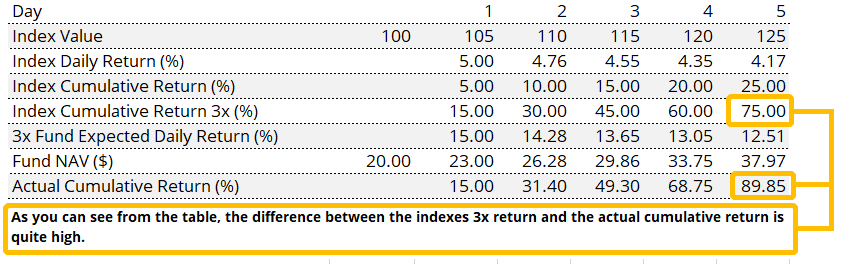
If a trader were to hold a leveraged ETF for a period longer than a single day in a steadily rising market, the fund's gains might potentially be more favorable than its stated daily goal, for that period.
The table illustrates this scenario. By studying the chart, you can see that with these exaggerated hypothetical daily index movements, the fund achieved its daily goal. You can also see that this trending market generated favorable compounding, which benefited the performance of the fund for this five-day period. In this example, the ETF gained 89.85%, which is more than 3X (75%) the 25% index gain for the period.
The Risks of Compounding - Market Declines Steadily
Market Declines Steadily
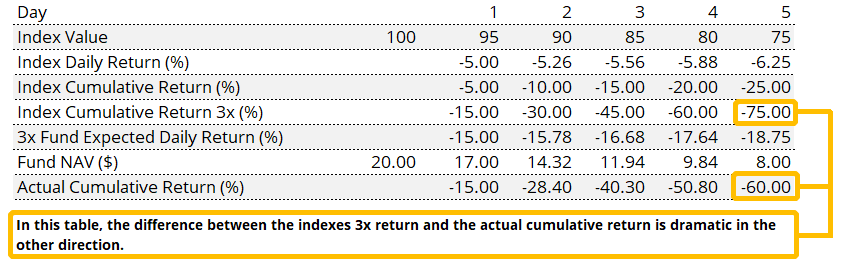
If a trader were to hold a leveraged ETF for a period longer than a single day in a steadily declining market, the fund's losses might potentially be less severe than its stated daily goal, for that period. The following table illustrates this scenario.
The table shows that, with these exaggerated hypothetical daily index movements, the fund achieved its daily goal. However, this downward trending market generated favorable compounding, which benefited the performance of the fund for this five-day period. In this example, the ETF lost -60.00%, which is less than 3X (-75%) the -25% index loss for the period.
The Risks of Compounding - Flat but Volatile Market
Market is Flat, Yet Volatile
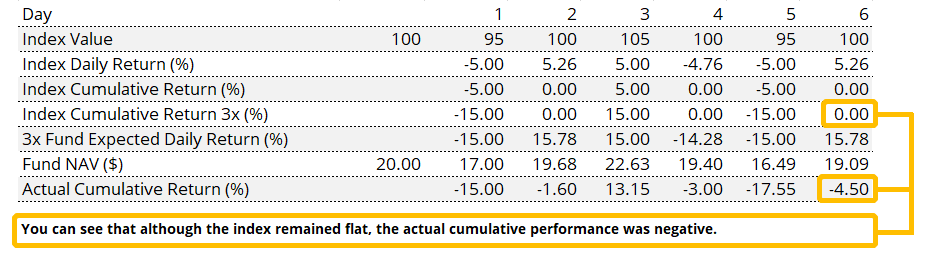
In volatile markets, the pursuit of daily investment goals will have a negative impact on the ETF's performance for periods longer than a single day, as illustrated in this final example.
When the market is experiencing volatile movements, a leveraged ETF that is required to reset its net assets to exposure ratio daily, will experience negative compounding and will not be able to keep up with the daily investment objectives for periods longer than a day.
The table illustrates an exaggerated hypothetical example where, for a six-day period, the index was flat (the index value is 100 initially and while volatile, ends at 100), but the fund lost 4.50% despite achieving its daily target each of those days.
To sum up, there are two critically important points that you should understand when using leveraged ETFs.
1. The performance of a leveraged ETF is based on the daily price performance of the underlying index.
2. Holding a leveraged ETF that has a daily objective of seeking a multiple of +/- 2X or +/- 3X of its underlying index for periods longer than a day will be impacted by the effects of compounding.
*These numbers do not reflect daily operating expenses and financing charges, are hypothetical in nature, and are not representative of any specific fund's returns. There is no guarantee the funds will achieve their objective.