'%3e %3cpath d='M41.7832962%2c0 C41.9459106%2c0 42.0882746%2c0.0866854658 42.1666825%2c0.216359069 C43.8289923%2c2.66540836 44.7676281%2c5.46271319 44.7676281%2c8.43208061 C44.7676281%2c18.1345746 34.7460532%2c26 22.383814%2c26 C10.0215749%2c26 0%2c18.1345746 0%2c8.43208061 C0%2c5.46716016 0.935826425%2c2.67378733 2.58829888%2c0.223985685 C2.67109477%2c0.0916264068 2.81687473%2c0 2.9840593%2c0 C3.23130408%2c0 3.43173558%2c0.200393004 3.43173558%2c0.447590303 C3.43173558%2c0.475056669 3.42926112%2c0.501945205 3.42452292%2c0.528045226 L3.41810883%2c0.550292077 C3.37800671%2c0.861741908 3.3575721%2c1.17661276 3.3575721%2c1.49443092 C3.3575721%2c7.98336 11.2132389%2c12.5742305 22.383814%2c12.5742305 C33.5543891%2c12.5742305 41.410056%2c7.98336 41.410056%2c1.49443092 C41.410056%2c1.17865223 41.3898828%2c0.865783153 41.3502888%2c0.556288325 C41.3402868%2c0.521941442 41.3356199%2c0.48531078 41.3356199%2c0.447590303 C41.3356199%2c0.200393004 41.5360514%2c0 41.7832962%2c0 Z' id='logo%e5%a4%87%e4%bb%bd-6' fill='white'%3e%3c/path%3e %3cpath d='M74.6899231%2c3.74404927 C75.2411227%2c3.74404927 75.7734299%2c3.66184338 76.2756219%2c3.50883715 L73.8159676%2c20.8666902 C73.5770593%2c22.5662954 72.8072434%2c23.0518969 71.4268838%2c23.0518969 L69.9934336%2c23.0518969 C68.7988917%2c23.0518969 68.1618027%2c22.458384 67.7901674%2c20.893668 L65.6930827%2c11.9909739 C65.639992%2c11.7481731 65.639992%2c11.6942174 65.5338105%2c11.6942174 C65.427629%2c11.6942174 65.4010836%2c11.7481731 65.3479929%2c11.9909739 L63.2509082%2c20.893668 C62.8792729%2c22.458384 62.2421839%2c23.0518969 61.047642%2c23.0518969 L59.6141918%2c23.0518969 C58.2338322%2c23.0518969 57.4640163%2c22.5662954 57.225108%2c20.8666902 L54.7463723%2c3.37406084 C55.3593498%2c3.61307396 56.0249975%2c3.74404927 56.7207458%2c3.74404927 C57.3314263%2c3.74404927 57.918917%2c3.64314414 58.4679557%2c3.4568446 L60.3574623%2c19.3829078 C60.3840076%2c19.6257086 60.3840076%2c19.7875757 60.4901891%2c19.7875757 C60.5963706%2c19.7875757 60.5963706%2c19.6257086 60.6494614%2c19.3829078 L62.9323637%2c9.91367858 C63.0916359%2c9.26620991 63.4632712%2c8.69967483 64.6047223%2c8.69967483 L66.4363532%2c8.69967483 C67.5778044%2c8.69967483 67.9494397%2c9.26620991 68.1087119%2c9.91367858 L70.3916142%2c19.3829078 C70.4447049%2c19.6257086 70.4447049%2c19.7875757 70.5508864%2c19.7875757 C70.6570679%2c19.7875757 70.6570679%2c19.6257086 70.6836133%2c19.3829078 L72.5891207%2c3.32292288 C73.2365902%2c3.59432921 73.9460524%2c3.74404927 74.6899231%2c3.74404927 Z' id='Combined-Shape' fill='white'%3e%3c/path%3e %3cpath d='M84.5933901%2c7.43171536 C88.6813779%2c7.43171536 90.9111894%2c10.2643908 90.9111894%2c14.2840921 L90.9111894%2c15.7948523 C90.9111894%2c16.2264981 90.7519172%2c16.4692988 90.3802819%2c16.4692988 L81.7264895%2c16.4692988 L81.7264895%2c16.5502324 C81.7264895%2c18.1149484 82.3635785%2c19.9764208 84.9119346%2c19.9764208 C86.849747%2c19.9764208 88.6813779%2c19.8145536 89.7962837%2c19.7066422 L89.8759198%2c19.7066422 C90.1413735%2c19.7066422 90.3537366%2c19.8415315 90.3537366%2c20.1113101 L90.3537366%2c21.8918489 C90.3537366%2c22.3234947 90.2741004%2c22.5123397 89.7962837%2c22.5932733 C88.0708343%2c22.9170076 87.0355646%2c23.0518969 84.6464808%2c23.0518969 C81.9919433%2c23.0518969 78.2225%2c21.5950924 78.2225%2c16.2804538 L78.2225%2c14.2840921 C78.2225%2c10.0755457 80.5319476%2c7.43171536 84.5933901%2c7.43171536 Z M84.5933901%2c10.5071915 C82.9475768%2c10.5071915 81.7530349%2c11.6942174 81.7530349%2c13.8254684 L81.7530349%2c13.9333799 L87.3806545%2c13.9333799 L87.3806545%2c13.8254684 C87.3806545%2c11.7211953 86.2392034%2c10.5071915 84.5933901%2c10.5071915 Z' id='Combined-Shape' fill='white'%3e%3c/path%3e %3cpath d='M97.4154906%2c2.98826245 L97.4148064%2c7.62056039 C98.3969853%2c7.48567108 99.3260735%2c7.43171536 99.9631625%2c7.43171536 C104.236968%2c7.43171536 106.307507%2c9.99461216 106.307507%2c14.2031585 L106.307507%2c16.2804538 C106.307507%2c20.4890001 104.236968%2c23.0518969 99.9631625%2c23.0518969 C98.2642584%2c23.0518969 96.2733553%2c22.7821183 94.627542%2c22.3504725 C94.0169984%2c22.1886054 93.9108169%2c22.0267382 93.9108169%2c21.6220703 L93.9098179%2c3.08694115 C94.4185466%2c3.24434375 94.9584615%2c3.32900525 95.5178331%2c3.32900525 C96.184659%2c3.32900525 96.8238351%2c3.20869291 97.4154906%2c2.98826245 Z M99.9631625%2c10.3453244 C99.3260735%2c10.3453244 98.1580769%2c10.4262579 97.4148064%2c10.5341694 L97.4148064%2c19.9494429 C97.9191686%2c20.0573544 99.007529%2c20.1382879 99.9631625%2c20.1382879 C102.246065%2c20.1382879 102.803518%2c18.4926384 102.803518%2c16.2804538 L102.803518%2c14.2031585 C102.803518%2c11.9909739 102.246065%2c10.3453244 99.9631625%2c10.3453244 Z' id='Combined-Shape' fill='white'%3e%3c/path%3e %3cpath d='M111.036668%2c8.72457747 C111.579488%2c8.72457747 112.103987%2c8.64485191 112.599444%2c8.49629404 L112.598761%2c16.5232546 C112.598761%2c19.3289521 113.607485%2c19.9764208 115.147117%2c19.9764208 L115.306389%2c19.9764208 C116.846021%2c19.9764208 117.854746%2c19.3289521 117.854746%2c16.5232546 L117.854207%2c8.4334735 C118.406525%2c8.62226395 118.997939%2c8.72457747 119.612866%2c8.72457747 C120.223332%2c8.72457747 120.810625%2c8.62374317 121.359498%2c8.43756894 L121.358735%2c16.5232546 C121.358735%2c22.4044283 116.872567%2c23.0518969 115.306389%2c23.0518969 L115.060464%2c23.0512514 C113.42215%2c23.0271041 109.094772%2c22.2994073 109.094772%2c16.5232546 L109.094446%2c8.36700801 C109.698522%2c8.59813531 110.353066%2c8.72457747 111.036668%2c8.72457747 Z' id='Combined-Shape' fill='white'%3e%3c/path%3e %3cpath d='M128.314162%2c3.03790128 L128.313623%2c22.269539 C128.313623%2c22.5662954 128.10126%2c22.836074 127.809261%2c22.836074 L125.340541%2c22.836074 C125.048542%2c22.836074 124.809634%2c22.5662954 124.809634%2c22.269539 L124.809455%2c3.04219481 C125.358161%2c3.22824247 125.945253%2c3.32900525 126.555503%2c3.32900525 C127.17043%2c3.32900525 127.761844%2c3.22669173 128.314162%2c3.03790128 Z' id='Combined-Shape' fill='white'%3e%3c/path%3e %3cpath d='M133.90653%2c3.32900525 C134.473329%2c3.32900525 135.02015%2c3.24208064 135.534793%2c3.08063296 L135.533966%2c22.269539 C135.533966%2c22.5662954 135.321603%2c22.836074 135.029603%2c22.836074 L132.560884%2c22.836074 C132.268884%2c22.836074 132.029976%2c22.5662954 132.029976%2c22.269539 L132.029909%2c2.99605058 C132.615669%2c3.21152525 133.2476%2c3.32900525 133.90653%2c3.32900525 Z' id='Combined-Shape' fill='white'%3e%3c/path%3e %3c/g%3e %3c/g%3e %3c/g%3e%3c/svg%3e)


Author: Jack Keating, CEO of Webull Tech US & Head of Institutional
1. “I’m excited—and a little bored”
Hello. I’m here today to talk to you about the future of digital investing and trading. To paint a picture of what brokerage is going to look like as the age of tokenization and agentic trading progresses.
My name is Jack Keating. I am the CEO of Webull Technologies Inc. I lead Webull’s Institutional Business and our AI Strategy. Webull is a fintech, broker dealer with over 40 million global users, regulatory approval to operate in over 30 markets, and offering investing into equities, options, futures, prediction markets, and digital assets to retail and institutional investors.
I’m extremely excited to talk to you today.
I’m also a little bored.
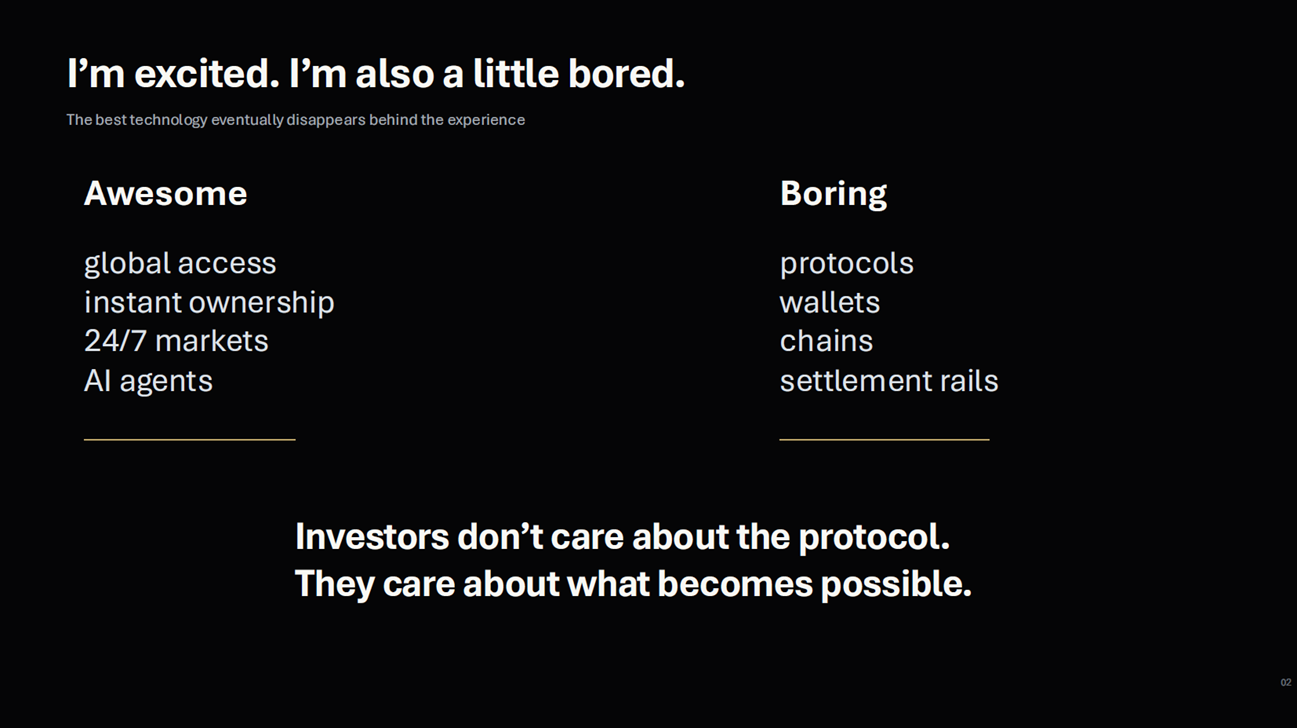
At a tokenization conference we are going to spend a lot of time talking about infrastructure and technology.
Blockchains, protocols, layers, smart contracts, Distributed Ledger Technology. Bitcoin, blockchain, and tokenization are great inventions. And we need to make sure we don’t fall prey to obsessing over product and failing to find market fit. Therefore, this talk has two sides.
The awesome side. What becomes possible with tokenization: global access, instant ownership, 24/7 markets, reduced counterparty credit risk, and AI agents trading around the clock.
The boring side. The machinery under the hood: protocols, wallets, chains, and settlement rails.
As we wade into this new age, both will matter.
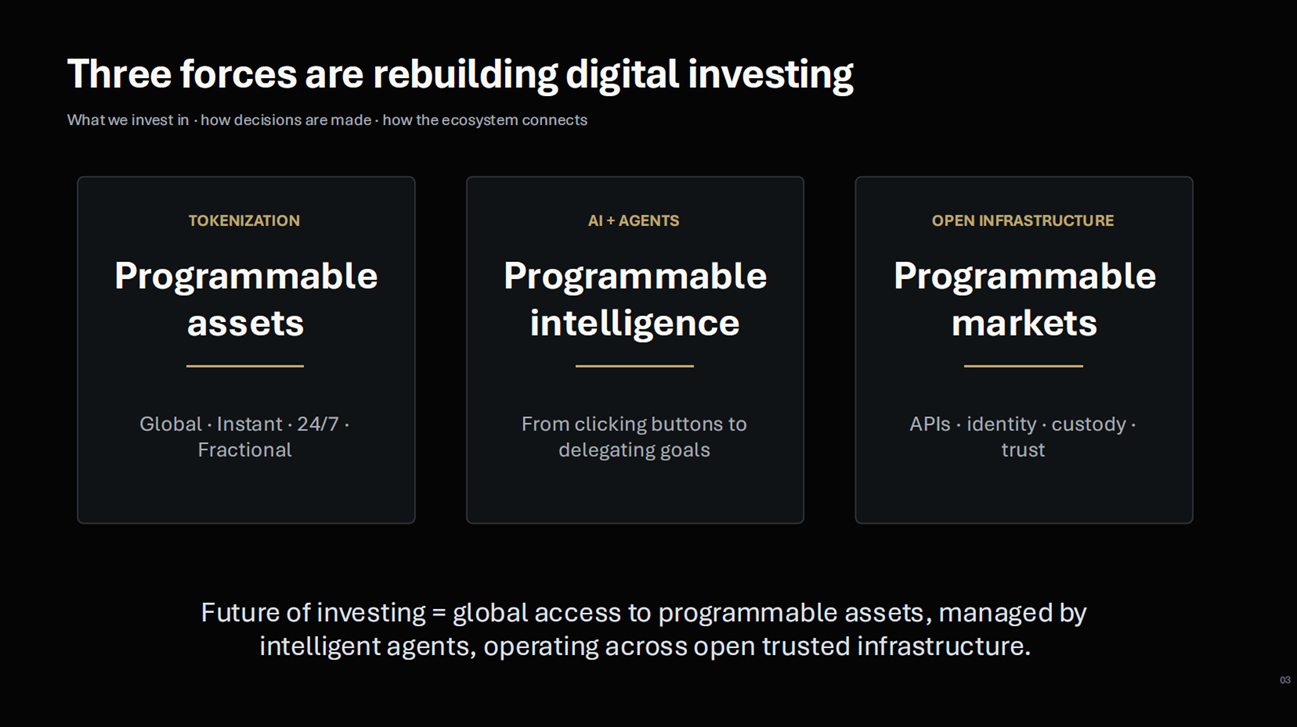
To set the backdrop. Modern brokerage is being impacted by three powerful forces that will eventually rebuild digital investing:
tokenization changes what we invest in;
AI and agents change how decisions are made; and
open, trusted infrastructure changes how the ecosystem connects.
The future of investing is global access to programmable assets, managed by intelligent agents, operating across open and trusted infrastructure.
The Awesome Part
2. We have seen this movie before: information went digital
I studied Philosophy at Boston College .... Go Eagles... and can’t help getting a bit metaphysical.
For thousands of years, information was stored in physical form.
Forty thousand years ago, men drew on cave walls.
Thirteen hundred years ago, Irish monks sat by candlelight painstakingly copying the Bible one page at a time.
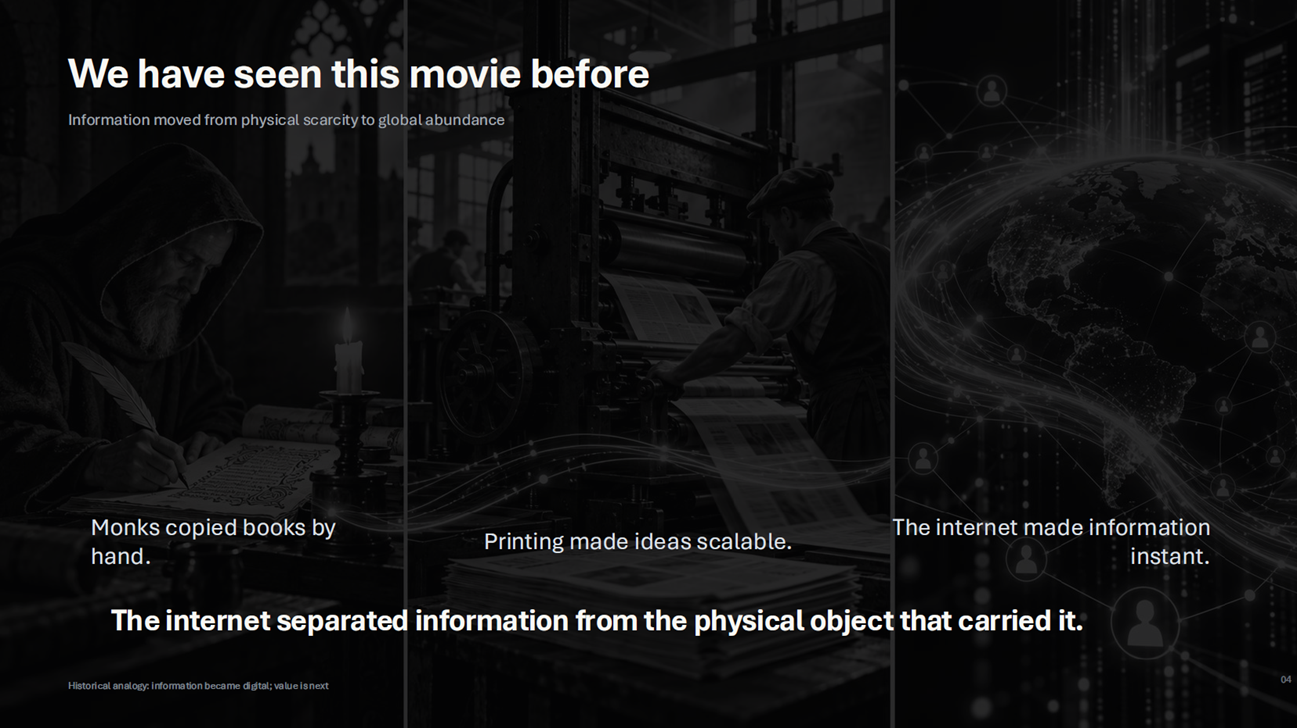
While the printing press allowed for information to be reproduced and distributed at scale, a physical component remained.
Then ... the internet. The Information Age. Digital information allowed for distribution:
Instant
Global
Free
The consequence of that change has been felt in every aspect of life.
One key concept is that in the Information Age, information shared on the Internet is authentic. It is as good as the real thing. In fact, it often is the real thing.
The internet did something extraordinary: it separated information from the physical object that historically carried it.
A brief history of brokerage:
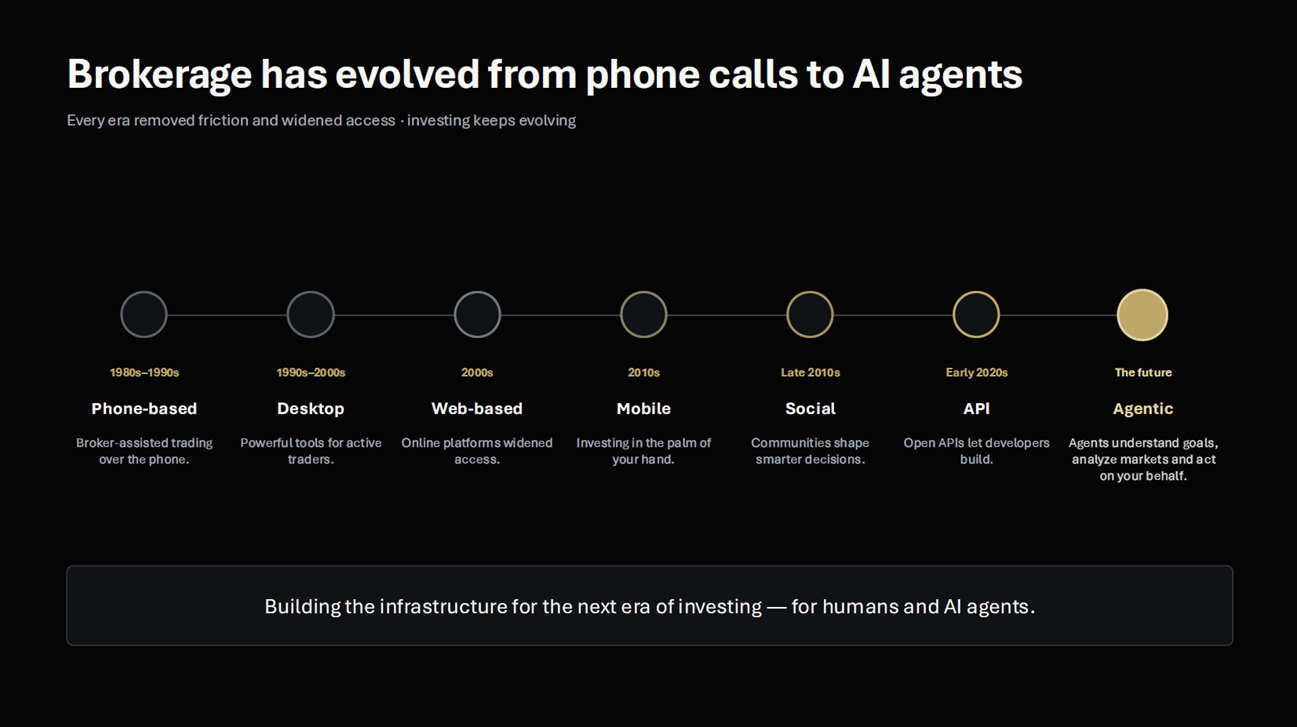
The history of modern brokerage is shorter.
We moved from paper tickets and phone-based trading, to desktop platforms, to the web, to mobile, to social investing, and on to open APIs.
Each era removed friction, reduced costs, and widened access.
Today, the era of tokenization and agentic trading is upon us.
With the internet, we digitized information. We also democratized access to investment services.
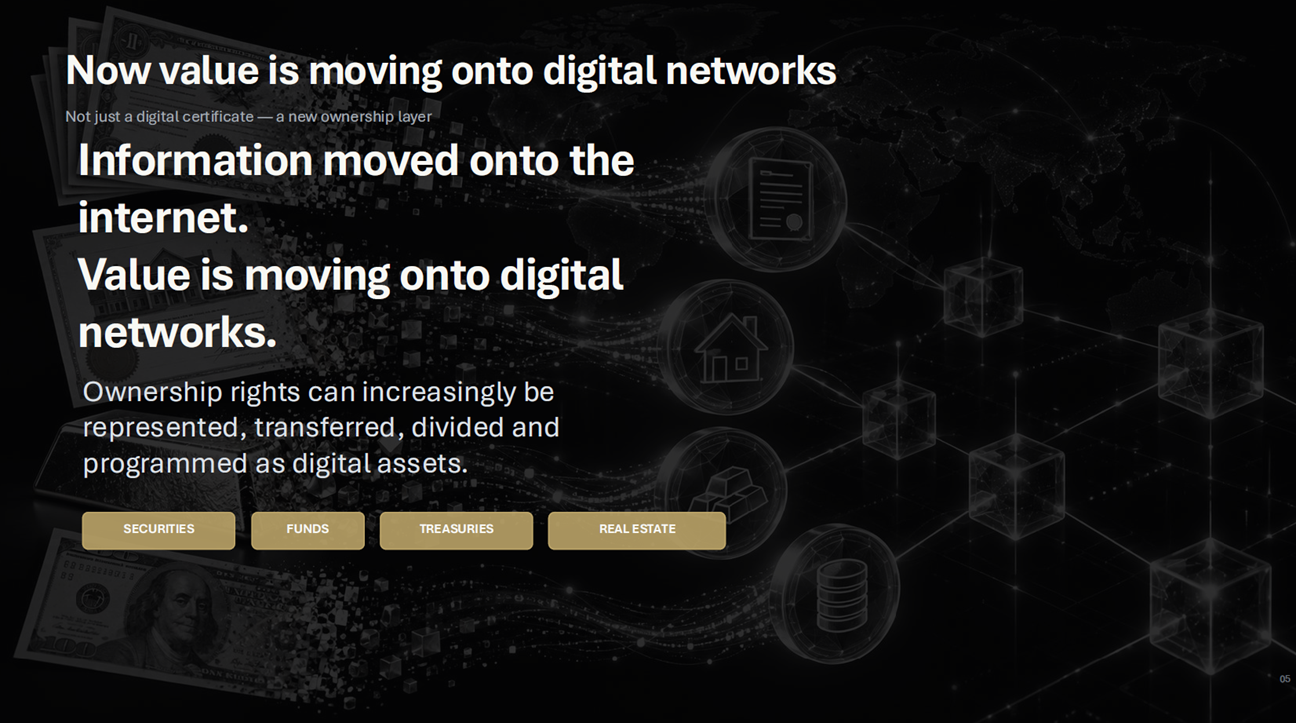
“Tokenization is doing something similar for value.”
Money, securities, funds, Treasuries, real estate, private companies and other ownership rights can increasingly be represented, transferred, fractionalized, and programmed as digital assets. This is not merely a digital certificate. It is the beginning of a new ownership layer.
The fundamental property rights shift of holding the IOU to holding the thing itself.
“Information moved onto the internet. Now value is moving onto digital networks.”
3. Tokenization changes the properties of ownership
So, why should we do it? What is so great about tokenization ?
For brokerage, tokenization presents an opportunity to upgrade the financial rails.
Brokerage back offices have been tortured by legacy protocols. ACATs. ACH. DWAC. Wires. DRS. NACHA. 2 Day Settlement. The list is long. Tokenization is an opportunity to upgrade to an entirely new infrastructure.
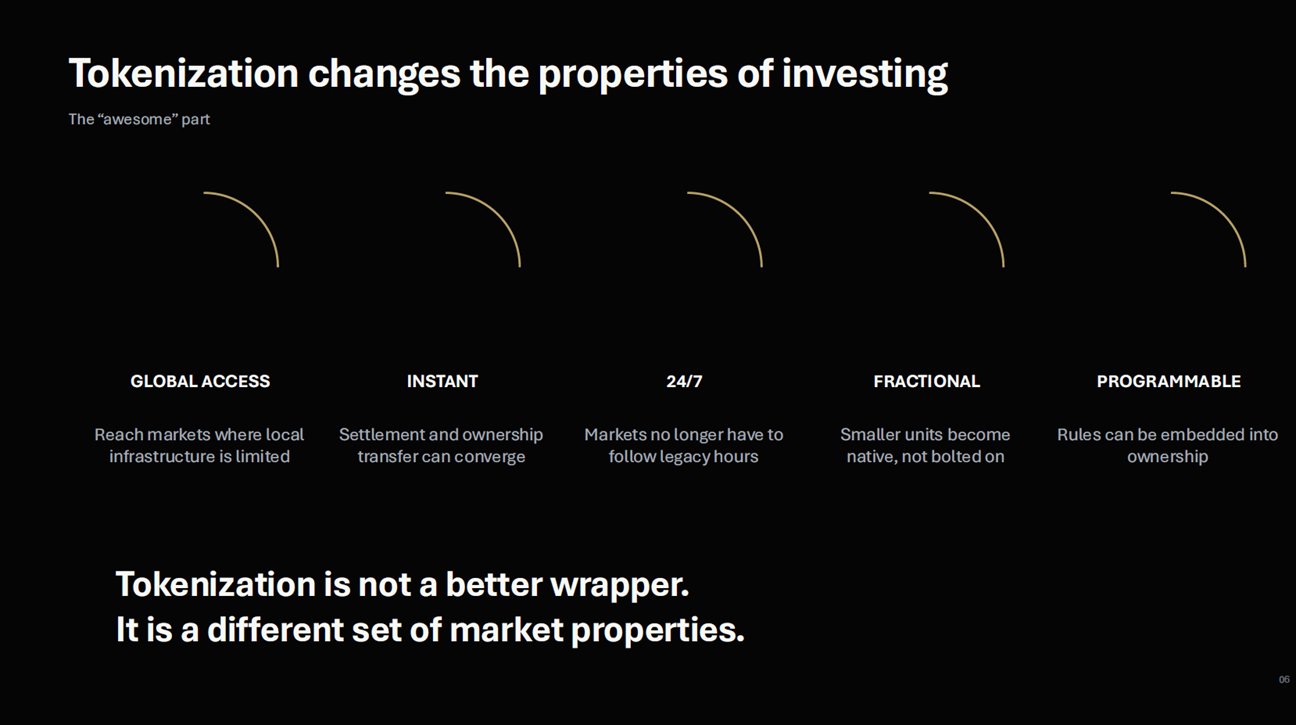
Digital investing on tokenized infrastructure introduces five defining properties:
a. global access,
b. instant settlement,
c. 24/7 availability,
d. native fractionalization and
e. programmable ownership.
Portability is an important consequence of this new ownership layer, but the central point is that tokenization does not simply improve the wrapper around an asset—it changes the properties of the market itself.
Let’s walk through each one.
A. Global
Someone living in a mature market generally has access to:
Regulated brokerage accounts
Stable banking infrastructure
Public markets
Government bonds
Funds
Sophisticated custody infrastructure
Someone elsewhere may live in a country with:
Little or no brokerage infrastructure
Weak capital markets
Limited investment products
Currency instability or hyperinflation
Restrictions on global investments
A financial system they may not fully trust
Today, geography often determines financial opportunities.
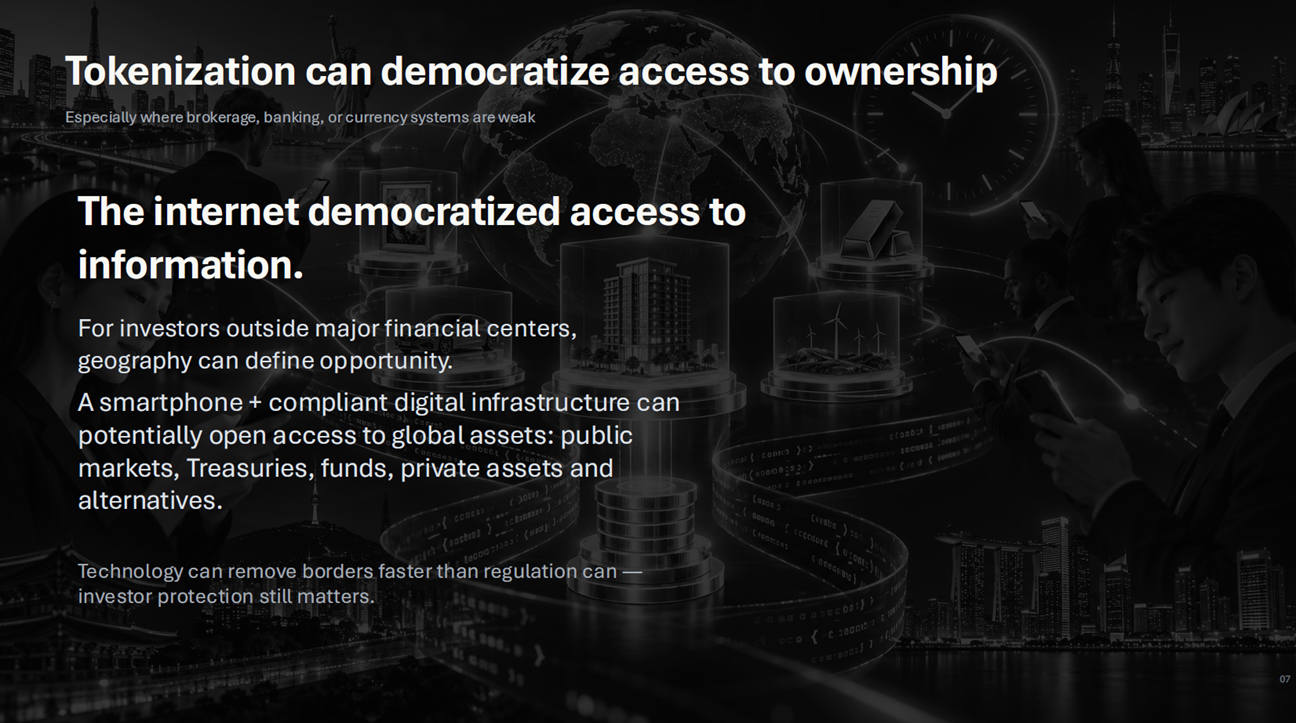
Further, the types of products available to investors remain constrained by lines on a map. Investing in a foreign security often comes with rigid, region-specific requirements. Data privacy, custody, etc.
Alignment around tokenized financial infrastructure can dramatically reduce some of those distribution barriers.
Tokenization is a path to a single, global financial infrastructure.
Imagine a single account where an investor -- or maybe their agent -- can swiftly move across asset classes and geographies: selling USDC, buying Bitcoin, borrowing against Apple stock, recalling assets from a DEFI yield product, liquidating a real estate token, buying an STO-interest in Samsung, all through a single account.
In the future, a person with a smartphone will be able to interact with markets without having to navigate the nightmarish user experience of a dozen accounts, transfer delays, and high costs.
We have already seen how blockchain-based finance can open markets where traditional financial infrastructure was limited. In countries such as Nigeria, a smartphone became an entry point into digital assets and blockchain-based financial services. The larger lesson is not that every investor should use crypto. It is that when the local rails are incomplete, people will be quick to adopt a new rail if it gives them access, portability and greater control.
“The internet democratized access to information. Tokenization has the potential to democratize access to ownership.”
That does not mean regulation disappears. Securities laws, investor protections, sanctions, identity requirements and jurisdictional rules still matter. Technology can remove technological borders much faster than governments remove regulatory ones.
Direct token distribution can initially serve as a shortcut, but the scalable model ultimately has to coexist with regulation.
B. Instant Settlement
Today, trade execution, matching, confirmation, settlement, and final transfer of ownership are distinct processes. Significant resources are required within brokers, exchanges, clearinghouses, and other market participants to reconcile those books.
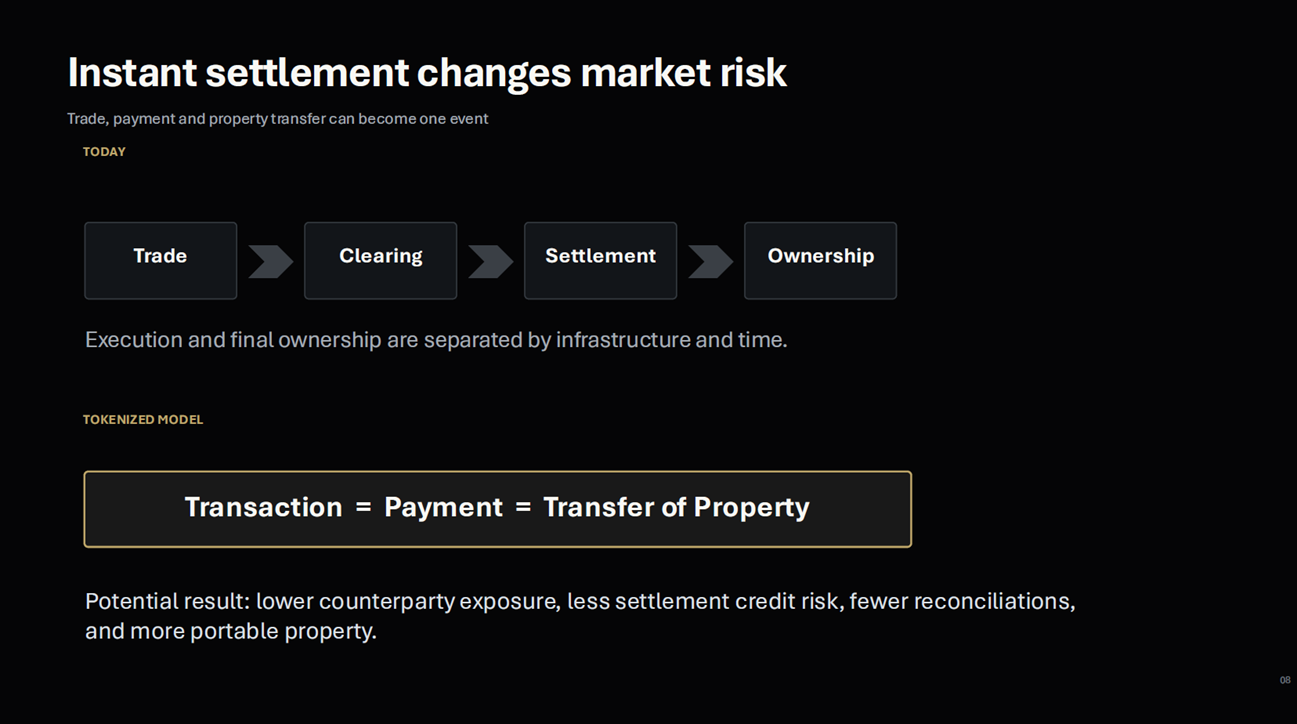
DKs. Multi-day settlement periods. 3-5 days for an ACH to move cash from one account to another.
Much of market infrastructure exists because these key processes occur separately. As we shift toward 24 x7 it becomes more challenging to compress the old processes running on old infrastructure into tighter schedules.
Some of the best businesses are middle men. Connecting buyers and sellers. Delivering liquidity. While the best technology often disintermediates a system. Tokenization offers both.
For financial transactions, blockchain makes another architecture possible:
Transaction + payment + transfer of property = one event.
That means potentially:
Instant ownership
Instant payment
Less counterparty exposure
Less settlement credit risk
Less reconciliation
Less capital trapped between institutions
“Today we trade at internet speed but settle through infrastructure designed for another era.”
Tokenization can be the unlock to close that gap.
C. Markets become 24/7
Traditional market hours are largely a function of legacy market structure.
The internet doesn't close at 4 p.m.
Blockchain doesn't go home for the weekend.
And an investor in Seoul shouldn't necessarily have to organize their financial life around New York's working day.
A lot of people are hanging the killer use case on 24/7.
TradFi markets, including BRUCE and BOATS, have already delivered overnight access to US equities. Just yesterday, BRUCE , announced plans for 24 by 7 trading.
“Global markets ultimately want global market hours. Tokenization is one path to round the clock trading.”
D. Fractionalization becomes the default
Traditional finance asks: “Can we fractionalize this asset?”
Tokenization may invert the question: “Why wouldn't this asset be fractional?”
A million-dollar asset can be divided into thousands or millions of economic units.
That matters enormously for:
Private companies
Real estate
Private credit
Funds
Infrastructure
Alternative assets
Fractionalization + global distribution is particularly powerful.
It simultaneously reduces the minimum investment and increases the potential investor population.
E. Ownership becomes programmable
Smart contracts can potentially embed rules into the asset:
Dividends
Interest
Voting
Vesting
Transfer restrictions
Eligibility
Collateral
Corporate actions
Revenue sharing
“The breakthrough here is that ownership becomes programmable.”
Through the tokenization software upgrade, we unlock:
global access,
instant settlement,
24/7 availability,
native fractionalization and
programmable ownership.
“Put those characteristics together and we aren't simply improving today's securities market. We are starting to create a different kind of market.”
Part II — AI: When Programmable Assets Meet Intelligent Agents
4. The investor is becoming digital too
“There is another transformation happening at exactly the same time. Assets are becoming programmable—and investors are gaining intelligent agents.”
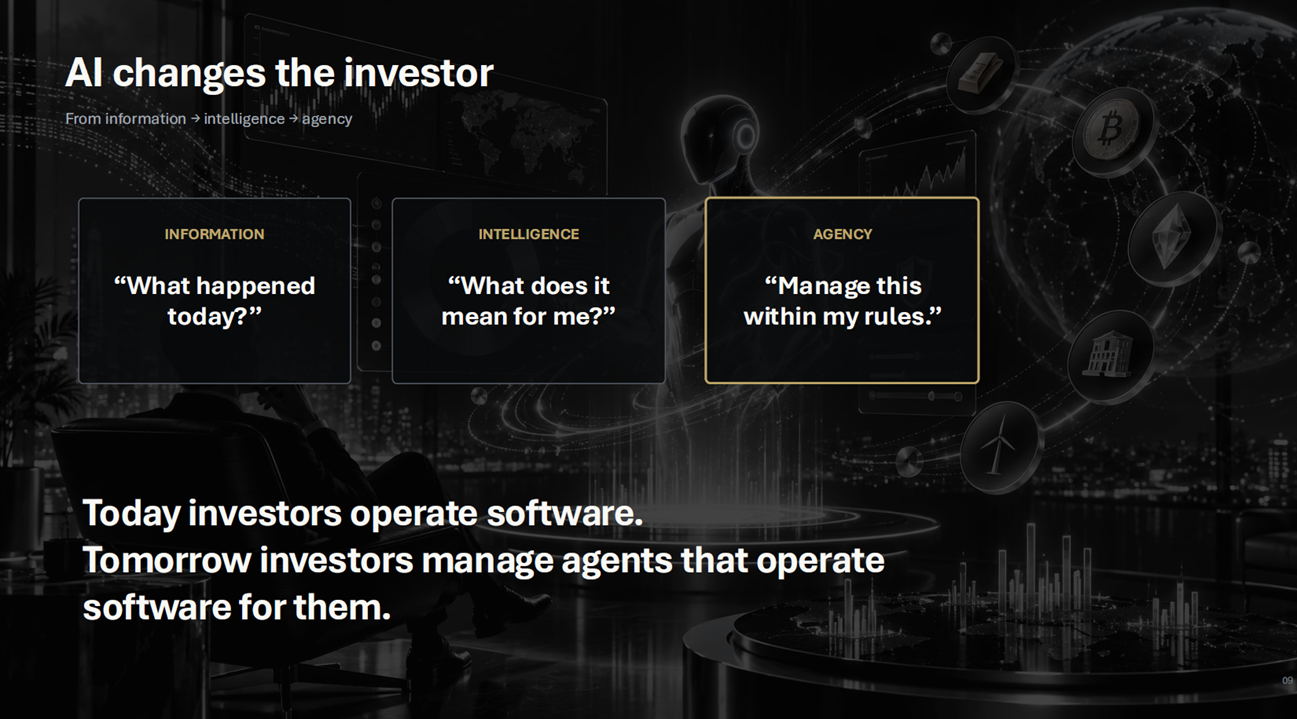
The next forum of battle in the retail broker war is happening within API and agentic trading. Investors and traders will spend less time in point and click trading interfaces and rely more on agents.
AI has evolved rapidly.
Information → Intelligence → Agency
First: “What happened to this stock today?”
Then: “What does this mean for my portfolio?”
Next: “Manage my portfolio within these rules.”
That is the leap from AI assistant to AI agent.
“Maintain six months of liquidity. Keep my risk moderate. Don't let any position exceed 10%. Minimize unnecessary taxes. Give me diversified exposure to global growth. And notify me before making anything outside these parameters.”
The agent can:
monitor → analyze → recommend → execute → rebalance → manage risk.
“Today investors operate software. Tomorrow investors will increasingly manage agents that operate software for them.”
5. Tokenization + AI is where this gets really interesting
The intersection of tokenization and AI is where sparks start to fly.
AI agents:
Don't sleep
Don't care what time zone they're in
Can process enormous amounts of information
Can continuously monitor portfolios
Tokenized assets:
Can span global markets
Trade 24/7
Settle immediately
Can be fractional
Can be programmable
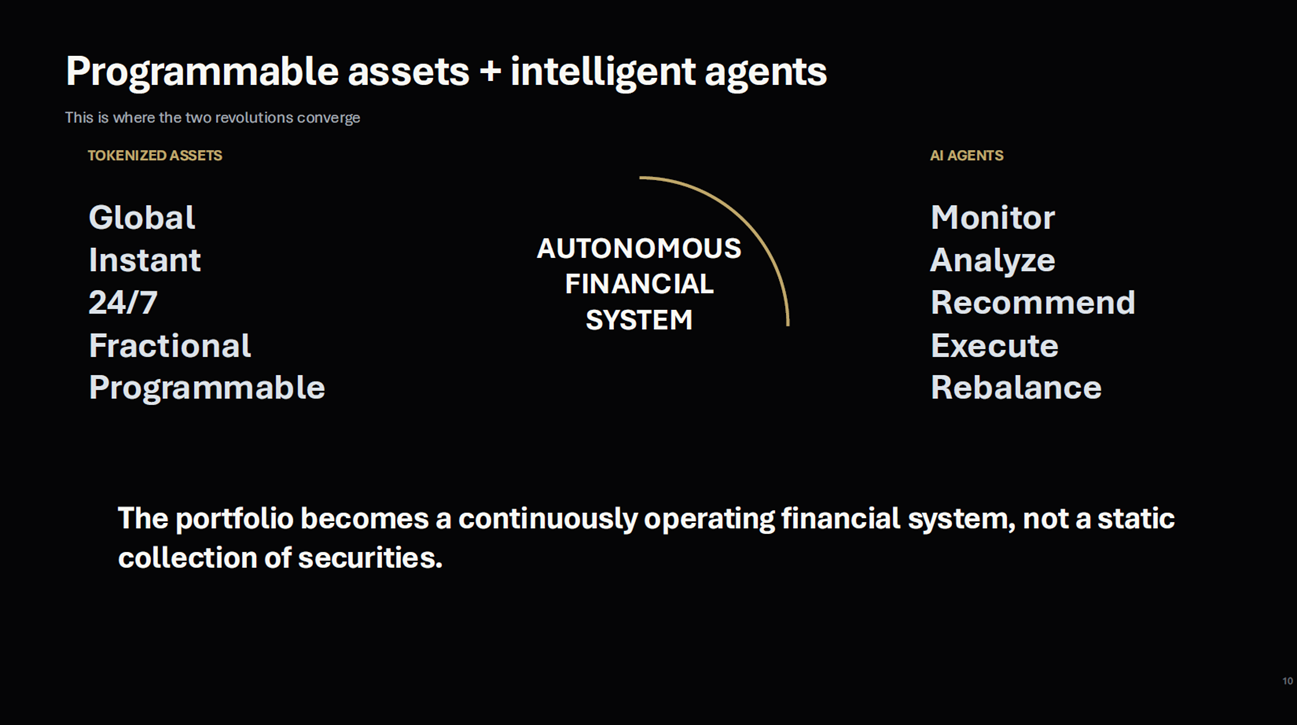
These changes will not simply automate the way markets operate today. Intelligent agents can increase trading volume, autonomously move across asset classes, optimize for tax, or rebalance portfolios continuously. That means more decisions, more transactions, and more interaction among markets that historically operated on separate schedules and systems.
Pairing tokenization and agentic trading. Imagine an agent continuously allocating capital among:
public equities, Treasuries, private assets, tokenized funds, commodities, cash, crypto and other instruments.
“A portfolio stops being a static collection of securities that a human periodically reviews. It becomes a continuously operating financial system.”
Part III — The “Boring Talk”
6. Users don't care about blockchain
“This is the boring slide.”
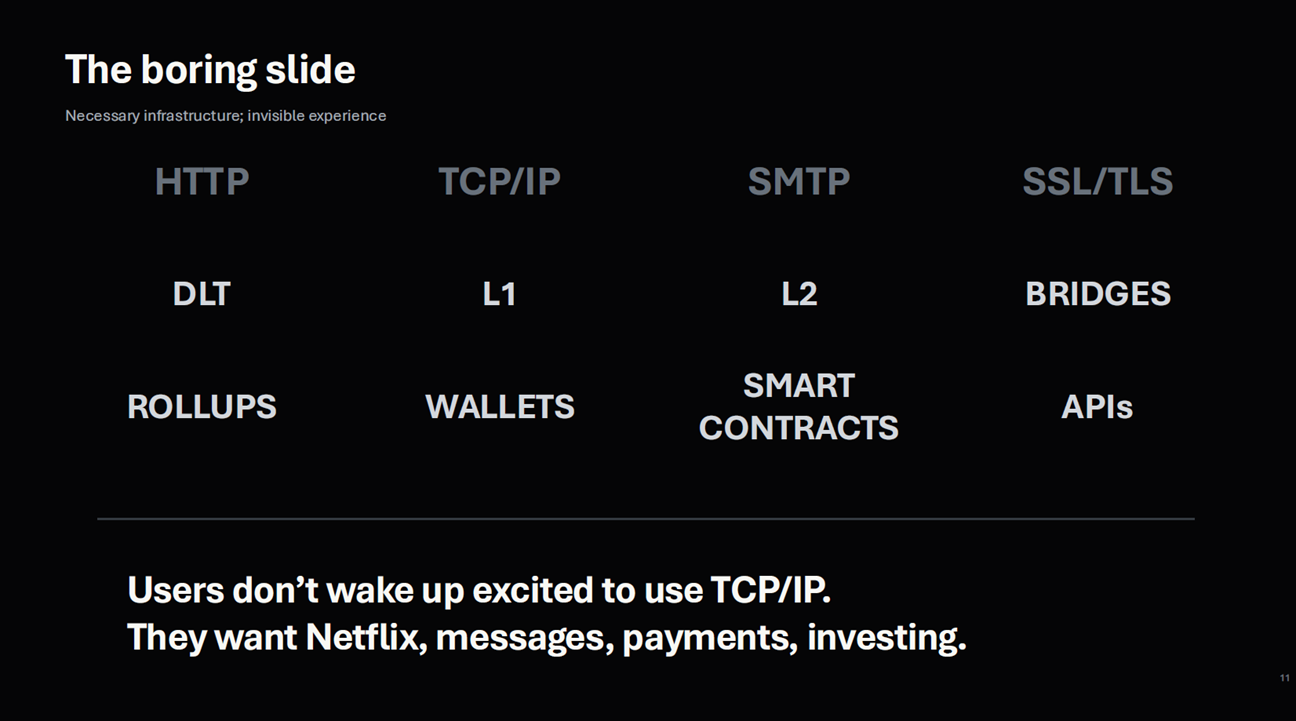
Engineers care deeply about these things. They should. The people building the infrastructure need to care passionately about protocols.
Operators, they care less, but are still interested.
Users, clients, consumers? Traders? “They don't care.”
Management cares. Because the entire financial services industry is built on trust.
Almost nobody wakes up and says: “I can't wait to use TCP/IP today.”
They say: “I want to watch Netflix.”
Or: “I want to send someone a message.”
Or: “I want to buy something.”
The internet became widely adopted when the technology disappeared behind the experience.
Blockchain will likely be similar. People don't fundamentally want a tokenized security. What they want is:
Better access
Lower costs
Faster settlement
More investment choices
Global markets
Better liquidity
Easier movement of their assets
The winning blockchain experience may eventually be the one where the customer doesn't even know—or care—that they are using blockchain.
7. The third pillar: Trust + interoperability
The third critical element isn't another technology. It's trusted, open financial infrastructure.
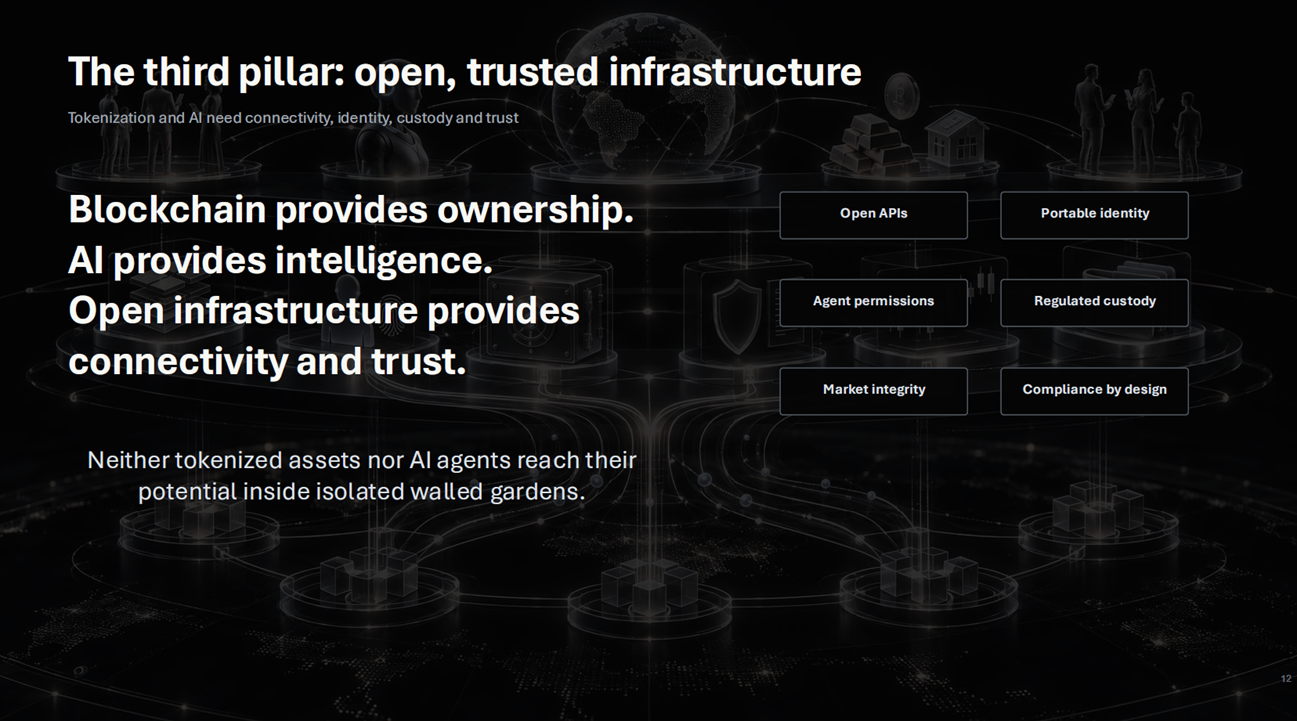
Tokenization gives us programmable assets.
AI gives us intelligent agents.
But neither achieves its full potential if everything lives inside isolated walled gardens.
The future needs:
Open APIs
Interoperable assets
Portable identity
Permission systems for AI agents
Regulated custody
Global connectivity
Investor protection
This is also where traditional financial institutions continue to matter.
Blockchain can replace or compress certain functions.
It does not eliminate the fundamental needs for: identity, trust, compliance, risk management, custody and market integrity.
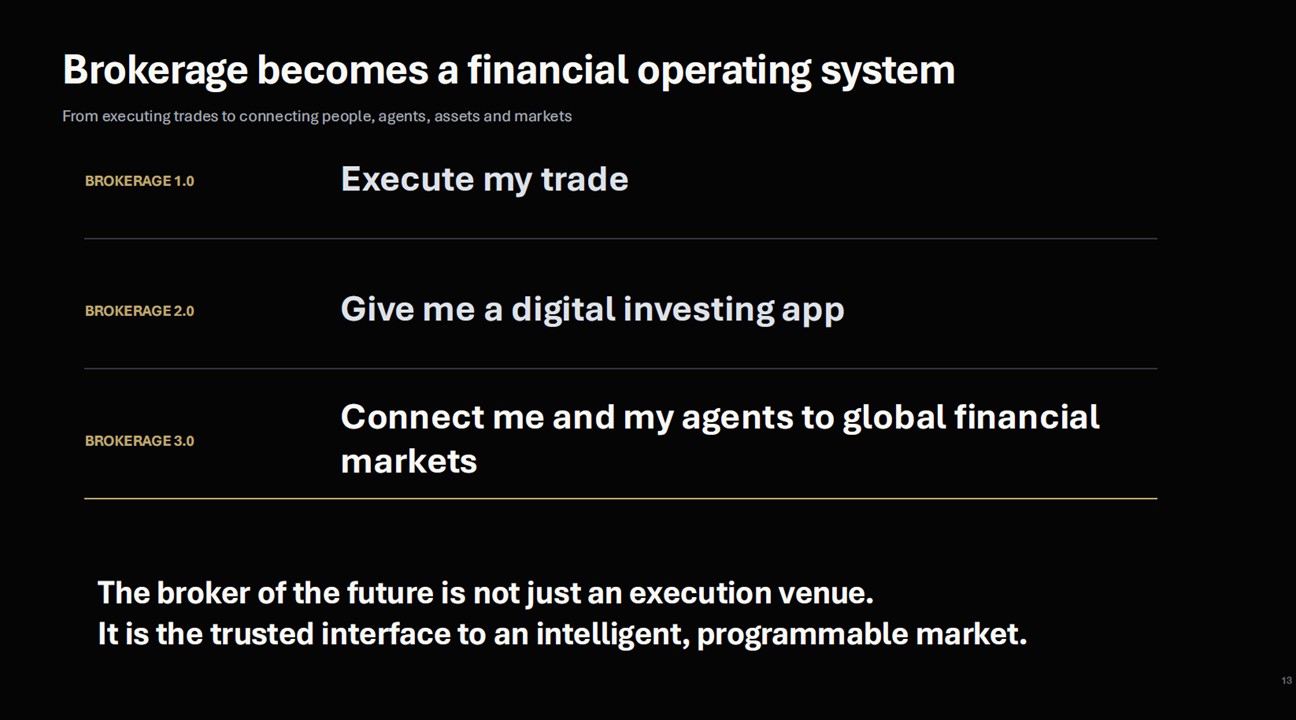
Brokerage continues to evolve:
Brokerage 1.0: Execute my trade.
Brokerage 2.0: Give me a great digital investing app.
Brokerage 3.0: Connect me—and my agents—to the global financial system.
“The broker of the future isn't simply an execution venue. It becomes a financial operating system.”
While we are on the topic of trust, I want to emphasize the importance in this new technology. We all witnessed the missteps taken by the crypto industry.
No one takes advantage of a crisis like a regulator. Should these private tokenization projects go the way of Celsius Lending Protocol, government and regulators will leverage the opportunity to centralize.
As stewards of fintech, there is an onus on us to not let greed overtake our reason.
8. Closing: From Brokerage to Blockchain
1300 hundred years ago, information was copied by hand.
The internet made information instant and global.
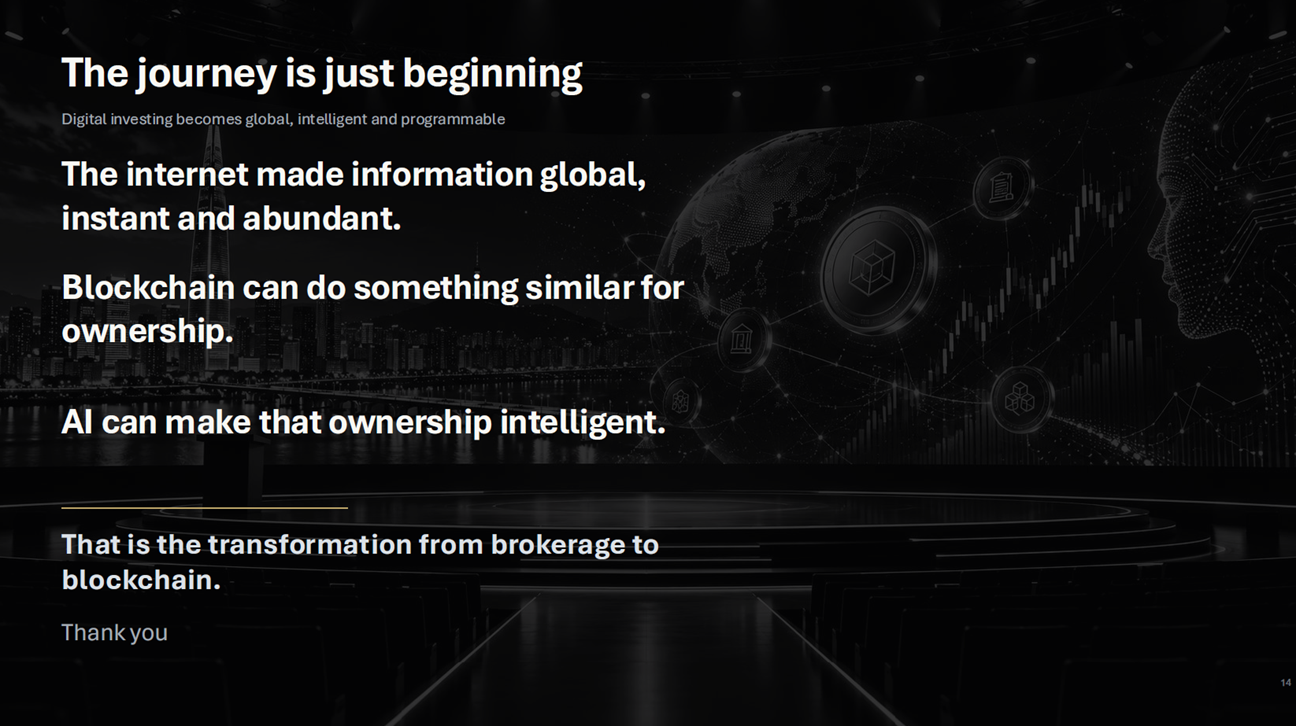
Looking ahead:
Tokenization changes the assets.
Global. Instant. Fractional. 24/7. Programmable.
AI changes how investment decisions are made. From clicking buttons to managing intelligent agents.
Open, trusted infrastructure connects the two. Allowing people, agents, assets and markets to interact globally.
Picture an investor in the near future:
"Protect my family. Maintain sufficient liquidity. Grow my wealth over the next 20 years. Give me access to the best opportunities globally. Manage my risk.”
The investor doesn't need to understand the blockchain. They don't need to understand the API. They don't need to understand the settlement architecture.
They care about the outcome.
To Conclude
The internet made information global, instant and abundant. Blockchain can do something similar for ownership. AI can make that ownership intelligent. And together they may transform investing from a collection of transactions into a global, autonomous financial system.
That is the journey from brokerage to blockchain.
Disclaimers:
Webull Financial LLC, Member SIPC, FINRA. Investing involves risk. More info at www.webull.com/policy.
The Webull OpenAPI and MCP Server are provided "as is" without warranty of any kind and do not constitute investment advice. All trading involves a substantial risk of loss. By utilizing these tools, you acknowledge that Al-driven agents may misinterpret instructions, act on delayed data, or perform poorly under certain market conditions. Webull assumes no liability for losses resulting from automated or Al-directed decisions. You are solely responsible for verifying all order details prior to execution, actively monitoring your positions, and ensuring that any connected agents, algorithms, or tools operate exactly as intended.
