'%3e %3cpath d='M41.7832962%2c0 C41.9459106%2c0 42.0882746%2c0.0866854658 42.1666825%2c0.216359069 C43.8289923%2c2.66540836 44.7676281%2c5.46271319 44.7676281%2c8.43208061 C44.7676281%2c18.1345746 34.7460532%2c26 22.383814%2c26 C10.0215749%2c26 0%2c18.1345746 0%2c8.43208061 C0%2c5.46716016 0.935826425%2c2.67378733 2.58829888%2c0.223985685 C2.67109477%2c0.0916264068 2.81687473%2c0 2.9840593%2c0 C3.23130408%2c0 3.43173558%2c0.200393004 3.43173558%2c0.447590303 C3.43173558%2c0.475056669 3.42926112%2c0.501945205 3.42452292%2c0.528045226 L3.41810883%2c0.550292077 C3.37800671%2c0.861741908 3.3575721%2c1.17661276 3.3575721%2c1.49443092 C3.3575721%2c7.98336 11.2132389%2c12.5742305 22.383814%2c12.5742305 C33.5543891%2c12.5742305 41.410056%2c7.98336 41.410056%2c1.49443092 C41.410056%2c1.17865223 41.3898828%2c0.865783153 41.3502888%2c0.556288325 C41.3402868%2c0.521941442 41.3356199%2c0.48531078 41.3356199%2c0.447590303 C41.3356199%2c0.200393004 41.5360514%2c0 41.7832962%2c0 Z' id='logo%e5%a4%87%e4%bb%bd-6' fill='white'%3e%3c/path%3e %3cpath d='M74.6899231%2c3.74404927 C75.2411227%2c3.74404927 75.7734299%2c3.66184338 76.2756219%2c3.50883715 L73.8159676%2c20.8666902 C73.5770593%2c22.5662954 72.8072434%2c23.0518969 71.4268838%2c23.0518969 L69.9934336%2c23.0518969 C68.7988917%2c23.0518969 68.1618027%2c22.458384 67.7901674%2c20.893668 L65.6930827%2c11.9909739 C65.639992%2c11.7481731 65.639992%2c11.6942174 65.5338105%2c11.6942174 C65.427629%2c11.6942174 65.4010836%2c11.7481731 65.3479929%2c11.9909739 L63.2509082%2c20.893668 C62.8792729%2c22.458384 62.2421839%2c23.0518969 61.047642%2c23.0518969 L59.6141918%2c23.0518969 C58.2338322%2c23.0518969 57.4640163%2c22.5662954 57.225108%2c20.8666902 L54.7463723%2c3.37406084 C55.3593498%2c3.61307396 56.0249975%2c3.74404927 56.7207458%2c3.74404927 C57.3314263%2c3.74404927 57.918917%2c3.64314414 58.4679557%2c3.4568446 L60.3574623%2c19.3829078 C60.3840076%2c19.6257086 60.3840076%2c19.7875757 60.4901891%2c19.7875757 C60.5963706%2c19.7875757 60.5963706%2c19.6257086 60.6494614%2c19.3829078 L62.9323637%2c9.91367858 C63.0916359%2c9.26620991 63.4632712%2c8.69967483 64.6047223%2c8.69967483 L66.4363532%2c8.69967483 C67.5778044%2c8.69967483 67.9494397%2c9.26620991 68.1087119%2c9.91367858 L70.3916142%2c19.3829078 C70.4447049%2c19.6257086 70.4447049%2c19.7875757 70.5508864%2c19.7875757 C70.6570679%2c19.7875757 70.6570679%2c19.6257086 70.6836133%2c19.3829078 L72.5891207%2c3.32292288 C73.2365902%2c3.59432921 73.9460524%2c3.74404927 74.6899231%2c3.74404927 Z' id='Combined-Shape' fill='white'%3e%3c/path%3e %3cpath d='M84.5933901%2c7.43171536 C88.6813779%2c7.43171536 90.9111894%2c10.2643908 90.9111894%2c14.2840921 L90.9111894%2c15.7948523 C90.9111894%2c16.2264981 90.7519172%2c16.4692988 90.3802819%2c16.4692988 L81.7264895%2c16.4692988 L81.7264895%2c16.5502324 C81.7264895%2c18.1149484 82.3635785%2c19.9764208 84.9119346%2c19.9764208 C86.849747%2c19.9764208 88.6813779%2c19.8145536 89.7962837%2c19.7066422 L89.8759198%2c19.7066422 C90.1413735%2c19.7066422 90.3537366%2c19.8415315 90.3537366%2c20.1113101 L90.3537366%2c21.8918489 C90.3537366%2c22.3234947 90.2741004%2c22.5123397 89.7962837%2c22.5932733 C88.0708343%2c22.9170076 87.0355646%2c23.0518969 84.6464808%2c23.0518969 C81.9919433%2c23.0518969 78.2225%2c21.5950924 78.2225%2c16.2804538 L78.2225%2c14.2840921 C78.2225%2c10.0755457 80.5319476%2c7.43171536 84.5933901%2c7.43171536 Z M84.5933901%2c10.5071915 C82.9475768%2c10.5071915 81.7530349%2c11.6942174 81.7530349%2c13.8254684 L81.7530349%2c13.9333799 L87.3806545%2c13.9333799 L87.3806545%2c13.8254684 C87.3806545%2c11.7211953 86.2392034%2c10.5071915 84.5933901%2c10.5071915 Z' id='Combined-Shape' fill='white'%3e%3c/path%3e %3cpath d='M97.4154906%2c2.98826245 L97.4148064%2c7.62056039 C98.3969853%2c7.48567108 99.3260735%2c7.43171536 99.9631625%2c7.43171536 C104.236968%2c7.43171536 106.307507%2c9.99461216 106.307507%2c14.2031585 L106.307507%2c16.2804538 C106.307507%2c20.4890001 104.236968%2c23.0518969 99.9631625%2c23.0518969 C98.2642584%2c23.0518969 96.2733553%2c22.7821183 94.627542%2c22.3504725 C94.0169984%2c22.1886054 93.9108169%2c22.0267382 93.9108169%2c21.6220703 L93.9098179%2c3.08694115 C94.4185466%2c3.24434375 94.9584615%2c3.32900525 95.5178331%2c3.32900525 C96.184659%2c3.32900525 96.8238351%2c3.20869291 97.4154906%2c2.98826245 Z M99.9631625%2c10.3453244 C99.3260735%2c10.3453244 98.1580769%2c10.4262579 97.4148064%2c10.5341694 L97.4148064%2c19.9494429 C97.9191686%2c20.0573544 99.007529%2c20.1382879 99.9631625%2c20.1382879 C102.246065%2c20.1382879 102.803518%2c18.4926384 102.803518%2c16.2804538 L102.803518%2c14.2031585 C102.803518%2c11.9909739 102.246065%2c10.3453244 99.9631625%2c10.3453244 Z' id='Combined-Shape' fill='white'%3e%3c/path%3e %3cpath d='M111.036668%2c8.72457747 C111.579488%2c8.72457747 112.103987%2c8.64485191 112.599444%2c8.49629404 L112.598761%2c16.5232546 C112.598761%2c19.3289521 113.607485%2c19.9764208 115.147117%2c19.9764208 L115.306389%2c19.9764208 C116.846021%2c19.9764208 117.854746%2c19.3289521 117.854746%2c16.5232546 L117.854207%2c8.4334735 C118.406525%2c8.62226395 118.997939%2c8.72457747 119.612866%2c8.72457747 C120.223332%2c8.72457747 120.810625%2c8.62374317 121.359498%2c8.43756894 L121.358735%2c16.5232546 C121.358735%2c22.4044283 116.872567%2c23.0518969 115.306389%2c23.0518969 L115.060464%2c23.0512514 C113.42215%2c23.0271041 109.094772%2c22.2994073 109.094772%2c16.5232546 L109.094446%2c8.36700801 C109.698522%2c8.59813531 110.353066%2c8.72457747 111.036668%2c8.72457747 Z' id='Combined-Shape' fill='white'%3e%3c/path%3e %3cpath d='M128.314162%2c3.03790128 L128.313623%2c22.269539 C128.313623%2c22.5662954 128.10126%2c22.836074 127.809261%2c22.836074 L125.340541%2c22.836074 C125.048542%2c22.836074 124.809634%2c22.5662954 124.809634%2c22.269539 L124.809455%2c3.04219481 C125.358161%2c3.22824247 125.945253%2c3.32900525 126.555503%2c3.32900525 C127.17043%2c3.32900525 127.761844%2c3.22669173 128.314162%2c3.03790128 Z' id='Combined-Shape' fill='white'%3e%3c/path%3e %3cpath d='M133.90653%2c3.32900525 C134.473329%2c3.32900525 135.02015%2c3.24208064 135.534793%2c3.08063296 L135.533966%2c22.269539 C135.533966%2c22.5662954 135.321603%2c22.836074 135.029603%2c22.836074 L132.560884%2c22.836074 C132.268884%2c22.836074 132.029976%2c22.5662954 132.029976%2c22.269539 L132.029909%2c2.99605058 C132.615669%2c3.21152525 133.2476%2c3.32900525 133.90653%2c3.32900525 Z' id='Combined-Shape' fill='white'%3e%3c/path%3e %3c/g%3e %3c/g%3e %3c/g%3e%3c/svg%3e)



Jev is a new class of AI model purpose-built for fast, structured decisions, not conversation. As AI decision model for trading automation gains traction among developers and active traders, understanding what Jev actually does, how it differs from large language models (LLMs), and where it fits into a real trading workflow has become an essential starting point for anyone exploring algorithmic strategies in US markets.
Key Takeaways
Jev is a System One decision model from TypeSafe AI that returns typed outputs, not generated text, in 70 to 500 milliseconds.
It supports three output types: Choice (category selection), Score (numeric rating), and Noul (yes/no probability).
Pricing is $0.042 per million input tokens, with output tokens free of charge.
Jev has been used in live trading applications including forex decision auditing, market-making bots, and real-time signal classification.
Webull's Open API supports stocks, options, futures, and crypto, providing a regulated execution layer for algorithmic strategies.
Automated trading does not eliminate market risk. All trading involves the potential loss of principal.
Part 1. Understanding Jev: TypeSafe AI's System One Decision Model
Jev was developed by TypeSafe AI and launched on September 15, 2026. It was built by Diogo Almeida, a co-inventor of RLHF (Reinforcement Learning from Human Feedback) and InstructGPT at OpenAI. TypeSafe describes the model class as "System One," drawing on Daniel Kahneman's framework for fast, intuitive thinking versus slow, deliberate reasoning.
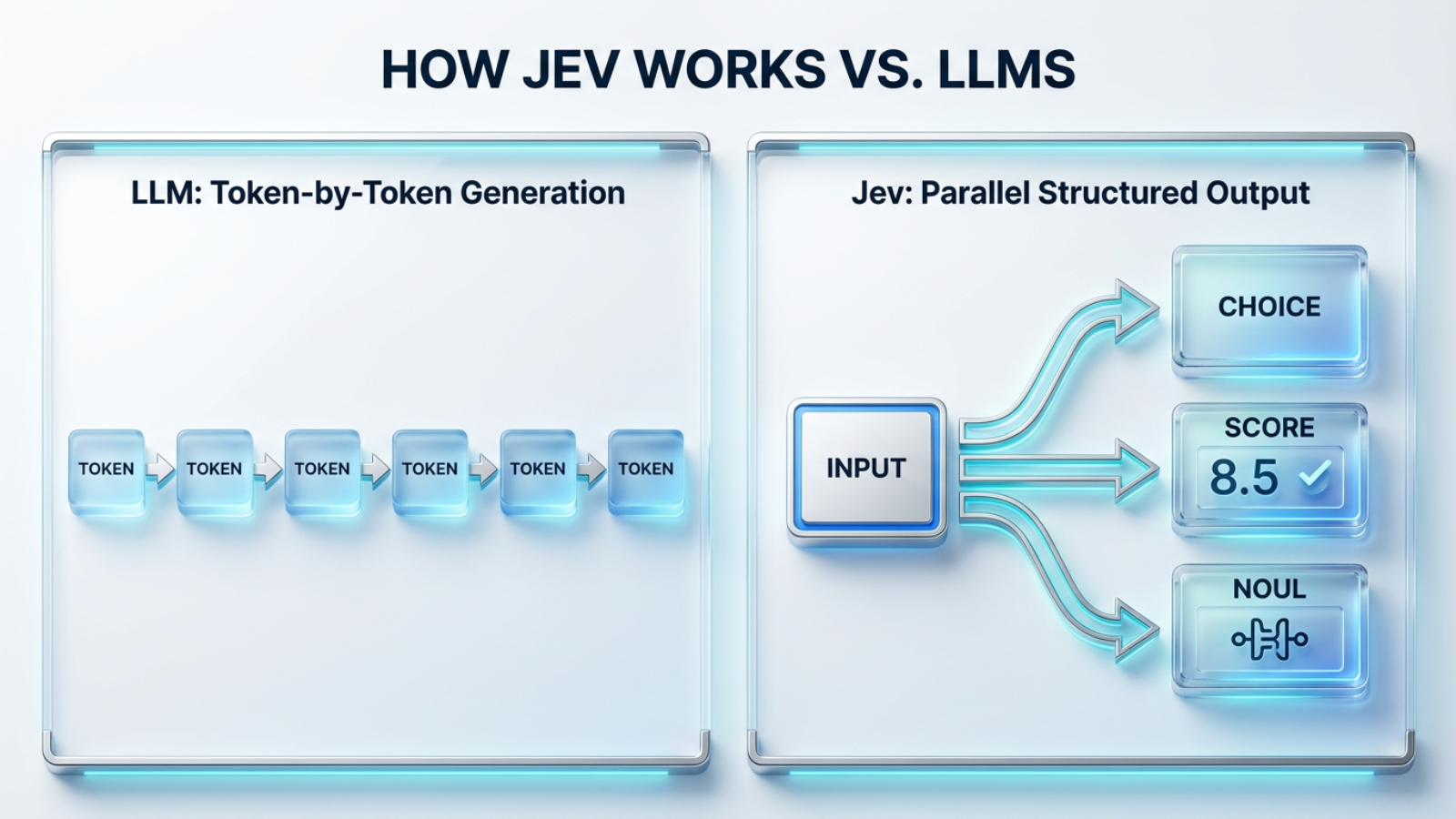
The core difference is architectural. Frontier LLMs generate responses one token at a time, sequentially. Jev generates all outputs in a single parallel pass. This design trades text generation entirely in exchange for speed, type safety, and structured probabilistic outputs.
TypeSafe trained Jev using a method it calls Reinforcement Learning for Calibrated Decisions (RLCD), which optimizes for epistemically honest probabilities rather than human preference or verifiable correctness alone. The result is a model that communicates confidence with every output, where higher confidence correlates with higher accuracy in aggregate.
TypeSafe AI — https://typesafe.ai/blog/introducing-system-one-models-and-jev
1.1 How Jev Differs from LLMs Like GPT and Claude
Standard LLMs are optimized for human-in-the-loop tasks: chatbots, writing assistants, and code generation. They produce flexible string outputs but introduce latency (3 to 329 seconds for frontier models, per TypeSafe's benchmarks) and variable structured-output error rates.
Jev occupies a different category. It cannot write prose, summarize documents, or reason through open-ended problems. What it does instead is answer predefined typed questions about a given state, quickly and cheaply, with calibrated confidence scores attached to every answer.
dev.to/valyuai — https://dev.to/valyuai/how-to-use-jev-a-practical-guide-to-typesafes-system-one-model-g5e
1.2 Three Output Primitives: Choice, Score, and Noul
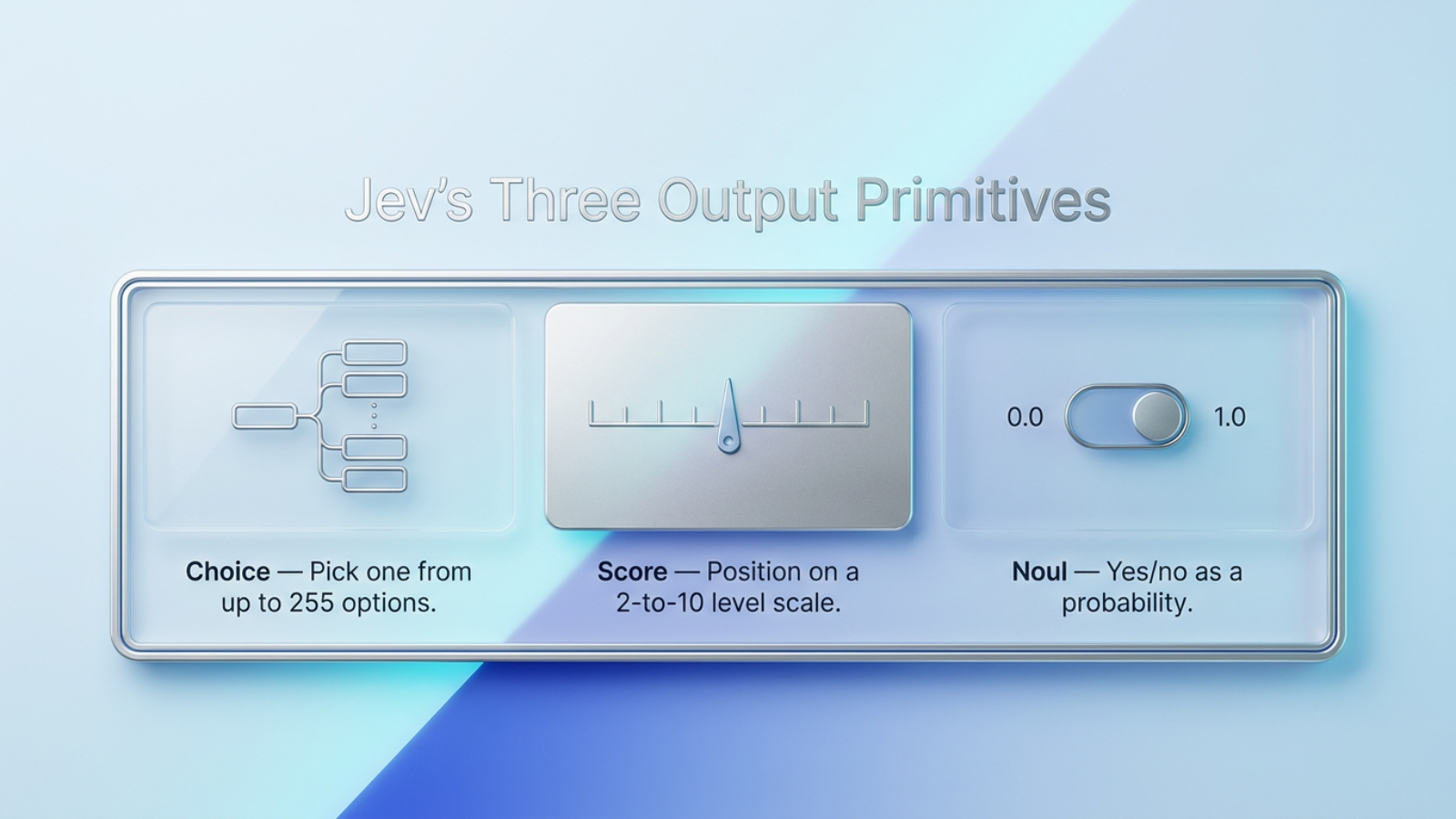
The entire Jev API is built around three question types:
Choice: Selects one option from a defined set of up to 255 categories. Returns the chosen label, per-option probabilities, and a confidence score.
Score: Returns a numeric position on a 2-to-10 level scale described in plain language. The score can land between defined levels (for example, 1.035), and includes probabilities and confidence.
Noul: Returns a single number from 0 to 1, representing the probability that a yes/no question is true. No confidence field is returned because the probability itself expresses the model's degree of belief.
All questions in a single API call run in parallel over the same input state. This means a call with ten questions takes roughly the same time as a call with one question, making speculative fan-out, asking everything upfront and filtering in code, a practical and cost-effective design pattern.
dev.to/valyuai — https://dev.to/valyuai/how-to-use-jev-a-practical-guide-to-typesafes-system-one-model-g5e
Part 2. Jev for Trading: Real-World Applications and Use Cases
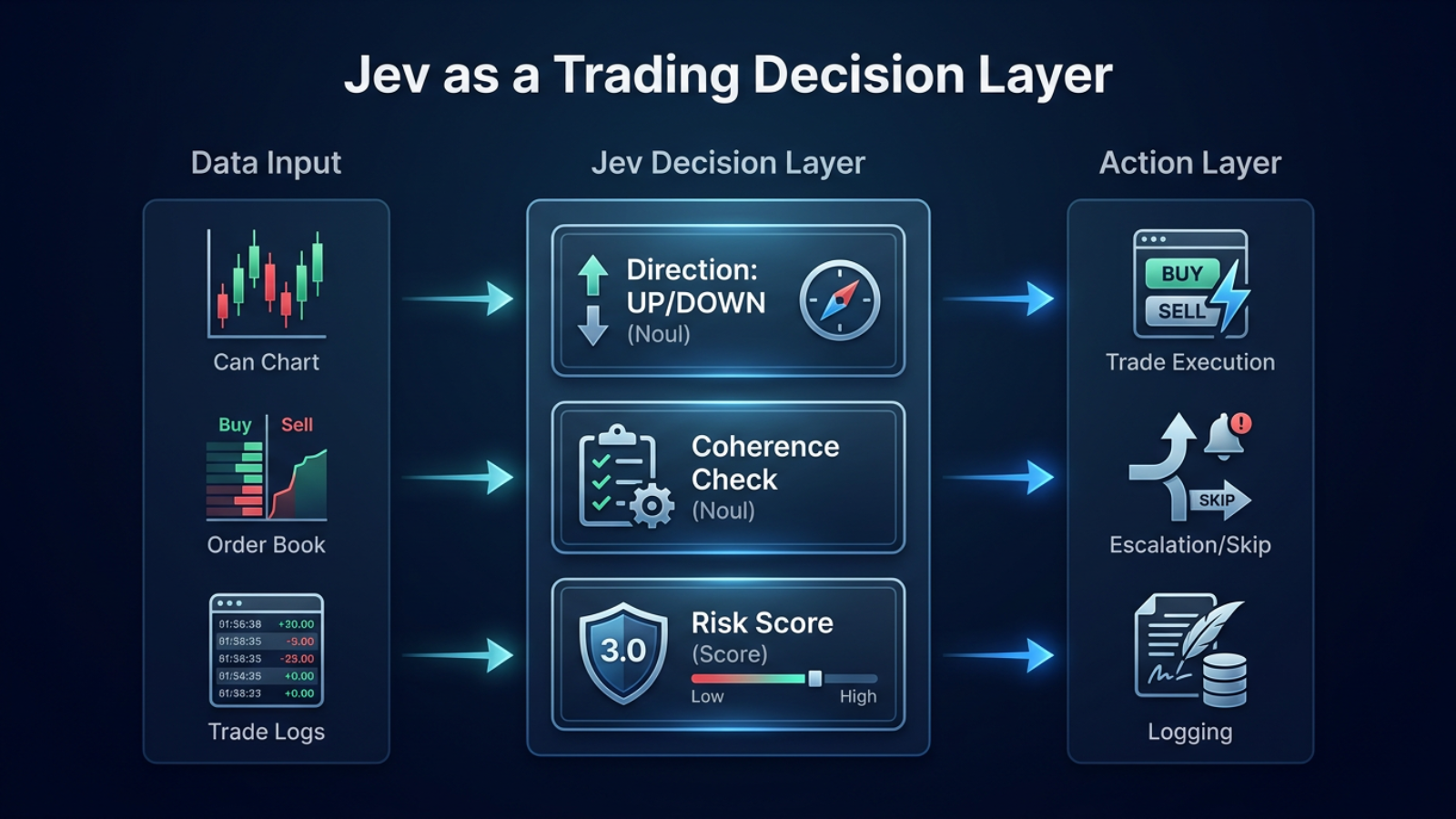
Jev's speed and cost profile make it a practical component in automated trading pipelines. Several documented use cases have emerged since its launch in September 2026. These examples illustrate the types of workflows Jev is suited to, though they do not represent typical trading results and should not be interpreted as evidence of profitability.
2.1 Trade Signal Classification and Routing
One documented use case involves real-time signal classification. A trading bot tested by MindStudio re-evaluated Bitcoin price direction using Jev approximately once per second, leveraging its sub-500ms latency to support rapid, repeated judgments. The same testing noted that speed does not guarantee trading accuracy, and the bot was not performing well in its first hour of testing.
MindStudio — https://www.mindstudio.ai/blog/jev-use-cases-automation
A market-making bot developed by a third-party developer used Jev to read a crypto order book and output a buy or sell decision roughly every 300 milliseconds per Monad block. The bot posted post-only limit orders one tick inside the spread, aiming to earn the spread rather than pay it. Reported model latency in the event stream was approximately 81ms for this use case.
dev.to/valyuai — https://dev.to/valyuai/how-to-use-jev-a-practical-guide-to-typesafes-system-one-model-g5e
2.2 Using Jev as a Reasoning Auditor for Trading Bots
A distinct and well-documented application involves using Jev not to make trading decisions directly, but to audit the reasoning of a separate vision-based trading system. A developer running a forex scalper on funded prop accounts built a shadow auditor that evaluates whether the primary model's directional thesis (UP or DOWN) is self-consistent with its stated reasoning.
The auditor uses a Noul question to check a binary property: does the recorded thesis coherently support the directional call? It cannot evaluate whether the directional call is correct. It evaluates internal logical consistency only. This makes it useful for detecting degraded or incoherent model outputs before they show up as losses, not as a predictor of trading outcomes.
The key design principle in this setup is pre-registration: the pass/fail thresholds for determining whether incoherence correlates with worse outcomes were locked in code before any real data was collected. This prevents the evaluation criteria from shifting after the results are known, a common weakness in backtesting methodologies.
dev.to/nodefiend — https://dev.to/nodefiend/jev-assisted-llm-trading-ofa
2.3 The Cascade Pattern: Where Jev Fits in a Multi-Model Pipeline
Jev is designed to complement rather than replace full-capability LLMs. The documented pattern across multiple implementations is a cascade: Jev classifies and routes cheaply at scale, ordinary code handles deterministic tasks (such as a balance lookup or order status query), and a frontier LLM handles only the subset of requests that genuinely require reasoning or text generation.
On TypeSafe's illustrative figures, routing one million support tickets through a cascade versus sending all of them to a full LLM produced an estimated cost of around $6,480 versus $30,400, with roughly 800,000 tickets answered in under half a second. These are TypeSafe's own figures, self-run and not independently reproduced.
dev.to/valyuai — https://dev.to/valyuai/how-to-use-jev-a-practical-guide-to-typesafes-system-one-model-g5e
Part 3. How Webull's Trading API Works With Automated Strategies
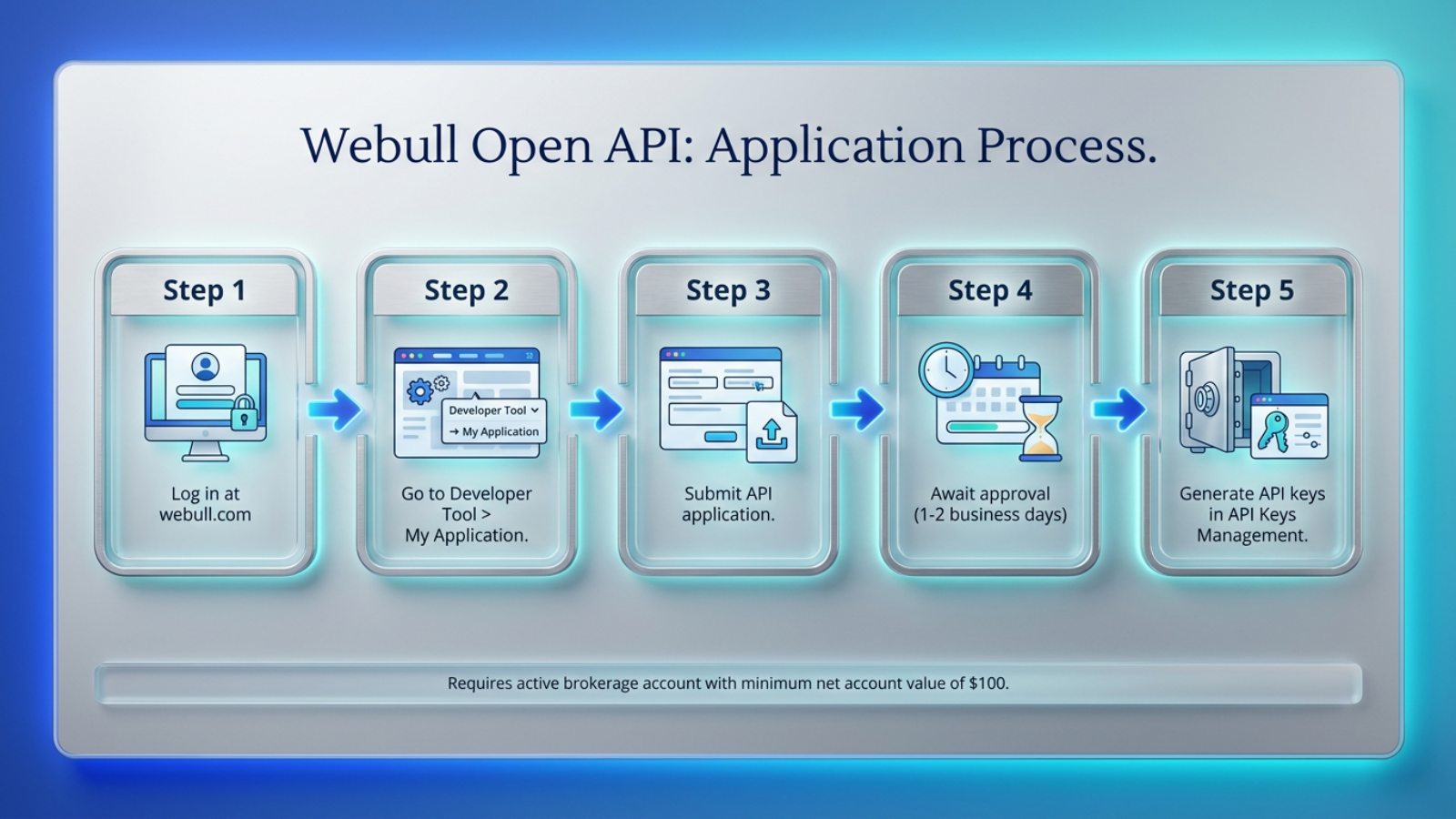
For traders looking to implement automated strategies in US markets, having a regulated broker with API access is a foundational requirement. Webull's Open API supports programmatic trading in stocks, options, futures, and crypto through a structured application process.
3.1 Webull API Overview: Eligible Assets, Requirements, and Access
The Webull API currently supports trading in stocks, options, futures, and crypto. Access requires an active Webull brokerage account, either newly opened or already established. To qualify, the account must have a minimum net account value of $100, and the application is reviewed based on the account holder's risk profile and trading history.
The application is submitted through the Webull website (not the mobile app) via Developer Tool, then My Application. After submission, a confirmation email is sent to the registered email address. Review typically takes 1 to 2 business days. Once approved, API keys (App Key and App Secret) are generated in the API Keys Management section.
Security practices recommended by Webull include keeping the App Key and App Secret confidential, enabling Two-Factor Authentication (2FA), and setting up IP whitelisting to restrict access. If a compromise is suspected, users can reset their key at any time.
3.2 Integrating Decision Models Into API-Based Trading Workflows
A decision model like Jev can, in principle, serve as a classification or routing layer upstream of an execution API. In the documented trading use cases, Jev reads structured state, such as order book data or a logged trade thesis, and returns a typed decision. That decision then drives a downstream action in code, such as whether to submit an order, skip a signal, or escalate for review.
Webull's API provides the execution infrastructure for eligible US brokerage accounts. Developers building on top of it can explore how decision layers integrate with their strategy logic. Those interested in the platform's full capabilities can also review Webull's active trading resources or the Webull paper trading environment for testing strategies without real capital at risk.
Part 4. Jev vs. Traditional LLMs for Trading Automation: Key Differences
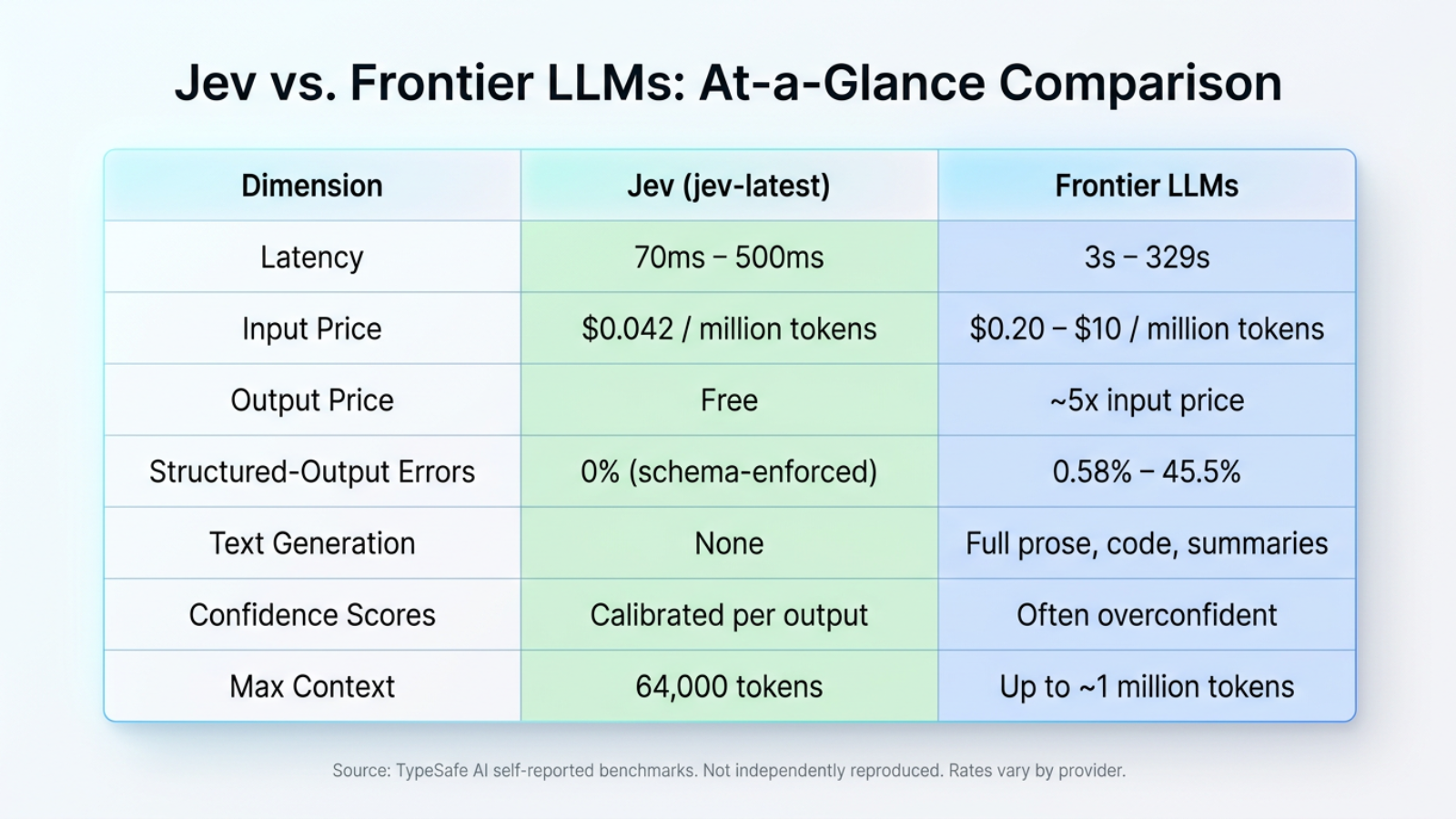
The distinction between Jev and standard LLMs is not simply a matter of cost or speed. They represent different computational primitives designed for different parts of a workflow. The table below compares them on dimensions relevant to trading automation, using figures from TypeSafe's published benchmarks. These are self-reported and have not been independently reproduced.
Dimension | Jev (jev-latest) | Frontier LLMs |
|---|---|---|
End-to-end latency | 70ms to 500ms | 3s to 329s |
Input price | $0.042 / million tokens | $0.20 to $10 / million tokens |
Output price | Free | Approximately 5x input price |
Structured-output errors | 0% (by schema construction) | 0.58% to 45.5% |
Text generation | None | Full prose, code, summaries |
Confidence scores | Calibrated per output | Often overconfident and inconsistent |
Max context (state + questions) | 64,000 tokens | Up to approximately 1 million tokens |
TypeSafe AI — https://typesafe.ai/blog/introducing-system-one-models-and-jev
Rates vary by service provider; please refer to the latest pricing.
Strengths of Jev for trading automation workflows:
Sub-second latency makes it suitable for real-time signal evaluation and order routing loops.
Calibrated confidence scores allow code to gate actions behind meaningful thresholds rather than treating all outputs equally.
Parallel question evaluation means a single API call can answer multiple independent classification questions simultaneously.
Free output pricing makes speculative fan-out, asking many questions and using only what's relevant, economically practical.
Limitations you must know before deploying:
Jev reads literally. The question you write is the question it answers, not the question you intended. Imprecise criteria produce unreliable outputs.
It does not count reliably. Arithmetic, date comparison, and counting tasks should be handled in code, not delegated to Jev.
It has no market knowledge. Jev evaluates only the structured state you send it. It cannot look up prices, news, or order book data independently.
Context rot is real. Accuracy declines when state includes information unrelated to the question being asked. Filter inputs tightly before sending.
Self-reported benchmarks only. TypeSafe designed and ran its own evaluations. Independent reproductions are not yet available.
dev.to/valyuai — https://dev.to/valyuai/how-to-use-jev-a-practical-guide-to-typesafes-system-one-model-g5e
Part 5. Risks, Compliance, and Platform Safety for AI-Assisted Trading
5.1 Trading Automation Does Not Eliminate Market Risk
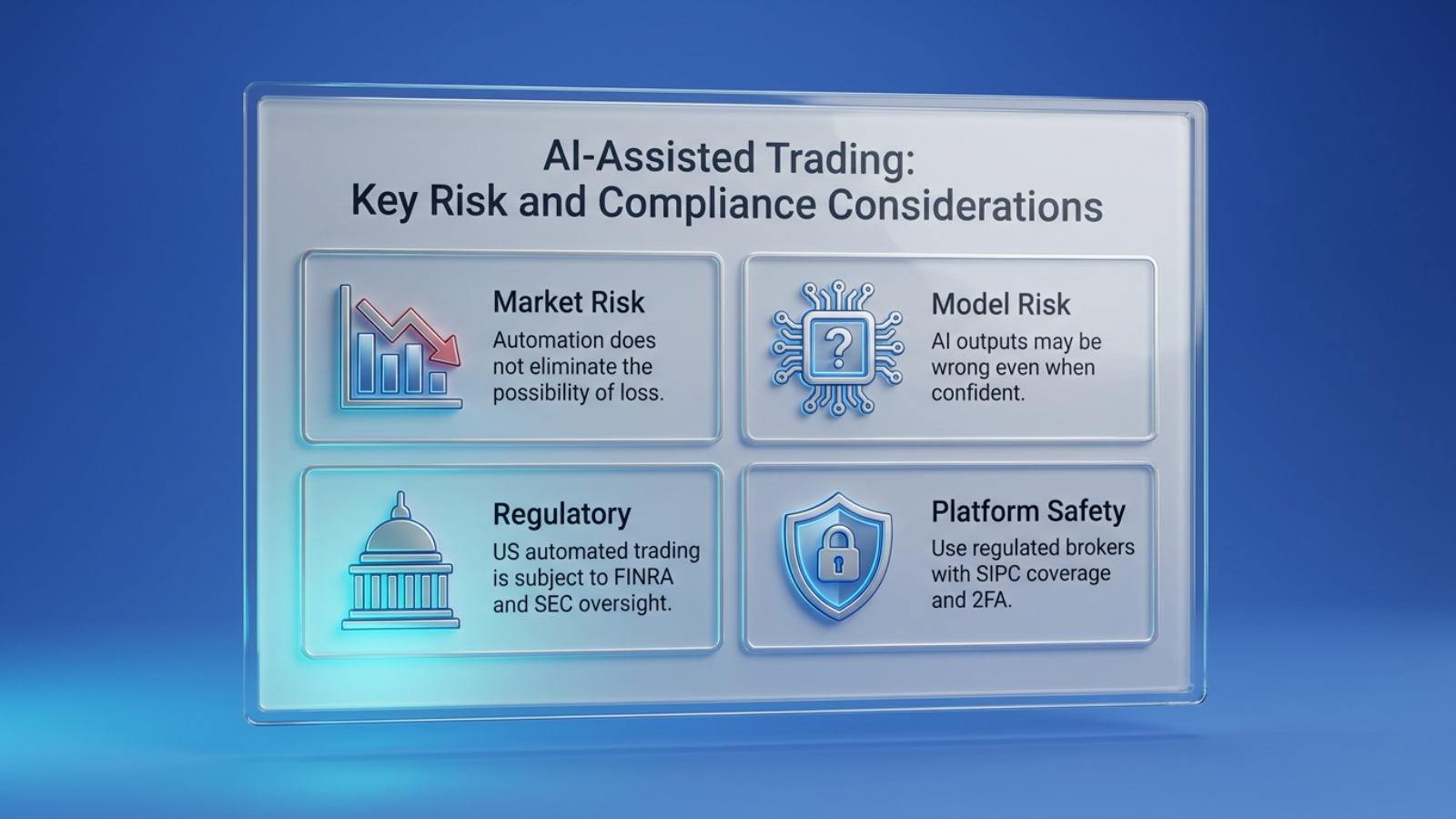
Automated trading systems, including those that incorporate AI decision models, do not protect against market losses. Any strategy that involves buying or selling securities carries the risk of losing principal. Speed and automation can reduce certain types of operational latency, but they do not reduce exposure to market volatility, liquidity gaps, adverse price movements, or system failures.
The forex trading bot documented in the dev.to case study illustrates this clearly. The first $10,000 funded account blew through its maximum drawdown limit on September 9, 2026, and was lost. The developer acknowledged that reviewing every trade log and reasoning trace after the fact told nothing about whether the reasoning was any good. Even a well-instrumented system can fail.
dev.to/nodefiend — https://dev.to/nodefiend/jev-assisted-llm-trading-ofa
5.2 Regulatory Landscape for Automated Trading in the US
Automated and algorithmic trading in US markets is subject to oversight by the Securities and Exchange Commission (SEC) and the Financial Industry Regulatory Authority (FINRA). Broker-dealers operating in the US must comply with applicable FINRA rules, including standards for fair and balanced communications and suitability or best-interest obligations under Regulation Best Interest (Reg BI).
Traders using third-party tools, APIs, or AI-assisted decision systems remain responsible for ensuring their trading activity complies with applicable regulations. Using an AI model to generate trade signals does not shift regulatory responsibility away from the account holder.
FINRA — https://www.finra.org/
SEC — https://www.sec.gov/
5.3 Webull's Regulatory and Platform Security Credentials
Webull Financial LLC is a registered broker-dealer and a member of FINRA and SIPC. SIPC membership means eligible customer accounts are protected up to $500,000 (including up to $250,000 for cash claims) in the event of broker failure, subject to SIPC rules and limitations. SIPC protection does not cover investment losses from market activity.
Webull — https://www.webull.com/about-us
For traders using the Webull API in automated contexts, the platform provides security features including Two-Factor Authentication (2FA) and IP whitelisting for API key protection. Traders can also explore Webull's options trading page and futures trading page to review product specifications and associated risks before building automated strategies around those instruments.
SIPC — https://www.sipc.org/
The Bottom Line
Jev offers a fast, low-cost structured decision layer that may suit trading developers who need reliable classification at scale. It is not a trading strategy, a signal generator, or a replacement for risk management. Paired with a regulated execution platform like Webull, it represents one component in a broader automated workflow. All trading involves risk, including the potential loss of principal. Evaluate carefully before deploying any AI-assisted system with real capital.
Disclosure:
The Webull OpenAPI and MCP Server are provided "as is" without warranty of any kind and do not constitute investment advice. All trading involves a substantial risk of loss. By utilizing these tools, you acknowledge that AI-driven agents may misinterpret instructions, act on delayed data, or perform poorly under certain market conditions. Webull assumes no liability for losses resulting from automated or AI-directed decisions. You are solely responsible for verifying all order details prior to execution, actively monitoring your positions, and ensuring that any connected agents, algorithms, or tools operate exactly as intended.
Webull Financial LLC (member SIPC, FINRA) offers self-directed securities trading. All investments involve risk. More info: https://www.webull.com/policy
The information provided does not constitute investment advice and it should not be relied on as such. It should not be considered a solicitation to buy or an offer to sell a security. It does not take into account any investor's particular investment objectives, strategies, tax status or investment horizon. Investing involves risk, including the risk of loss of principal.
