'%3e %3cpath d='M41.7832962%2c0 C41.9459106%2c0 42.0882746%2c0.0866854658 42.1666825%2c0.216359069 C43.8289923%2c2.66540836 44.7676281%2c5.46271319 44.7676281%2c8.43208061 C44.7676281%2c18.1345746 34.7460532%2c26 22.383814%2c26 C10.0215749%2c26 0%2c18.1345746 0%2c8.43208061 C0%2c5.46716016 0.935826425%2c2.67378733 2.58829888%2c0.223985685 C2.67109477%2c0.0916264068 2.81687473%2c0 2.9840593%2c0 C3.23130408%2c0 3.43173558%2c0.200393004 3.43173558%2c0.447590303 C3.43173558%2c0.475056669 3.42926112%2c0.501945205 3.42452292%2c0.528045226 L3.41810883%2c0.550292077 C3.37800671%2c0.861741908 3.3575721%2c1.17661276 3.3575721%2c1.49443092 C3.3575721%2c7.98336 11.2132389%2c12.5742305 22.383814%2c12.5742305 C33.5543891%2c12.5742305 41.410056%2c7.98336 41.410056%2c1.49443092 C41.410056%2c1.17865223 41.3898828%2c0.865783153 41.3502888%2c0.556288325 C41.3402868%2c0.521941442 41.3356199%2c0.48531078 41.3356199%2c0.447590303 C41.3356199%2c0.200393004 41.5360514%2c0 41.7832962%2c0 Z' id='logo%e5%a4%87%e4%bb%bd-6' fill='white'%3e%3c/path%3e %3cpath d='M74.6899231%2c3.74404927 C75.2411227%2c3.74404927 75.7734299%2c3.66184338 76.2756219%2c3.50883715 L73.8159676%2c20.8666902 C73.5770593%2c22.5662954 72.8072434%2c23.0518969 71.4268838%2c23.0518969 L69.9934336%2c23.0518969 C68.7988917%2c23.0518969 68.1618027%2c22.458384 67.7901674%2c20.893668 L65.6930827%2c11.9909739 C65.639992%2c11.7481731 65.639992%2c11.6942174 65.5338105%2c11.6942174 C65.427629%2c11.6942174 65.4010836%2c11.7481731 65.3479929%2c11.9909739 L63.2509082%2c20.893668 C62.8792729%2c22.458384 62.2421839%2c23.0518969 61.047642%2c23.0518969 L59.6141918%2c23.0518969 C58.2338322%2c23.0518969 57.4640163%2c22.5662954 57.225108%2c20.8666902 L54.7463723%2c3.37406084 C55.3593498%2c3.61307396 56.0249975%2c3.74404927 56.7207458%2c3.74404927 C57.3314263%2c3.74404927 57.918917%2c3.64314414 58.4679557%2c3.4568446 L60.3574623%2c19.3829078 C60.3840076%2c19.6257086 60.3840076%2c19.7875757 60.4901891%2c19.7875757 C60.5963706%2c19.7875757 60.5963706%2c19.6257086 60.6494614%2c19.3829078 L62.9323637%2c9.91367858 C63.0916359%2c9.26620991 63.4632712%2c8.69967483 64.6047223%2c8.69967483 L66.4363532%2c8.69967483 C67.5778044%2c8.69967483 67.9494397%2c9.26620991 68.1087119%2c9.91367858 L70.3916142%2c19.3829078 C70.4447049%2c19.6257086 70.4447049%2c19.7875757 70.5508864%2c19.7875757 C70.6570679%2c19.7875757 70.6570679%2c19.6257086 70.6836133%2c19.3829078 L72.5891207%2c3.32292288 C73.2365902%2c3.59432921 73.9460524%2c3.74404927 74.6899231%2c3.74404927 Z' id='Combined-Shape' fill='white'%3e%3c/path%3e %3cpath d='M84.5933901%2c7.43171536 C88.6813779%2c7.43171536 90.9111894%2c10.2643908 90.9111894%2c14.2840921 L90.9111894%2c15.7948523 C90.9111894%2c16.2264981 90.7519172%2c16.4692988 90.3802819%2c16.4692988 L81.7264895%2c16.4692988 L81.7264895%2c16.5502324 C81.7264895%2c18.1149484 82.3635785%2c19.9764208 84.9119346%2c19.9764208 C86.849747%2c19.9764208 88.6813779%2c19.8145536 89.7962837%2c19.7066422 L89.8759198%2c19.7066422 C90.1413735%2c19.7066422 90.3537366%2c19.8415315 90.3537366%2c20.1113101 L90.3537366%2c21.8918489 C90.3537366%2c22.3234947 90.2741004%2c22.5123397 89.7962837%2c22.5932733 C88.0708343%2c22.9170076 87.0355646%2c23.0518969 84.6464808%2c23.0518969 C81.9919433%2c23.0518969 78.2225%2c21.5950924 78.2225%2c16.2804538 L78.2225%2c14.2840921 C78.2225%2c10.0755457 80.5319476%2c7.43171536 84.5933901%2c7.43171536 Z M84.5933901%2c10.5071915 C82.9475768%2c10.5071915 81.7530349%2c11.6942174 81.7530349%2c13.8254684 L81.7530349%2c13.9333799 L87.3806545%2c13.9333799 L87.3806545%2c13.8254684 C87.3806545%2c11.7211953 86.2392034%2c10.5071915 84.5933901%2c10.5071915 Z' id='Combined-Shape' fill='white'%3e%3c/path%3e %3cpath d='M97.4154906%2c2.98826245 L97.4148064%2c7.62056039 C98.3969853%2c7.48567108 99.3260735%2c7.43171536 99.9631625%2c7.43171536 C104.236968%2c7.43171536 106.307507%2c9.99461216 106.307507%2c14.2031585 L106.307507%2c16.2804538 C106.307507%2c20.4890001 104.236968%2c23.0518969 99.9631625%2c23.0518969 C98.2642584%2c23.0518969 96.2733553%2c22.7821183 94.627542%2c22.3504725 C94.0169984%2c22.1886054 93.9108169%2c22.0267382 93.9108169%2c21.6220703 L93.9098179%2c3.08694115 C94.4185466%2c3.24434375 94.9584615%2c3.32900525 95.5178331%2c3.32900525 C96.184659%2c3.32900525 96.8238351%2c3.20869291 97.4154906%2c2.98826245 Z M99.9631625%2c10.3453244 C99.3260735%2c10.3453244 98.1580769%2c10.4262579 97.4148064%2c10.5341694 L97.4148064%2c19.9494429 C97.9191686%2c20.0573544 99.007529%2c20.1382879 99.9631625%2c20.1382879 C102.246065%2c20.1382879 102.803518%2c18.4926384 102.803518%2c16.2804538 L102.803518%2c14.2031585 C102.803518%2c11.9909739 102.246065%2c10.3453244 99.9631625%2c10.3453244 Z' id='Combined-Shape' fill='white'%3e%3c/path%3e %3cpath d='M111.036668%2c8.72457747 C111.579488%2c8.72457747 112.103987%2c8.64485191 112.599444%2c8.49629404 L112.598761%2c16.5232546 C112.598761%2c19.3289521 113.607485%2c19.9764208 115.147117%2c19.9764208 L115.306389%2c19.9764208 C116.846021%2c19.9764208 117.854746%2c19.3289521 117.854746%2c16.5232546 L117.854207%2c8.4334735 C118.406525%2c8.62226395 118.997939%2c8.72457747 119.612866%2c8.72457747 C120.223332%2c8.72457747 120.810625%2c8.62374317 121.359498%2c8.43756894 L121.358735%2c16.5232546 C121.358735%2c22.4044283 116.872567%2c23.0518969 115.306389%2c23.0518969 L115.060464%2c23.0512514 C113.42215%2c23.0271041 109.094772%2c22.2994073 109.094772%2c16.5232546 L109.094446%2c8.36700801 C109.698522%2c8.59813531 110.353066%2c8.72457747 111.036668%2c8.72457747 Z' id='Combined-Shape' fill='white'%3e%3c/path%3e %3cpath d='M128.314162%2c3.03790128 L128.313623%2c22.269539 C128.313623%2c22.5662954 128.10126%2c22.836074 127.809261%2c22.836074 L125.340541%2c22.836074 C125.048542%2c22.836074 124.809634%2c22.5662954 124.809634%2c22.269539 L124.809455%2c3.04219481 C125.358161%2c3.22824247 125.945253%2c3.32900525 126.555503%2c3.32900525 C127.17043%2c3.32900525 127.761844%2c3.22669173 128.314162%2c3.03790128 Z' id='Combined-Shape' fill='white'%3e%3c/path%3e %3cpath d='M133.90653%2c3.32900525 C134.473329%2c3.32900525 135.02015%2c3.24208064 135.534793%2c3.08063296 L135.533966%2c22.269539 C135.533966%2c22.5662954 135.321603%2c22.836074 135.029603%2c22.836074 L132.560884%2c22.836074 C132.268884%2c22.836074 132.029976%2c22.5662954 132.029976%2c22.269539 L132.029909%2c2.99605058 C132.615669%2c3.21152525 133.2476%2c3.32900525 133.90653%2c3.32900525 Z' id='Combined-Shape' fill='white'%3e%3c/path%3e %3c/g%3e %3c/g%3e %3c/g%3e%3c/svg%3e)



Every futures contract has an expiration date, and when that date approaches, traders who want to keep their market exposure intact must execute a futures contract rollover. Unlike stocks, which can be held indefinitely, futures require active management around each expiration cycle. Whether you're managing quarterly equity index positions in the E-mini S&P 500 or navigating monthly crude oil contracts, mastering the mechanics of rolling a futures position is an essential skill for US futures markets.
Key Takeaways
A futures contract rollover means closing a position in a near-expiring front-month contract and reopening equivalent exposure in the next active (back-month) contract.
Rollover timing varies by market: equity index futures (ES, NQ) expire quarterly; crude oil (CL) expires monthly; metals follow semi-monthly active periods.
Roll yield, determined by whether a market is in contango or backwardation, represents a real cost or credit on every roll.
Chart gaps at rollover are a pricing artifact caused by switching contract symbols, not a real market move.
Webull provides eligible US residents with futures trading access across indices, energies, metals, currencies, agricultural commodities, and more.
Part 1. What Is a Futures Contract Rollover?
1.1 The Core Definition
Futures contract rollover defined: Closing an open position in a near-expiration (front-month) futures contract and opening an equivalent position in a later-dated (back-month) contract, so a trader can maintain continuous market exposure without facing settlement or physical delivery of the underlying asset.
A futures contract is a legal agreement between a buyer and a seller to buy or sell a commodity, like crude oil, or a financial instrument like the E-mini S&P 500, at a pre-established price on a specified future date. Unlike stocks or spot instruments, every futures contract has a hard expiration date. After that date, it either settles in cash or triggers physical delivery.
Rolling the position before expiration is the standard method most traders use to maintain exposure to the underlying market while avoiding the logistical or financial complications of settlement.
1.2 Physical Delivery vs. Cash Settlement
Settlement type shapes how urgently a trader must act before expiration.
Physically settled contracts require actual delivery of the underlying commodity at expiration. A clearinghouse matches long and short holders, and the commodity changes hands. For example, one crude oil contract controls 1,000 barrels. At $50 per barrel, the long holder must deposit $50,000 with the clearinghouse just to take delivery, plus additional storage and delivery costs. For most retail traders, rolling or closing well before expiration is the practical choice. Physical delivery is not supported at Webull, so positions must be closed or otherwise managed by this date to avoid liquidation. If no action is taken by 11 AM on the last holding date, Webull may close the position.
Cash-settled contracts(financially settled) require no physical transfer. At expiry, each trader's account is debited or credited based on the final settlement price. The E-mini S&P 500 (ES) is cash-settled: it settles to the Special Opening Quotation (SOQ), a price derived from the opening prices of all S&P 500 component stocks on the third Friday of the contract month.
CME Group — https://www.cmegroup.com/articles/2025/cash-settlement-vs-physical-delivery.html
Part 2. Futures Rollover Dates: When Each Market Rolls
2.1 Equity Index Futures: The Quarterly Cycle
CME equity index futures trade on a quarterly expiration cycle: March (H), June (M), September (U), and December (Z). This covers the E-mini S&P 500 (ES), E-mini Nasdaq-100 (NQ), E-mini Russell 2000 (RTY), and E-mini Dow (YM), along with their Micro counterparts (MES, MNQ, M2K, MYM) at one-tenth the notional size.
Equity index futures expire on the third Friday of the contract month and settle in cash. Traders should confirm exact dates on the current CME rollover calendar.
Contract symbols combine a product code, a month code, and a year. ESU26, for example, means the E-mini S&P 500 expiring in September 2026 (U = September, 26 = year).
2.2 Crude Oil and Energy Futures: Monthly Rolls
Energy futures, including crude oil (CL), natural gas (NG), RBOB gasoline (RB), and heating oil (HO), list every calendar month and roll monthly rather than quarterly.
A critical naming convention: energy and metals contracts are named by their delivery month, meaning the contract actually terminates the calendar month before the name suggests. A "February" crude oil contract (CLG6) stops trading in January. Always verify the specific last trading date on a current contract calendar before acting.
2.3 Gold, Silver, and Metals Futures
Gold (GC) and silver (SI) are physically delivered contracts. Active months for gold include February, April, June, August, and December.
Major Futures Rollover Reference:
Contract | Expiration Cycle |
|---|---|
E-mini S&P 500 (ES) | Quarterly (Mar, Jun, Sep, Dec) |
Crude Oil (CL) | Monthly |
Gold (GC) | Semi-monthly (active: Feb, Apr, Jun, Aug, Dec) |
Micro E-minis (MES, MNQ) | Same quarterly cycle as full-size |
All windows are market conventions. Always confirm on a current CME rollover calendar before trading.
CME Group publishes first-notice, last-trading, and settlement dates for all listed contracts. Use live exchange sources rather than memorized dates, as exact dates can vary.
Part 3. Roll Yield and the Real Cost of Rolling a Futures Contract
3.1 Contango, Backwardation, and Roll Yield
Roll yield is the gain or loss a trader incurs when replacing an expiring contract with a later-dated one. It is determined by the price relationship between the two contract months.
In contango, the back-month contract trades above the front month. When a market is in contango, rolling costs the trader money because they pay up to move exposure forward. This produces negative roll yield.
In backwardation, the back-month trades below the front month. Rolling in backwardation earns the trader a credit, producing positive roll yield.
Over multiple roll cycles, the cumulative roll yield becomes a measurable component of futures trading performance. Traders who regularly maintain exposure through rolls should log the spread between their exit and re-entry prices to track this cost or credit over time.
3.2 Why Did My Futures Chart Gap Overnight?
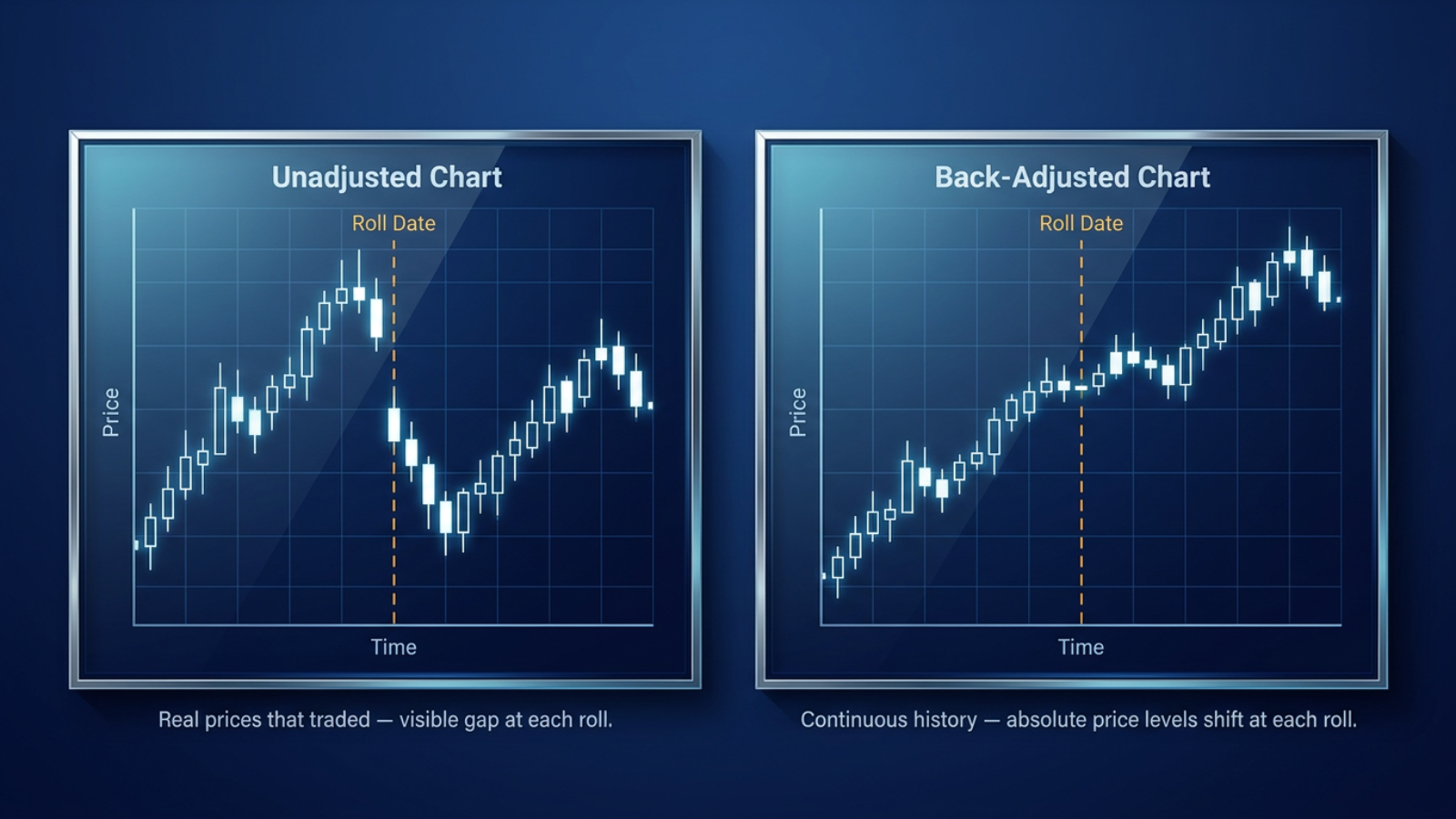
A chart gap at rollover is not a real market move. It is a pricing artifact caused by the charting platform switching its displayed symbol from the expiring front-month contract to the back-month contract, which trades at a different price due to cost-of-carry.
Consider this illustrative example: the June ES is at 5,400 and September ES is at 5,360. When the platform switches to September, the displayed price drops 40 points. That equals 160 ticks or approximately $2,000 per ES contract (40 points x $50/point). This represents the spread between two different instruments, not any change in a trader's actual position value.
The practical risk: resting orders (stops, limits, brackets) keyed to the new contract symbol can be triggered by the chart gap. Traders must cancel all orders on the old contract and recreate them on the new contract, adjusting price levels by the roll spread before the platform switches symbols.
3.3 Continuous Charts and Back-Adjustment Methods
Charting platforms stitch successive contracts into a continuous price series using three common methods:
Method | What It Does at Each Roll | Preserves | Limitation |
|---|---|---|---|
Difference (Panama / back-adjusted) | Shifts all prior bars by the price gap so the seam is flat | Absolute point moves | Historical price levels shift; deep history can go negative |
Ratio (proportional) | Multiplies historical bars by the new/old price ratio | Percentage returns | Absolute levels still differ from traded prices |
Unadjusted | Shows raw prices that actually traded | Real tradeable prices | Visible gap at every roll |
Because back-adjusted charts re-shift all prior history at every new roll, horizontal support and resistance levels drawn on a continuous chart may sit at different absolute prices after each rollover. For reading a current tradeable price, use the live front-month contract.
Part 4. How to Roll a Futures Contract on Webull
4.1 Opening a Webull Futures Account
Webull provides futures trading to eligible users. To open a futures account, you must be a US resident and hold an existing individual Webull brokerage account. Joint brokerage accounts cannot be used to apply for or maintain a futures account.
To apply via the Webull mobile app:
Step 1 Tap the Menu logo and select Settings.
Step 2 Tap Account Management.
Step 3 Scroll down and select Apply for new accounts.
Step 4 Choose Futures and follow the application prompts.
To apply via the Webull website:
Step 1 Click your avatar in the top right and select My Account.
Step 2 Click Explore more Accounts.
Step 3 Scroll down, select Futures, click the Open Futures Account hyperlink, and follow the prompts.
4.2 Funding Your Webull Futures Account
Three deposit methods are available for a Webull futures account:
Internal Transfer: Move cash from your linked brokerage account to your futures account via the Transfer Money section in the Webull app or website. This is generally the most direct funding path.
ACH: Deposit funds directly into your futures account via ACH. ACH deposits made directly into futures accounts have settlement timelines that may differ from standard brokerage ACH deposits. For current processing times, please refer to Webull's ACH deposit information. ACH deposits do not provide Instant Buying Power.
Wire Transfer: Deposit funds via wire. Wire instructions are provided after selecting the futures account as the destination. Include your Webull futures account number in the memo field of the wire.
4.3 Margin Requirements for Rollover Planning
Understanding the three margin tiers at Webull is essential when planning a rollover, particularly for positions held overnight.
Intraday margin is the lowest margin tier, generally applicable between 9:00 AM ET and 4:15 PM ET for eligible contracts. It enables higher leverage during intraday sessions. Intraday margin increases leverage, which can increase risk and may not be suitable for all investors.
Initial margin is required when opening a position intended to be held through the end of intraday hours, or when entering outside those hours. It is typically between 3% and 12% of the futures contract's notional value, depending on the contract and market conditions.
Maintenance margin is the minimum equity needed to keep an open position beyond intraday hours. If an account falls below this level, the trader must deposit additional funds to restore the account to the initial margin threshold, or the position may be liquidated.
When planning a rollover, always confirm sufficient margin is available in the back-month contract before closing the front-month position. A full list of margin requirements for all supported futures products is available on Webull's futures margin rates page.
4.4 Step-by-Step: Rolling a Futures Position on Webull
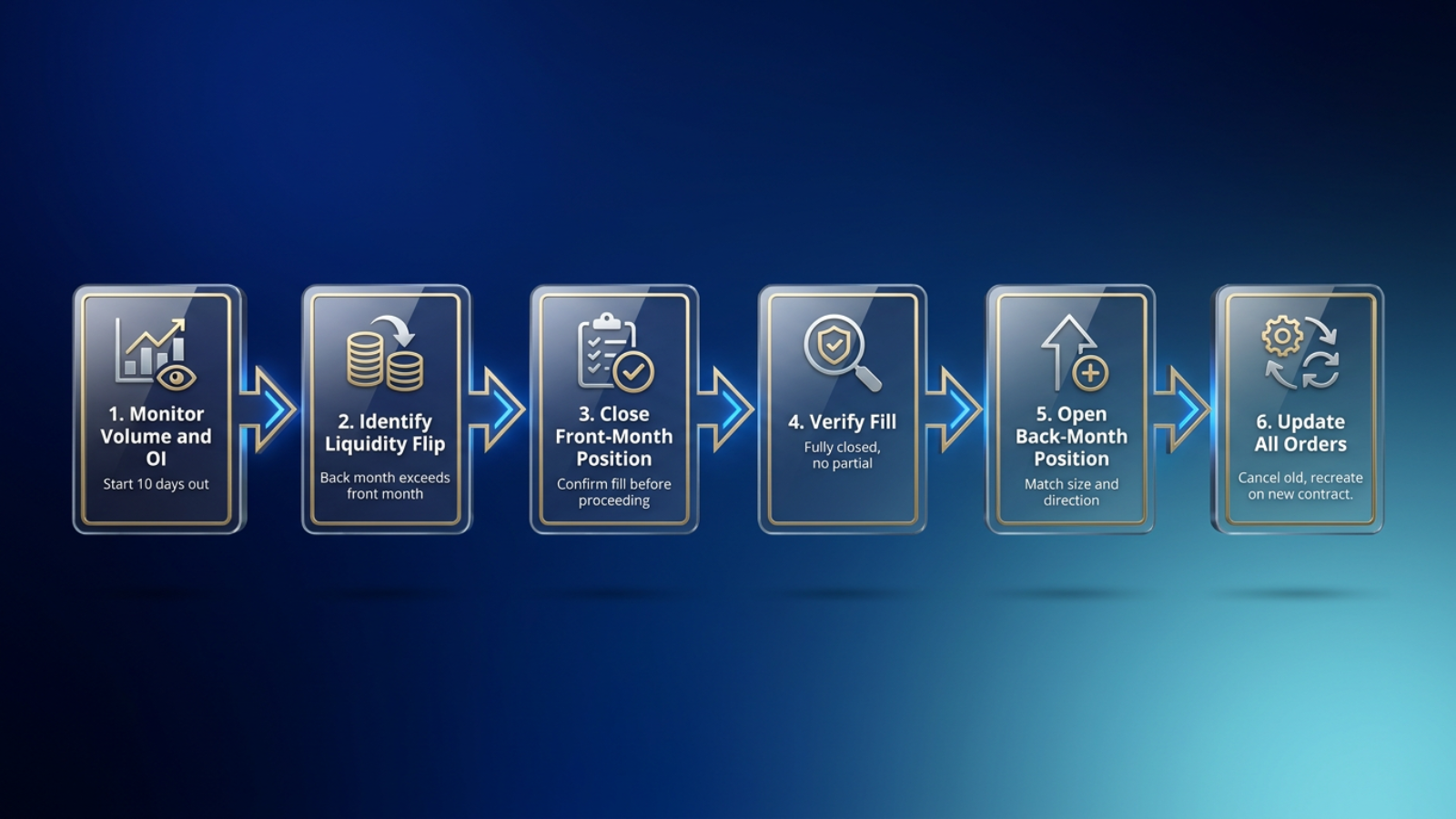
Step 1 — Monitor the option as the expiration date approaches. Check volume and open interest in both the expiring front-month and the next contract. If back-month volume is approaching or exceeding front-month volume, the roll is already underway.
Step 2 — Close the front-month position first. Submit a closing order using your preferred order type. Webull supports market orders, limit orders, stop limit orders, stop market orders, trailing stop orders, and OCO orders for futures positions.
Step 3 — Confirm the fill before proceeding. Verify the front-month position is fully closed before placing any new order. Do not open the back-month leg until the close is fully confirmed.
Step 4 — Open the back-month position. Enter the equivalent position in the next active contract month, matching the original size and direction.
Step 5 — Move all resting orders to the new contract. Cancel any stops, limits, or bracket orders attached to the old symbol. Recreate them on the new contract, adjusting price levels by the roll spread to account for the cost-of-carry difference between the two contracts.
4.5 Futures Products Available on Webull
Webull provides access to futures contracts across equity indices, interest rates, currencies, agricultural commodities, metals, energies, and cryptocurrencies. The futures market is open virtually 24 hours a day, six days a week, though specific trading hours vary by contract.
Customers place orders through exchanges including the Chicago Mercantile Exchange (CME) and the New York Mercantile Exchange (NYMEX). Each listed contract specifies the underlying asset, delivery location, delivery date, quantity, and, for physical commodities, acceptable quality.
Part 5. Open Interest, Rollover Volatility, and Critical Expiration Dates
5.1 How Open Interest Shifts During Rollover
Open interest (OI) is the total number of outstanding futures contracts that have not yet been settled or closed. It functions as a key indicator of market participation and trend strength.
During rollover periods, OI in the expiring contract decreases as traders close or transfer positions, while OI in the new contract increases. Commercial hedgers tend to be early movers, migrating OI before shorter-term traders follow. The point at which back-month volume and OI both exceed the front month's is known as the liquidity flip, and it serves as the most reliable practical signal that the rollover is underway.
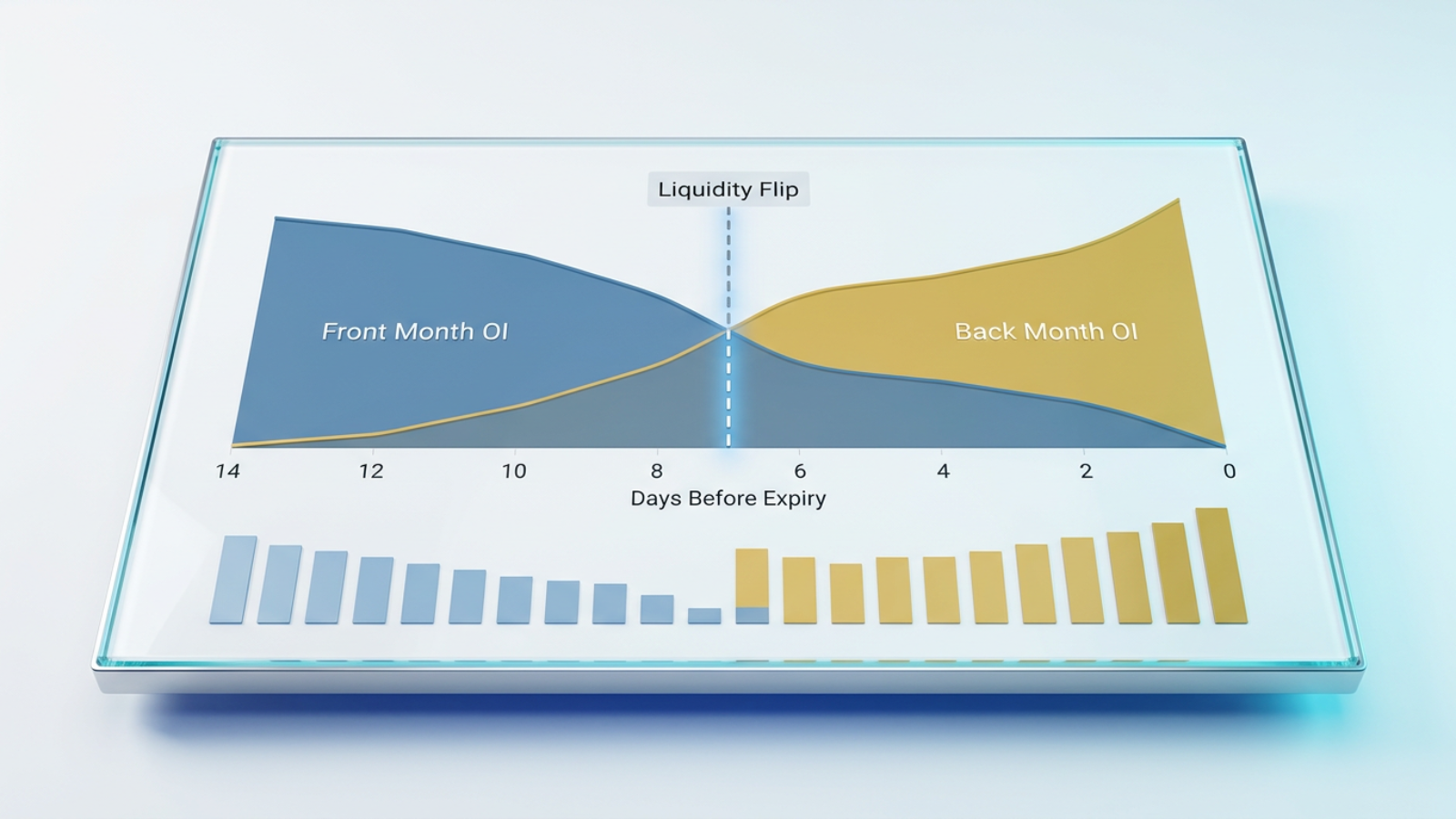
A sharp rise in OI in the new contract alongside rising prices in that contract can signal growing bullish participation. Conversely, declining OI in a rising market may indicate weakening trend momentum. Open interest is most useful when read alongside price and volume, not in isolation.
5.2 Triple and Quadruple Witching: Elevated Rollover Volatility
Rollover volatility is amplified on certain expiration dates when multiple derivative classes expire on the same day. Traders should plan for wider spreads and greater intraday price swings during these windows.
Double witching occurs eight times per year on the third Friday of each month except March, June, September, and December. Stock index futures and stock index options expire simultaneously.
Triple witching occurs four times per year, on the third Friday of March, June, September, and December, when stock index futures, stock index options, and stock options all expire on the same day.
Quadruple witching falls on those same four quarterly Fridays and adds single-stock futures to the mix. These periods can produce elevated volatility, wider spreads, and less predictable price behavior across futures markets.
5.3 Three Critical Dates Every Futures Trader Must Track
Three specific contract dates define the outer boundaries of rollover and delivery risk. Missing any one of them can result in forced liquidation or an unintended settlement.
The Last Holding Date is the final day a trader must act to avoid physical delivery. Physical delivery is not supported at Webull, so positions in physically deliverable contracts must be closed or managed before this date. If no action is taken by 11 AM on the last holding date, Webull may close the position.
The First Notice Date (FND) is the first day a buyer of a physically delivered contract can be notified of delivery assignment. The FND occurs after the last holding date. No open positions subject to physical delivery are held at Webull at this point.
The Last Trading Date is the final day a futures contract can be traded before settlement. Trading hours may differ on this date. After it passes, financially settled contracts are settled by the exchange's procedures, resulting in a debit or credit based on the final settlement value.
Rollover Timing: Pros and Cons of Acting Early vs. at the Liquidity Flip
Rolling Early (before liquidity flip) | Rolling at the Liquidity Flip | |
|---|---|---|
Advantage | More lead time, less time pressure | Better back-month liquidity, tighter spreads |
Disadvantage | Thinner back-month book, wider spreads, more slippage | Less margin for error if busy on that day |
Best suited for | Traders with infrequent monitoring schedules | Active traders watching volume and OI daily |
The Bottom Line
A futures contract rollover is a routine but precision-sensitive process. Knowing when each market rolls, how roll yield affects position cost, and how to manage orders and chart levels through the transition keeps a strategy running cleanly past expiration. Webull offers eligible US residents access to futures across a broad range of asset classes, with the account structure, order types, and margin tools needed to manage rollovers effectively. Futures trading involves significant risk and is not suitable for all investors.
Disclosure:
Please note futures trading involves substantial risk and is not suitable for all investors. Please read the FCM Risk Disclosure statement (https://www.webull.com/fcm-disclosures) prior to signing up for Futures Trading.
