'%3e %3cpath d='M41.7832962%2c0 C41.9459106%2c0 42.0882746%2c0.0866854658 42.1666825%2c0.216359069 C43.8289923%2c2.66540836 44.7676281%2c5.46271319 44.7676281%2c8.43208061 C44.7676281%2c18.1345746 34.7460532%2c26 22.383814%2c26 C10.0215749%2c26 0%2c18.1345746 0%2c8.43208061 C0%2c5.46716016 0.935826425%2c2.67378733 2.58829888%2c0.223985685 C2.67109477%2c0.0916264068 2.81687473%2c0 2.9840593%2c0 C3.23130408%2c0 3.43173558%2c0.200393004 3.43173558%2c0.447590303 C3.43173558%2c0.475056669 3.42926112%2c0.501945205 3.42452292%2c0.528045226 L3.41810883%2c0.550292077 C3.37800671%2c0.861741908 3.3575721%2c1.17661276 3.3575721%2c1.49443092 C3.3575721%2c7.98336 11.2132389%2c12.5742305 22.383814%2c12.5742305 C33.5543891%2c12.5742305 41.410056%2c7.98336 41.410056%2c1.49443092 C41.410056%2c1.17865223 41.3898828%2c0.865783153 41.3502888%2c0.556288325 C41.3402868%2c0.521941442 41.3356199%2c0.48531078 41.3356199%2c0.447590303 C41.3356199%2c0.200393004 41.5360514%2c0 41.7832962%2c0 Z' id='logo%e5%a4%87%e4%bb%bd-6' fill='white'%3e%3c/path%3e %3cpath d='M74.6899231%2c3.74404927 C75.2411227%2c3.74404927 75.7734299%2c3.66184338 76.2756219%2c3.50883715 L73.8159676%2c20.8666902 C73.5770593%2c22.5662954 72.8072434%2c23.0518969 71.4268838%2c23.0518969 L69.9934336%2c23.0518969 C68.7988917%2c23.0518969 68.1618027%2c22.458384 67.7901674%2c20.893668 L65.6930827%2c11.9909739 C65.639992%2c11.7481731 65.639992%2c11.6942174 65.5338105%2c11.6942174 C65.427629%2c11.6942174 65.4010836%2c11.7481731 65.3479929%2c11.9909739 L63.2509082%2c20.893668 C62.8792729%2c22.458384 62.2421839%2c23.0518969 61.047642%2c23.0518969 L59.6141918%2c23.0518969 C58.2338322%2c23.0518969 57.4640163%2c22.5662954 57.225108%2c20.8666902 L54.7463723%2c3.37406084 C55.3593498%2c3.61307396 56.0249975%2c3.74404927 56.7207458%2c3.74404927 C57.3314263%2c3.74404927 57.918917%2c3.64314414 58.4679557%2c3.4568446 L60.3574623%2c19.3829078 C60.3840076%2c19.6257086 60.3840076%2c19.7875757 60.4901891%2c19.7875757 C60.5963706%2c19.7875757 60.5963706%2c19.6257086 60.6494614%2c19.3829078 L62.9323637%2c9.91367858 C63.0916359%2c9.26620991 63.4632712%2c8.69967483 64.6047223%2c8.69967483 L66.4363532%2c8.69967483 C67.5778044%2c8.69967483 67.9494397%2c9.26620991 68.1087119%2c9.91367858 L70.3916142%2c19.3829078 C70.4447049%2c19.6257086 70.4447049%2c19.7875757 70.5508864%2c19.7875757 C70.6570679%2c19.7875757 70.6570679%2c19.6257086 70.6836133%2c19.3829078 L72.5891207%2c3.32292288 C73.2365902%2c3.59432921 73.9460524%2c3.74404927 74.6899231%2c3.74404927 Z' id='Combined-Shape' fill='white'%3e%3c/path%3e %3cpath d='M84.5933901%2c7.43171536 C88.6813779%2c7.43171536 90.9111894%2c10.2643908 90.9111894%2c14.2840921 L90.9111894%2c15.7948523 C90.9111894%2c16.2264981 90.7519172%2c16.4692988 90.3802819%2c16.4692988 L81.7264895%2c16.4692988 L81.7264895%2c16.5502324 C81.7264895%2c18.1149484 82.3635785%2c19.9764208 84.9119346%2c19.9764208 C86.849747%2c19.9764208 88.6813779%2c19.8145536 89.7962837%2c19.7066422 L89.8759198%2c19.7066422 C90.1413735%2c19.7066422 90.3537366%2c19.8415315 90.3537366%2c20.1113101 L90.3537366%2c21.8918489 C90.3537366%2c22.3234947 90.2741004%2c22.5123397 89.7962837%2c22.5932733 C88.0708343%2c22.9170076 87.0355646%2c23.0518969 84.6464808%2c23.0518969 C81.9919433%2c23.0518969 78.2225%2c21.5950924 78.2225%2c16.2804538 L78.2225%2c14.2840921 C78.2225%2c10.0755457 80.5319476%2c7.43171536 84.5933901%2c7.43171536 Z M84.5933901%2c10.5071915 C82.9475768%2c10.5071915 81.7530349%2c11.6942174 81.7530349%2c13.8254684 L81.7530349%2c13.9333799 L87.3806545%2c13.9333799 L87.3806545%2c13.8254684 C87.3806545%2c11.7211953 86.2392034%2c10.5071915 84.5933901%2c10.5071915 Z' id='Combined-Shape' fill='white'%3e%3c/path%3e %3cpath d='M97.4154906%2c2.98826245 L97.4148064%2c7.62056039 C98.3969853%2c7.48567108 99.3260735%2c7.43171536 99.9631625%2c7.43171536 C104.236968%2c7.43171536 106.307507%2c9.99461216 106.307507%2c14.2031585 L106.307507%2c16.2804538 C106.307507%2c20.4890001 104.236968%2c23.0518969 99.9631625%2c23.0518969 C98.2642584%2c23.0518969 96.2733553%2c22.7821183 94.627542%2c22.3504725 C94.0169984%2c22.1886054 93.9108169%2c22.0267382 93.9108169%2c21.6220703 L93.9098179%2c3.08694115 C94.4185466%2c3.24434375 94.9584615%2c3.32900525 95.5178331%2c3.32900525 C96.184659%2c3.32900525 96.8238351%2c3.20869291 97.4154906%2c2.98826245 Z M99.9631625%2c10.3453244 C99.3260735%2c10.3453244 98.1580769%2c10.4262579 97.4148064%2c10.5341694 L97.4148064%2c19.9494429 C97.9191686%2c20.0573544 99.007529%2c20.1382879 99.9631625%2c20.1382879 C102.246065%2c20.1382879 102.803518%2c18.4926384 102.803518%2c16.2804538 L102.803518%2c14.2031585 C102.803518%2c11.9909739 102.246065%2c10.3453244 99.9631625%2c10.3453244 Z' id='Combined-Shape' fill='white'%3e%3c/path%3e %3cpath d='M111.036668%2c8.72457747 C111.579488%2c8.72457747 112.103987%2c8.64485191 112.599444%2c8.49629404 L112.598761%2c16.5232546 C112.598761%2c19.3289521 113.607485%2c19.9764208 115.147117%2c19.9764208 L115.306389%2c19.9764208 C116.846021%2c19.9764208 117.854746%2c19.3289521 117.854746%2c16.5232546 L117.854207%2c8.4334735 C118.406525%2c8.62226395 118.997939%2c8.72457747 119.612866%2c8.72457747 C120.223332%2c8.72457747 120.810625%2c8.62374317 121.359498%2c8.43756894 L121.358735%2c16.5232546 C121.358735%2c22.4044283 116.872567%2c23.0518969 115.306389%2c23.0518969 L115.060464%2c23.0512514 C113.42215%2c23.0271041 109.094772%2c22.2994073 109.094772%2c16.5232546 L109.094446%2c8.36700801 C109.698522%2c8.59813531 110.353066%2c8.72457747 111.036668%2c8.72457747 Z' id='Combined-Shape' fill='white'%3e%3c/path%3e %3cpath d='M128.314162%2c3.03790128 L128.313623%2c22.269539 C128.313623%2c22.5662954 128.10126%2c22.836074 127.809261%2c22.836074 L125.340541%2c22.836074 C125.048542%2c22.836074 124.809634%2c22.5662954 124.809634%2c22.269539 L124.809455%2c3.04219481 C125.358161%2c3.22824247 125.945253%2c3.32900525 126.555503%2c3.32900525 C127.17043%2c3.32900525 127.761844%2c3.22669173 128.314162%2c3.03790128 Z' id='Combined-Shape' fill='white'%3e%3c/path%3e %3cpath d='M133.90653%2c3.32900525 C134.473329%2c3.32900525 135.02015%2c3.24208064 135.534793%2c3.08063296 L135.533966%2c22.269539 C135.533966%2c22.5662954 135.321603%2c22.836074 135.029603%2c22.836074 L132.560884%2c22.836074 C132.268884%2c22.836074 132.029976%2c22.5662954 132.029976%2c22.269539 L132.029909%2c2.99605058 C132.615669%2c3.21152525 133.2476%2c3.32900525 133.90653%2c3.32900525 Z' id='Combined-Shape' fill='white'%3e%3c/path%3e %3c/g%3e %3c/g%3e %3c/g%3e%3c/svg%3e)



Understanding futures contango and backwardation is essential for anyone trading commodity or financial futures. Whether you trade crude oil, equity index futures, or agricultural contracts, the shape of the futures curve directly affects strategy costs, roll yield, and risk management outcomes. This guide explains both concepts, what drives each market condition, and how curve structure can influence common futures trading approaches.
Key Takeaways
Contango means futures prices are higher than the spot price, producing an upward-sloping forward curve.
Backwardation means futures prices are lower than the spot price, producing a downward-sloping curve.
Contango typically creates a negative roll yield; backwardation typically creates a positive roll yield. Past performance does not guarantee future results.
The curve shape reflects supply, demand, carrying costs, and market sentiment.
Webull offers futures trading on indices, commodities, currencies, and more for eligible US residents.
Part 1. What Is Contango in Futures Markets?
Contango is one of the two primary states a futures market can occupy, and understanding it is foundational to any serious futures trading education.
1.1 Contango Definition
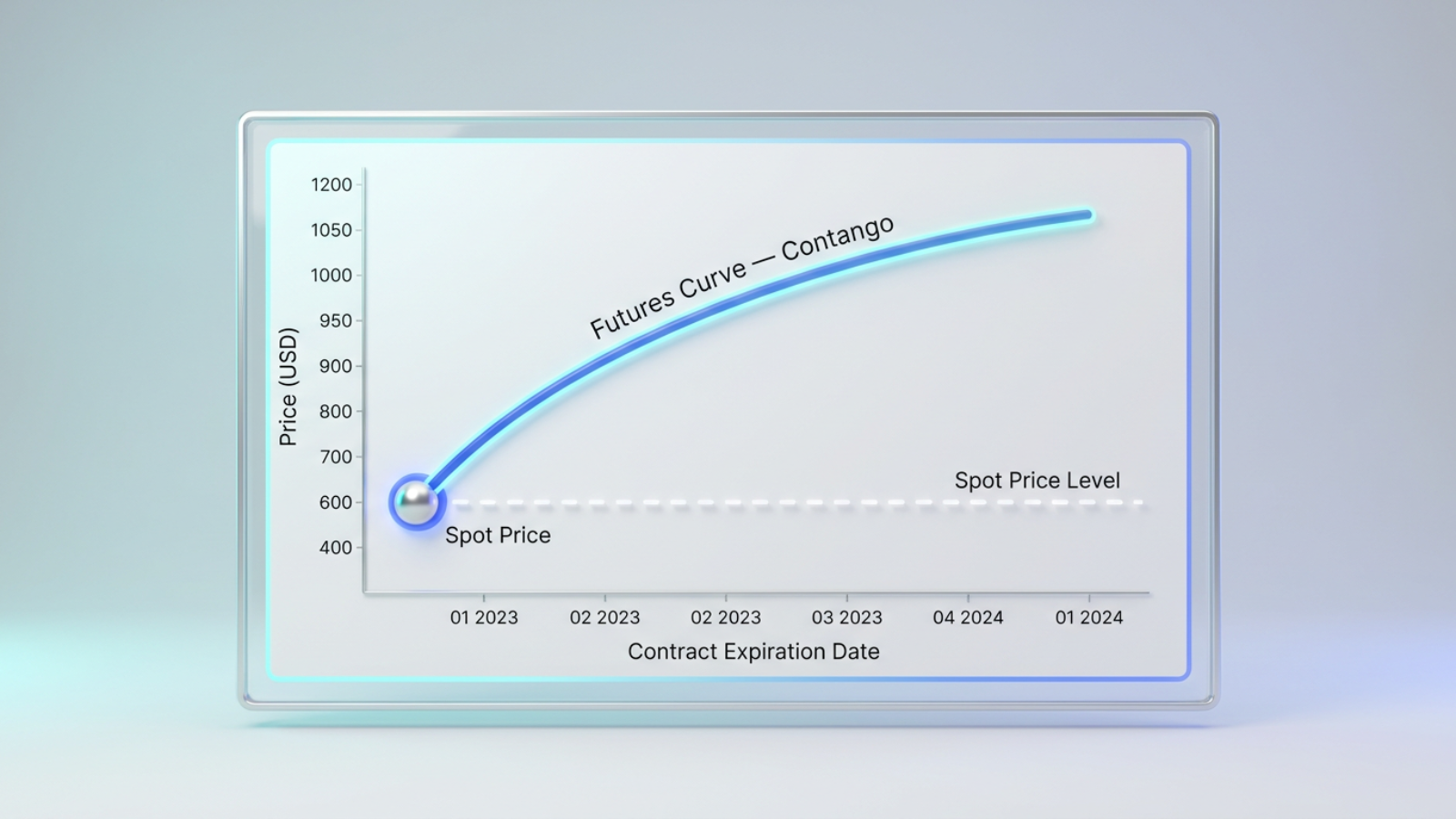
What is contango? Contango occurs when the futures price of an asset trades above the current spot price. This relationship produces a forward curve that slopes upward, with longer-dated contracts priced higher than shorter-dated ones.
Contango is generally considered the normal state for non-perishable commodities because holding physical inventory involves real costs. These carrying costs include storage fees, insurance, and the opportunity cost of capital tied up in inventory.
CME Group — https://www.cmegroup.com/education/courses/introduction-to-ferrous-metals/what-is-contango-and-backwardation
1.2 What Causes Contango?
Several market forces can push a futures curve into contango:
Near-term oversupply. When the market holds more of an asset than buyers need, producers cut prices to move inventory, pushing spot prices below futures prices.
Weak near-term demand. Soft current demand depresses spot prices, while longer-dated futures may remain elevated if a recovery is expected.
Bullish long-term sentiment. Expectations of rising future prices encourage traders to price a premium into longer-dated contracts.
Low convenience yield. When inventories are abundant, the implied benefit of holding physical supply is low, making futures contracts relatively more attractive than buying at spot.
1.3 Contango and the Cost of Carry
Contango should not exceed the full cost of carry. If the futures premium grew larger than storage, insurance, and financing costs combined, arbitrageurs would step in. They would buy the physical commodity at spot, store it, and sell the futures contract forward, locking in a spread until the gap closed.
This arbitrage mechanism acts as a natural ceiling on how steep a contango curve can become for storable commodities.
Part 2. What Is Backwardation in Futures Trading?
Backwardation is the opposite of contango and tends to signal tighter near-term market conditions.
2.1 Backwardation Definition
What is backwardation? Backwardation occurs when the futures price of an asset trades below the current spot price. This produces a downward-sloping (inverted) forward curve, with shorter-dated futures priced higher than longer-dated ones.
Backwardation is less common than contango but tends to appear during periods of acute supply tightness, geopolitical disruption, or unexpected spikes in near-term demand.
CME Group — https://www.cmegroup.com/education/courses/introduction-to-ferrous-metals/what-is-contango-and-backwardation
2.2 What Causes Backwardation?
Several factors can push a futures curve into backwardation:
Supply shortages. Near-term scarcity drives buyers to pay a premium for immediate delivery, pushing spot prices above futures prices.
Strong near-term demand. High current demand lifts spot prices while the market prices in a future normalization of conditions.
Bearish long-term sentiment. If participants expect prices to decline, futures prices for later delivery dates may remain depressed.
High convenience yield. When inventories are low, the benefit of holding physical supply rises significantly, pulling buyers toward the spot market and driving spot prices higher.
2.3 Convenience Yield and Backwardation
The convenience yield is an implied return on holding physical inventory rather than a futures contract. Consider a food manufacturer that needs a steady supply of grain. That company would rather hold physical stock than rely solely on futures, particularly when supplies are uncertain.
When warehouse stocks are low, convenience yield rises sharply. This elevated yield pulls buyers toward spot markets, widening the gap between spot and futures prices. According to CME Group, steep backwardation often signals that market participants perceive a genuine near-term shortage of the underlying commodity.
CME Group — https://www.cmegroup.com/education/courses/introduction-to-ferrous-metals/what-is-contango-and-backwardation
Part 3. Contango vs. Backwardation: Roll Yield, Convergence, and Strategy Costs
The shape of the futures curve has direct, measurable effects on trading costs and returns. Understanding these mechanics is critical before building any futures-based strategy.
3.1 Roll Yield: The Hidden Cost or Tailwind
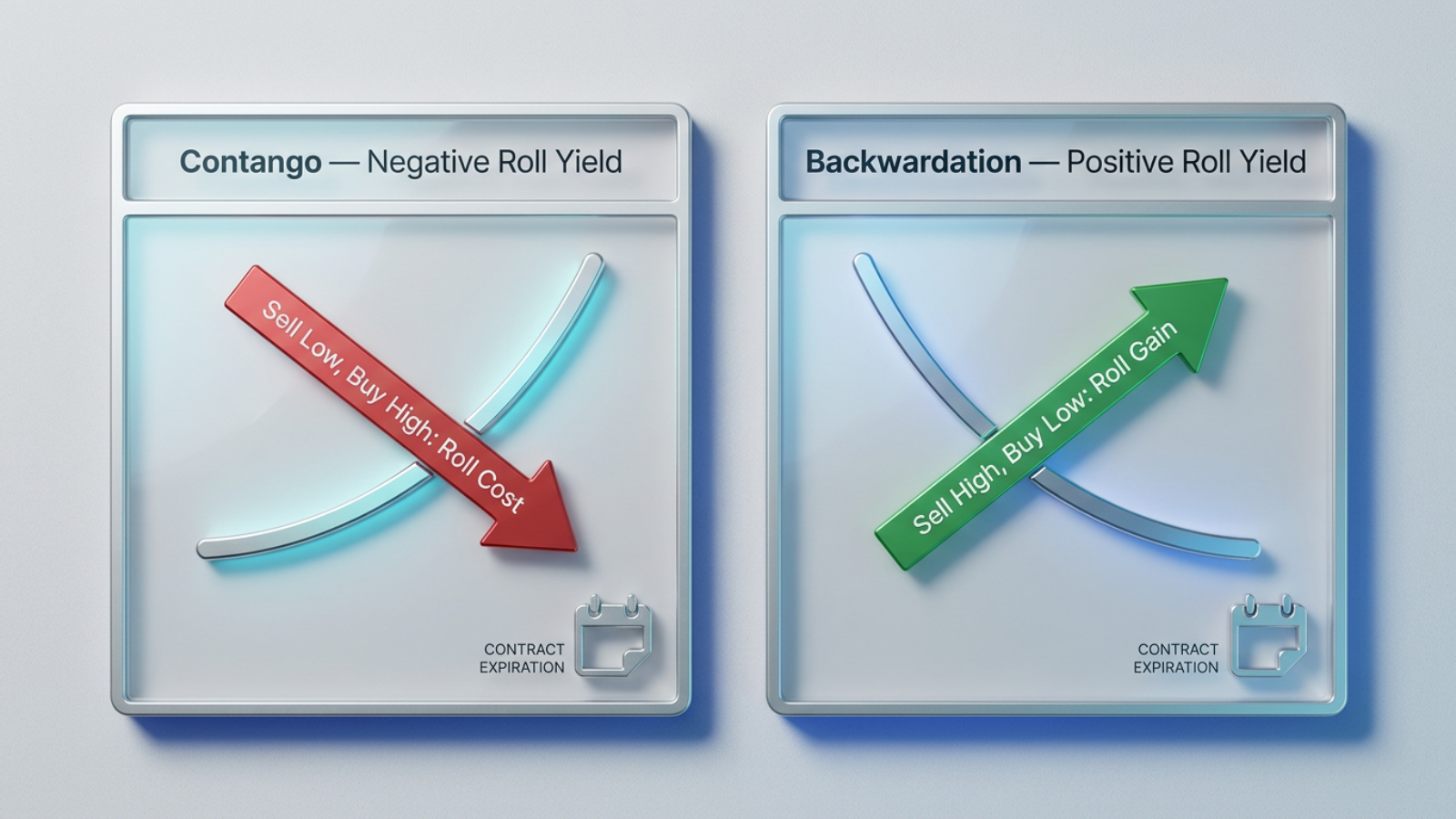
When a futures trader holds a position beyond the expiration of a contract, they must roll forward. This means selling the expiring contract and buying the next one. The price difference between the two contracts drives the roll yield.
In a contango market, the new contract is priced higher. The trader pays a premium to roll, creating a negative roll yield that can erode returns over time.
In a backwardation market, the new contract is priced lower. The trader sells the expiring contract at a higher price and buys the new one at a lower price, creating a positive roll yield.
Negative roll yield lowers potential returns even when spot prices are rising. Positive roll yield can add to returns when curve structure persists. However, past performance does not guarantee future results, and overall returns depend on many factors beyond roll yield alone.
3.2 Impact on Hedging Strategies
The curve shape directly affects the cost of maintaining a futures hedge. In a contango market, rolling a hedge forward is progressively more expensive, since each new longer-dated contract carries a higher price. This cumulative cost can weigh on the net effectiveness of a hedge over time.
Conversely, backwardation makes rolling a hedge less expensive. Selling an expiring contract at a higher price and purchasing a cheaper new contract reduces the cumulative cost of maintaining that hedge. The practical impact will vary based on the specific contracts used and prevailing market conditions.
3.3 Convergence: What Happens at Expiration
As a futures contract approaches its expiration date, its price and the spot price converge. This process is called convergence. Carrying costs diminish as delivery nears, narrowing the gap between the two prices naturally.
At expiration, a futures contract's price is typically equal to the spot price. If it were not, arbitrageurs would exploit the difference. Traders and hedgers should account for convergence when planning the timing of position exits or rolls, since it directly influences realized profit or loss relative to the original entry price.
CME Group — https://www.cmegroup.com/education/courses/introduction-to-ferrous-metals/what-is-contango-and-backwardation
Part 4. Real-World Examples: Contango and Backwardation in Commodity Markets
Seeing these concepts applied to actual market conditions helps traders recognize curve structures and their potential implications in practice.
4.1 Crude Oil Contango Example
In late 2014, rapid advances in hydraulic fracturing technology led to a surge in U.S. shale oil production. This created a global crude oil supply glut that sharply depressed near-term spot prices, while longer-dated futures contracts held relatively higher. The result was a pronounced contango curve.
Traders who were long front-month crude contracts and rolling forward during this period faced meaningful negative roll yield. The realized return on rolled futures positions was notably lower than the performance of unrolled spot prices suggested over the same period. Past performance does not guarantee future results.
4.2 Historical Crude Oil Curve Distribution
Research from CME Group shows that since 1985, the crude oil market has been in contango approximately 42% of the time and in backwardation approximately 58% of the time, measured by the price difference between the front-month contract and contracts six months forward.
Historical data also suggests that most crude oil bear markets coincided with periods of contango, while periods of backwardation more often corresponded with flat or rising prices. However, this historical pattern does not predict future outcomes. Past performance does not guarantee future results. There are documented examples of rising prices during contango and falling prices during backwardation.
4.3 Contango and Backwardation in Options Markets
These concepts extend beyond commodity futures. In the options market, contango and backwardation describe the term structure of implied volatility (IV). When IV for longer-dated options is higher than for shorter-dated options, the options market is in contango. When IV for shorter-dated options is higher, the market is in backwardation.
Contango is considered the normal state of the options market, reflecting greater uncertainty about how much an asset will move further into the future. Backwardation in the options market often reflects elevated near-term fear or uncertainty among participants.
Part 5. How to Trade Futures on Webull: Platform, Account Setup, and Key Considerations
For US traders looking to apply knowledge of contango and backwardation in live markets, Webull offers a futures trading platform designed for eligible individual account holders.
5.1 Eligibility and Account Setup
Webull provides futures trading to eligible US residents who hold an individual Webull brokerage account. Joint brokerage account holders cannot apply for a futures account separately under a joint account.
To open a futures account on the Webull mobile app:
Tap the Menu icon and select Settings.
Select Account Management.
Scroll down to Apply for new accounts.
Choose Futures and follow the application prompts.
To open via the Webull website:
Click your avatar in the top right and select My Account.
Click Explore more Accounts.
Scroll down, select Futures, and follow the prompts.
5.2 Minimum Requirements and Margin Types
Webull futures margin comes in three forms:
Intraday margin: The lowest requirement, applying to positions intended to be closed before the end of the intraday session (generally 9:00 AM to 4:15 PM ET). Intraday margin increases leverage, which can increase risk and may not be suitable for all investors.
Initial margin: Required when opening a position intended to be held beyond intraday hours. Typically between 3% and 12% of the futures contract's notional value, depending on the contract and market conditions.
Maintenance margin: The minimum equity required to hold a position beyond intraday hours after the initial margin requirement is met. It is lower than initial margin and varies by contract.
Rates vary by service provider; please refer to the latest pricing at Webull's Futures Margin Rates page.
5.3 Available Futures Products
Webull supports futures contracts across a broad range of asset classes, giving traders exposure to different markets. Available categories include:
Equity index futures (e.g., E-mini S&P 500, contract code: /ES)
Interest rate futures
Currency futures
Agricultural futures (e.g., grains, soybeans)
Metal futures (e.g., gold, silver)
Energy futures (e.g., crude oil, natural gas)
Cryptocurrency futures
Futures are traded through exchanges such as the Chicago Mercantile Exchange (CME) or the New York Mercantile Exchange (NYMEX). Customers place orders through the Webull platform.
5.4 Order Types, Trading Hours, and Contract Rolls
Webull futures trading supports multiple order types:
Market orders
Limit orders
Stop limit orders
Stop market orders
Trailing stop orders
OCO (One-Cancels-the-Other) orders
With an OCO order, both parts of the order are live in the marketplace simultaneously. Due to market volatility, it is possible that both legs could execute. Cancellations are performed on a best-efforts basis.
The futures market is open virtually 24 hours a day, six days a week, though each product has its own specific trading hours. Rolling a position means closing the current contract month and opening a new position in a further-traded contract month, making an awareness of contango or backwardation particularly relevant at roll time.
5.5 Funding and Physical Delivery Policies
Funding options for a Webull futures account:
Internal transfer: Move cash from a linked Webull brokerage account via the Transfer Money section in the app or on the website.
ACH deposit: Typically settles within 2-3 business days. Does not provide Instant Buying Power.
Wire transfer: Funds wired directly to the futures account. Include the Webull futures account number in the wire memo line.
Physical delivery is not supported at Webull. Positions that could result in physical delivery must be closed or managed by the Last Holding Date. If no action is taken by 11:00 AM ET on that date, Webull may close the position on the account holder's behalf.
For questions or support, Webull Futures can be reached at 888-816-0040 or futures@webull.com, Monday through Friday, 8:00 AM to 5:00 PM ET.
5.6 Regulation, Oversight, and Investor Protections
Webull Financial LLC is a member of FINRA and SIPC. Futures trading at Webull is conducted through Webull's registered futures affiliate, subject to oversight by the National Futures Association (NFA) and the Commodity Futures Trading Commission (CFTC).
Traders should be aware that futures are leveraged products. Leverage can multiply potential gains but also amplifies potential losses. A position may lose more than the initial margin deposited. Futures trading carries significant risk and may not be suitable for all investors.
FINRA — https://www.finra.org/
CFTC — https://www.cftc.gov/
The Bottom Line
Contango and backwardation describe the shape of the futures forward curve and directly affect roll yield, hedging costs, and strategy outcomes. Contango can create a negative roll yield; backwardation can create a positive one. Past performance does not guarantee future results. Recognizing these conditions may help traders manage risk and evaluate strategy costs more clearly. Eligible US traders can explore futures markets across indices, commodities, and more through Webull's platform.
Disclosure:
Please note futures trading involves substantial risk and is not suitable for all investors. Please read the FCM Risk Disclosure statement (https://www.webull.com/fcm-disclosures) prior to signing up for Futures Trading.
