'%3e %3cpath d='M41.7832962%2c0 C41.9459106%2c0 42.0882746%2c0.0866854658 42.1666825%2c0.216359069 C43.8289923%2c2.66540836 44.7676281%2c5.46271319 44.7676281%2c8.43208061 C44.7676281%2c18.1345746 34.7460532%2c26 22.383814%2c26 C10.0215749%2c26 0%2c18.1345746 0%2c8.43208061 C0%2c5.46716016 0.935826425%2c2.67378733 2.58829888%2c0.223985685 C2.67109477%2c0.0916264068 2.81687473%2c0 2.9840593%2c0 C3.23130408%2c0 3.43173558%2c0.200393004 3.43173558%2c0.447590303 C3.43173558%2c0.475056669 3.42926112%2c0.501945205 3.42452292%2c0.528045226 L3.41810883%2c0.550292077 C3.37800671%2c0.861741908 3.3575721%2c1.17661276 3.3575721%2c1.49443092 C3.3575721%2c7.98336 11.2132389%2c12.5742305 22.383814%2c12.5742305 C33.5543891%2c12.5742305 41.410056%2c7.98336 41.410056%2c1.49443092 C41.410056%2c1.17865223 41.3898828%2c0.865783153 41.3502888%2c0.556288325 C41.3402868%2c0.521941442 41.3356199%2c0.48531078 41.3356199%2c0.447590303 C41.3356199%2c0.200393004 41.5360514%2c0 41.7832962%2c0 Z' id='logo%e5%a4%87%e4%bb%bd-6' fill='white'%3e%3c/path%3e %3cpath d='M74.6899231%2c3.74404927 C75.2411227%2c3.74404927 75.7734299%2c3.66184338 76.2756219%2c3.50883715 L73.8159676%2c20.8666902 C73.5770593%2c22.5662954 72.8072434%2c23.0518969 71.4268838%2c23.0518969 L69.9934336%2c23.0518969 C68.7988917%2c23.0518969 68.1618027%2c22.458384 67.7901674%2c20.893668 L65.6930827%2c11.9909739 C65.639992%2c11.7481731 65.639992%2c11.6942174 65.5338105%2c11.6942174 C65.427629%2c11.6942174 65.4010836%2c11.7481731 65.3479929%2c11.9909739 L63.2509082%2c20.893668 C62.8792729%2c22.458384 62.2421839%2c23.0518969 61.047642%2c23.0518969 L59.6141918%2c23.0518969 C58.2338322%2c23.0518969 57.4640163%2c22.5662954 57.225108%2c20.8666902 L54.7463723%2c3.37406084 C55.3593498%2c3.61307396 56.0249975%2c3.74404927 56.7207458%2c3.74404927 C57.3314263%2c3.74404927 57.918917%2c3.64314414 58.4679557%2c3.4568446 L60.3574623%2c19.3829078 C60.3840076%2c19.6257086 60.3840076%2c19.7875757 60.4901891%2c19.7875757 C60.5963706%2c19.7875757 60.5963706%2c19.6257086 60.6494614%2c19.3829078 L62.9323637%2c9.91367858 C63.0916359%2c9.26620991 63.4632712%2c8.69967483 64.6047223%2c8.69967483 L66.4363532%2c8.69967483 C67.5778044%2c8.69967483 67.9494397%2c9.26620991 68.1087119%2c9.91367858 L70.3916142%2c19.3829078 C70.4447049%2c19.6257086 70.4447049%2c19.7875757 70.5508864%2c19.7875757 C70.6570679%2c19.7875757 70.6570679%2c19.6257086 70.6836133%2c19.3829078 L72.5891207%2c3.32292288 C73.2365902%2c3.59432921 73.9460524%2c3.74404927 74.6899231%2c3.74404927 Z' id='Combined-Shape' fill='white'%3e%3c/path%3e %3cpath d='M84.5933901%2c7.43171536 C88.6813779%2c7.43171536 90.9111894%2c10.2643908 90.9111894%2c14.2840921 L90.9111894%2c15.7948523 C90.9111894%2c16.2264981 90.7519172%2c16.4692988 90.3802819%2c16.4692988 L81.7264895%2c16.4692988 L81.7264895%2c16.5502324 C81.7264895%2c18.1149484 82.3635785%2c19.9764208 84.9119346%2c19.9764208 C86.849747%2c19.9764208 88.6813779%2c19.8145536 89.7962837%2c19.7066422 L89.8759198%2c19.7066422 C90.1413735%2c19.7066422 90.3537366%2c19.8415315 90.3537366%2c20.1113101 L90.3537366%2c21.8918489 C90.3537366%2c22.3234947 90.2741004%2c22.5123397 89.7962837%2c22.5932733 C88.0708343%2c22.9170076 87.0355646%2c23.0518969 84.6464808%2c23.0518969 C81.9919433%2c23.0518969 78.2225%2c21.5950924 78.2225%2c16.2804538 L78.2225%2c14.2840921 C78.2225%2c10.0755457 80.5319476%2c7.43171536 84.5933901%2c7.43171536 Z M84.5933901%2c10.5071915 C82.9475768%2c10.5071915 81.7530349%2c11.6942174 81.7530349%2c13.8254684 L81.7530349%2c13.9333799 L87.3806545%2c13.9333799 L87.3806545%2c13.8254684 C87.3806545%2c11.7211953 86.2392034%2c10.5071915 84.5933901%2c10.5071915 Z' id='Combined-Shape' fill='white'%3e%3c/path%3e %3cpath d='M97.4154906%2c2.98826245 L97.4148064%2c7.62056039 C98.3969853%2c7.48567108 99.3260735%2c7.43171536 99.9631625%2c7.43171536 C104.236968%2c7.43171536 106.307507%2c9.99461216 106.307507%2c14.2031585 L106.307507%2c16.2804538 C106.307507%2c20.4890001 104.236968%2c23.0518969 99.9631625%2c23.0518969 C98.2642584%2c23.0518969 96.2733553%2c22.7821183 94.627542%2c22.3504725 C94.0169984%2c22.1886054 93.9108169%2c22.0267382 93.9108169%2c21.6220703 L93.9098179%2c3.08694115 C94.4185466%2c3.24434375 94.9584615%2c3.32900525 95.5178331%2c3.32900525 C96.184659%2c3.32900525 96.8238351%2c3.20869291 97.4154906%2c2.98826245 Z M99.9631625%2c10.3453244 C99.3260735%2c10.3453244 98.1580769%2c10.4262579 97.4148064%2c10.5341694 L97.4148064%2c19.9494429 C97.9191686%2c20.0573544 99.007529%2c20.1382879 99.9631625%2c20.1382879 C102.246065%2c20.1382879 102.803518%2c18.4926384 102.803518%2c16.2804538 L102.803518%2c14.2031585 C102.803518%2c11.9909739 102.246065%2c10.3453244 99.9631625%2c10.3453244 Z' id='Combined-Shape' fill='white'%3e%3c/path%3e %3cpath d='M111.036668%2c8.72457747 C111.579488%2c8.72457747 112.103987%2c8.64485191 112.599444%2c8.49629404 L112.598761%2c16.5232546 C112.598761%2c19.3289521 113.607485%2c19.9764208 115.147117%2c19.9764208 L115.306389%2c19.9764208 C116.846021%2c19.9764208 117.854746%2c19.3289521 117.854746%2c16.5232546 L117.854207%2c8.4334735 C118.406525%2c8.62226395 118.997939%2c8.72457747 119.612866%2c8.72457747 C120.223332%2c8.72457747 120.810625%2c8.62374317 121.359498%2c8.43756894 L121.358735%2c16.5232546 C121.358735%2c22.4044283 116.872567%2c23.0518969 115.306389%2c23.0518969 L115.060464%2c23.0512514 C113.42215%2c23.0271041 109.094772%2c22.2994073 109.094772%2c16.5232546 L109.094446%2c8.36700801 C109.698522%2c8.59813531 110.353066%2c8.72457747 111.036668%2c8.72457747 Z' id='Combined-Shape' fill='white'%3e%3c/path%3e %3cpath d='M128.314162%2c3.03790128 L128.313623%2c22.269539 C128.313623%2c22.5662954 128.10126%2c22.836074 127.809261%2c22.836074 L125.340541%2c22.836074 C125.048542%2c22.836074 124.809634%2c22.5662954 124.809634%2c22.269539 L124.809455%2c3.04219481 C125.358161%2c3.22824247 125.945253%2c3.32900525 126.555503%2c3.32900525 C127.17043%2c3.32900525 127.761844%2c3.22669173 128.314162%2c3.03790128 Z' id='Combined-Shape' fill='white'%3e%3c/path%3e %3cpath d='M133.90653%2c3.32900525 C134.473329%2c3.32900525 135.02015%2c3.24208064 135.534793%2c3.08063296 L135.533966%2c22.269539 C135.533966%2c22.5662954 135.321603%2c22.836074 135.029603%2c22.836074 L132.560884%2c22.836074 C132.268884%2c22.836074 132.029976%2c22.5662954 132.029976%2c22.269539 L132.029909%2c2.99605058 C132.615669%2c3.21152525 133.2476%2c3.32900525 133.90653%2c3.32900525 Z' id='Combined-Shape' fill='white'%3e%3c/path%3e %3c/g%3e %3c/g%3e %3c/g%3e%3c/svg%3e)



Futures trading offers leveraged access to a wide range of markets, but before placing your first trade, you need to understand futures margin requirements. Unlike stock margin, which involves borrowing money from a broker, futures margin is a good-faith deposit that ensures you can cover potential losses. Knowing the difference between initial margin vs. maintenance margin for futures can help you manage capital more effectively and avoid unexpected liquidations.
Key Takeaways
Futures margin is a performance bond, not a loan; it represents a small percentage of a contract's total notional value.
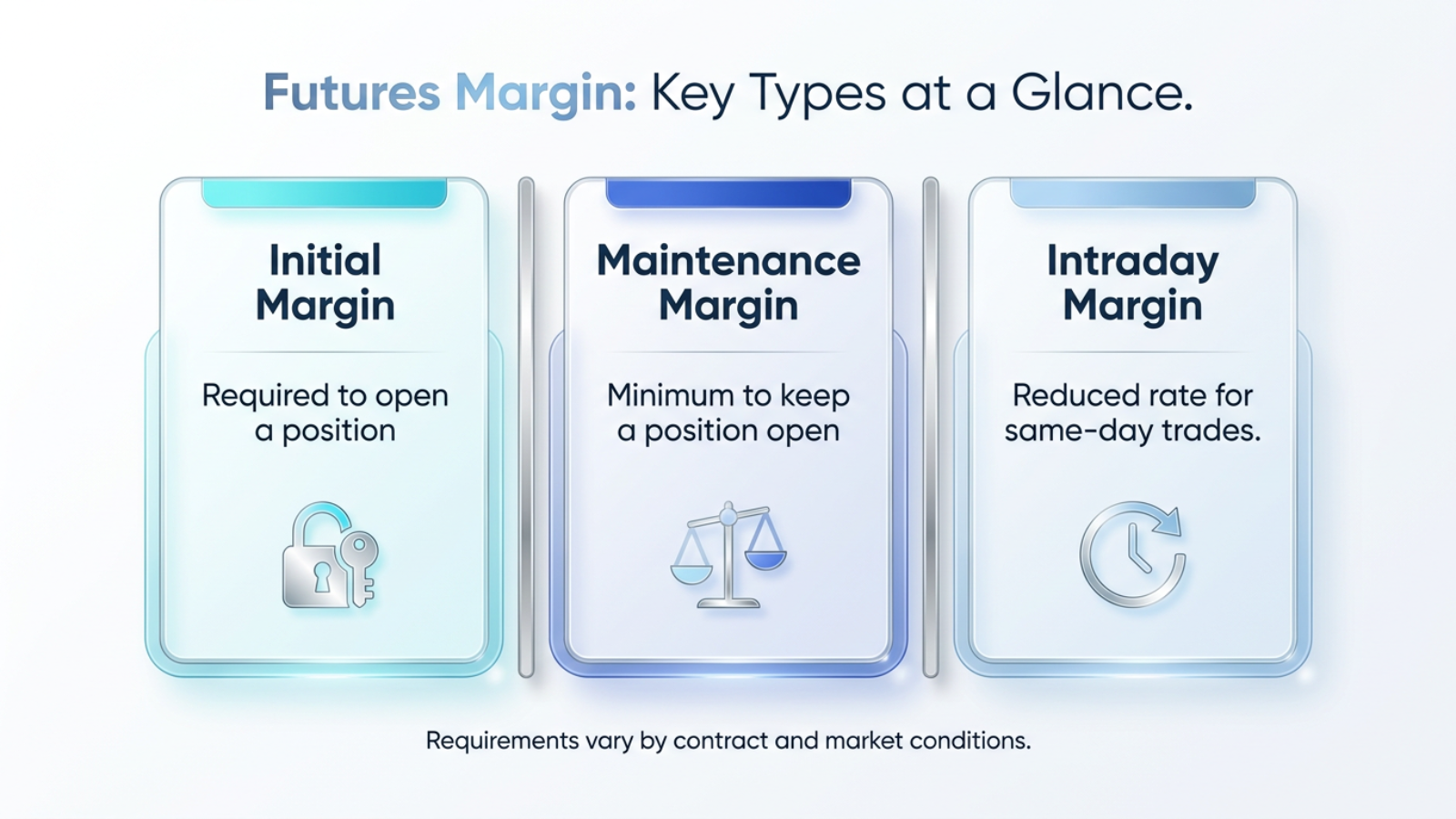
There are three main types: initial margin, maintenance margin, and intraday (day trading) margin.
Exchanges like CME Group set baseline requirements; brokers may add their own overlays.
Margin requirements change with market volatility, news events, and structural contract updates.
If your account falls below the maintenance margin level, you may receive a margin call or face position liquidation.
Part 1. What Are Futures Margin Requirements?
A futures margin requirement is the minimum amount of money a trader must deposit in their account to open and hold a futures position. It is not a down payment toward ownership of an asset. Instead, it functions as collateral, sometimes called a "performance bond," that protects all parties involved in the contract.
Futures margin requirements are calculated based on the potential risk of price movement in a given contract. The CME Group uses a risk model called SPAN (Standard Portfolio Analysis of Risk), which evaluates 16 different price scenarios to determine the maximum likely loss over a one-day period. The margin is then set to cover 99% of those scenarios.
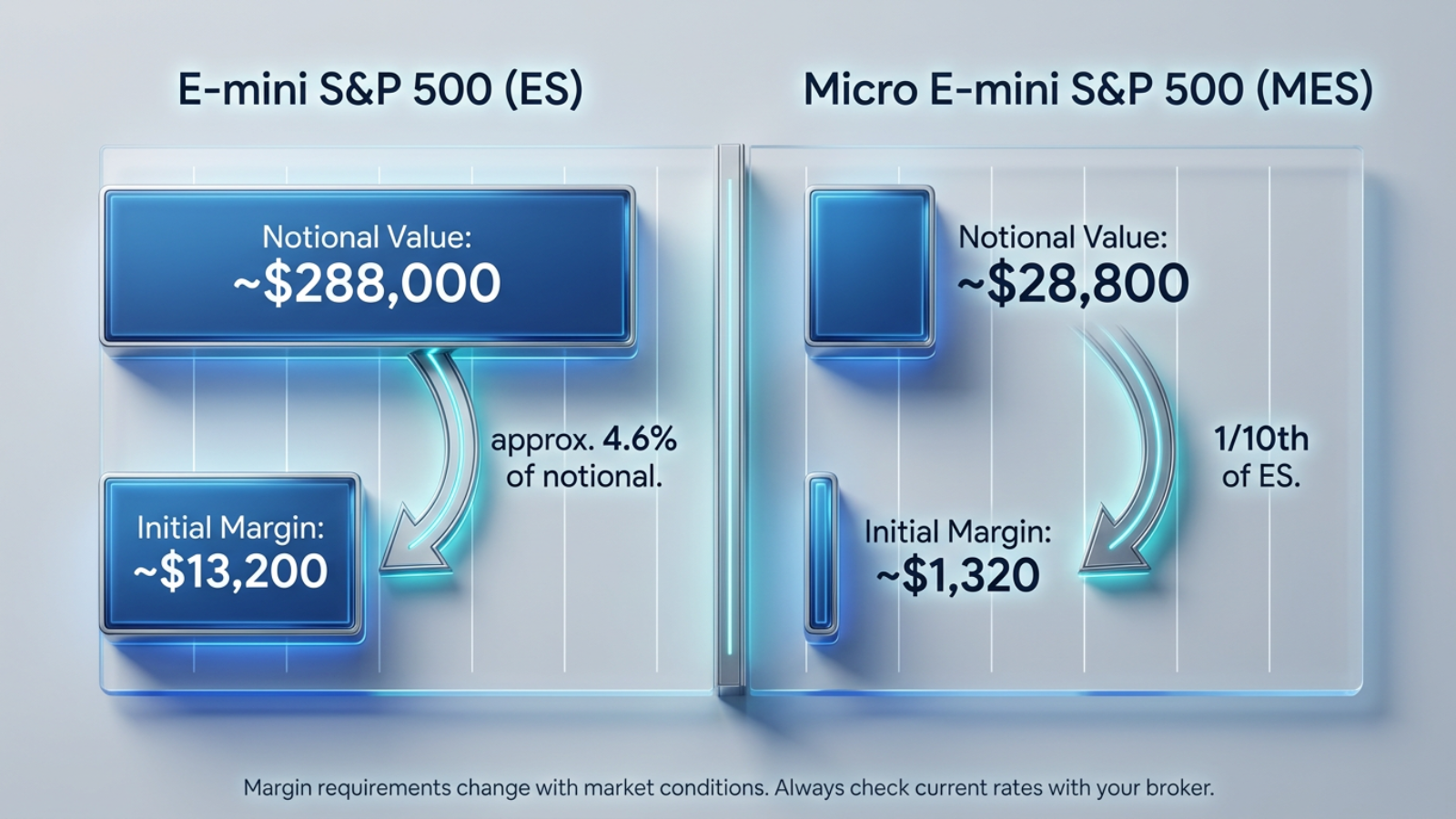
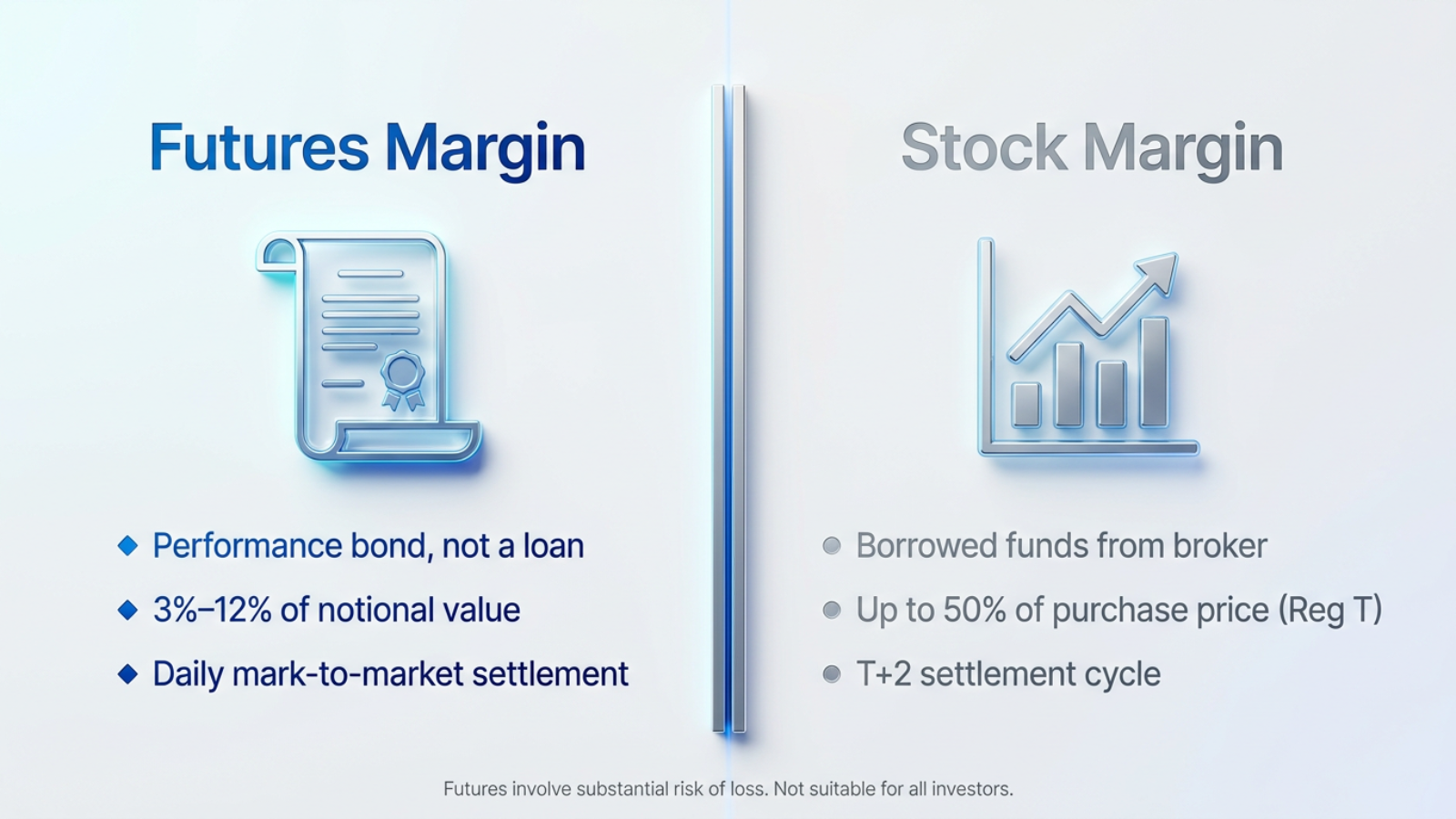
Because futures use leverage, the margin requirement is typically a small fraction of the contract's notional value. According to CME Group, futures margin generally represents 3% to 12% of the notional value of the contract. This is significantly lower than stock margin, which under Federal Reserve Regulation T allows borrowing up to 50% of the purchase price.
CME Group — https://www.cmegroup.com/education/courses/introduction-to-futures/margin-know-what-is-needed
It is important to note that futures are leveraged products. While leverage can amplify potential gains, it can also amplify losses. Traders should be aware that it is possible to lose more than the initial margin deposited to open a futures position.
Part 2. Types of Futures Margin Requirements Explained
Understanding the different types of futures margin is essential before placing any trade. Each type serves a distinct purpose and applies at different stages of holding a futures position.
2.1 Initial Margin
Initial margin is the amount of equity required in your account to open a new futures position. This is the starting threshold, whether you plan to hold the position overnight or through a future expiration date.
On Webull, initial margin applies when you open a position with the intention of holding it through the end of intraday trading hours, or when opening a position outside of those hours. The initial margin requirement on Webull is typically between 3% and 12% of the futures contract's notional value, depending on the contract and current market conditions.
2.2 Maintenance Margin
Maintenance margin is the minimum equity level you must maintain in your account once a position is open. It is always lower than the initial margin requirement.
On Webull, if your account equity drops below the maintenance margin level, you will be asked to bring the account back up to the initial margin requirement. If this is not done promptly, your position may be liquidated.
As an illustration: if the initial margin for one ES contract is $13,200 and the maintenance margin is approximately $10,000 to $11,000, a move of roughly 80 points against your position (a $4,000 loss on a single contract) could bring your equity close to the margin call threshold.
CME Group — https://www.cmegroup.com/education/courses/introduction-to-futures/margin-know-what-is-needed
2.3 Intraday (Day Trading) Margin
Intraday margin, also called day trading margin, is the reduced margin requirement available for positions opened and closed within designated intraday trading hours, with no intention of holding through the session close.
On Webull, intraday margin is the lowest margin requirement available for eligible contracts. It generally applies between 9:00 AM ET and 4:15 PM ET. Intraday margin increases leverage, which can increase risk and may not be suitable for all investors.
Brokers set their own intraday margin rates, and these can be significantly lower than exchange-level initial margin. However, if a position is not closed before the intraday session ends, the account must meet the full initial margin requirement. Failure to do so can result in automatic position liquidation at market prices.
Part 3. How Futures Margin Requirements Are Set and Why They Change
Margin requirements are not fixed. They are dynamic and reflect the current state of the market. Knowing who sets them and what drives changes can help traders plan better and avoid surprises.
3.1 Who Sets Margin Requirements
Two entities determine the margin requirements a trader must meet: the exchange and the broker.
The exchange establishes the baseline initial and maintenance margin levels. For contracts like the ES, NQ, and their micro equivalents, that is CME Group. According to CME Group, margins are evaluated at the end of each trading day.
The broker can increase margin requirements above exchange levels based on their own risk assessment. Brokers may also offer reduced intraday margin rates to attract active retail traders. This broker-level flexibility means requirements can vary across platforms.
3.2 Why Margins Change
Margin requirements are designed to reflect real-time risk. Several factors commonly drive changes:
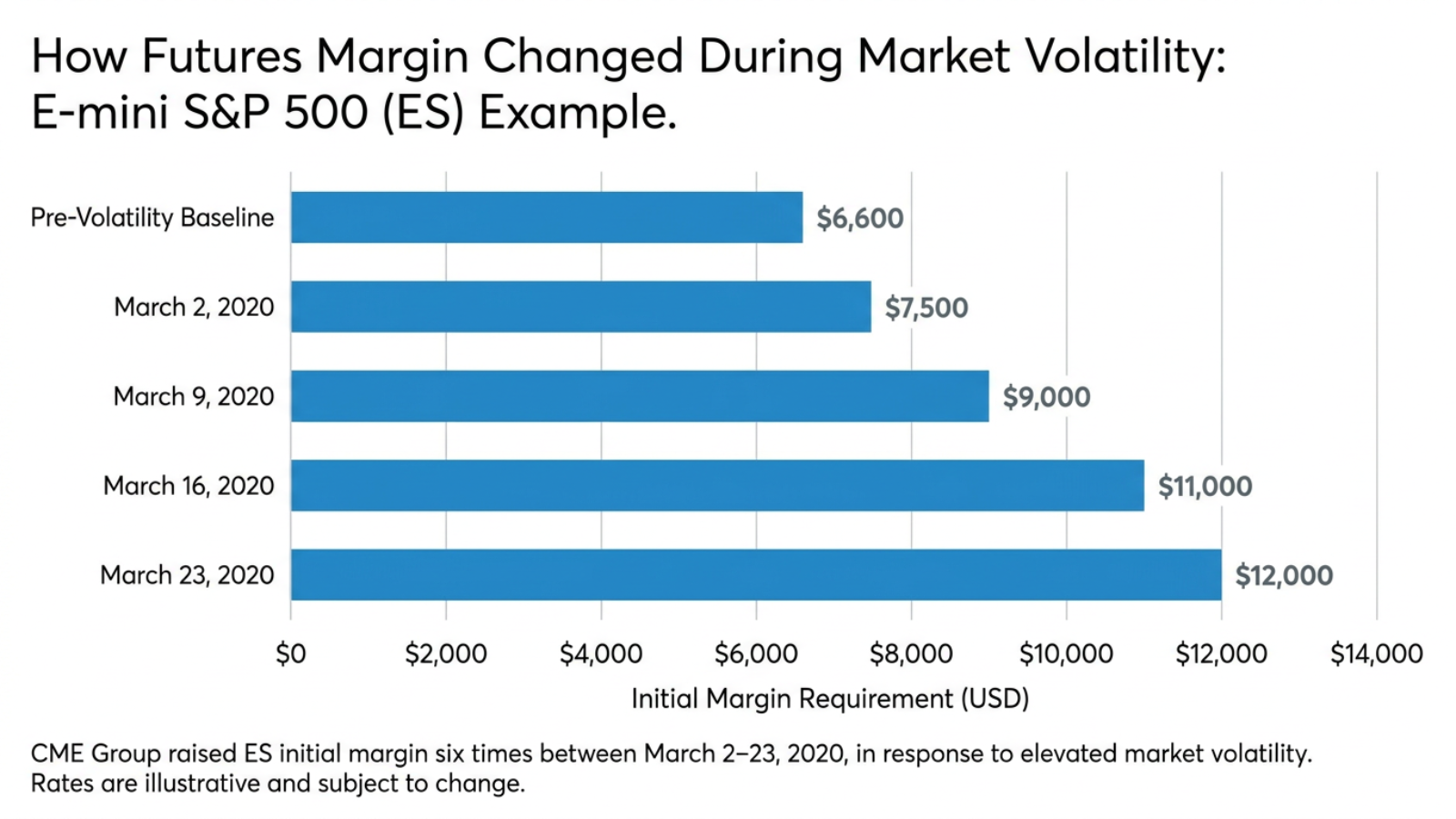
Market volatility: When price swings become more extreme, exchanges raise margins to ensure traders can cover potential losses. During the March 2020 onset of the COVID-19 pandemic, the CME raised margins on the E-mini S&P 500 six times between March 2 and March 23, 2020. The initial margin for the E-mini S&P 500 rose from approximately $6,600 to $12,000 during that period.
News and geopolitical events: Elections, armed conflict, and unexpected macroeconomic announcements can prompt temporary margin increases as a risk safeguard.
Liquidity: Reduced liquidity, such as during non-US market hours, can lead brokers to apply higher intraday margins.
Contract structure changes: Updates to tick size, lot size, or the exchange's risk model can also affect margin levels.
Part 4. Futures Margin vs. Stock Margin: Key Differences
Traders coming from equities often find futures margin works very differently. The table below outlines the core distinctions.
Feature | Futures Margin | Stock Margin |
|---|---|---|
Nature | Performance bond (collateral) | Borrowing from broker |
Requirement level | Typically 3%–12% of notional value | Up to 50% of purchase price (Reg T) |
Interest charged | No interest on margin deposit | Interest applies on borrowed funds |
Settlement | Daily mark-to-market | T+2 settlement |
Margin call response | Same-day; may be immediate | May allow several days to respond |
PDT rule | No minimum account size for day trading | $25,000 minimum for unlimited day trading |
Leverage | 20:1 or higher is common | Up to 2:1 for most retail traders |
One of the most significant differences is that futures are subject to daily mark-to-market settlement. Gains and losses are credited or debited to your account at the end of each trading day, even if the position remains open. This means unrealized losses become very real every day, unlike stocks where unrealized losses are not settled until a position is closed.
Part 5. How to Trade Futures with Webull and Meet Margin Requirements
Webull offers futures trading to eligible US residents across a range of asset classes, including indices, interest rates, currencies, agriculture, metals, energies, and cryptocurrencies. Futures are traded through exchanges such as the Chicago Mercantile Exchange (CME) or the New York Mercantile Exchange (NYMEX), and customers can place orders through Webull.
Learn more about Webull's futures offerings at Webull Futures.
5.1 Opening a Futures Account on Webull
To be eligible for a futures account with Webull, you must:
Be a resident of the United States.
Have an existing individual Webull brokerage account (not a joint brokerage account).
Complete the futures account application.
Via the Webull mobile app:
Tap the Menu logo, then select Settings.
Tap Account Management.
Scroll down and select Apply for new accounts.
Choose Futures and follow the application prompts.
Via the Webull website:
Click on your avatar or photo in the top right and select My Account.
Click Explore more Accounts.
Scroll down and select Futures.
Click the hyperlink "Open Futures Account" and follow the prompts.
5.2 Funding Your Futures Account
Once approved, you can fund your Webull futures account through the following methods:
Internal Transfer: Move cash from your Webull brokerage account to your futures account through the Transfer Money section in the app or website.
ACH: Deposit funds directly into your futures account. ACH deposits typically settle within 2 to 3 business days and do not provide Instant Buying Power.
Wire Transfer: Deposit funds via wire. When wiring directly to your futures account, include your Webull futures account number in the memo section.
5.3 Margin Requirements on Webull
To place any trade, you must meet the applicable margin requirement for the specific futures contract you intend to trade. For a full list of margin requirements across all supported futures products, Webull provides a dedicated Futures Margin Rates page.
Webull provides three types of futures margin:
Intraday margin: The lowest requirement, available for positions opened and closed within designated intraday hours (generally 9:00 AM to 4:15 PM ET for eligible contracts).
Initial margin: Required when opening a position outside intraday hours or when intending to hold through the session close. Typically 3% to 12% of the contract's notional value.
Maintenance margin: The minimum equity needed to hold a position past intraday trading hours. Lower than the initial margin; varies by contract.
Order types available on Webull for futures trading include market orders, limit orders, stop limit orders, stop market orders, trailing stop orders, and OCO (one-cancels-other) orders.
Traders can contact the Webull Futures support team by phone at 888-816-0040 or by email at futures@webull.com, Monday through Friday, 8:00 AM to 5:00 PM ET.
5.4 What Happens If You Fall Below Margin on Webull
If your account equity drops below the maintenance margin requirement due to adverse price movements, Webull will require you to deposit sufficient funds to bring the account back up to the initial margin level. If you do not meet this requirement, your position may be liquidated.
Webull also enforces last holding date policies to prevent physical delivery. Physical delivery is not supported on Webull, so positions in physically deliverable contracts must be closed or managed before the last holding date. If no action is taken by 11 AM ET on the last holding date, Webull may close the position on your behalf.
Buying power on Webull is calculated as: Cash + Margin Requirements minus open orders. It is not the same as your cash balance.
The Bottom Line
Futures margin requirements define how much capital you need to open and hold a position, and they shift with market conditions. Understanding the difference between initial, maintenance, and intraday margin is foundational to managing risk effectively. Webull provides futures trading access for eligible US residents with transparent margin structures, multiple order types, and dedicated support. Always review current margin rates before placing a trade, as requirements can change.
Disclosure:
Please note futures trading involves substantial risk and is not suitable for all investors. Please read the FCM Risk Disclosure statement (https://www.webull.com/fcm-disclosures) prior to signing up for Futures Trading.
