'%3e %3cpath d='M41.7832962%2c0 C41.9459106%2c0 42.0882746%2c0.0866854658 42.1666825%2c0.216359069 C43.8289923%2c2.66540836 44.7676281%2c5.46271319 44.7676281%2c8.43208061 C44.7676281%2c18.1345746 34.7460532%2c26 22.383814%2c26 C10.0215749%2c26 0%2c18.1345746 0%2c8.43208061 C0%2c5.46716016 0.935826425%2c2.67378733 2.58829888%2c0.223985685 C2.67109477%2c0.0916264068 2.81687473%2c0 2.9840593%2c0 C3.23130408%2c0 3.43173558%2c0.200393004 3.43173558%2c0.447590303 C3.43173558%2c0.475056669 3.42926112%2c0.501945205 3.42452292%2c0.528045226 L3.41810883%2c0.550292077 C3.37800671%2c0.861741908 3.3575721%2c1.17661276 3.3575721%2c1.49443092 C3.3575721%2c7.98336 11.2132389%2c12.5742305 22.383814%2c12.5742305 C33.5543891%2c12.5742305 41.410056%2c7.98336 41.410056%2c1.49443092 C41.410056%2c1.17865223 41.3898828%2c0.865783153 41.3502888%2c0.556288325 C41.3402868%2c0.521941442 41.3356199%2c0.48531078 41.3356199%2c0.447590303 C41.3356199%2c0.200393004 41.5360514%2c0 41.7832962%2c0 Z' id='logo%e5%a4%87%e4%bb%bd-6' fill='white'%3e%3c/path%3e %3cpath d='M74.6899231%2c3.74404927 C75.2411227%2c3.74404927 75.7734299%2c3.66184338 76.2756219%2c3.50883715 L73.8159676%2c20.8666902 C73.5770593%2c22.5662954 72.8072434%2c23.0518969 71.4268838%2c23.0518969 L69.9934336%2c23.0518969 C68.7988917%2c23.0518969 68.1618027%2c22.458384 67.7901674%2c20.893668 L65.6930827%2c11.9909739 C65.639992%2c11.7481731 65.639992%2c11.6942174 65.5338105%2c11.6942174 C65.427629%2c11.6942174 65.4010836%2c11.7481731 65.3479929%2c11.9909739 L63.2509082%2c20.893668 C62.8792729%2c22.458384 62.2421839%2c23.0518969 61.047642%2c23.0518969 L59.6141918%2c23.0518969 C58.2338322%2c23.0518969 57.4640163%2c22.5662954 57.225108%2c20.8666902 L54.7463723%2c3.37406084 C55.3593498%2c3.61307396 56.0249975%2c3.74404927 56.7207458%2c3.74404927 C57.3314263%2c3.74404927 57.918917%2c3.64314414 58.4679557%2c3.4568446 L60.3574623%2c19.3829078 C60.3840076%2c19.6257086 60.3840076%2c19.7875757 60.4901891%2c19.7875757 C60.5963706%2c19.7875757 60.5963706%2c19.6257086 60.6494614%2c19.3829078 L62.9323637%2c9.91367858 C63.0916359%2c9.26620991 63.4632712%2c8.69967483 64.6047223%2c8.69967483 L66.4363532%2c8.69967483 C67.5778044%2c8.69967483 67.9494397%2c9.26620991 68.1087119%2c9.91367858 L70.3916142%2c19.3829078 C70.4447049%2c19.6257086 70.4447049%2c19.7875757 70.5508864%2c19.7875757 C70.6570679%2c19.7875757 70.6570679%2c19.6257086 70.6836133%2c19.3829078 L72.5891207%2c3.32292288 C73.2365902%2c3.59432921 73.9460524%2c3.74404927 74.6899231%2c3.74404927 Z' id='Combined-Shape' fill='white'%3e%3c/path%3e %3cpath d='M84.5933901%2c7.43171536 C88.6813779%2c7.43171536 90.9111894%2c10.2643908 90.9111894%2c14.2840921 L90.9111894%2c15.7948523 C90.9111894%2c16.2264981 90.7519172%2c16.4692988 90.3802819%2c16.4692988 L81.7264895%2c16.4692988 L81.7264895%2c16.5502324 C81.7264895%2c18.1149484 82.3635785%2c19.9764208 84.9119346%2c19.9764208 C86.849747%2c19.9764208 88.6813779%2c19.8145536 89.7962837%2c19.7066422 L89.8759198%2c19.7066422 C90.1413735%2c19.7066422 90.3537366%2c19.8415315 90.3537366%2c20.1113101 L90.3537366%2c21.8918489 C90.3537366%2c22.3234947 90.2741004%2c22.5123397 89.7962837%2c22.5932733 C88.0708343%2c22.9170076 87.0355646%2c23.0518969 84.6464808%2c23.0518969 C81.9919433%2c23.0518969 78.2225%2c21.5950924 78.2225%2c16.2804538 L78.2225%2c14.2840921 C78.2225%2c10.0755457 80.5319476%2c7.43171536 84.5933901%2c7.43171536 Z M84.5933901%2c10.5071915 C82.9475768%2c10.5071915 81.7530349%2c11.6942174 81.7530349%2c13.8254684 L81.7530349%2c13.9333799 L87.3806545%2c13.9333799 L87.3806545%2c13.8254684 C87.3806545%2c11.7211953 86.2392034%2c10.5071915 84.5933901%2c10.5071915 Z' id='Combined-Shape' fill='white'%3e%3c/path%3e %3cpath d='M97.4154906%2c2.98826245 L97.4148064%2c7.62056039 C98.3969853%2c7.48567108 99.3260735%2c7.43171536 99.9631625%2c7.43171536 C104.236968%2c7.43171536 106.307507%2c9.99461216 106.307507%2c14.2031585 L106.307507%2c16.2804538 C106.307507%2c20.4890001 104.236968%2c23.0518969 99.9631625%2c23.0518969 C98.2642584%2c23.0518969 96.2733553%2c22.7821183 94.627542%2c22.3504725 C94.0169984%2c22.1886054 93.9108169%2c22.0267382 93.9108169%2c21.6220703 L93.9098179%2c3.08694115 C94.4185466%2c3.24434375 94.9584615%2c3.32900525 95.5178331%2c3.32900525 C96.184659%2c3.32900525 96.8238351%2c3.20869291 97.4154906%2c2.98826245 Z M99.9631625%2c10.3453244 C99.3260735%2c10.3453244 98.1580769%2c10.4262579 97.4148064%2c10.5341694 L97.4148064%2c19.9494429 C97.9191686%2c20.0573544 99.007529%2c20.1382879 99.9631625%2c20.1382879 C102.246065%2c20.1382879 102.803518%2c18.4926384 102.803518%2c16.2804538 L102.803518%2c14.2031585 C102.803518%2c11.9909739 102.246065%2c10.3453244 99.9631625%2c10.3453244 Z' id='Combined-Shape' fill='white'%3e%3c/path%3e %3cpath d='M111.036668%2c8.72457747 C111.579488%2c8.72457747 112.103987%2c8.64485191 112.599444%2c8.49629404 L112.598761%2c16.5232546 C112.598761%2c19.3289521 113.607485%2c19.9764208 115.147117%2c19.9764208 L115.306389%2c19.9764208 C116.846021%2c19.9764208 117.854746%2c19.3289521 117.854746%2c16.5232546 L117.854207%2c8.4334735 C118.406525%2c8.62226395 118.997939%2c8.72457747 119.612866%2c8.72457747 C120.223332%2c8.72457747 120.810625%2c8.62374317 121.359498%2c8.43756894 L121.358735%2c16.5232546 C121.358735%2c22.4044283 116.872567%2c23.0518969 115.306389%2c23.0518969 L115.060464%2c23.0512514 C113.42215%2c23.0271041 109.094772%2c22.2994073 109.094772%2c16.5232546 L109.094446%2c8.36700801 C109.698522%2c8.59813531 110.353066%2c8.72457747 111.036668%2c8.72457747 Z' id='Combined-Shape' fill='white'%3e%3c/path%3e %3cpath d='M128.314162%2c3.03790128 L128.313623%2c22.269539 C128.313623%2c22.5662954 128.10126%2c22.836074 127.809261%2c22.836074 L125.340541%2c22.836074 C125.048542%2c22.836074 124.809634%2c22.5662954 124.809634%2c22.269539 L124.809455%2c3.04219481 C125.358161%2c3.22824247 125.945253%2c3.32900525 126.555503%2c3.32900525 C127.17043%2c3.32900525 127.761844%2c3.22669173 128.314162%2c3.03790128 Z' id='Combined-Shape' fill='white'%3e%3c/path%3e %3cpath d='M133.90653%2c3.32900525 C134.473329%2c3.32900525 135.02015%2c3.24208064 135.534793%2c3.08063296 L135.533966%2c22.269539 C135.533966%2c22.5662954 135.321603%2c22.836074 135.029603%2c22.836074 L132.560884%2c22.836074 C132.268884%2c22.836074 132.029976%2c22.5662954 132.029976%2c22.269539 L132.029909%2c2.99605058 C132.615669%2c3.21152525 133.2476%2c3.32900525 133.90653%2c3.32900525 Z' id='Combined-Shape' fill='white'%3e%3c/path%3e %3c/g%3e %3c/g%3e %3c/g%3e%3c/svg%3e)


Micro e-mini futures have opened the door to index futures trading for a broader range of retail traders. Originally launched by CME Group, these contracts let you gain exposure to major U.S. stock indexes at one-tenth the size of a standard E-mini contract. Whether you are exploring how to trade micro e-mini futures for the first time or comparing platforms, this guide covers everything you need to make an informed decision.
Key Takeaways
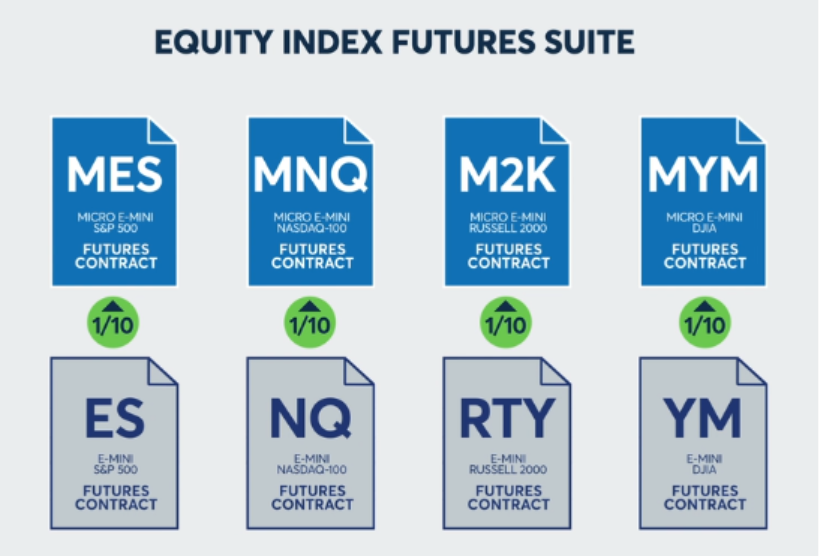
Micro e-mini futures are 1/10 the size of E-mini futures, covering the S&P 500, Nasdaq-100, Dow Jones, and Russell 2000.
Contract multipliers range from $0.50 (MYM) to $5 (MES and M2K).
Trading is available nearly 24 hours a day, six days a week on CME Globex.
Futures are leveraged products; losses can exceed your initial deposit.
Part 1. What Are Micro E-Mini Futures and Why Were They Created?
1.1 The Origin of Micro E-Mini Contracts
CME Group introduced Micro E-mini futures to give retail traders a more accessible entry point into U.S. equity index futures. The standard E-mini contracts had grown in notional value to the point where capital requirements were becoming a barrier for many individual traders. By creating contracts that are exactly 1/10 the size, CME Group allowed a wider audience to participate.
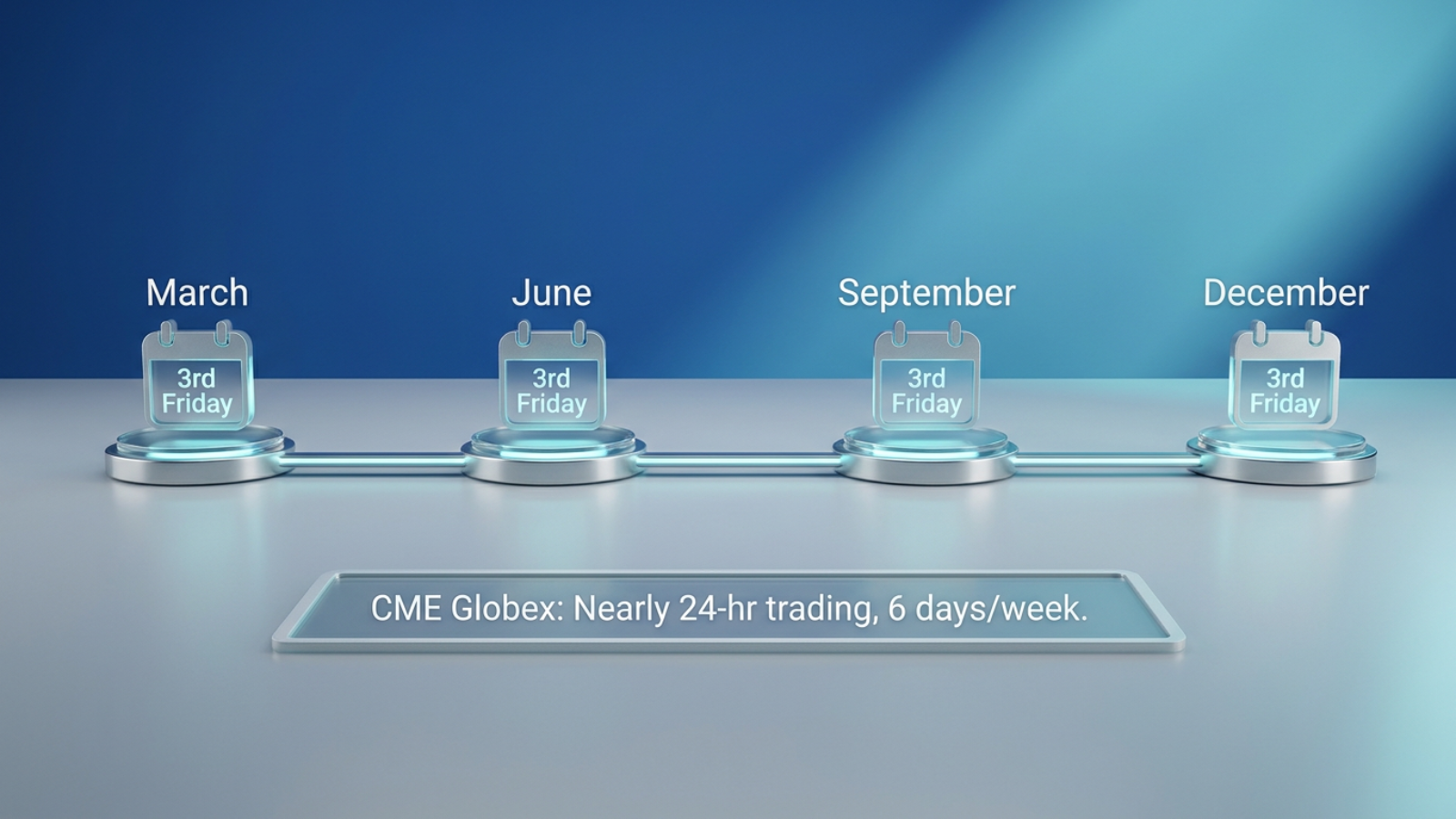
All four Micro E-mini contracts track the same underlying indexes as their E-mini counterparts. They settle in cash on a quarterly basis, on the third Friday of March, June, September, and December. Because these are index-based contracts, there is no physical delivery.
CME Group — https://www.cmegroup.com/education/courses/micro-e-mini-futures/micro-e-mini-futures-products-overview
1.2 How Micro E-Mini Futures Differ from Standard Futures
A futures contract is a legal agreement to buy or sell an underlying asset at a predetermined price on a specified date. With index futures, cash settlement replaces physical delivery.
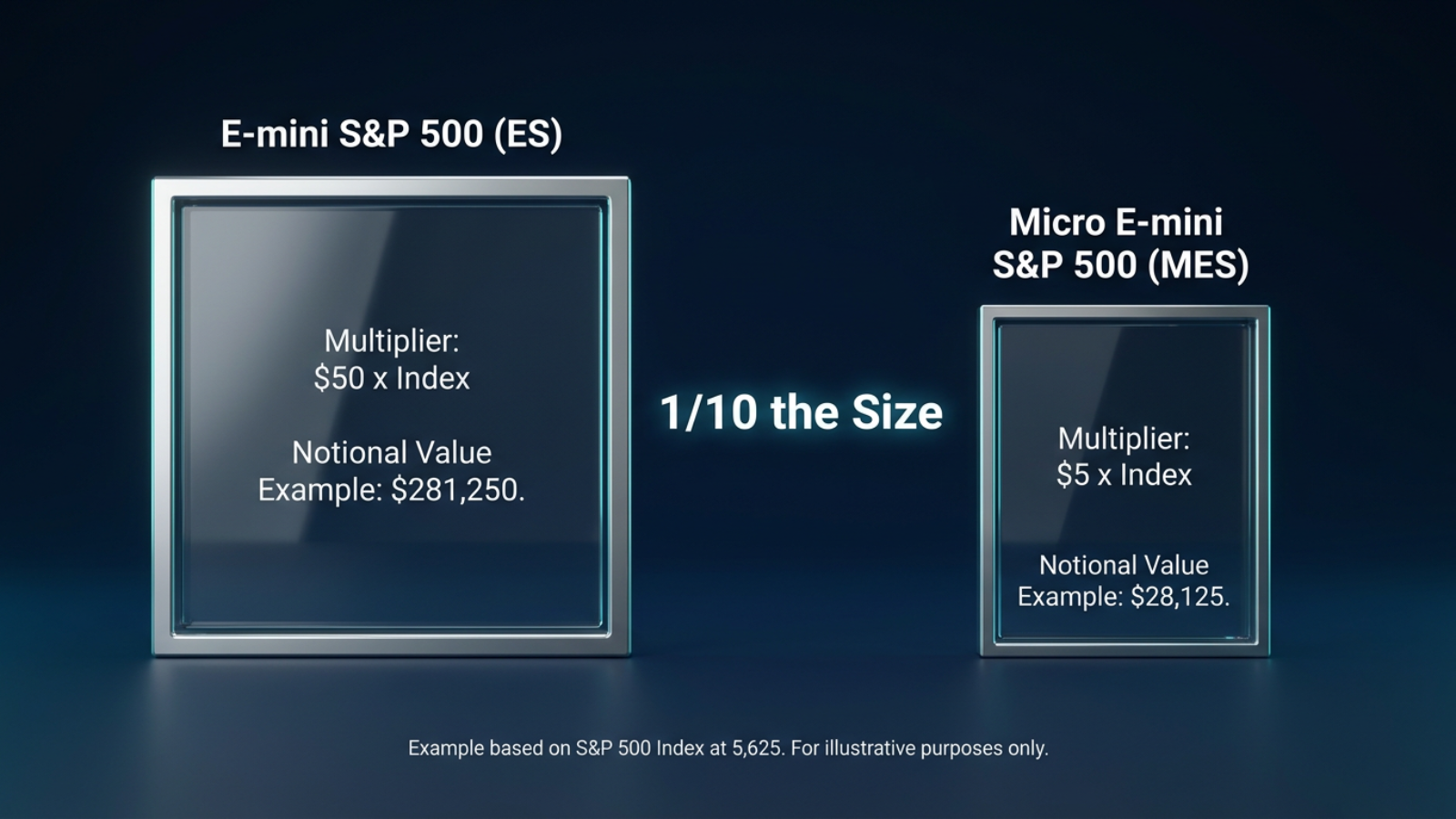
The key distinction between micro and standard E-mini contracts is the contract multiplier. For example, the E-mini S&P 500 (ES) carries a $50 multiplier, while the Micro E-mini S&P 500 (MES) carries a $5 multiplier. This means each one-point move in the S&P 500 Index is worth $5 in the MES contract versus $50 in the ES contract.
Part 2. Micro E-Mini Futures Contract Specifications
2.1 The Four Core Contracts and Their Multipliers
Each of the four Micro E-mini contracts covers a major U.S. equity index. The table below summarizes key specifications:
Index | Ticker | Multiplier | E-mini Multiplier |
|---|---|---|---|
S&P 500 | MES | $5 x Index | $50 x Index |
Nasdaq-100 | MNQ | $2 x Index | $20 x Index |
Dow Jones Industrial Average | MYM | $0.50 x Index | $5 x Index |
Russell 2000 | M2K | $5 x Index | $50 x Index |
Each Micro E-mini contract is 1/10 the size of the corresponding E-mini contract. The Micro E-mini S&P 500 and Micro E-mini Russell 2000 share the same $5 multiplier, while the Micro E-mini Nasdaq-100 uses a $2 multiplier and the Micro E-mini Dow uses a $0.50 multiplier.
CME Group — https://www.cmegroup.com/education/courses/micro-e-mini-futures/micro-e-mini-futures-products-overview
2.2 Tick Sizes and Tick Values
Tick size is the minimum price increment by which a contract can move. Each Micro E-mini contract has its own tick increment:
Contract | Tick Size | Tick Value (Outright) |
|---|---|---|
MES (S&P 500) | 0.25 index points | $1.25 |
MNQ (Nasdaq-100) | 0.25 index points | $0.50 |
MYM (Dow Jones) | 1.00 index points | $0.50 |
M2K (Russell 2000) | 0.10 index points | $0.50 |
For the MES contract, a one-point move (four ticks) is worth $5. To calculate the contract multiplier, divide the tick value by the tick size. For example, $1.25 / 0.25 = $5, which confirms the MES multiplier.
2.3 Trading Hours and Expiration Cycle
Micro E-mini futures trade on the CME Globex electronic platform nearly 24 hours a day, six days a week. Trading opens at 6:00 p.m. ET on Sunday and runs through 5:00 p.m. ET on Friday, with a brief daily maintenance halt.
Contracts expire on a quarterly cycle: the third Friday of March, June, September, and December. Most traders choose to roll their positions before expiration rather than holding through settlement. Cash settlement means no physical delivery occurs.
CME Group — https://www.cmegroup.com/education/courses/micro-e-mini-futures/micro-e-mini-futures-products-overview
Part 3. Micro E-Mini Futures Margin Requirements and Capital Considerations
3.1 How Futures Margin Works
Futures margin is not a loan or a down payment in the traditional sense. It functions as a performance bond, a deposit held to ensure traders can meet their financial obligations. There are three primary margin types relevant to micro e-mini futures trading:
Initial margin is the amount required to open a position with the intention of holding it overnight or beyond intraday hours. The initial margin requirement is typically between 3% and 12% of the futures contract's notional value, depending on the contract and market conditions.
Maintenance margin is the minimum equity that must be maintained while holding a position. If your account falls below the maintenance level, you may be required to deposit additional funds or face liquidation.
Intraday margin is a lower requirement available for positions opened and closed within designated intraday hours, generally 9:00 a.m. ET to 4:15 p.m. ET. It increases leverage, which in turn increases risk.
3.2 Capital Requirements at Webull
To place any trade, you must meet the applicable margin requirement for the specific futures contract you intend to trade.
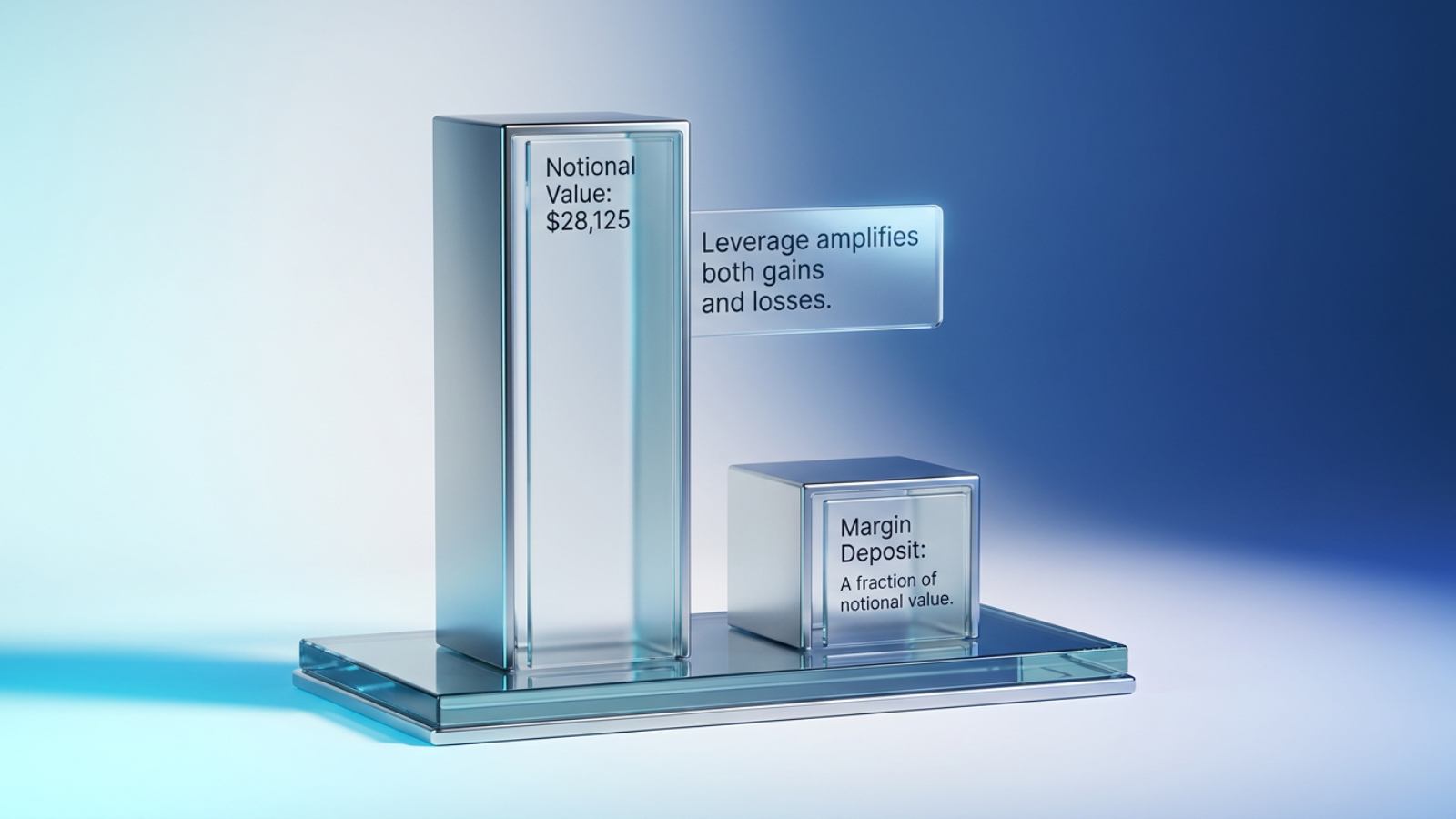
Futures contracts are leveraged products. This means you are only required to deposit a fraction of the contract's total notional value, but losses can exceed your initial deposit. Intraday margin increases leverage and may not be suitable for all investors.
For a full list of current margin requirements across all supported futures products, please visit the Futures Margin Rates page on Webull
3.3 Notional Value and Leverage in Practice
To understand leverage in context, consider a practical example. If the S&P 500 Index is trading at 5,625, the notional value of one MES contract is $5 x 5,625 = $28,125. An initial margin requirement of approximately 3% to 12% means a trader might need somewhere between roughly $845 and $3,375 to establish that position overnight.
Leverage can amplify both gains and losses. A relatively small price movement against your position can result in losses that are significant relative to the margin deposited. Proper position sizing and risk management are essential.
Part 4. How to Trade Micro E-Mini Futures on Webull
4.1 Eligibility and Account Requirements
Webull offers futures trading to eligible U.S. residents. To apply for a futures account, you must already have an individual Webull brokerage account. Joint brokerage account holders cannot use that account to apply for or maintain a futures account. Users located outside the U.S. will not see the futures account application option.
4.2 Step-by-Step: Opening a Futures Account on Webull
Via the Webull Mobile App:
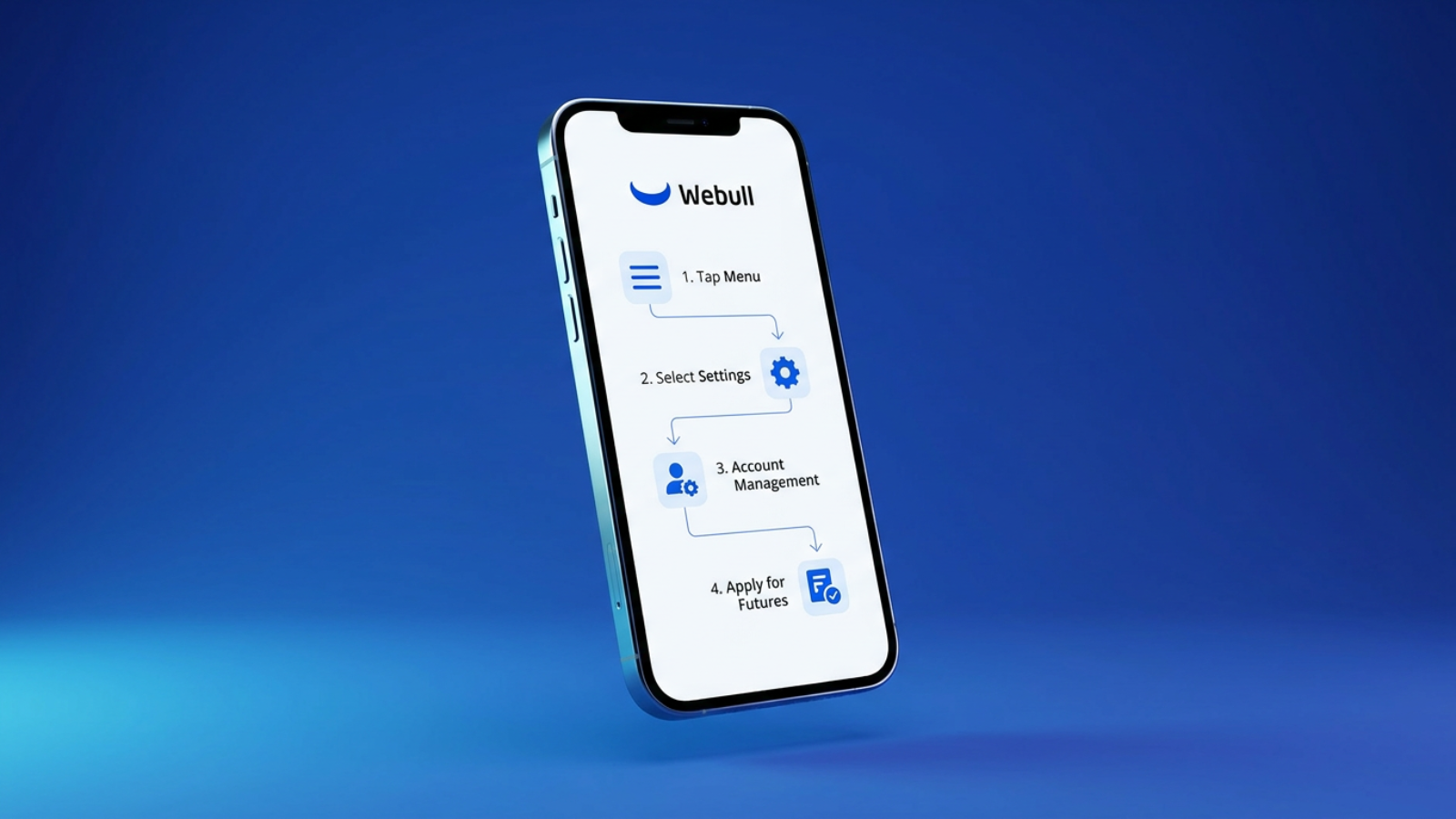
Tap the Menu icon.
Select Settings.
Tap Account Management.
Scroll down and select Apply for new accounts.
Choose Futures and follow the application prompts.
Via the Webull Website:
Click on your avatar or photo in the top right and select My Account.
Click Explore more Accounts.
Scroll down and select Futures.
Click the hyperlink Open Futures Account and follow the prompts.
Via the Webull Desktop App:
Click the drop-down menu in the top right where your account number is displayed.
Select Futures.
You will be redirected to the website; on the My Account page, scroll down and select Futures.
Follow the prompts to complete the application.
4.3 Funding Your Webull Futures Account
Webull supports three methods for funding a futures account:
Internal Transfer: Move cash from your existing Webull brokerage account to your futures account through the Transfer Money section in the app or on the website. This is typically the fastest method.
ACH Deposit: Deposit funds directly via ACH. ACH deposits generally settle within 2 to 3 business days and do not provide Instant Buying Power.
Wire Transfer: Submit a wire through the Transfer Money section. When wiring, include your Webull Futures account number in the memo. Wire fees and processing timelines follow the same procedures as standard brokerage accounts.
4.4 Order Types Available for Futures on Webull
Webull supports a range of order types for futures trading, including:
Market orders
Limit orders
Stop limit orders
Stop market orders
Trailing stop orders
OCO (One-Cancels-the-Other) orders
With OCO orders, both parts of the order are live in the marketplace simultaneously. Due to market volatility, it is possible that both the stop and the limit order could be executed. Cancellations are performed on a best-efforts basis, and using advanced orders carries the acceptance of the risks involved.
4.5 What Futures Products Does Webull Offer?
Beyond the four Micro E-mini equity index contracts, Webull provides access to futures contracts across multiple categories: indices, interest rates, currencies, agriculture, metals, energies, and cryptocurrencies.
4.6 Key Platform Features for Futures Traders
Webull's platform is designed to support active futures traders with tools for analysis and execution. Key features include real-time data and quotes, advanced charting tools, multiple order type support, and access to nearly 24-hour futures markets. For educational resources and account management, visit https://www.webull.com/learn.
Webull Financial LLC is a member of FINRA and SIPC. Futures trading on Webull is conducted through Webull's futures-enabled accounts, subject to applicable regulatory requirements. For any account or trading questions, the Webull Futures support team is available by phone at 888-816-0040 or by email at futures@webull.com, Monday through Friday, 8:00 a.m. to 5:00 p.m. ET.
Part 5. Benefits, Risks, and Who Should Consider Micro E-Mini Futures
5.1 Potential Benefits of Micro E-Mini Futures
Micro e-mini futures offer several characteristics that may appeal to a range of traders:
Capital efficiency: Futures are leveraged instruments, meaning a relatively small deposit can control a much larger notional position. The initial margin requirement is typically between 3% and 12% of the contract's notional value.
Portfolio diversification: Traders can gain long or short exposure to an entire equity index for a fraction of the cost of buying individual stocks or index funds.
Flexible risk management: Short positions in Micro E-mini futures may help investors manage portfolio risk without selling underlying equity positions.
Around-the-clock access: Trading is available nearly 24 hours a day, six days a week, allowing traders to respond to global market events as they occur.
Precision and scalability: The smaller contract size makes it more practical to scale positions in or out by partial increments, a technique that is difficult to execute with larger contracts.
5.2 Risks to Understand Before Trading
Futures trading involves substantial risk, and micro e-mini futures are no exception. Because these are leveraged products, losses can exceed the amount initially deposited.
Key risks include:
If a trade moves against your position, you may face a margin call requiring immediate additional deposits or risk having your position liquidated, potentially without advance notice from your broker.
Under certain rare market conditions, such as when a market hits a daily price fluctuation limit (limit-up or limit-down) or a circuit breaker, it may become difficult or impossible to close an existing position.
Stop orders on futures are not guaranteed execution. Exchanges may reject or substitute an order under specific conditions.
The availability of nearly 24-hour trading may encourage overtrading, which can result in larger aggregate losses.
Past performance does not guarantee future results.
5.3 Hedgers vs. Speculators: Different Use Cases
Futures markets serve two broad types of participants. Hedgers use futures to protect against adverse price movements. For example, a portfolio manager holding large equity positions might use Micro E-mini futures to reduce downside exposure during volatile periods. Speculators aim to profit from price movements without any intention of owning the underlying asset.
Both approaches carry distinct risk profiles. Speculators in particular should understand that leverage magnifies losses just as it can amplify gains.
5.4 Suitability Considerations
Micro e-mini futures are not suitable for every investor. Because futures are leveraged products, they carry the risk of loss beyond the initial margin deposited. Intraday margin, which allows for reduced margin requirements during designated trading hours, increases leverage further and is associated with heightened risk.
Prospective traders should carefully evaluate their financial situation, risk tolerance, and familiarity with futures markets before opening a futures account.
The Bottom Line
Micro e-mini futures offer retail traders a capital-efficient path to U.S. equity index exposure, with contract sizes one-tenth those of standard E-mini contracts. As these are leveraged instruments, understanding margin requirements and risk management is essential before trading. Rates vary by service provider; please refer to the latest pricing.
Disclosure:
Please note futures trading involves substantial risk and is not suitable for all investors. Please read the FCM Risk Disclosure statement (https://www.webull.com/fcm-disclosures) prior to signing up for Futures Trading
