'%3e %3cpath d='M41.7832962%2c0 C41.9459106%2c0 42.0882746%2c0.0866854658 42.1666825%2c0.216359069 C43.8289923%2c2.66540836 44.7676281%2c5.46271319 44.7676281%2c8.43208061 C44.7676281%2c18.1345746 34.7460532%2c26 22.383814%2c26 C10.0215749%2c26 0%2c18.1345746 0%2c8.43208061 C0%2c5.46716016 0.935826425%2c2.67378733 2.58829888%2c0.223985685 C2.67109477%2c0.0916264068 2.81687473%2c0 2.9840593%2c0 C3.23130408%2c0 3.43173558%2c0.200393004 3.43173558%2c0.447590303 C3.43173558%2c0.475056669 3.42926112%2c0.501945205 3.42452292%2c0.528045226 L3.41810883%2c0.550292077 C3.37800671%2c0.861741908 3.3575721%2c1.17661276 3.3575721%2c1.49443092 C3.3575721%2c7.98336 11.2132389%2c12.5742305 22.383814%2c12.5742305 C33.5543891%2c12.5742305 41.410056%2c7.98336 41.410056%2c1.49443092 C41.410056%2c1.17865223 41.3898828%2c0.865783153 41.3502888%2c0.556288325 C41.3402868%2c0.521941442 41.3356199%2c0.48531078 41.3356199%2c0.447590303 C41.3356199%2c0.200393004 41.5360514%2c0 41.7832962%2c0 Z' id='logo%e5%a4%87%e4%bb%bd-6' fill='white'%3e%3c/path%3e %3cpath d='M74.6899231%2c3.74404927 C75.2411227%2c3.74404927 75.7734299%2c3.66184338 76.2756219%2c3.50883715 L73.8159676%2c20.8666902 C73.5770593%2c22.5662954 72.8072434%2c23.0518969 71.4268838%2c23.0518969 L69.9934336%2c23.0518969 C68.7988917%2c23.0518969 68.1618027%2c22.458384 67.7901674%2c20.893668 L65.6930827%2c11.9909739 C65.639992%2c11.7481731 65.639992%2c11.6942174 65.5338105%2c11.6942174 C65.427629%2c11.6942174 65.4010836%2c11.7481731 65.3479929%2c11.9909739 L63.2509082%2c20.893668 C62.8792729%2c22.458384 62.2421839%2c23.0518969 61.047642%2c23.0518969 L59.6141918%2c23.0518969 C58.2338322%2c23.0518969 57.4640163%2c22.5662954 57.225108%2c20.8666902 L54.7463723%2c3.37406084 C55.3593498%2c3.61307396 56.0249975%2c3.74404927 56.7207458%2c3.74404927 C57.3314263%2c3.74404927 57.918917%2c3.64314414 58.4679557%2c3.4568446 L60.3574623%2c19.3829078 C60.3840076%2c19.6257086 60.3840076%2c19.7875757 60.4901891%2c19.7875757 C60.5963706%2c19.7875757 60.5963706%2c19.6257086 60.6494614%2c19.3829078 L62.9323637%2c9.91367858 C63.0916359%2c9.26620991 63.4632712%2c8.69967483 64.6047223%2c8.69967483 L66.4363532%2c8.69967483 C67.5778044%2c8.69967483 67.9494397%2c9.26620991 68.1087119%2c9.91367858 L70.3916142%2c19.3829078 C70.4447049%2c19.6257086 70.4447049%2c19.7875757 70.5508864%2c19.7875757 C70.6570679%2c19.7875757 70.6570679%2c19.6257086 70.6836133%2c19.3829078 L72.5891207%2c3.32292288 C73.2365902%2c3.59432921 73.9460524%2c3.74404927 74.6899231%2c3.74404927 Z' id='Combined-Shape' fill='white'%3e%3c/path%3e %3cpath d='M84.5933901%2c7.43171536 C88.6813779%2c7.43171536 90.9111894%2c10.2643908 90.9111894%2c14.2840921 L90.9111894%2c15.7948523 C90.9111894%2c16.2264981 90.7519172%2c16.4692988 90.3802819%2c16.4692988 L81.7264895%2c16.4692988 L81.7264895%2c16.5502324 C81.7264895%2c18.1149484 82.3635785%2c19.9764208 84.9119346%2c19.9764208 C86.849747%2c19.9764208 88.6813779%2c19.8145536 89.7962837%2c19.7066422 L89.8759198%2c19.7066422 C90.1413735%2c19.7066422 90.3537366%2c19.8415315 90.3537366%2c20.1113101 L90.3537366%2c21.8918489 C90.3537366%2c22.3234947 90.2741004%2c22.5123397 89.7962837%2c22.5932733 C88.0708343%2c22.9170076 87.0355646%2c23.0518969 84.6464808%2c23.0518969 C81.9919433%2c23.0518969 78.2225%2c21.5950924 78.2225%2c16.2804538 L78.2225%2c14.2840921 C78.2225%2c10.0755457 80.5319476%2c7.43171536 84.5933901%2c7.43171536 Z M84.5933901%2c10.5071915 C82.9475768%2c10.5071915 81.7530349%2c11.6942174 81.7530349%2c13.8254684 L81.7530349%2c13.9333799 L87.3806545%2c13.9333799 L87.3806545%2c13.8254684 C87.3806545%2c11.7211953 86.2392034%2c10.5071915 84.5933901%2c10.5071915 Z' id='Combined-Shape' fill='white'%3e%3c/path%3e %3cpath d='M97.4154906%2c2.98826245 L97.4148064%2c7.62056039 C98.3969853%2c7.48567108 99.3260735%2c7.43171536 99.9631625%2c7.43171536 C104.236968%2c7.43171536 106.307507%2c9.99461216 106.307507%2c14.2031585 L106.307507%2c16.2804538 C106.307507%2c20.4890001 104.236968%2c23.0518969 99.9631625%2c23.0518969 C98.2642584%2c23.0518969 96.2733553%2c22.7821183 94.627542%2c22.3504725 C94.0169984%2c22.1886054 93.9108169%2c22.0267382 93.9108169%2c21.6220703 L93.9098179%2c3.08694115 C94.4185466%2c3.24434375 94.9584615%2c3.32900525 95.5178331%2c3.32900525 C96.184659%2c3.32900525 96.8238351%2c3.20869291 97.4154906%2c2.98826245 Z M99.9631625%2c10.3453244 C99.3260735%2c10.3453244 98.1580769%2c10.4262579 97.4148064%2c10.5341694 L97.4148064%2c19.9494429 C97.9191686%2c20.0573544 99.007529%2c20.1382879 99.9631625%2c20.1382879 C102.246065%2c20.1382879 102.803518%2c18.4926384 102.803518%2c16.2804538 L102.803518%2c14.2031585 C102.803518%2c11.9909739 102.246065%2c10.3453244 99.9631625%2c10.3453244 Z' id='Combined-Shape' fill='white'%3e%3c/path%3e %3cpath d='M111.036668%2c8.72457747 C111.579488%2c8.72457747 112.103987%2c8.64485191 112.599444%2c8.49629404 L112.598761%2c16.5232546 C112.598761%2c19.3289521 113.607485%2c19.9764208 115.147117%2c19.9764208 L115.306389%2c19.9764208 C116.846021%2c19.9764208 117.854746%2c19.3289521 117.854746%2c16.5232546 L117.854207%2c8.4334735 C118.406525%2c8.62226395 118.997939%2c8.72457747 119.612866%2c8.72457747 C120.223332%2c8.72457747 120.810625%2c8.62374317 121.359498%2c8.43756894 L121.358735%2c16.5232546 C121.358735%2c22.4044283 116.872567%2c23.0518969 115.306389%2c23.0518969 L115.060464%2c23.0512514 C113.42215%2c23.0271041 109.094772%2c22.2994073 109.094772%2c16.5232546 L109.094446%2c8.36700801 C109.698522%2c8.59813531 110.353066%2c8.72457747 111.036668%2c8.72457747 Z' id='Combined-Shape' fill='white'%3e%3c/path%3e %3cpath d='M128.314162%2c3.03790128 L128.313623%2c22.269539 C128.313623%2c22.5662954 128.10126%2c22.836074 127.809261%2c22.836074 L125.340541%2c22.836074 C125.048542%2c22.836074 124.809634%2c22.5662954 124.809634%2c22.269539 L124.809455%2c3.04219481 C125.358161%2c3.22824247 125.945253%2c3.32900525 126.555503%2c3.32900525 C127.17043%2c3.32900525 127.761844%2c3.22669173 128.314162%2c3.03790128 Z' id='Combined-Shape' fill='white'%3e%3c/path%3e %3cpath d='M133.90653%2c3.32900525 C134.473329%2c3.32900525 135.02015%2c3.24208064 135.534793%2c3.08063296 L135.533966%2c22.269539 C135.533966%2c22.5662954 135.321603%2c22.836074 135.029603%2c22.836074 L132.560884%2c22.836074 C132.268884%2c22.836074 132.029976%2c22.5662954 132.029976%2c22.269539 L132.029909%2c2.99605058 C132.615669%2c3.21152525 133.2476%2c3.32900525 133.90653%2c3.32900525 Z' id='Combined-Shape' fill='white'%3e%3c/path%3e %3c/g%3e %3c/g%3e %3c/g%3e%3c/svg%3e)



A bull market is one of the most important concepts for any US investor to understand. Whether you're building long-term wealth or actively trading, recognizing a bull market—and knowing how to invest during one—can make a meaningful difference in your portfolio outcomes. This guide covers the bull market definition, how it compares to a bear market, what drives one, and which bull market investing strategies are worth considering.
Key Takeaways
A bull market is a sustained period of rising stock prices, typically fueled by strong economic growth and positive investor sentiment.
Bull markets have historically lasted a median of 42 months and produced a median price increase of 87%.
Common strategies during bull markets include growth stock investing, momentum investing, and tactical asset allocation.
Recognizing warning signs—such as declining market breadth and irrational exuberance—may help investors manage risk near market peaks.
Platforms like Webull offer tools to help investors navigate both bull and bear market conditions.
Part 1. What Is a Bull Market? Definition and Key Characteristics
1.1 Bull Market Definition
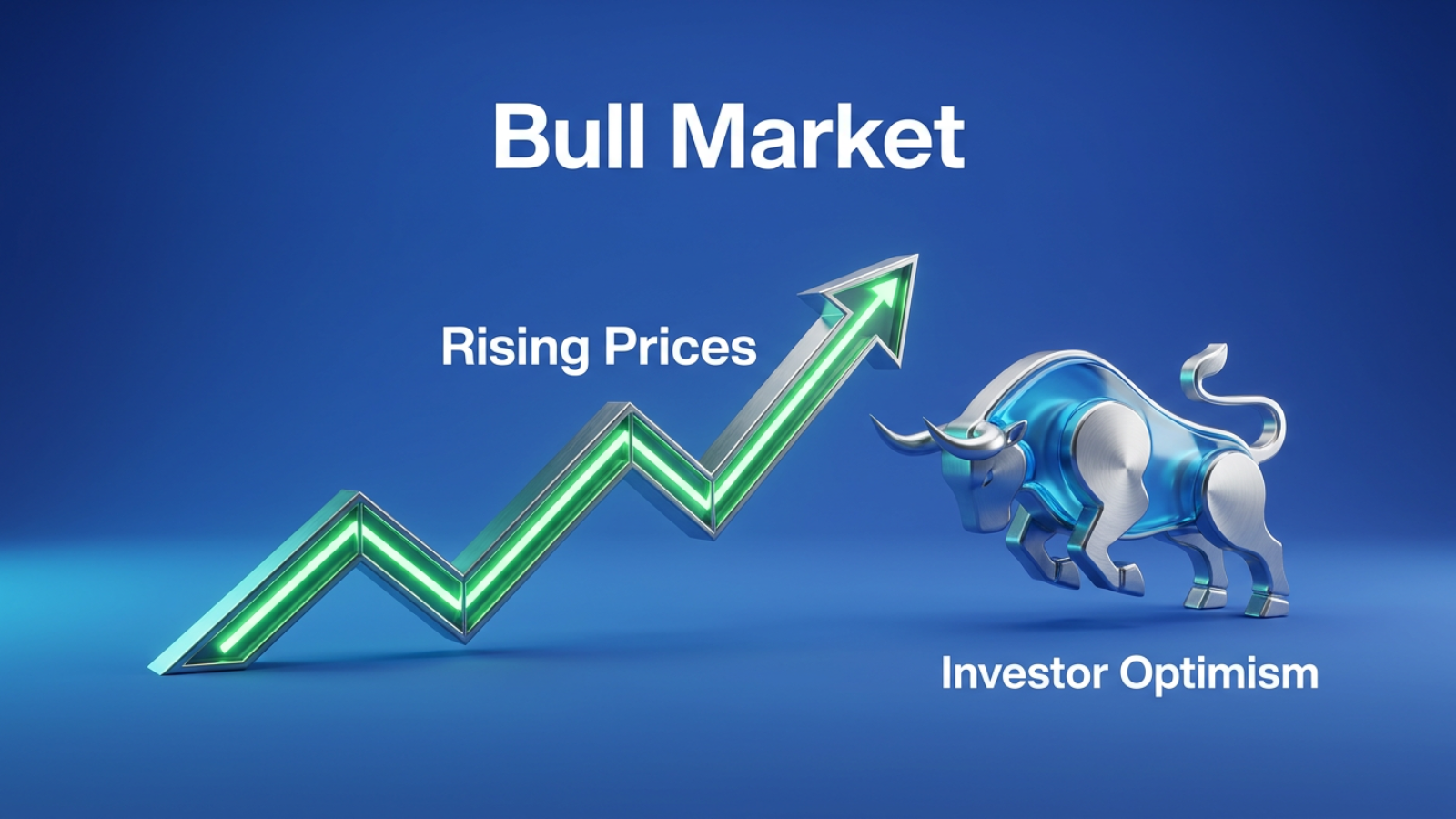
A bull market refers to a financial market environment in which prices are rising or are expected to rise over a sustained period. For stock markets, this typically means a major index—such as the S&P 500—has climbed at least 20% from a recent low.
Bull markets don't follow a single fixed rule for their start. Some analysts define the threshold as a 20% gain from a recent trough, while others focus on the sustained upward trajectory of prices and improving economic fundamentals over time.
Investopedia — https://www.investopedia.com/insights/digging-deeper-bull-and-bear-markets/
1.2 Common Traits of a Bull Market
Bull markets share recognizable characteristics that set them apart from other market phases:
Rising stock prices: Share prices trend upward broadly, with most stocks participating in gains.
Strong investor optimism: Confidence in future economic growth drives increased buying activity.
Healthy economic indicators: GDP growth, low unemployment, and solid consumer spending often accompany bull markets.
Growing corporate earnings: Businesses report improved profits, reinforcing investor confidence.
Accommodative interest rates: Lower borrowing costs support consumer spending and business investment.
Resilience to negative news: Even when setbacks occur, stocks tend to recover relatively quickly.
Britannica — https://www.britannica.com/money/bull-market-vs-bear-market
Part 2. Bull Market vs. Bear Market: Key Differences US Investors Should Know
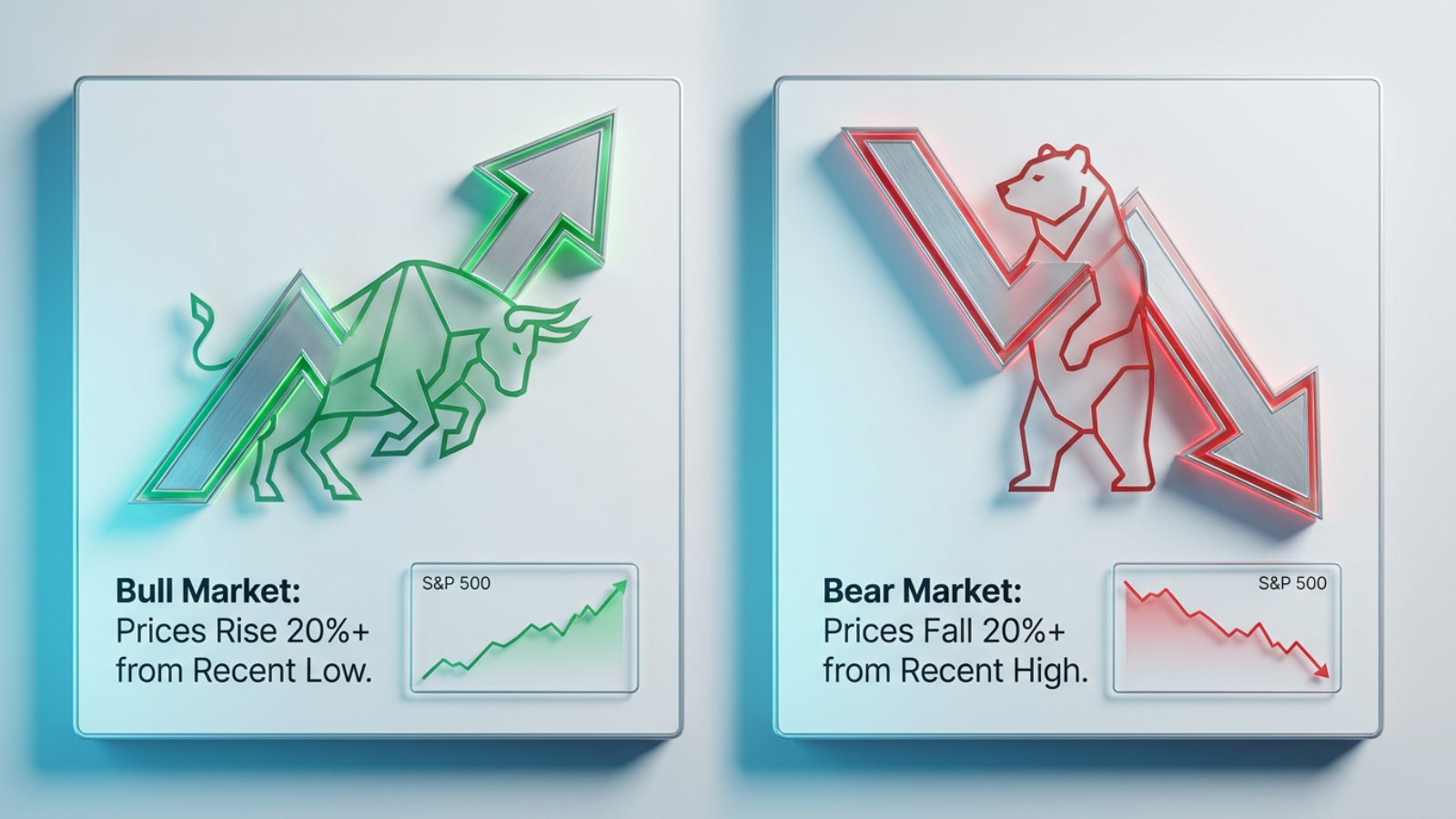
Understanding the contrast between a bull market and a bear market helps investors make more informed portfolio decisions at different points in the market cycle.
2.1 Duration and Historical Returns
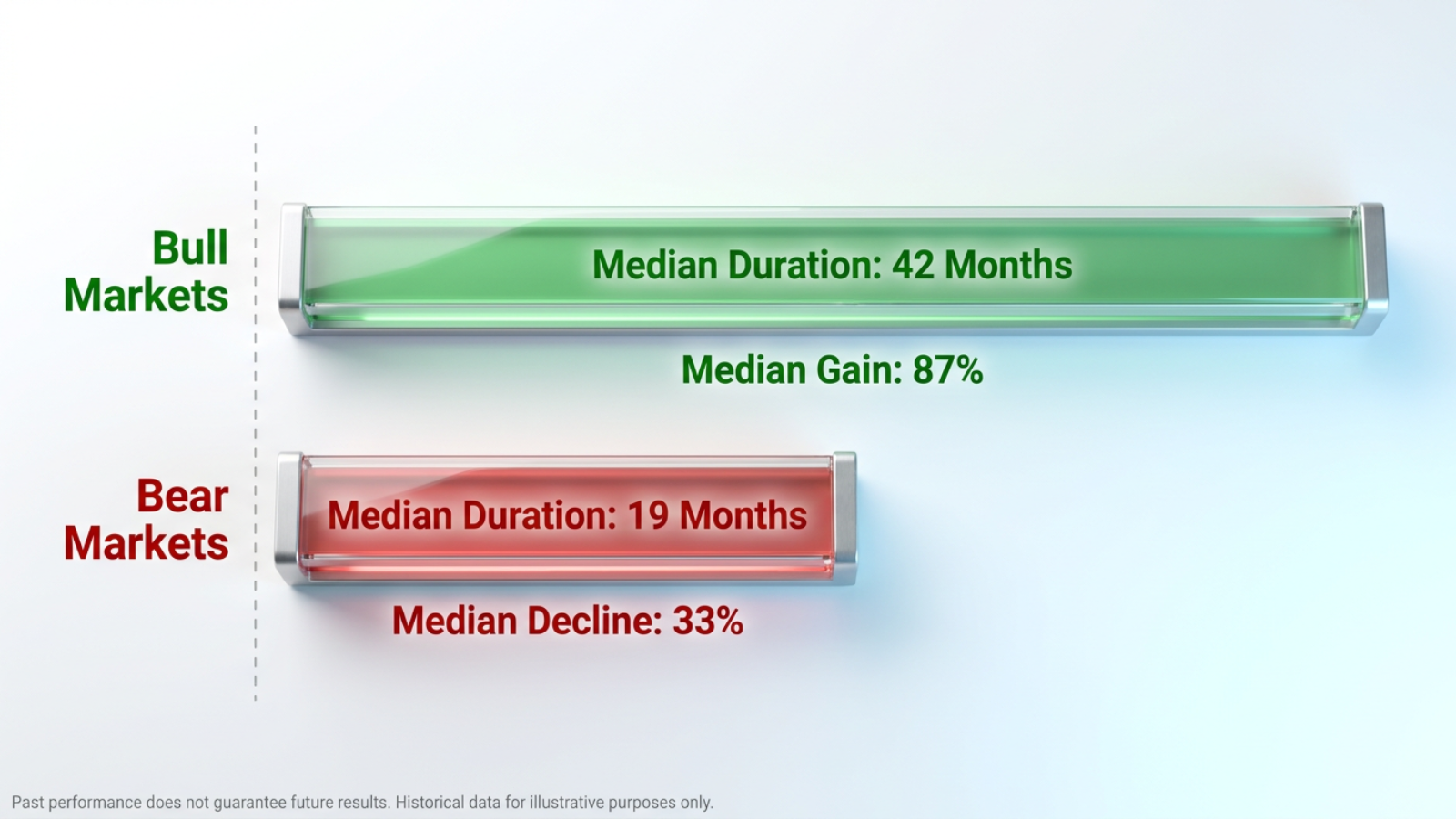
Bull markets have historically lasted longer than bear markets. According to historical data, bull markets lasted a median of 42 months (approximately 3.5 years), with a median price increase of 87%. Bear markets, by contrast, lasted a median of 19 months with a median price decline of 33%.
2.2 Investor Psychology in Bull vs. Bear Markets
Investor psychology plays a central role in shaping both bull and bear markets. In a bull market, optimism feeds on itself: rising prices attract more buyers, which pushes prices higher, encouraging even more investment. This cycle can sustain upward momentum as long as economic conditions remain supportive.
Bear markets work in reverse. Falling prices trigger fear and uncertainty, prompting investors to sell. This creates a downward spiral, where declining prices erode confidence further and lead to additional selling pressure. Markets are often said to be driven by two powerful forces: greed (dominant in bull markets) and fear (dominant in bear markets).
Fidelity — https://www.fidelity.com/learning-center/smart-money/bear-vs-bull-market
2.3 Economic Indicators: Bulls vs. Bears
The table below summarizes the key economic differences typically observed between bull and bear market environments:
Indicator | Bull Market | Bear Market |
|---|---|---|
GDP Growth | Expanding | Contracting or slowing |
Unemployment | Declining or low | Rising |
Corporate Earnings | Growing | Declining |
Interest Rates | Often low or stable | May be rising |
Consumer Spending | Strong | Weakening |
Investor Sentiment | Optimistic | Pessimistic |
It's worth noting that the stock market and the broader economy are not the same thing. Stock prices can trend upward even as economic output slows—and vice versa. Around 25% of historical bear markets have occurred without an accompanying recession.
NerdWallet — https://www.nerdwallet.com/investing/learn/bullish-vs-bearish
Part 3. What Causes a Bull Market? Economic Drivers Explained
3.1 GDP Growth and Corporate Earnings
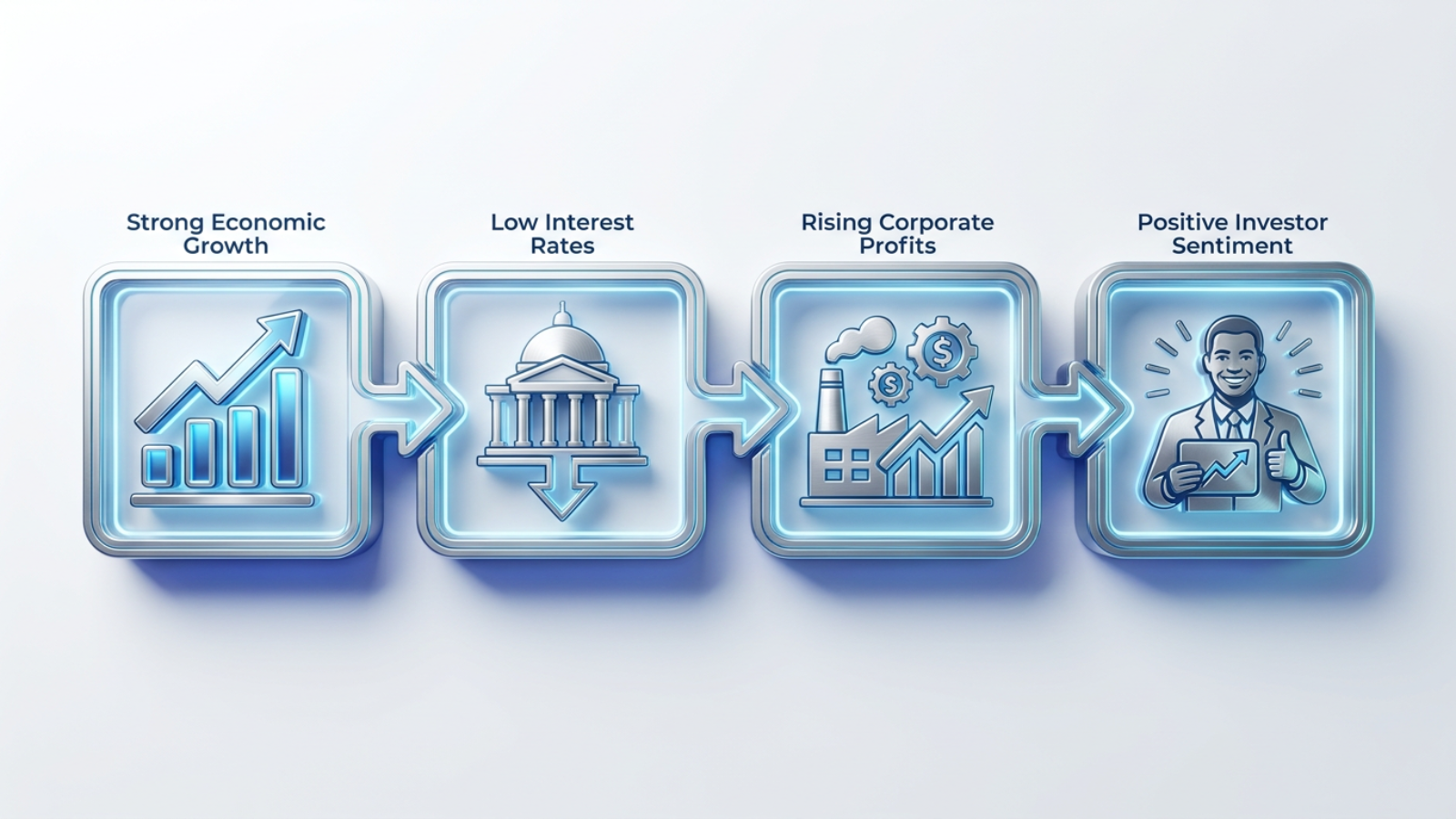
A robust economy is often the foundation of a bull market. When GDP is expanding, businesses experience higher revenues and report stronger earnings. Rising profits increase the fundamental value of companies, which in turn attracts more investment and drives stock prices higher.
Employment growth and consumer spending also reinforce this cycle. When more people are working and earning, discretionary spending rises. This benefits a wide range of businesses, particularly in consumer discretionary, technology, and industrials sectors.
Investopedia — https://www.investopedia.com/insights/digging-deeper-bull-and-bear-markets/
3.2 Monetary Policy and Interest Rates
Central bank policy is a significant driver of bull markets. In the US, the Federal Reserve can stimulate economic activity by lowering interest rates. Lower rates reduce borrowing costs for consumers and businesses, encouraging spending, investment, and expansion.
This influx of capital can boost corporate profits and make equities more attractive compared to lower-yielding fixed-income alternatives. Conversely, when the Federal Reserve raises rates to combat inflation, borrowing costs increase, potentially cooling economic growth and signaling headwinds for a bull market.
Investopedia — https://www.investopedia.com/insights/digging-deeper-bull-and-bear-markets/
3.3 Investor Sentiment and Market Psychology
Beyond economic fundamentals, collective investor psychology can sustain or accelerate a bull market. Positive news cycles, strong earnings reports, and technological breakthroughs can create widespread optimism. As confidence grows, more investors enter the market, increasing demand for stocks and further lifting prices.
However, this sentiment-driven momentum has limits. Excessive optimism—sometimes called irrational exuberance—can push asset prices well beyond their fundamental values, creating the conditions for a market correction or bubble.
Britannica — https://www.britannica.com/money/bull-market-vs-bear-market
Part 4. How to Invest in a Bull Market: Strategies for US Investors
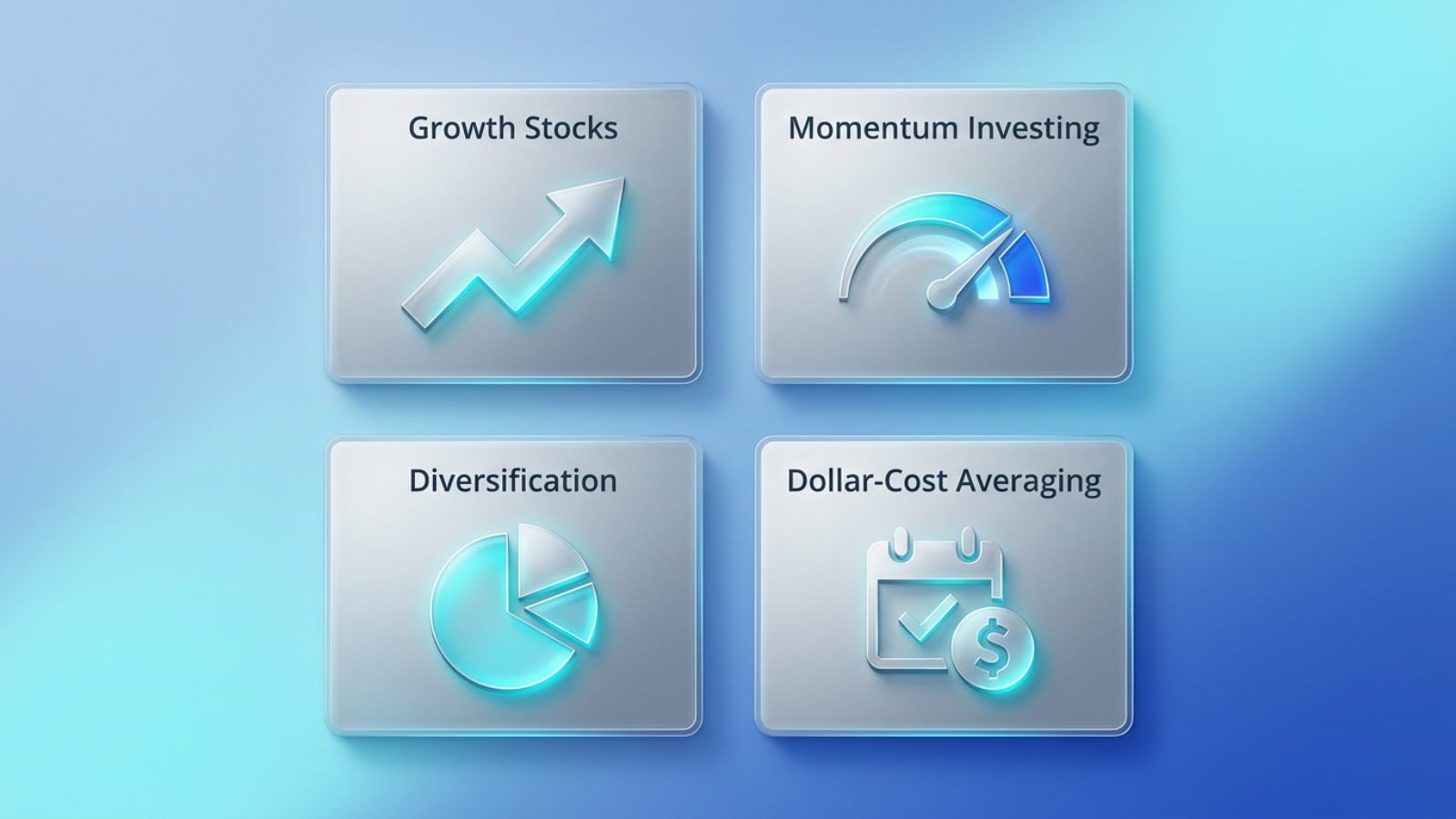
Bull markets create opportunities for investors who approach them with clear strategies and disciplined risk management. Below are four approaches commonly used during rising market environments.
4.1 Growth Stocks and Sector Allocation
One common approach is to focus on growth stocks—companies expected to grow earnings at an above-average rate. During bull markets, sectors such as technology, biotechnology, and consumer discretionary have historically shown strong performance, though sector leadership can vary by cycle.
Tactical asset allocation involves adjusting your portfolio mix to increase exposure to sectors or asset classes expected to outperform in the current environment. For example, increasing allocation to cyclical stocks—companies whose performance tracks closely with the economic cycle—may be worth considering when economic expansion is underway.
Investopedia — https://www.investopedia.com/insights/digging-deeper-bull-and-bear-markets/
4.2 Momentum Investing
Momentum investing involves buying assets that have shown strong recent performance and are likely to continue appreciating in the near term, based on technical analysis. This approach seeks to capitalize on sustained price trends rather than fundamental valuations.
Technical tools such as moving averages, relative strength indicators (RSI), and volume analysis can help identify momentum candidates. On Webull's desktop and mobile platform, investors can access advanced charting tools, real-time market data, and technical indicators to support momentum-based research.
Investopedia — https://www.investopedia.com/insights/digging-deeper-bull-and-bear-markets/
4.3 Diversification and Portfolio Rebalancing
Even during a bull market, maintaining a diversified portfolio is an important risk management practice. Not all sectors move at the same pace, and some may underperform or experience corrections even as the broader market rises.
A well-structured portfolio might include a mix of equities, fixed-income securities, and potentially international investments. This balance can provide some stability if a sector rotates or the bull market shows signs of ending. Diversification does not guarantee a profit or protect against loss.
As stock prices rise during a bull market, equity allocations can drift higher than intended. For instance, a portfolio originally set at 60% stocks and 40% bonds might shift to 70% stocks after an extended rally. Periodic rebalancing helps bring allocations back in line with your goals and risk tolerance.
Fidelity — https://www.fidelity.com/learning-center/smart-money/bear-vs-bull-market
4.4 Using Webull to Navigate Bull Markets
Webull is a US-regulated brokerage platform offering tools designed to support investors through different market environments. Key features include:
Advanced charting and technical indicators for identifying trends and momentum opportunities
Real-time market data and news feeds to monitor economic indicators and corporate earnings
Screeners and watchlists to track growth stocks and sector performance
Paper trading for testing strategies in a simulated environment before committing capital
Commission-free trading on US-listed stocks and ETFs (other fees and costs may apply; rates vary by service provider, please refer to the latest pricing)
Part 5. Recognizing Bull Market Peaks and Managing Risk in US Markets
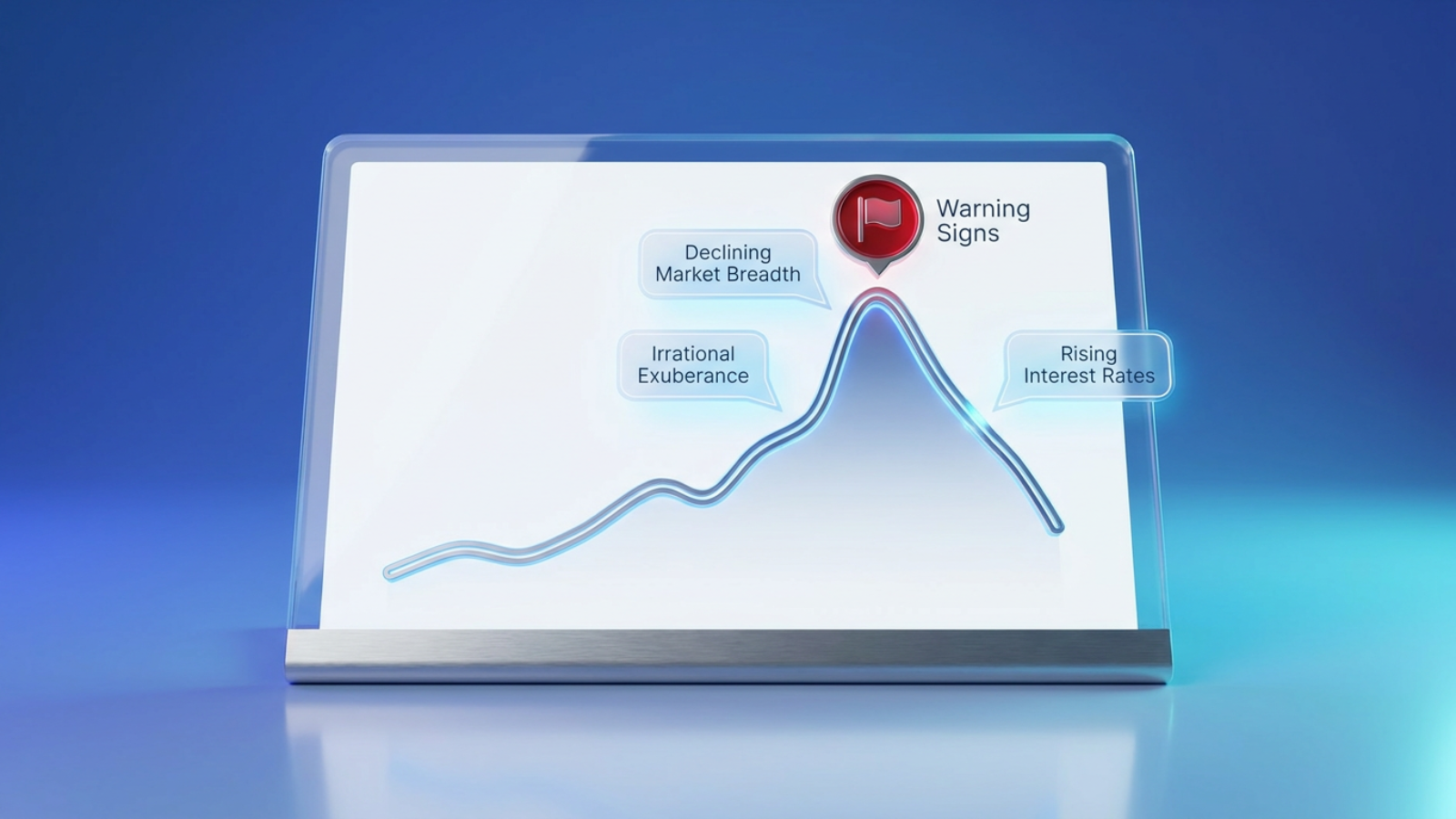
5.1 Warning Signs That a Bull Market May Be Peaking
Identifying the top of a bull market is notoriously difficult, but certain signals may suggest the rally is losing momentum:
Excessive investor optimism and market euphoria: When widespread speculation pushes asset prices well above fundamental values, the market may be overheating.
Surge in IPO activity: A high volume of initial public offerings—especially from companies with limited earnings history—can indicate late-cycle speculative behavior.
Divergence between prices and fundamentals: If stock prices keep rising while GDP growth slows, corporate earnings decline, or unemployment rises, the rally may lack fundamental support.
Declining market breadth: When fewer stocks are driving overall market gains, the rally may be losing its broad base.
Rising inflation and rate hikes: Central bank tightening can dampen economic growth and pressure stock valuations.
Investopedia — https://www.investopedia.com/insights/digging-deeper-bull-and-bear-markets/
5.2 Speculative Bubbles Within Bull Markets
Not all bull markets end in bubbles, but excessive optimism can sometimes give rise to speculative excess. Economist Hyman Minsky described a recurring five-stage pattern that often precedes market busts:
Displacement: A new technology or policy change captures investor attention.
Boom: Early investors profit and others rush to participate.
Euphoria: Traditional valuation metrics are ignored; prices appear unstoppable.
Profit-Taking: More experienced investors quietly exit their positions.
Panic: Widespread selling triggers a sharp decline.
Historical examples include the dot-com bubble of the late 1990s and the "meme stock" craze of 2020. Recognizing these stages isn't a guarantee of perfect market timing, but it can help investors remain disciplined. Past performance does not guarantee future results.
Investopedia — https://www.investopedia.com/insights/digging-deeper-bull-and-bear-markets/
5.3 Risk Management Tips for Bull Market Investors
Managing risk during a bull market requires discipline, particularly when optimism is high and gains appear self-reinforcing. Consider these practices:
Avoid letting emotions drive decisions. Bull market euphoria can lead to overconcentration in high-flying assets or chasing recent winners without adequate research.
Set and review your target asset allocation. A long rally can silently shift your portfolio toward higher-risk positions. Rebalancing periodically helps maintain your intended risk level.
Use dollar-cost averaging. Investing a fixed amount at regular intervals can reduce the impact of market timing and smooth out entry prices over time. Dollar-cost averaging does not guarantee a profit or protect against a loss.
Maintain perspective on valuations. Price-to-earnings ratios and other metrics can indicate whether stocks are becoming expensive relative to earnings.
Have a plan for the next bear market. Bull markets don't last indefinitely. Investors who plan ahead—including maintaining adequate liquidity and fixed-income exposure—may be better positioned when conditions eventually shift.
Fidelity — https://www.fidelity.com/learning-center/smart-money/bear-vs-bull-market
The Bottom Line
Bull markets present meaningful opportunities for US investors who approach them with clear strategies, realistic expectations, and sound risk management. Understanding what drives a bull market—and how to recognize its limits—is foundational to informed investing. Webull offers the tools and data investors may find useful when navigating market cycles. As always, consider your individual goals and risk tolerance before making investment decisions.
Disclosure
Webull Financial LLC (member SIPC, FINRA) offers self-directed securities trading. All investments involve risk. More info: https://www.webull.com/policy
The information provided does not constitute investment advice and it should not be relied on as such. It should not be considered a solicitation to buy or an offer to sell a security. It does not take into account any investor's particular investment objectives, strategies, tax status or investment horizon. Investing involves risk, including the risk of loss of principal.
