'%3e %3cpath d='M41.7832962%2c0 C41.9459106%2c0 42.0882746%2c0.0866854658 42.1666825%2c0.216359069 C43.8289923%2c2.66540836 44.7676281%2c5.46271319 44.7676281%2c8.43208061 C44.7676281%2c18.1345746 34.7460532%2c26 22.383814%2c26 C10.0215749%2c26 0%2c18.1345746 0%2c8.43208061 C0%2c5.46716016 0.935826425%2c2.67378733 2.58829888%2c0.223985685 C2.67109477%2c0.0916264068 2.81687473%2c0 2.9840593%2c0 C3.23130408%2c0 3.43173558%2c0.200393004 3.43173558%2c0.447590303 C3.43173558%2c0.475056669 3.42926112%2c0.501945205 3.42452292%2c0.528045226 L3.41810883%2c0.550292077 C3.37800671%2c0.861741908 3.3575721%2c1.17661276 3.3575721%2c1.49443092 C3.3575721%2c7.98336 11.2132389%2c12.5742305 22.383814%2c12.5742305 C33.5543891%2c12.5742305 41.410056%2c7.98336 41.410056%2c1.49443092 C41.410056%2c1.17865223 41.3898828%2c0.865783153 41.3502888%2c0.556288325 C41.3402868%2c0.521941442 41.3356199%2c0.48531078 41.3356199%2c0.447590303 C41.3356199%2c0.200393004 41.5360514%2c0 41.7832962%2c0 Z' id='logo%e5%a4%87%e4%bb%bd-6' fill='white'%3e%3c/path%3e %3cpath d='M74.6899231%2c3.74404927 C75.2411227%2c3.74404927 75.7734299%2c3.66184338 76.2756219%2c3.50883715 L73.8159676%2c20.8666902 C73.5770593%2c22.5662954 72.8072434%2c23.0518969 71.4268838%2c23.0518969 L69.9934336%2c23.0518969 C68.7988917%2c23.0518969 68.1618027%2c22.458384 67.7901674%2c20.893668 L65.6930827%2c11.9909739 C65.639992%2c11.7481731 65.639992%2c11.6942174 65.5338105%2c11.6942174 C65.427629%2c11.6942174 65.4010836%2c11.7481731 65.3479929%2c11.9909739 L63.2509082%2c20.893668 C62.8792729%2c22.458384 62.2421839%2c23.0518969 61.047642%2c23.0518969 L59.6141918%2c23.0518969 C58.2338322%2c23.0518969 57.4640163%2c22.5662954 57.225108%2c20.8666902 L54.7463723%2c3.37406084 C55.3593498%2c3.61307396 56.0249975%2c3.74404927 56.7207458%2c3.74404927 C57.3314263%2c3.74404927 57.918917%2c3.64314414 58.4679557%2c3.4568446 L60.3574623%2c19.3829078 C60.3840076%2c19.6257086 60.3840076%2c19.7875757 60.4901891%2c19.7875757 C60.5963706%2c19.7875757 60.5963706%2c19.6257086 60.6494614%2c19.3829078 L62.9323637%2c9.91367858 C63.0916359%2c9.26620991 63.4632712%2c8.69967483 64.6047223%2c8.69967483 L66.4363532%2c8.69967483 C67.5778044%2c8.69967483 67.9494397%2c9.26620991 68.1087119%2c9.91367858 L70.3916142%2c19.3829078 C70.4447049%2c19.6257086 70.4447049%2c19.7875757 70.5508864%2c19.7875757 C70.6570679%2c19.7875757 70.6570679%2c19.6257086 70.6836133%2c19.3829078 L72.5891207%2c3.32292288 C73.2365902%2c3.59432921 73.9460524%2c3.74404927 74.6899231%2c3.74404927 Z' id='Combined-Shape' fill='white'%3e%3c/path%3e %3cpath d='M84.5933901%2c7.43171536 C88.6813779%2c7.43171536 90.9111894%2c10.2643908 90.9111894%2c14.2840921 L90.9111894%2c15.7948523 C90.9111894%2c16.2264981 90.7519172%2c16.4692988 90.3802819%2c16.4692988 L81.7264895%2c16.4692988 L81.7264895%2c16.5502324 C81.7264895%2c18.1149484 82.3635785%2c19.9764208 84.9119346%2c19.9764208 C86.849747%2c19.9764208 88.6813779%2c19.8145536 89.7962837%2c19.7066422 L89.8759198%2c19.7066422 C90.1413735%2c19.7066422 90.3537366%2c19.8415315 90.3537366%2c20.1113101 L90.3537366%2c21.8918489 C90.3537366%2c22.3234947 90.2741004%2c22.5123397 89.7962837%2c22.5932733 C88.0708343%2c22.9170076 87.0355646%2c23.0518969 84.6464808%2c23.0518969 C81.9919433%2c23.0518969 78.2225%2c21.5950924 78.2225%2c16.2804538 L78.2225%2c14.2840921 C78.2225%2c10.0755457 80.5319476%2c7.43171536 84.5933901%2c7.43171536 Z M84.5933901%2c10.5071915 C82.9475768%2c10.5071915 81.7530349%2c11.6942174 81.7530349%2c13.8254684 L81.7530349%2c13.9333799 L87.3806545%2c13.9333799 L87.3806545%2c13.8254684 C87.3806545%2c11.7211953 86.2392034%2c10.5071915 84.5933901%2c10.5071915 Z' id='Combined-Shape' fill='white'%3e%3c/path%3e %3cpath d='M97.4154906%2c2.98826245 L97.4148064%2c7.62056039 C98.3969853%2c7.48567108 99.3260735%2c7.43171536 99.9631625%2c7.43171536 C104.236968%2c7.43171536 106.307507%2c9.99461216 106.307507%2c14.2031585 L106.307507%2c16.2804538 C106.307507%2c20.4890001 104.236968%2c23.0518969 99.9631625%2c23.0518969 C98.2642584%2c23.0518969 96.2733553%2c22.7821183 94.627542%2c22.3504725 C94.0169984%2c22.1886054 93.9108169%2c22.0267382 93.9108169%2c21.6220703 L93.9098179%2c3.08694115 C94.4185466%2c3.24434375 94.9584615%2c3.32900525 95.5178331%2c3.32900525 C96.184659%2c3.32900525 96.8238351%2c3.20869291 97.4154906%2c2.98826245 Z M99.9631625%2c10.3453244 C99.3260735%2c10.3453244 98.1580769%2c10.4262579 97.4148064%2c10.5341694 L97.4148064%2c19.9494429 C97.9191686%2c20.0573544 99.007529%2c20.1382879 99.9631625%2c20.1382879 C102.246065%2c20.1382879 102.803518%2c18.4926384 102.803518%2c16.2804538 L102.803518%2c14.2031585 C102.803518%2c11.9909739 102.246065%2c10.3453244 99.9631625%2c10.3453244 Z' id='Combined-Shape' fill='white'%3e%3c/path%3e %3cpath d='M111.036668%2c8.72457747 C111.579488%2c8.72457747 112.103987%2c8.64485191 112.599444%2c8.49629404 L112.598761%2c16.5232546 C112.598761%2c19.3289521 113.607485%2c19.9764208 115.147117%2c19.9764208 L115.306389%2c19.9764208 C116.846021%2c19.9764208 117.854746%2c19.3289521 117.854746%2c16.5232546 L117.854207%2c8.4334735 C118.406525%2c8.62226395 118.997939%2c8.72457747 119.612866%2c8.72457747 C120.223332%2c8.72457747 120.810625%2c8.62374317 121.359498%2c8.43756894 L121.358735%2c16.5232546 C121.358735%2c22.4044283 116.872567%2c23.0518969 115.306389%2c23.0518969 L115.060464%2c23.0512514 C113.42215%2c23.0271041 109.094772%2c22.2994073 109.094772%2c16.5232546 L109.094446%2c8.36700801 C109.698522%2c8.59813531 110.353066%2c8.72457747 111.036668%2c8.72457747 Z' id='Combined-Shape' fill='white'%3e%3c/path%3e %3cpath d='M128.314162%2c3.03790128 L128.313623%2c22.269539 C128.313623%2c22.5662954 128.10126%2c22.836074 127.809261%2c22.836074 L125.340541%2c22.836074 C125.048542%2c22.836074 124.809634%2c22.5662954 124.809634%2c22.269539 L124.809455%2c3.04219481 C125.358161%2c3.22824247 125.945253%2c3.32900525 126.555503%2c3.32900525 C127.17043%2c3.32900525 127.761844%2c3.22669173 128.314162%2c3.03790128 Z' id='Combined-Shape' fill='white'%3e%3c/path%3e %3cpath d='M133.90653%2c3.32900525 C134.473329%2c3.32900525 135.02015%2c3.24208064 135.534793%2c3.08063296 L135.533966%2c22.269539 C135.533966%2c22.5662954 135.321603%2c22.836074 135.029603%2c22.836074 L132.560884%2c22.836074 C132.268884%2c22.836074 132.029976%2c22.5662954 132.029976%2c22.269539 L132.029909%2c2.99605058 C132.615669%2c3.21152525 133.2476%2c3.32900525 133.90653%2c3.32900525 Z' id='Combined-Shape' fill='white'%3e%3c/path%3e %3c/g%3e %3c/g%3e %3c/g%3e%3c/svg%3e)



Understanding margin rates is essential before using borrowed funds to trade securities. Whether you're a day trader looking for extra buying power or a long-term investor hedging positions, the margin interest rate you pay directly affects your net returns — and choosing the right platform matters.
Key Takeaways
Margin rates represent the annual interest charged on funds borrowed from a brokerage to purchase securities.
Webull offers a flat 8.74% margin rate for Standard accounts and tiered rates starting at 5.20% for Webull Premium members.
Interest accrues daily and is charged monthly, typically between the 15th and 18th of each month on Webull.
Webull margin accounts provide up to 4x day-trade buying power and 2x overnight buying power.
A minimum of $2,000 in equity is required to use margin at Webull.
Hard-to-Borrow (HTB) fees apply separately on certain short positions.
Part 1. What Are Margin Rates and How Do They Work?
1.1 The Definition of a Margin Rate
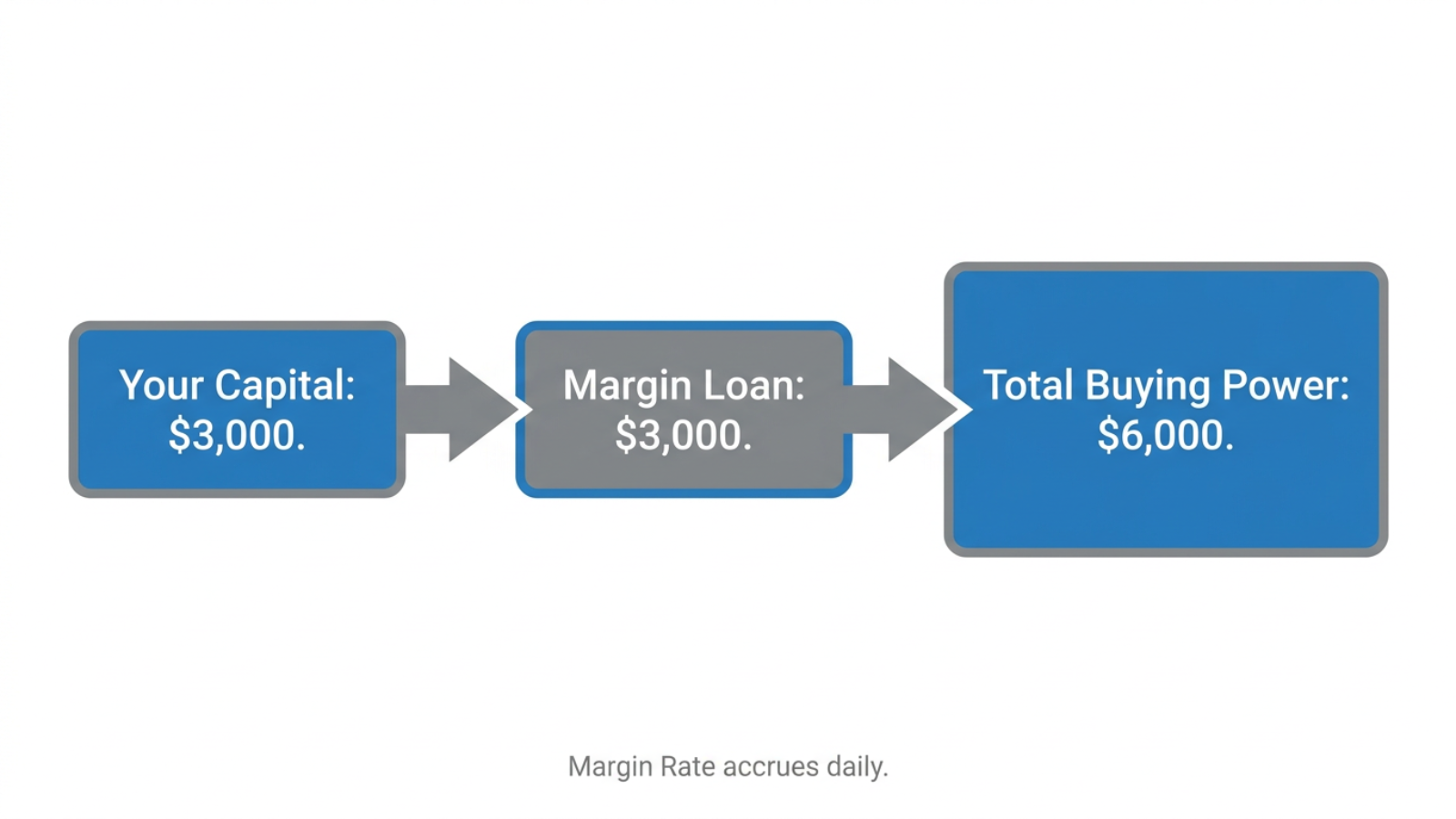
A margin rate is the interest rate applied to the funds you borrow from your brokerage when trading on margin. When you open a margin account, you gain the ability to purchase securities beyond what your cash balance alone would allow — effectively taking out a loan from your broker.
Brokerage firms charge margin rates the same way banks charge interest on loans — as compensation for credit risk and the cost of capital. The rate is expressed as an annual percentage but accrues on a daily basis.
Under Federal Reserve Board Regulation T, brokerages can lend investors up to 50% of the purchase price of eligible marginable securities. This is called the initial margin requirement.
SoFi — https://www.sofi.com/learn/content/margin-rates/
1.2 How Margin Interest Accrues and Gets Charged
Margin interest accrues every calendar day you maintain a debit balance — including weekends and holidays. It is then charged monthly, typically appearing as a debit in your account statement.
The longer you hold a margin position, the more total interest you pay. For short-term trades — especially intraday positions closed before end of day — margin interest may be minimal or even zero, depending on your broker's policy.
Most US brokerages calculate daily interest by dividing the annual margin rate by 360 (the industry standard for a trading year).
SoFi — https://www.sofi.com/learn/content/margin-rates/
1.3 Factors That Influence Margin Rates
Several factors determine the margin rate a brokerage sets:
Broker call rate: The rate banks charge brokerages for the funds used to finance margin loans. Higher broker call rates typically lead to higher margin rates for clients.
Your margin balance: Many brokerages apply tiered pricing — the larger your debit balance, the lower your effective rate.
Inflation and monetary policy: Rising interest rate environments generally push margin rates higher across all brokerages.
Supply and demand: High demand for margin borrowing can push rates upward.
SoFi — https://www.sofi.com/learn/content/margin-rates/
Part 2. Webull Margin Rates: Tiered Pricing and the Premium Plan
2.1 Webull Standard Margin Rates
Webull offers two distinct margin rate structures depending on whether your account is enrolled in Webull Premium.
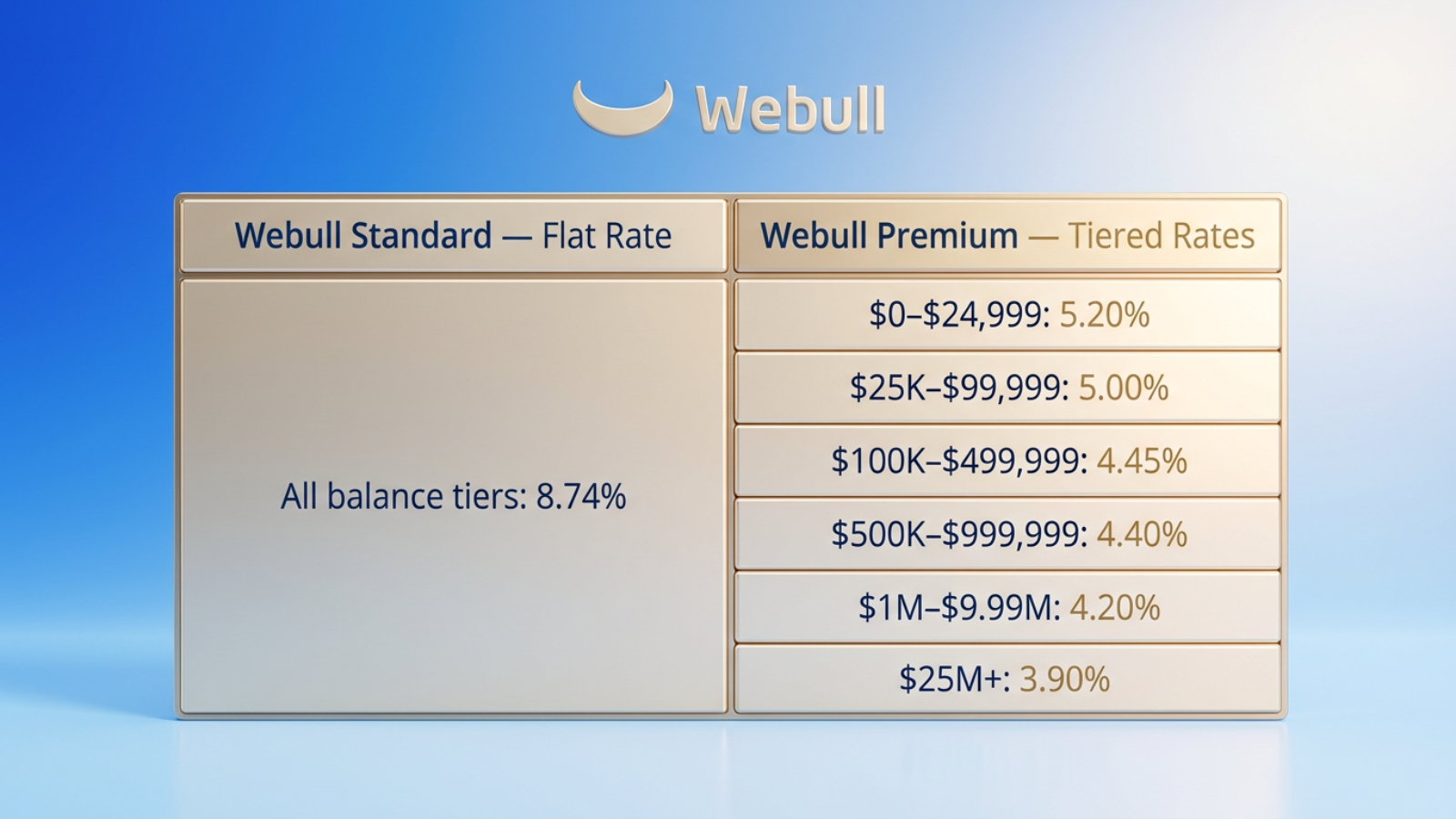
For Standard (non-Premium) accounts, Webull charges a flat 8.74% annual margin rate across all balance tiers. This flat structure means every dollar borrowed — from the first to the last — is subject to the same rate, regardless of account size.
Rates shown are as of March 31, 2026, and are subject to change.
Webull — https://www.webull.com/trading-investing/margin
2.2 Webull Premium Margin Rates
Webull Premium members benefit from a tiered margin rate schedule that can significantly reduce borrowing costs at higher balances. The current Premium rates are:
Margin Balance | Premium Rate |
|---|---|
$0 – $24,999.99 | 5.20% |
$25,000 – $99,999.99 | 5.00% |
$100,000 – $499,999.99 | 4.45% |
$500,000 – $999,999.99 | 4.40% |
$1,000,000 – $9,999,999.99 | 4.20% |
$10,000,000 – $24,999,999.99 | 4.15% |
$25,000,000+ | 3.90% |
Rates vary by service provider; please refer to the latest pricing. Webull — https://www.webull.com/pricing
2.3 Buying Power and Leverage Offered
A Webull margin account provides:
4x day-trade buying power (DTBP): For eligible traders, intraday buying power is up to four times your account equity value.
2x overnight buying power (ONBP): Positions held overnight are limited to two times your equity value.
Note: If you are classified as a Pattern Day Trader (PDT), your equity must remain above $25,000 at all times to continue day trading. Falling below this threshold may trigger an Equity Maintenance (EM) call.
Webull — https://www.webull.com/trading-investing/margin
Part 3. How Webull Margin Interest Is Calculated
3.1 The Daily Average Method
Webull calculates margin interest using a daily average debit balance method. Each day's closing debit balance is recorded and accumulated over the billing month. The monthly average is then used as the principal on which interest is charged.
The closing debit balance is based on the settlement of positions opened — not necessarily your real-time cash balance. If a trade hasn't settled yet, it may still affect your debit balance calculation.
Webull — https://www.webull.com/pricing
3.2 The Margin Interest Formula
Webull uses the following formula to calculate monthly margin interest:
Monthly Margin Interest = Average Daily Debit Balance × (Annual Interest Rate ÷ 360) × Number of Days in Period
Example: If your average daily debit balance is $10,000 over a 30-day period, and your annual rate is 8.74%:
Daily rate: 8.74% ÷ 360 = 0.0243%
Monthly interest: $10,000 × 0.0243% × 30 = $72.83
Intraday positions opened and closed on the same day do not accrue margin interest.
Webull FAQ — https://www.webull.com/pricing
3.3 Short Selling Fees and Hard-to-Borrow (HTB) Rates
Short selling involves borrowing shares before selling them. Webull charges a separate stock loan fee for short positions, calculated as:
Daily Short Interest = Daily Market Value of Borrowed Shares × Stock Loan Rate ÷ 360
Stock loan rates and availability change daily based on market supply and demand. For stocks with limited borrowing availability, an additional Hard-to-Borrow (HTB) fee applies.
HTB Fee Calculation:
Step 1 — Per-share collateral: Multiply the prior closing price by the industry convention rate (e.g., 1.02), then round up to the nearest dollar. Example: $13.00 × 1.02 = $13.26, rounded to $14.00.
Step 2 — Trade value: Multiply per-share collateral by shares shorted. Example: $14.00 × 1,000 shares = $14,000.
Step 3 — Annual HTB fee: Multiply trade value by the annual HTB rate. Example: $14,000 × 6% = $840.
Step 4 — Daily HTB fee: Divide annual fee by 360. Example: $840 ÷ 360 = $2.33/day.
HTB fees accrue on non-trading days (weekends, holidays). The HTB rate can change daily. Whether a stock is Easy-to-Borrow (ETB), Hard-to-Borrow (HTB), or non-shortable is updated daily by Webull's clearing firm.
Webull FAQ — https://www.webull.com/pricing
Part 4. Comparing Margin Rates Across US Brokers
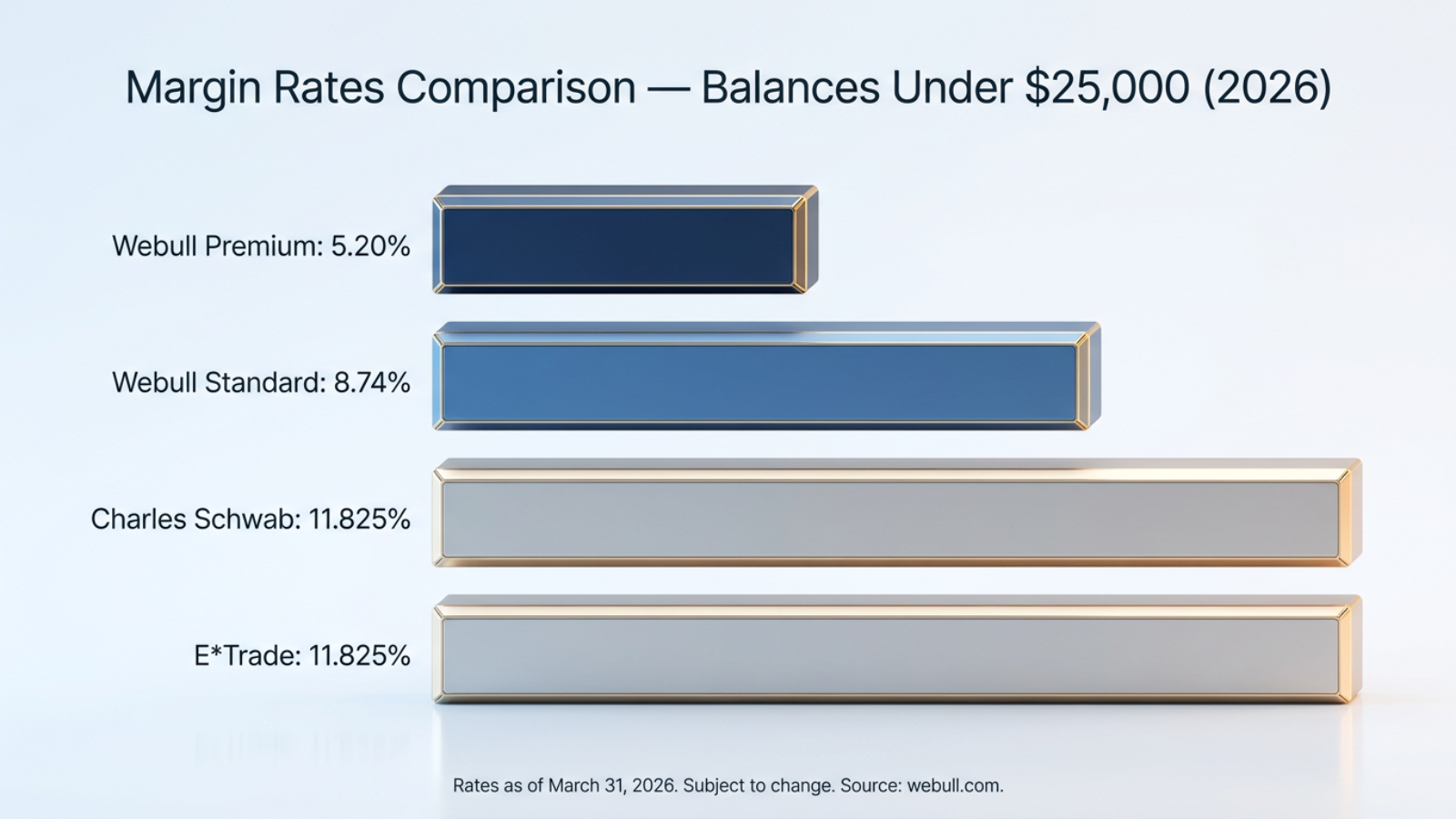
Understanding how Webull's margin rates stack up against other major US brokerages can help investors evaluate total cost of borrowing. The table below reflects publicly available rates.
Broker | Balance Under $25K | $25K–$99.9K | $100K–$499.9K |
|---|---|---|---|
Webull Premium | 5.20% | 5.00% | 4.45% |
Webull Standard | 8.74% | 8.74% | 8.74% |
Charles Schwab | 11.825% | 10.375%–11.325% | 10.075%–10.325% |
E\*Trade | 11.825% | 10.375%–11.325% | 10.075%–10.325% |
Rates vary by service provider; please refer to the latest pricing. Rates are as of March 31, 2026, and are subject to change without notice.
Webull — https://www.webull.com/trading-investing/margin | Charles Schwab — https://www.schwab.com/margin/margin-rates-and-requirements
Important context: Margin rate comparisons should account for a broker's full fee structure, platform capabilities, account minimums, and regulatory protections. A lower rate alone does not make one platform universally suitable for all investors.
Part 5. How to Open and Manage a Webull Margin Account
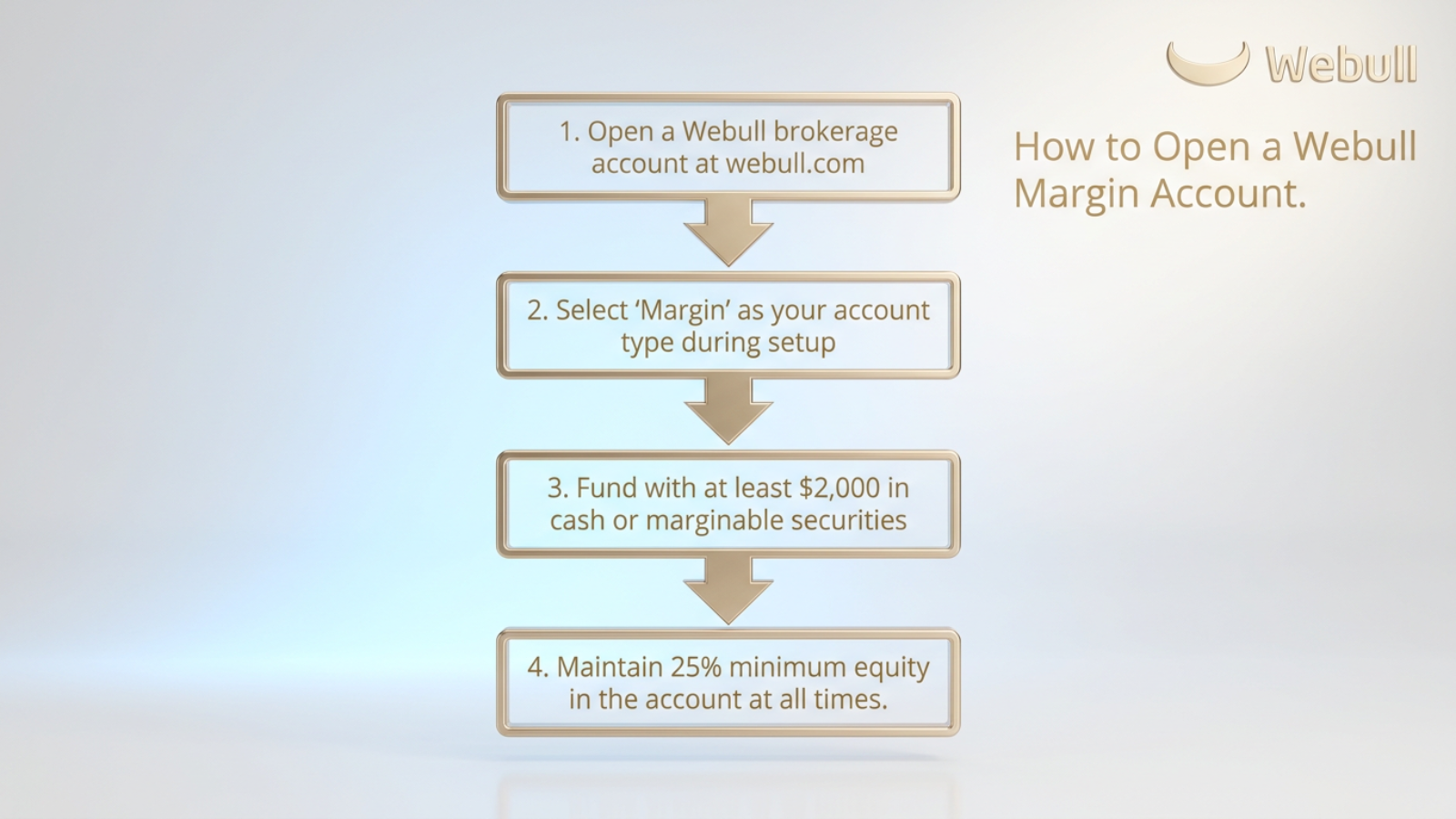
5.1 Margin Account Requirements and Setup
To open a Webull margin account, you need to meet the following requirements:
Minimum equity: $2,000 in cash or marginable securities (per FINRA regulations)
Account type: Select "Margin" when opening a new Webull brokerage account, or upgrade an existing cash account via Account Settings → My Account → Manage My Account
Maintenance requirement: Keep at least 25% of total account value as equity at all times
Downgrading from a margin account back to cash requires a call to Webull customer service, as it cannot be done through the app or website.
Webull — https://www.webull.com/trading-investing/margin | Brokerage Review — https://www.brokerage-review.com/online-brokers/marginrates/webull.aspx
5.2 What You Can Trade with Webull Margin
A Webull margin account supports trading across a wide range of asset classes:
Stocks (long and short positions)
ETFs, including leveraged ETFs (subject to higher margin requirements)
Options, including advanced multi-leg strategies (spreads, iron butterflies, strangles, calendars)
IPO participation
Futures
Note: Webull does not offer limited margin for Individual Retirement Accounts (IRAs). IRAs at Webull operate on a cash-only basis and cannot be used for day trading or options spreads.
Brokerage Review — https://www.brokerage-review.com/online-brokers/marginrates/webull.aspx
5.3 Margin Requirements for Long and Short Positions
Long positions (stocks priced above $5):
Initial requirement: 50% of market value
Maintenance requirement: 25% of market value
Day trading requirement: 25% of market value
Short positions (stocks priced above $16.625):
Initial requirement: 30% of market value
Maintenance requirement: 30% of market value
Day trading requirement: 30% of market value
Note: Margin requirements may vary by security type and price and may change without prior notice. Check the specific security margin requirements on Webull before trading. Learn more: Margin Maintenance Requirements
5.4 Understanding Margin Calls and Account Risk
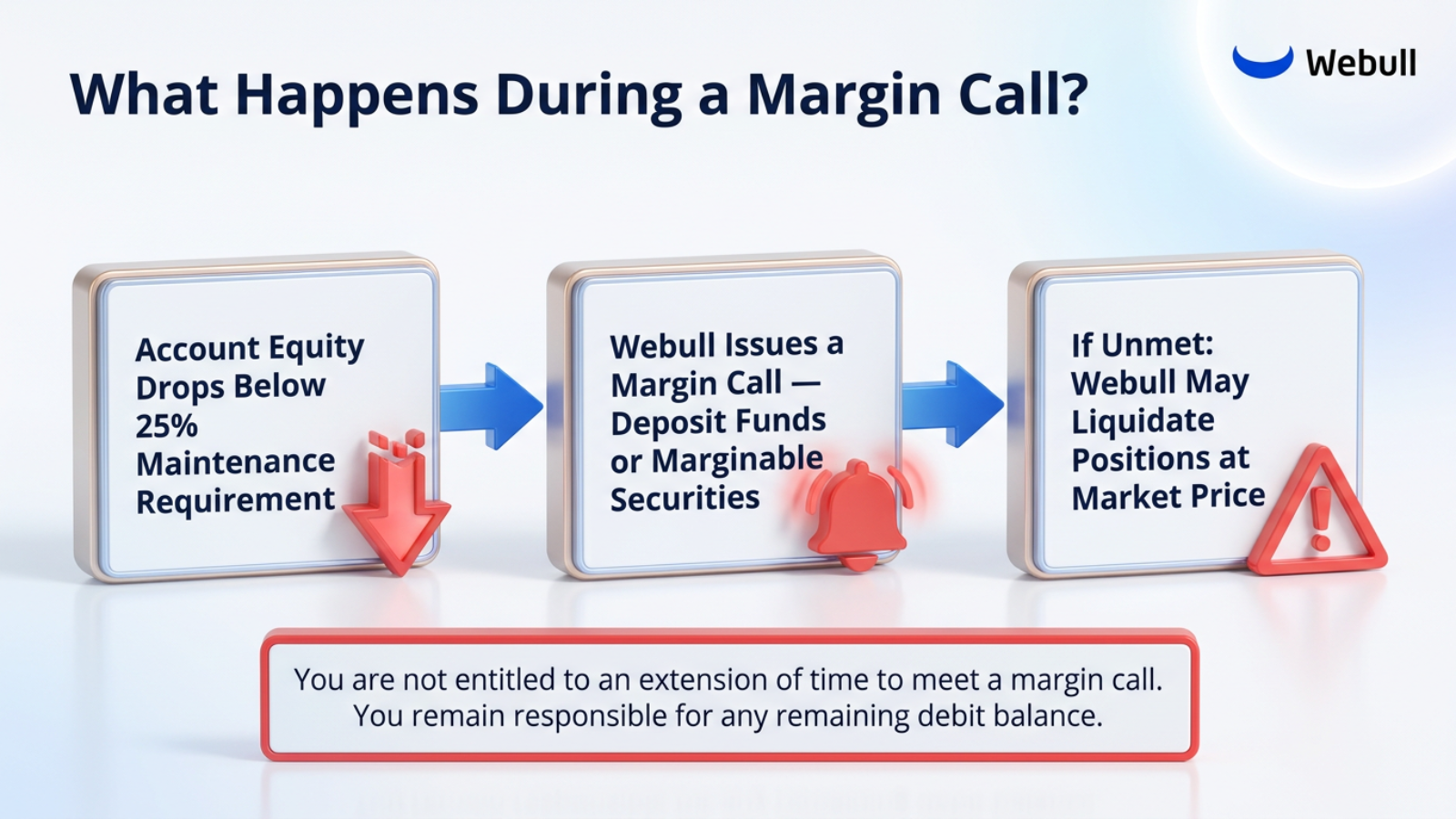
A margin call occurs when your account equity falls below the required maintenance level. When this happens:
You must deposit additional funds or marginable securities to bring equity back above the minimum threshold.
Failure to meet a margin call may result in Webull liquidating positions in your account at current market prices.
You are not entitled to an extension of time to meet a margin call.
If liquidation proceeds do not cover your debit balance, you remain responsible for repaying the outstanding amount.
Webull — https://www.webull.com/trading-investing/margin
Key risks of margin trading include:
Potential for losses exceeding your initial investment
Margin calls and forced liquidation of positions
Short selling losses that can theoretically be unlimited
HTB fees that may change suddenly and without advance notice
Additional costs from accruing margin interest charges over time
Margin trading is complex and involves rules and regulations beyond standard cash trading. It requires a thorough understanding of risk before you begin.
Past performance is not indicative of future results. Tax strategies discussed do not constitute tax advice, and actual results may vary by individual.
5.5 Regulation and Investor Protections
Webull Financial LLC is a member of FINRA and SIPC. SIPC protects securities customers of its members up to $500,000 (including $250,000 for claims for cash) in the event of brokerage insolvency.
Margin accounts are subject to FINRA Rule 4210, Regulation T, and Webull's internal margin policies. Webull may change its margin rate schedule at its discretion and without prior notice.
For the most current margin rates and full pricing details, visit the Webull Pricing Page.
FINRA — https://www.finra.org | SIPC — https://www.sipc.org
The Bottom Line
Margin rates directly impact the profitability of any leveraged trading strategy. Webull provides a transparent, tiered margin rate structure — with a flat 8.74% for Standard accounts and rates as low as 3.90% for Premium members with larger balances. Before using margin, carefully evaluate borrowing costs, maintenance requirements, and the full risk profile of leveraged trading. Visit webull.com/trading-investing/margin for current rates and account details.
Diversification does not eliminate the risk of experiencing investment losses. Margin trading increases risk of loss and includes the possibility of a forced sale if account equity drops below required levels. Margin is not available in all account types. Margin trading privileges are subject to Webull Financial LLC review and approval. Leverage carries a high level of risk and is not suitable for all investors. Greater leverage creates greater losses in the event of adverse market movement.
Webull Financial LLC (member SIPC, FINRA) offers self-directed securities trading. All investments involve risk. More info: https://www.webull.com/policy
The information provided does not constitute investment advice and it should not be relied on as such. It should not be considered a solicitation to buy or an offer to sell a security. It does not take into account any investor's particular investment objectives, strategies, tax status or investment horizon. Investing involves risk, including the risk of loss of principal.
