'%3e %3cpath d='M41.7832962%2c0 C41.9459106%2c0 42.0882746%2c0.0866854658 42.1666825%2c0.216359069 C43.8289923%2c2.66540836 44.7676281%2c5.46271319 44.7676281%2c8.43208061 C44.7676281%2c18.1345746 34.7460532%2c26 22.383814%2c26 C10.0215749%2c26 0%2c18.1345746 0%2c8.43208061 C0%2c5.46716016 0.935826425%2c2.67378733 2.58829888%2c0.223985685 C2.67109477%2c0.0916264068 2.81687473%2c0 2.9840593%2c0 C3.23130408%2c0 3.43173558%2c0.200393004 3.43173558%2c0.447590303 C3.43173558%2c0.475056669 3.42926112%2c0.501945205 3.42452292%2c0.528045226 L3.41810883%2c0.550292077 C3.37800671%2c0.861741908 3.3575721%2c1.17661276 3.3575721%2c1.49443092 C3.3575721%2c7.98336 11.2132389%2c12.5742305 22.383814%2c12.5742305 C33.5543891%2c12.5742305 41.410056%2c7.98336 41.410056%2c1.49443092 C41.410056%2c1.17865223 41.3898828%2c0.865783153 41.3502888%2c0.556288325 C41.3402868%2c0.521941442 41.3356199%2c0.48531078 41.3356199%2c0.447590303 C41.3356199%2c0.200393004 41.5360514%2c0 41.7832962%2c0 Z' id='logo%e5%a4%87%e4%bb%bd-6' fill='white'%3e%3c/path%3e %3cpath d='M74.6899231%2c3.74404927 C75.2411227%2c3.74404927 75.7734299%2c3.66184338 76.2756219%2c3.50883715 L73.8159676%2c20.8666902 C73.5770593%2c22.5662954 72.8072434%2c23.0518969 71.4268838%2c23.0518969 L69.9934336%2c23.0518969 C68.7988917%2c23.0518969 68.1618027%2c22.458384 67.7901674%2c20.893668 L65.6930827%2c11.9909739 C65.639992%2c11.7481731 65.639992%2c11.6942174 65.5338105%2c11.6942174 C65.427629%2c11.6942174 65.4010836%2c11.7481731 65.3479929%2c11.9909739 L63.2509082%2c20.893668 C62.8792729%2c22.458384 62.2421839%2c23.0518969 61.047642%2c23.0518969 L59.6141918%2c23.0518969 C58.2338322%2c23.0518969 57.4640163%2c22.5662954 57.225108%2c20.8666902 L54.7463723%2c3.37406084 C55.3593498%2c3.61307396 56.0249975%2c3.74404927 56.7207458%2c3.74404927 C57.3314263%2c3.74404927 57.918917%2c3.64314414 58.4679557%2c3.4568446 L60.3574623%2c19.3829078 C60.3840076%2c19.6257086 60.3840076%2c19.7875757 60.4901891%2c19.7875757 C60.5963706%2c19.7875757 60.5963706%2c19.6257086 60.6494614%2c19.3829078 L62.9323637%2c9.91367858 C63.0916359%2c9.26620991 63.4632712%2c8.69967483 64.6047223%2c8.69967483 L66.4363532%2c8.69967483 C67.5778044%2c8.69967483 67.9494397%2c9.26620991 68.1087119%2c9.91367858 L70.3916142%2c19.3829078 C70.4447049%2c19.6257086 70.4447049%2c19.7875757 70.5508864%2c19.7875757 C70.6570679%2c19.7875757 70.6570679%2c19.6257086 70.6836133%2c19.3829078 L72.5891207%2c3.32292288 C73.2365902%2c3.59432921 73.9460524%2c3.74404927 74.6899231%2c3.74404927 Z' id='Combined-Shape' fill='white'%3e%3c/path%3e %3cpath d='M84.5933901%2c7.43171536 C88.6813779%2c7.43171536 90.9111894%2c10.2643908 90.9111894%2c14.2840921 L90.9111894%2c15.7948523 C90.9111894%2c16.2264981 90.7519172%2c16.4692988 90.3802819%2c16.4692988 L81.7264895%2c16.4692988 L81.7264895%2c16.5502324 C81.7264895%2c18.1149484 82.3635785%2c19.9764208 84.9119346%2c19.9764208 C86.849747%2c19.9764208 88.6813779%2c19.8145536 89.7962837%2c19.7066422 L89.8759198%2c19.7066422 C90.1413735%2c19.7066422 90.3537366%2c19.8415315 90.3537366%2c20.1113101 L90.3537366%2c21.8918489 C90.3537366%2c22.3234947 90.2741004%2c22.5123397 89.7962837%2c22.5932733 C88.0708343%2c22.9170076 87.0355646%2c23.0518969 84.6464808%2c23.0518969 C81.9919433%2c23.0518969 78.2225%2c21.5950924 78.2225%2c16.2804538 L78.2225%2c14.2840921 C78.2225%2c10.0755457 80.5319476%2c7.43171536 84.5933901%2c7.43171536 Z M84.5933901%2c10.5071915 C82.9475768%2c10.5071915 81.7530349%2c11.6942174 81.7530349%2c13.8254684 L81.7530349%2c13.9333799 L87.3806545%2c13.9333799 L87.3806545%2c13.8254684 C87.3806545%2c11.7211953 86.2392034%2c10.5071915 84.5933901%2c10.5071915 Z' id='Combined-Shape' fill='white'%3e%3c/path%3e %3cpath d='M97.4154906%2c2.98826245 L97.4148064%2c7.62056039 C98.3969853%2c7.48567108 99.3260735%2c7.43171536 99.9631625%2c7.43171536 C104.236968%2c7.43171536 106.307507%2c9.99461216 106.307507%2c14.2031585 L106.307507%2c16.2804538 C106.307507%2c20.4890001 104.236968%2c23.0518969 99.9631625%2c23.0518969 C98.2642584%2c23.0518969 96.2733553%2c22.7821183 94.627542%2c22.3504725 C94.0169984%2c22.1886054 93.9108169%2c22.0267382 93.9108169%2c21.6220703 L93.9098179%2c3.08694115 C94.4185466%2c3.24434375 94.9584615%2c3.32900525 95.5178331%2c3.32900525 C96.184659%2c3.32900525 96.8238351%2c3.20869291 97.4154906%2c2.98826245 Z M99.9631625%2c10.3453244 C99.3260735%2c10.3453244 98.1580769%2c10.4262579 97.4148064%2c10.5341694 L97.4148064%2c19.9494429 C97.9191686%2c20.0573544 99.007529%2c20.1382879 99.9631625%2c20.1382879 C102.246065%2c20.1382879 102.803518%2c18.4926384 102.803518%2c16.2804538 L102.803518%2c14.2031585 C102.803518%2c11.9909739 102.246065%2c10.3453244 99.9631625%2c10.3453244 Z' id='Combined-Shape' fill='white'%3e%3c/path%3e %3cpath d='M111.036668%2c8.72457747 C111.579488%2c8.72457747 112.103987%2c8.64485191 112.599444%2c8.49629404 L112.598761%2c16.5232546 C112.598761%2c19.3289521 113.607485%2c19.9764208 115.147117%2c19.9764208 L115.306389%2c19.9764208 C116.846021%2c19.9764208 117.854746%2c19.3289521 117.854746%2c16.5232546 L117.854207%2c8.4334735 C118.406525%2c8.62226395 118.997939%2c8.72457747 119.612866%2c8.72457747 C120.223332%2c8.72457747 120.810625%2c8.62374317 121.359498%2c8.43756894 L121.358735%2c16.5232546 C121.358735%2c22.4044283 116.872567%2c23.0518969 115.306389%2c23.0518969 L115.060464%2c23.0512514 C113.42215%2c23.0271041 109.094772%2c22.2994073 109.094772%2c16.5232546 L109.094446%2c8.36700801 C109.698522%2c8.59813531 110.353066%2c8.72457747 111.036668%2c8.72457747 Z' id='Combined-Shape' fill='white'%3e%3c/path%3e %3cpath d='M128.314162%2c3.03790128 L128.313623%2c22.269539 C128.313623%2c22.5662954 128.10126%2c22.836074 127.809261%2c22.836074 L125.340541%2c22.836074 C125.048542%2c22.836074 124.809634%2c22.5662954 124.809634%2c22.269539 L124.809455%2c3.04219481 C125.358161%2c3.22824247 125.945253%2c3.32900525 126.555503%2c3.32900525 C127.17043%2c3.32900525 127.761844%2c3.22669173 128.314162%2c3.03790128 Z' id='Combined-Shape' fill='white'%3e%3c/path%3e %3cpath d='M133.90653%2c3.32900525 C134.473329%2c3.32900525 135.02015%2c3.24208064 135.534793%2c3.08063296 L135.533966%2c22.269539 C135.533966%2c22.5662954 135.321603%2c22.836074 135.029603%2c22.836074 L132.560884%2c22.836074 C132.268884%2c22.836074 132.029976%2c22.5662954 132.029976%2c22.269539 L132.029909%2c2.99605058 C132.615669%2c3.21152525 133.2476%2c3.32900525 133.90653%2c3.32900525 Z' id='Combined-Shape' fill='white'%3e%3c/path%3e %3c/g%3e %3c/g%3e %3c/g%3e%3c/svg%3e)



If you're exploring options trading, understanding options Greeks is one of the most practical skills you can develop. These mathematical measures help traders assess how factors like price movement, time decay, and implied volatility affect the value of an options position — and knowing how to read them can meaningfully inform how you manage risk.
Key Takeaways
Options Greeks are risk metrics that measure an option's sensitivity to price, time, volatility, and interest rates.
The five primary Greeks are delta, gamma, theta, vega, and rho.
Delta is the most widely used Greek — it measures how much an option's price changes for every $1 move in the underlying asset.
Gamma tracks how quickly delta itself changes as the stock price moves.
Theta quantifies daily time decay; vega measures sensitivity to implied volatility shifts.
Rho captures interest rate sensitivity — most relevant for longer-dated options like LEAPS.
Platforms like Webull provide real-time options Greeks powered by Cboe, giving traders access to live analytics directly within the options chain.

Part 1. What Are Options Greeks and Why Do They Matter?
Options contracts are derivatives — their value doesn't move in a straight line with the underlying stock. Instead, several variables interact simultaneously to push an option's premium up or down. Options Greeks are the quantitative tools that isolate each of these forces so traders can measure, monitor, and manage their exposure.
Specifically, the Greeks represent the sensitivities of an option's value to incremental changes in four key inputs: the price of the underlying asset, the passage of time, implied volatility, and the risk-free interest rate. Each Greek isolates one variable while holding the others constant — a theoretical framework that helps traders build a clearer picture of where their risk actually lives.
For stock options, the five Greeks are delta (Δ), gamma (γ), theta (Θ), vega (ν), and rho (ρ). Together, they function like a dashboard — not a guarantee of outcomes, but a structured way to evaluate how an option position may behave under different market scenarios.
One important point: Greeks can be evaluated on an individual option or at the portfolio level. Because Greeks are additive, you can sum the individual Greeks of all your positions — weighted by position size — to understand the overall risk profile of an entire options portfolio. This practice is standard among professional options portfolio managers.
The Greeks are derived from option pricing models. For U.S.-listed equity options, the industry-standard framework is the Black-Scholes model, which uses variables including the underlying asset price, strike price, time to expiration, implied volatility, and the risk-free rate to compute theoretical option values — and, from those, the Greeks.
Part 2. Delta and Gamma — Measuring Directional Risk
2.1 Delta (Δ): Price Sensitivity
Delta is widely regarded as the most important of the options Greeks. It measures how much an option's theoretical value is expected to change for every $1 move in the price of the underlying stock.
For call options, delta ranges from 0.0 to +1.0
For put options, delta ranges from 0.0 to −1.0
An at-the-money (ATM) option typically carries a delta near 0.50
For example, if you hold a call option with a delta of 0.40 and the stock rises by $1, your option's value is expected to increase by approximately $0.40 — assuming other variables remain constant.
Delta as a probability estimate
Many traders use the absolute value of delta as a rough approximation of the probability that an option will expire in-the-money (ITM). An option with a 0.30 delta suggests roughly a 30% chance of expiring ITM; a 0.70 delta suggests approximately a 70% chance. This is a commonly used heuristic, not a precise statistical guarantee.
Put-call parity and delta
Due to put-call parity, if you know the delta of a call option, you can derive the delta of the corresponding put with the same strike price by subtracting the call's delta from 1. For example, a call option with a delta of 0.40 implies the corresponding put has a delta of 0.60. The combined absolute deltas of a call-put pair with the same strike cannot exceed 1.
Portfolio delta
When managing multiple positions on the same underlying asset, the total portfolio delta is simply the sum of each individual position's delta, weighted by position size. This gives traders a single number representing the net directional exposure of the entire book.

2.2 Gamma (γ): The Rate of Change in Delta
While delta tells you how an option responds to a $1 price move right now, gamma tells you how delta itself will change as the stock continues to move. Gamma is the second derivative of an option's value with respect to the underlying asset's price — essentially, the "delta of the delta."
Long option positions (whether calls or puts) have positive gamma
Short option positions have negative gamma
Gamma is highest for at-the-money options and approaches zero as an option moves deep ITM or deep OTM
Practical example: Suppose you own a call option with a delta of 0.50 and a gamma of 0.05. If the stock rises $1, your new delta becomes approximately 0.55 — meaning the option is now more sensitive to further price moves. This acceleration can work in your favor when the stock moves the way you want, but it also magnifies losses when the stock moves against you.
Traders often review gamma when deciding between near-term and longer-dated options, evaluating risk in options spreads, or managing positions during periods of heightened market volatility. High-gamma positions near expiration can shift in value rapidly, which requires careful attention.
Part 3. Theta and Vega — Time Decay and Volatility Sensitivity
3.1 Theta (Θ): The Cost of Time
Unlike stocks, options have an expiration date — and every day that passes without a favorable price move erodes a portion of an option's value. Theta quantifies this erosion. It represents the amount an option's price is expected to decline each day, with all other variables held constant.
Theta is expressed as a negative value for long option positions. For example, a theta of −0.05 means the option loses approximately $0.05 in value per day. The magnitude of theta is not constant — it accelerates as expiration approaches, particularly for at-the-money options.
Key dynamics to understand:
Long options (buyers) have negative theta — time works against them
Short options (sellers) have positive theta — time works in their favor
Theta is typically highest for ATM options near expiration, where time decay is most rapid
OTM options with high implied volatility can also carry significant theta
This asymmetry makes theta a central consideration for options income strategies — sellers collect premium and benefit from time decay, while buyers must see a favorable price or volatility move large enough to offset the ongoing erosion.
Past performance is not indicative of future results.
3.2 Vega (ν): Sensitivity to Implied Volatility
Vega measures how much an option's price is expected to change for every 1% change in implied volatility (IV) of the underlying asset. It is not actually a Greek letter — the symbol ν (nu) is used as a substitute — but it is one of the most widely tracked sensitivities in options trading.
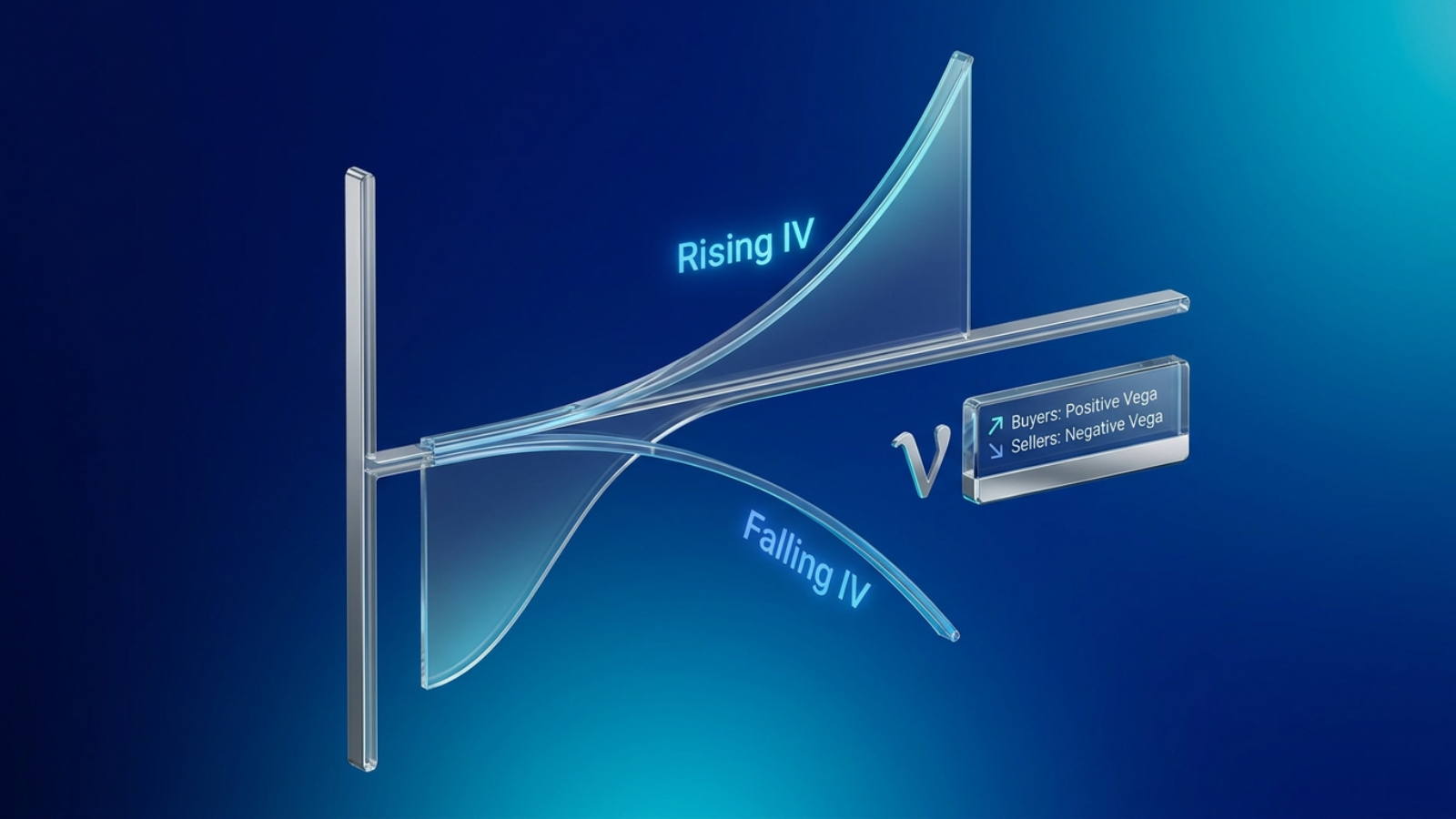
Unlike delta and theta, vega is not about price direction or time. It reflects market expectations about future volatility. When implied volatility rises — often during periods of market uncertainty — option premiums increase for both calls and puts. When IV falls, premiums compress.
Long option positions have positive vega: they benefit from rising IV
Short option positions have negative vega: they benefit from falling IV
Vega is highest for ATM options and for longer-dated contracts; it declines as expiration approaches
Traders running volatility-sensitive strategies — such as at-the-money straddles — need to monitor their vega exposure carefully, especially if they plan to close the position before expiration. A sudden drop in implied volatility can offset gains from a correct directional move.
Vega can change independently of the underlying stock's price, driven entirely by shifts in market expectations about future volatility.
Part 4. Rho and Implied Volatility — Interest Rates and Broader Context
4.1 Rho (ρ): Interest Rate Sensitivity
Rho measures an option's sensitivity to changes in the risk-free interest rate. Specifically, it represents the expected change in an option's value for a 1% change in interest rates.
Call options typically increase in value when rates rise; rho is positive for long calls
Put options typically decrease in value when rates rise; rho is negative for long puts
Rho is generally considered the least impactful of the primary Greeks for short-term options
For most near-term options traders, rho is a background factor — interest rates don't change daily, and their effect on short-dated options is relatively minor compared to price moves, time decay, or volatility shifts. However, rho becomes meaningfully more relevant for long-dated options such as LEAPS (Long-Term Equity Anticipation Securities), where the compounding effect of interest rate changes over months or years can influence pricing more substantially.
4.2 Implied Volatility — The Non-Greek Greek
While not technically a Greek, implied volatility (IV) is closely related to the Greeks and is a critical input in any options analysis. IV represents the market's forward-looking estimate of how much an asset's price may move — specifically, the annualized expected range that captures approximately 68% of outcomes (one standard deviation) over a one-year period.
When implied volatility is high, option premiums rise across the board — both calls and puts become more expensive. When IV is low, premiums compress. Options traders use IV to assess whether an option appears relatively expensive or inexpensive compared to historical norms and to gauge the market's expectations ahead of events like earnings announcements.
Monitoring implied volatility is particularly important when managing vega-sensitive positions, since IV can shift rapidly and independently of the underlying stock's actual price movement.
Part 5. How to View Real-Time Options Greeks on Webull
For traders who want to apply options Greeks to their portfolios, access to real-time data is essential. Webull stands out for providing live options analytics directly within its platform — covering delta, gamma, theta, vega, and rho — powered by Cboe Global Markets.
About Cboe's data
Cboe Global Markets is a leading financial computing provider specializing in risk management and derivatives analytics. Cboe produces and displays implied volatilities and the full suite of Greeks — delta, gamma, theta, vega, and rho — for global listed options markets in real time, using industry-standard models and high-quality market inputs. This coverage spans the full OPRA universe of listed options.
Webull's real-time implied volatility and Greeks data are powered by Cboe, meaning traders on the platform benefit from the same analytics infrastructure used by institutional participants and professional options desk operators.
Where to find Greeks on Webull
Within Webull's mobile app, website, and desktop platform, traders can access the options chain for any eligible underlying. Within the options chain view, the following information is available for each listed option:
Implied volatility for each strike
Delta, gamma, and theta for each option contract
Current underlying stock price
Bid/ask prices and spreads
Breakeven price at expiration
Percent change and trading volume
This real-time data allows traders to quickly assess how their current or prospective option positions are positioned relative to price movement, time decay, and volatility — all in one screen without switching between tools.

Getting started with options on Webull
To trade options on Webull, you need to complete an options trading application and receive approval on eligible accounts.
You can explore Webull's options features and apply for options trading at www.webull.com.
Applying Greeks in practice on Webull
Once inside the options chain on Webull, traders can use the displayed Greeks to:
Evaluate directional exposure — review delta to understand how sensitive each contract is to a $1 move in the stock
Assess time decay risk — check theta to understand how much value a long option position is expected to lose per day
Monitor volatility sensitivity — use vega and implied volatility readings to understand how a shift in market expectations could affect open positions
Compare strikes and expirations — use gamma values to identify which contracts carry the highest sensitivity near expiration
This integrated, real-time Greeks display supports more informed, risk-aware decision-making for active options traders — from evaluating individual contracts to managing a portfolio of positions.

FAQs: Options Greeks
Q1. What are options Greeks and what do they measure?
Options Greeks are mathematical risk metrics used in options trading to measure how sensitive an option's price is to changes in various market factors. The five primary Greeks are delta (price sensitivity), gamma (rate of change in delta), theta (time decay), vega (implied volatility sensitivity), and rho (interest rate sensitivity). Together, they help traders quantify and manage the different dimensions of options risk.
Q2. What is the difference between delta and gamma in options trading?
Delta measures how much an option's price is expected to change for a $1 move in the underlying stock — it reflects directional exposure at a given moment. Gamma measures how quickly delta itself changes as the stock price moves. A high gamma means delta is accelerating, which can amplify both gains and losses. Traders often use both together to understand their current exposure and how that exposure may shift with further price movement.
Q3. How does theta affect long options positions?
Theta represents the daily time decay of an option's value. For long options positions (buyers), theta is negative — meaning the position loses a small amount of value every day, all else being equal. This erosion accelerates significantly in the final weeks before expiration, particularly for at-the-money options. Traders holding long options need a sufficiently large favorable price or volatility move to offset ongoing theta decay. Past performance is not indicative of future results.
Q4. Why does vega matter when trading options around earnings?
Vega measures how much an option's price changes for every 1% move in implied volatility. Ahead of earnings announcements, implied volatility typically rises as traders price in uncertainty — inflating option premiums for both calls and puts. After the announcement, IV often contracts sharply (a phenomenon sometimes called "IV crush"), which can cause option premiums to fall even if the stock moves in the expected direction. Understanding vega helps traders anticipate how much of the premium they're paying reflects volatility expectations rather than pure directional exposure.
Q5. How can I view real-time options Greeks on Webull?
Webull provides real-time implied volatility and Greeks — including delta, gamma, and theta — directly within the options chain on its mobile app, website, and desktop platform. This data is powered by Cboe Global Markets, using industry-standard models and live market inputs. To access it, navigate to any eligible underlying's options chain view. Note that options trading requires prior application and approval. You can learn more and explore options features at www.webull.com.
The Bottom Line
Options Greeks — delta, gamma, theta, vega, and rho — are practical tools for understanding how an option's price may respond to market changes. Mastering them supports more informed, risk-aware trading decisions. Webull provides real-time Greeks data powered by Cboe, making these analytics accessible directly within the platform's options chain. Options trading involves significant risk and may not be suitable for all investors.
Disclaimer:
Webull Financial LLC. Member FINRA, SIPC. Options are risky and not suitable for all investors. Losses can occur quickly and exceed initial investment. Before trading options, read 'Characteristics and Risks of Standardized Options' available at https://www.webull.com/policy Regulatory and exchange fees apply.
The information provided does not constitute investment advice and it should not be relied on as such. It should not be considered a solicitation to buy or an offer to sell a security. It does not take into account any investor's particular investment objectives, strategies, tax status or investment horizon. Investing involves risk, including the risk of loss of principal.
