'%3e %3cpath d='M41.7832962%2c0 C41.9459106%2c0 42.0882746%2c0.0866854658 42.1666825%2c0.216359069 C43.8289923%2c2.66540836 44.7676281%2c5.46271319 44.7676281%2c8.43208061 C44.7676281%2c18.1345746 34.7460532%2c26 22.383814%2c26 C10.0215749%2c26 0%2c18.1345746 0%2c8.43208061 C0%2c5.46716016 0.935826425%2c2.67378733 2.58829888%2c0.223985685 C2.67109477%2c0.0916264068 2.81687473%2c0 2.9840593%2c0 C3.23130408%2c0 3.43173558%2c0.200393004 3.43173558%2c0.447590303 C3.43173558%2c0.475056669 3.42926112%2c0.501945205 3.42452292%2c0.528045226 L3.41810883%2c0.550292077 C3.37800671%2c0.861741908 3.3575721%2c1.17661276 3.3575721%2c1.49443092 C3.3575721%2c7.98336 11.2132389%2c12.5742305 22.383814%2c12.5742305 C33.5543891%2c12.5742305 41.410056%2c7.98336 41.410056%2c1.49443092 C41.410056%2c1.17865223 41.3898828%2c0.865783153 41.3502888%2c0.556288325 C41.3402868%2c0.521941442 41.3356199%2c0.48531078 41.3356199%2c0.447590303 C41.3356199%2c0.200393004 41.5360514%2c0 41.7832962%2c0 Z' id='logo%e5%a4%87%e4%bb%bd-6' fill='white'%3e%3c/path%3e %3cpath d='M74.6899231%2c3.74404927 C75.2411227%2c3.74404927 75.7734299%2c3.66184338 76.2756219%2c3.50883715 L73.8159676%2c20.8666902 C73.5770593%2c22.5662954 72.8072434%2c23.0518969 71.4268838%2c23.0518969 L69.9934336%2c23.0518969 C68.7988917%2c23.0518969 68.1618027%2c22.458384 67.7901674%2c20.893668 L65.6930827%2c11.9909739 C65.639992%2c11.7481731 65.639992%2c11.6942174 65.5338105%2c11.6942174 C65.427629%2c11.6942174 65.4010836%2c11.7481731 65.3479929%2c11.9909739 L63.2509082%2c20.893668 C62.8792729%2c22.458384 62.2421839%2c23.0518969 61.047642%2c23.0518969 L59.6141918%2c23.0518969 C58.2338322%2c23.0518969 57.4640163%2c22.5662954 57.225108%2c20.8666902 L54.7463723%2c3.37406084 C55.3593498%2c3.61307396 56.0249975%2c3.74404927 56.7207458%2c3.74404927 C57.3314263%2c3.74404927 57.918917%2c3.64314414 58.4679557%2c3.4568446 L60.3574623%2c19.3829078 C60.3840076%2c19.6257086 60.3840076%2c19.7875757 60.4901891%2c19.7875757 C60.5963706%2c19.7875757 60.5963706%2c19.6257086 60.6494614%2c19.3829078 L62.9323637%2c9.91367858 C63.0916359%2c9.26620991 63.4632712%2c8.69967483 64.6047223%2c8.69967483 L66.4363532%2c8.69967483 C67.5778044%2c8.69967483 67.9494397%2c9.26620991 68.1087119%2c9.91367858 L70.3916142%2c19.3829078 C70.4447049%2c19.6257086 70.4447049%2c19.7875757 70.5508864%2c19.7875757 C70.6570679%2c19.7875757 70.6570679%2c19.6257086 70.6836133%2c19.3829078 L72.5891207%2c3.32292288 C73.2365902%2c3.59432921 73.9460524%2c3.74404927 74.6899231%2c3.74404927 Z' id='Combined-Shape' fill='white'%3e%3c/path%3e %3cpath d='M84.5933901%2c7.43171536 C88.6813779%2c7.43171536 90.9111894%2c10.2643908 90.9111894%2c14.2840921 L90.9111894%2c15.7948523 C90.9111894%2c16.2264981 90.7519172%2c16.4692988 90.3802819%2c16.4692988 L81.7264895%2c16.4692988 L81.7264895%2c16.5502324 C81.7264895%2c18.1149484 82.3635785%2c19.9764208 84.9119346%2c19.9764208 C86.849747%2c19.9764208 88.6813779%2c19.8145536 89.7962837%2c19.7066422 L89.8759198%2c19.7066422 C90.1413735%2c19.7066422 90.3537366%2c19.8415315 90.3537366%2c20.1113101 L90.3537366%2c21.8918489 C90.3537366%2c22.3234947 90.2741004%2c22.5123397 89.7962837%2c22.5932733 C88.0708343%2c22.9170076 87.0355646%2c23.0518969 84.6464808%2c23.0518969 C81.9919433%2c23.0518969 78.2225%2c21.5950924 78.2225%2c16.2804538 L78.2225%2c14.2840921 C78.2225%2c10.0755457 80.5319476%2c7.43171536 84.5933901%2c7.43171536 Z M84.5933901%2c10.5071915 C82.9475768%2c10.5071915 81.7530349%2c11.6942174 81.7530349%2c13.8254684 L81.7530349%2c13.9333799 L87.3806545%2c13.9333799 L87.3806545%2c13.8254684 C87.3806545%2c11.7211953 86.2392034%2c10.5071915 84.5933901%2c10.5071915 Z' id='Combined-Shape' fill='white'%3e%3c/path%3e %3cpath d='M97.4154906%2c2.98826245 L97.4148064%2c7.62056039 C98.3969853%2c7.48567108 99.3260735%2c7.43171536 99.9631625%2c7.43171536 C104.236968%2c7.43171536 106.307507%2c9.99461216 106.307507%2c14.2031585 L106.307507%2c16.2804538 C106.307507%2c20.4890001 104.236968%2c23.0518969 99.9631625%2c23.0518969 C98.2642584%2c23.0518969 96.2733553%2c22.7821183 94.627542%2c22.3504725 C94.0169984%2c22.1886054 93.9108169%2c22.0267382 93.9108169%2c21.6220703 L93.9098179%2c3.08694115 C94.4185466%2c3.24434375 94.9584615%2c3.32900525 95.5178331%2c3.32900525 C96.184659%2c3.32900525 96.8238351%2c3.20869291 97.4154906%2c2.98826245 Z M99.9631625%2c10.3453244 C99.3260735%2c10.3453244 98.1580769%2c10.4262579 97.4148064%2c10.5341694 L97.4148064%2c19.9494429 C97.9191686%2c20.0573544 99.007529%2c20.1382879 99.9631625%2c20.1382879 C102.246065%2c20.1382879 102.803518%2c18.4926384 102.803518%2c16.2804538 L102.803518%2c14.2031585 C102.803518%2c11.9909739 102.246065%2c10.3453244 99.9631625%2c10.3453244 Z' id='Combined-Shape' fill='white'%3e%3c/path%3e %3cpath d='M111.036668%2c8.72457747 C111.579488%2c8.72457747 112.103987%2c8.64485191 112.599444%2c8.49629404 L112.598761%2c16.5232546 C112.598761%2c19.3289521 113.607485%2c19.9764208 115.147117%2c19.9764208 L115.306389%2c19.9764208 C116.846021%2c19.9764208 117.854746%2c19.3289521 117.854746%2c16.5232546 L117.854207%2c8.4334735 C118.406525%2c8.62226395 118.997939%2c8.72457747 119.612866%2c8.72457747 C120.223332%2c8.72457747 120.810625%2c8.62374317 121.359498%2c8.43756894 L121.358735%2c16.5232546 C121.358735%2c22.4044283 116.872567%2c23.0518969 115.306389%2c23.0518969 L115.060464%2c23.0512514 C113.42215%2c23.0271041 109.094772%2c22.2994073 109.094772%2c16.5232546 L109.094446%2c8.36700801 C109.698522%2c8.59813531 110.353066%2c8.72457747 111.036668%2c8.72457747 Z' id='Combined-Shape' fill='white'%3e%3c/path%3e %3cpath d='M128.314162%2c3.03790128 L128.313623%2c22.269539 C128.313623%2c22.5662954 128.10126%2c22.836074 127.809261%2c22.836074 L125.340541%2c22.836074 C125.048542%2c22.836074 124.809634%2c22.5662954 124.809634%2c22.269539 L124.809455%2c3.04219481 C125.358161%2c3.22824247 125.945253%2c3.32900525 126.555503%2c3.32900525 C127.17043%2c3.32900525 127.761844%2c3.22669173 128.314162%2c3.03790128 Z' id='Combined-Shape' fill='white'%3e%3c/path%3e %3cpath d='M133.90653%2c3.32900525 C134.473329%2c3.32900525 135.02015%2c3.24208064 135.534793%2c3.08063296 L135.533966%2c22.269539 C135.533966%2c22.5662954 135.321603%2c22.836074 135.029603%2c22.836074 L132.560884%2c22.836074 C132.268884%2c22.836074 132.029976%2c22.5662954 132.029976%2c22.269539 L132.029909%2c2.99605058 C132.615669%2c3.21152525 133.2476%2c3.32900525 133.90653%2c3.32900525 Z' id='Combined-Shape' fill='white'%3e%3c/path%3e %3c/g%3e %3c/g%3e %3c/g%3e%3c/svg%3e)



Options trading strategies offer US investors a structured way to pursue income, hedge existing positions, or express a directional market view — all with defined risk parameters. Whether you're exploring options trading strategies for income through covered calls or building complex multi-leg spreads, understanding how each approach works is essential before placing your first trade.
Key Takeaways
Options strategies are organized by approval level (Level 1–4), with each level unlocking more complex trades.
Income-focused strategies such as covered calls and cash-secured puts are available at Level 1.
Multi-leg strategies including iron condors and butterflies require Level 3 with a margin account.
Naked options (Level 4) carry unlimited risk potential and require a minimum net account value of $10,000.
All options trading involves significant risk; investors can rapidly lose the entire value of their investment.
Part 1. Understanding Options Trading Strategies: Core Concepts
Before selecting any options trading strategy, it helps to understand what options contracts are and how approval levels determine which strategies you can access.
An options contract gives the holder the right — but not the obligation — to buy (call) or sell (put) 100 shares of an underlying asset at a fixed strike price before the expiration date. The buyer pays a premium for this right, while the seller receives that premium in exchange for taking on an obligation.
Options trading levels determine which strategies a trader may execute:
Level 1: Covered calls, buy-writes, cash-secured puts
Level 2: Long calls, long puts, collars, protective puts, straddles, strangles (margin required for some)
Level 3: Vertical spreads, calendar spreads, diagonal spreads, butterflies, condors, iron butterflies, iron condors, ratio spreads (margin + $2,000 minimum start-of-day equity required)
Level 4: Naked calls and puts (margin + $10,000 minimum net account value required; available only for S&P 500 stocks, indices, and select index ETFs)
Cash accounts (including IRAs) may apply for up to Level 2. Margin accounts may apply for up to Level 4.
On Webull, traders can apply for options approval through an options trading application on eligible accounts. To learn more about how Webull structures its options tiers, visit Webull's options overview page.
Part 2. Income-Generating Options Trading Strategies
2.1 Covered Calls
A covered call is written against a long stock position. The seller receives premium income while agreeing to sell shares at the strike price if the option is exercised. This strategy suits investors with a neutral to slightly bullish outlook who want to generate additional income on holdings they already own.
Max gain: Limited to the strike price plus the premium received
Max loss: The full decline in stock value to $0.00, partially offset by the premium received
Breakeven: Stock purchase price minus premium received
Required level: Level 1
A related variation is the buy-write, where an investor simultaneously purchases the stock and sells a call option. This locks in a lower cost basis from the outset.
Advantages of covered calls and buy-writes include:
Potential income generation on existing holdings
Slight downside cushion equal to the premium received
May be used to establish a sell-discipline at a targeted exit price
Risks to consider:
Upside participation is capped at the strike price
The underlying stock remains exposed to significant downside
Early assignment is possible, particularly around ex-dividend dates
Webull supports covered calls and buy-writes at Level 1, making them accessible for investors who have passed the initial options application. For a detailed breakdown of how covered calls work on the platform, visit Webull's options strategies page.
2.2 Cash-Secured Puts
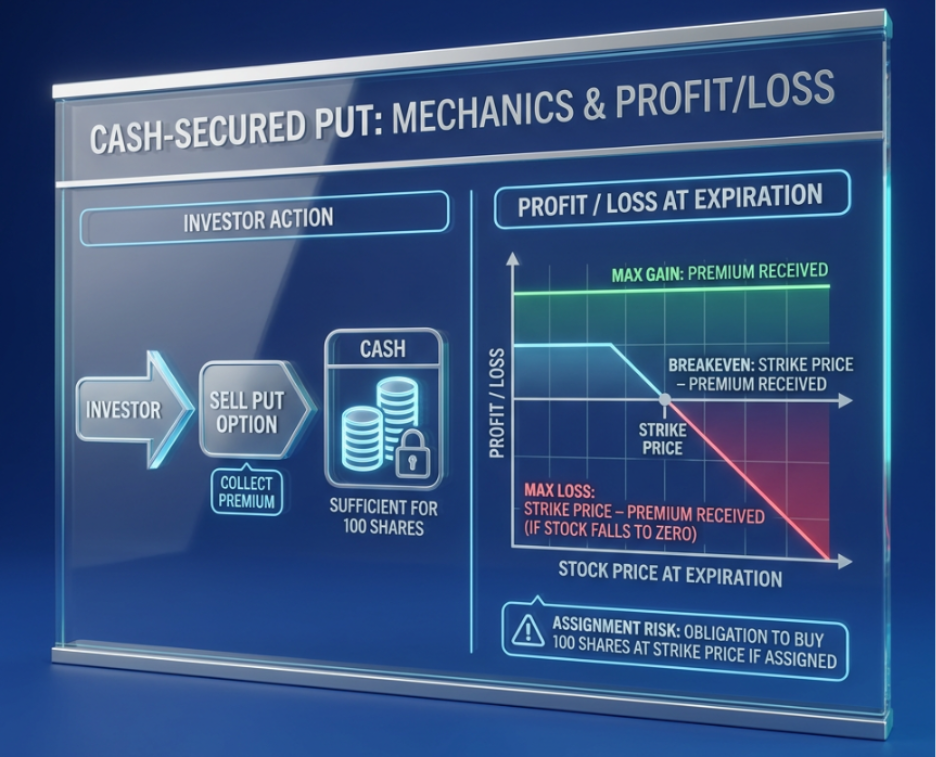
A cash-secured put involves selling a put option while holding sufficient cash to purchase 100 shares of the underlying stock at the strike price if assigned. It is a neutral-to-bullish strategy for investors willing to acquire a stock at a targeted price.
Max gain: Limited to the premium received
Max loss: Occurs if the stock falls to zero; equal to the strike price minus the premium received
Breakeven: Strike price minus premium received
Required level: Level 1
The premium received effectively reduces the cost basis should assignment occur. However, the position still carries substantial downside risk if the underlying stock declines sharply.
Income-focused investors often use covered calls and cash-secured puts together: selling puts to potentially acquire a stock at a discount, then selling covered calls once shares are owned to generate ongoing premium income.
Part 3. Hedging and Directional Options Trading Strategies
3.1 Protective Puts and Collars
Protective puts are used by investors who hold a stock position and want to limit downside risk. By purchasing a put option at or below the current stock price, the investor gains the right to sell shares at the strike price, effectively setting a floor on losses.
Risk: Time-limited protection; the put will eventually expire. The option's value can erode independently of the stock price.
Required level: Level 2
A collar combines a protective put with a short covered call. The premium earned from the sold call can help offset the cost of the protective put, potentially providing downside protection at little to no net cost.
Max gain: Limited to the difference between the stock price and the short call strike, adjusted for the net premium paid or received
Max loss: Limited to the difference between the stock price and the protective put strike, adjusted for the net premium paid or received
Breakeven: Stock purchase price ± the net premium paid or received
Required level: Level 2
The trade-off with collars is that upside participation is capped. Early assignment on the short call is also possible.
3.2 Long Calls and Long Puts
Long single-leg options are straightforward directional strategies. A long call profits when the underlying stock rises above the strike price plus premium paid. A long put profits when the underlying falls below the strike price minus premium paid.
Max gain: Unlimited for long calls; strike price minus premium paid for long puts
Max loss: The premium paid
Required level: Level 2
These strategies are commonly used for speculation. While max loss is defined (the premium), the full premium can be lost if the position expires worthless — a frequent outcome when the underlying does not move sufficiently before expiration.
3.3 Straddles and Strangles
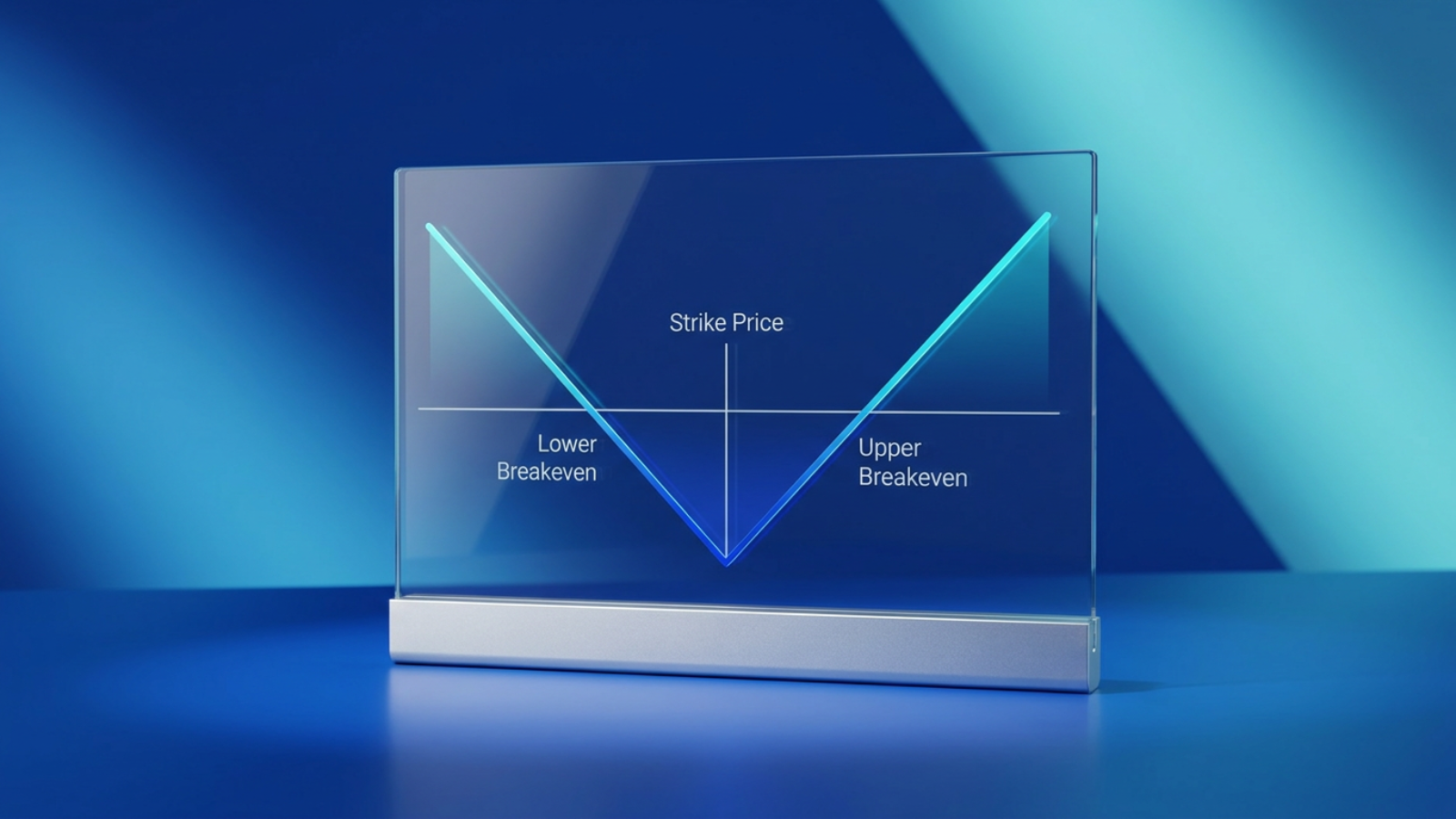
A long straddle involves buying both a call and a put at the same strike price and expiration. This strategy is designed to profit from significant price movement in either direction, regardless of which way the stock moves.
A long strangle uses different strike prices for the call and the put, typically placing both out-of-the-money. This reduces the upfront premium but requires a larger price move to reach profitability.
Max gain: Unlimited for both strategies
Max loss: The total premium paid
Required level: Level 2 in a margin account
Both strategies require the underlying asset to move enough to overcome the combined cost of two options. In a low-volatility environment, these strategies can experience significant time decay.
Part 4. Advanced Multi-Leg Options Trading Strategies on Webull
4.1 Vertical Spreads
A vertical spread involves buying and selling two options of the same type (calls or puts) with the same expiration date but different strike prices. Vertical spreads define both maximum gain and maximum loss at entry.
Vertical credit spreads generate income by collecting a net premium:
Put credit spread: sell higher-strike put, buy lower-strike put
Call credit spread: sell lower-strike call, buy higher-strike call
Max gain: Net premium received
Max loss: Difference between strike prices minus net premium received
Vertical debit spreads reduce the cost of a directional trade:
Call debit spread: buy lower-strike call, sell higher-strike call
Put debit spread: buy higher-strike put, sell lower-strike put
Max gain: Difference between strike prices minus premium paid
Max loss: Net debit paid
Required level: Level 3 in a margin account with a minimum start-of-day margin equity of $2,000.
4.2 Calendar and Diagonal Spreads
A calendar spread uses the same strike price across two different expiration dates. The short-dated option decays faster than the longer-dated option, and the strategy is typically designed to profit when the underlying stays near the strike price at the front-month expiration.
Max loss: Net premium paid
Required level: Level 3 in a margin account
Note: Calendar spreads and diagonal spreads are not available for cash-settled index options on Webull.
A diagonal spread combines elements of both vertical and calendar spreads — different strike prices and different expiration dates. It can be structured with calls or puts to express a directional bias while benefiting from time decay.
4.3 Butterflies and Condors
A butterfly spread uses three strike prices with options of the same type and same expiration: buy one lower-strike option, sell two middle-strike options, buy one higher-strike option (equidistant strikes). It profits when the underlying stays near the middle strike at expiration.
Max gain: Width between strikes minus net premium paid (achieved when stock closes exactly at the middle strike)
Max loss: Net premium paid
Required level: Level 3
A condor is similar but uses four distinct strike prices, creating a wider profit range. Both structures are entered for a net debit.
4.4 Iron Butterflies and Iron Condors
An iron butterfly combines a bull put spread and a bear call spread at the same middle strike price, creating a four-leg structure entered for a net credit. It profits when the underlying stays close to the short strikes at expiration.
Max gain: Net premium received
Max loss: Width of the wings minus net premium received
An iron condor is a four-leg, range-bound strategy combining a bull put spread and a bear call spread at different strike prices. The short strikes are placed closer to the current price, while the long strikes provide defined protection on both sides.
Max gain: Net premium received
Max loss: Difference between strike prices on either spread side, minus net premium received
Required level: Level 3 in a margin account
4.5 Ratio Spreads and Naked Options
Ratio spreads involve an unequal number of long and short options of the same type, typically a 2:1 ratio (two short, one long). Front ratio spreads (Level 4) carry undefined risk on the uncovered leg.
Naked calls and naked puts (Level 4) involve selling options without an offsetting position:
Naked call: Sell a call without holding the underlying stock. Max loss is theoretically unlimited.
Naked put: Sell a put without holding offsetting shares. Max loss occurs if the stock falls to zero.
Level 4 requires a margin account with a minimum net account value of $10,000 and is restricted to stocks in the S&P 500, indices, and certain index ETFs.
Strategy Comparison Table
Strategy | Direction | Max Gain | Max Loss | Level Required |
|---|---|---|---|---|
Covered Call | Neutral/Bullish | Limited | Stock to $0 (less premium) | Level 1 |
Cash-Secured Put | Neutral/Bullish | Premium received | Strike minus premium | Level 1 |
Long Call | Bullish | Unlimited | Premium paid | Level 2 |
Long Put | Bearish | Strike minus premium | Premium paid | Level 2 |
Long Straddle | Volatile | Unlimited | Total premium paid | Level 2 (margin) |
Vertical Credit Spread | Directional | Net credit | Spread width minus credit | Level 3 (margin) |
Iron Condor | Neutral/Range-bound | Net credit | Spread width minus credit | Level 3 (margin) |
Butterfly | Low volatility | Spread width minus debit | Net debit | Level 3 (margin) |
Naked Call/Put | Directional | Premium received | Unlimited / Strike minus premium | Level 4 (margin) |
Part 5. How to Choose and Manage Options Trading Strategies
5.1 Aligning Strategy to Market Outlook
Selecting the appropriate options trading strategy begins with your market outlook:
Bullish outlook: Long calls, bull put credit spreads, cash-secured puts
Bearish outlook: Long puts, bear call credit spreads
Neutral / range-bound: Iron condors, iron butterflies, short straddles/strangles (higher level required)
High volatility expected: Long straddles, long strangles
Low volatility expected: Butterflies, calendar spreads, iron condors
No strategy is suited for all market conditions, and outcomes depend heavily on timing, strike selection, and underlying asset behavior.
5.2 Risk Management Fundamentals
Effective risk management is critical for options traders at any experience level:
Time decay (theta): Options sellers benefit from time decay, which accelerates as expiration approaches. However, short-dated options carry heightened gamma risk — meaning P&L can move rapidly with small changes in the underlying's price.

FAQs: Options Trading Strategies
Q1. How do options trading levels work on platforms like Webull?
Options trading levels (1 through 4) determine which strategies a trader can access. Level 1 covers income strategies such as covered calls. Levels 2 and 3 progressively unlock directional and multi-leg strategies. Level 4 allows naked options trading with a minimum net account value of $10,000 in a margin account. Cash accounts and IRAs can apply for up to Level 2.
Q2. What is the difference between a debit spread and a credit spread?
A debit spread requires a net premium paid upfront and is used to gain directional exposure with defined risk. A credit spread generates a net premium received at entry and profits when the spread expires out-of-the-money. Both types define the maximum gain and maximum loss at the time the position is opened, and both require Level 3 approval in a margin account.
Q3. What are the risks of trading iron condors?
An iron condor profits when the underlying asset stays within the range defined by the short strikes. If the underlying moves significantly beyond either short strike, the strategy incurs a loss up to the difference between the spread width and the net credit received. The strategy carries limited, defined risk on both sides — but significant adverse moves can result in losses that exceed the premium collected.
The Bottom Line
Options trading strategies range from straightforward income tools like covered calls to complex multi-leg structures such as iron condors. Each approach carries distinct risk/reward characteristics and requires a specific approval level. Webull supports the full spectrum — from Level 1 through Level 4 — on eligible accounts. Review Webull's platform and options resources to explore which strategies may align with your financial situation and risk tolerance.
Past performance is not indicative of future results.
Disclaimer:
Webull Financial LLC. Member FINRA, SIPC. Options are risky and not suitable for all investors. Losses can occur quickly and exceed initial investment. Before trading options, read 'Characteristics and Risks of Standardized Options' available at https://www.webull.com/policy Regulatory and exchange fees apply.
The information provided does not constitute investment advice and it should not be relied on as such. It should not be considered a solicitation to buy or an offer to sell a security. It does not take into account any investor's particular investment objectives, strategies, tax status or investment horizon. Investing involves risk, including the risk of loss of principal.
