'%3e %3cpath d='M41.7832962%2c0 C41.9459106%2c0 42.0882746%2c0.0866854658 42.1666825%2c0.216359069 C43.8289923%2c2.66540836 44.7676281%2c5.46271319 44.7676281%2c8.43208061 C44.7676281%2c18.1345746 34.7460532%2c26 22.383814%2c26 C10.0215749%2c26 0%2c18.1345746 0%2c8.43208061 C0%2c5.46716016 0.935826425%2c2.67378733 2.58829888%2c0.223985685 C2.67109477%2c0.0916264068 2.81687473%2c0 2.9840593%2c0 C3.23130408%2c0 3.43173558%2c0.200393004 3.43173558%2c0.447590303 C3.43173558%2c0.475056669 3.42926112%2c0.501945205 3.42452292%2c0.528045226 L3.41810883%2c0.550292077 C3.37800671%2c0.861741908 3.3575721%2c1.17661276 3.3575721%2c1.49443092 C3.3575721%2c7.98336 11.2132389%2c12.5742305 22.383814%2c12.5742305 C33.5543891%2c12.5742305 41.410056%2c7.98336 41.410056%2c1.49443092 C41.410056%2c1.17865223 41.3898828%2c0.865783153 41.3502888%2c0.556288325 C41.3402868%2c0.521941442 41.3356199%2c0.48531078 41.3356199%2c0.447590303 C41.3356199%2c0.200393004 41.5360514%2c0 41.7832962%2c0 Z' id='logo%e5%a4%87%e4%bb%bd-6' fill='white'%3e%3c/path%3e %3cpath d='M74.6899231%2c3.74404927 C75.2411227%2c3.74404927 75.7734299%2c3.66184338 76.2756219%2c3.50883715 L73.8159676%2c20.8666902 C73.5770593%2c22.5662954 72.8072434%2c23.0518969 71.4268838%2c23.0518969 L69.9934336%2c23.0518969 C68.7988917%2c23.0518969 68.1618027%2c22.458384 67.7901674%2c20.893668 L65.6930827%2c11.9909739 C65.639992%2c11.7481731 65.639992%2c11.6942174 65.5338105%2c11.6942174 C65.427629%2c11.6942174 65.4010836%2c11.7481731 65.3479929%2c11.9909739 L63.2509082%2c20.893668 C62.8792729%2c22.458384 62.2421839%2c23.0518969 61.047642%2c23.0518969 L59.6141918%2c23.0518969 C58.2338322%2c23.0518969 57.4640163%2c22.5662954 57.225108%2c20.8666902 L54.7463723%2c3.37406084 C55.3593498%2c3.61307396 56.0249975%2c3.74404927 56.7207458%2c3.74404927 C57.3314263%2c3.74404927 57.918917%2c3.64314414 58.4679557%2c3.4568446 L60.3574623%2c19.3829078 C60.3840076%2c19.6257086 60.3840076%2c19.7875757 60.4901891%2c19.7875757 C60.5963706%2c19.7875757 60.5963706%2c19.6257086 60.6494614%2c19.3829078 L62.9323637%2c9.91367858 C63.0916359%2c9.26620991 63.4632712%2c8.69967483 64.6047223%2c8.69967483 L66.4363532%2c8.69967483 C67.5778044%2c8.69967483 67.9494397%2c9.26620991 68.1087119%2c9.91367858 L70.3916142%2c19.3829078 C70.4447049%2c19.6257086 70.4447049%2c19.7875757 70.5508864%2c19.7875757 C70.6570679%2c19.7875757 70.6570679%2c19.6257086 70.6836133%2c19.3829078 L72.5891207%2c3.32292288 C73.2365902%2c3.59432921 73.9460524%2c3.74404927 74.6899231%2c3.74404927 Z' id='Combined-Shape' fill='white'%3e%3c/path%3e %3cpath d='M84.5933901%2c7.43171536 C88.6813779%2c7.43171536 90.9111894%2c10.2643908 90.9111894%2c14.2840921 L90.9111894%2c15.7948523 C90.9111894%2c16.2264981 90.7519172%2c16.4692988 90.3802819%2c16.4692988 L81.7264895%2c16.4692988 L81.7264895%2c16.5502324 C81.7264895%2c18.1149484 82.3635785%2c19.9764208 84.9119346%2c19.9764208 C86.849747%2c19.9764208 88.6813779%2c19.8145536 89.7962837%2c19.7066422 L89.8759198%2c19.7066422 C90.1413735%2c19.7066422 90.3537366%2c19.8415315 90.3537366%2c20.1113101 L90.3537366%2c21.8918489 C90.3537366%2c22.3234947 90.2741004%2c22.5123397 89.7962837%2c22.5932733 C88.0708343%2c22.9170076 87.0355646%2c23.0518969 84.6464808%2c23.0518969 C81.9919433%2c23.0518969 78.2225%2c21.5950924 78.2225%2c16.2804538 L78.2225%2c14.2840921 C78.2225%2c10.0755457 80.5319476%2c7.43171536 84.5933901%2c7.43171536 Z M84.5933901%2c10.5071915 C82.9475768%2c10.5071915 81.7530349%2c11.6942174 81.7530349%2c13.8254684 L81.7530349%2c13.9333799 L87.3806545%2c13.9333799 L87.3806545%2c13.8254684 C87.3806545%2c11.7211953 86.2392034%2c10.5071915 84.5933901%2c10.5071915 Z' id='Combined-Shape' fill='white'%3e%3c/path%3e %3cpath d='M97.4154906%2c2.98826245 L97.4148064%2c7.62056039 C98.3969853%2c7.48567108 99.3260735%2c7.43171536 99.9631625%2c7.43171536 C104.236968%2c7.43171536 106.307507%2c9.99461216 106.307507%2c14.2031585 L106.307507%2c16.2804538 C106.307507%2c20.4890001 104.236968%2c23.0518969 99.9631625%2c23.0518969 C98.2642584%2c23.0518969 96.2733553%2c22.7821183 94.627542%2c22.3504725 C94.0169984%2c22.1886054 93.9108169%2c22.0267382 93.9108169%2c21.6220703 L93.9098179%2c3.08694115 C94.4185466%2c3.24434375 94.9584615%2c3.32900525 95.5178331%2c3.32900525 C96.184659%2c3.32900525 96.8238351%2c3.20869291 97.4154906%2c2.98826245 Z M99.9631625%2c10.3453244 C99.3260735%2c10.3453244 98.1580769%2c10.4262579 97.4148064%2c10.5341694 L97.4148064%2c19.9494429 C97.9191686%2c20.0573544 99.007529%2c20.1382879 99.9631625%2c20.1382879 C102.246065%2c20.1382879 102.803518%2c18.4926384 102.803518%2c16.2804538 L102.803518%2c14.2031585 C102.803518%2c11.9909739 102.246065%2c10.3453244 99.9631625%2c10.3453244 Z' id='Combined-Shape' fill='white'%3e%3c/path%3e %3cpath d='M111.036668%2c8.72457747 C111.579488%2c8.72457747 112.103987%2c8.64485191 112.599444%2c8.49629404 L112.598761%2c16.5232546 C112.598761%2c19.3289521 113.607485%2c19.9764208 115.147117%2c19.9764208 L115.306389%2c19.9764208 C116.846021%2c19.9764208 117.854746%2c19.3289521 117.854746%2c16.5232546 L117.854207%2c8.4334735 C118.406525%2c8.62226395 118.997939%2c8.72457747 119.612866%2c8.72457747 C120.223332%2c8.72457747 120.810625%2c8.62374317 121.359498%2c8.43756894 L121.358735%2c16.5232546 C121.358735%2c22.4044283 116.872567%2c23.0518969 115.306389%2c23.0518969 L115.060464%2c23.0512514 C113.42215%2c23.0271041 109.094772%2c22.2994073 109.094772%2c16.5232546 L109.094446%2c8.36700801 C109.698522%2c8.59813531 110.353066%2c8.72457747 111.036668%2c8.72457747 Z' id='Combined-Shape' fill='white'%3e%3c/path%3e %3cpath d='M128.314162%2c3.03790128 L128.313623%2c22.269539 C128.313623%2c22.5662954 128.10126%2c22.836074 127.809261%2c22.836074 L125.340541%2c22.836074 C125.048542%2c22.836074 124.809634%2c22.5662954 124.809634%2c22.269539 L124.809455%2c3.04219481 C125.358161%2c3.22824247 125.945253%2c3.32900525 126.555503%2c3.32900525 C127.17043%2c3.32900525 127.761844%2c3.22669173 128.314162%2c3.03790128 Z' id='Combined-Shape' fill='white'%3e%3c/path%3e %3cpath d='M133.90653%2c3.32900525 C134.473329%2c3.32900525 135.02015%2c3.24208064 135.534793%2c3.08063296 L135.533966%2c22.269539 C135.533966%2c22.5662954 135.321603%2c22.836074 135.029603%2c22.836074 L132.560884%2c22.836074 C132.268884%2c22.836074 132.029976%2c22.5662954 132.029976%2c22.269539 L132.029909%2c2.99605058 C132.615669%2c3.21152525 133.2476%2c3.32900525 133.90653%2c3.32900525 Z' id='Combined-Shape' fill='white'%3e%3c/path%3e %3c/g%3e %3c/g%3e %3c/g%3e%3c/svg%3e)



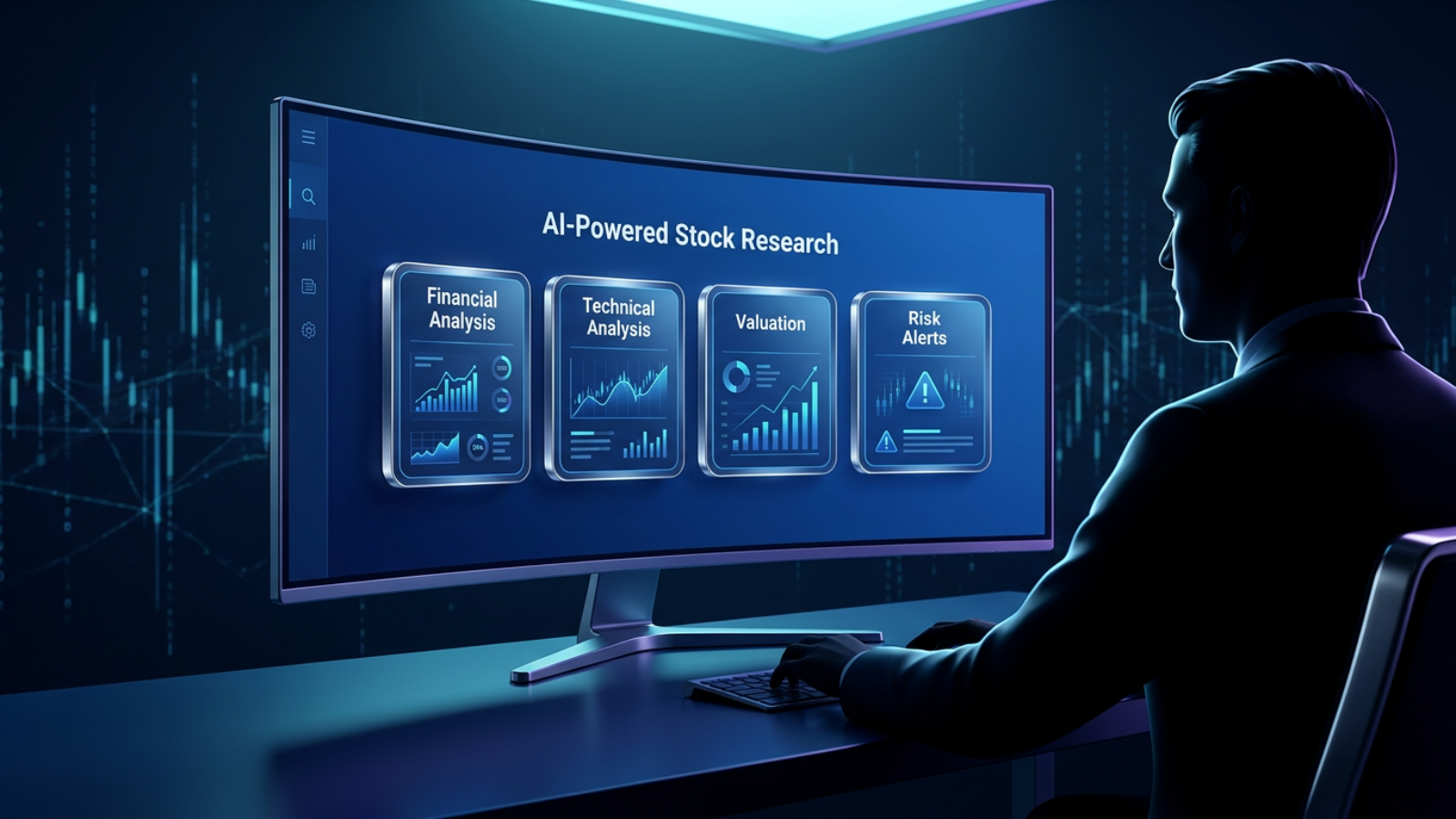
AI is reshaping how US investors approach stock research. From generating real-time company reports to surfacing technical signals, AI tools for stock trading research are becoming part of everyday investor workflows. This guide explores what "claude trading" means in today's market, what to look for in an AI research tool, and how platforms like Webull are building AI-powered analysis directly into the investing experience.
Key Takeaways
"Claude trading" refers to using large language model (LLM)-based AI tools — such as Anthropic's Claude — to assist with market research, stock analysis, and investment decision-making.
AI research tools vary widely in depth, data recency, and analytical scope — module-based systems offer more targeted insights.
Webull's Vega Analyst lets users generate on-demand, modular AI stock reports covering financials, valuation, technicals, industry trends, and risk factors.
Credits determine how many reports you can generate; unused credits do not roll over.
AI-generated content is for informational purposes only and does not constitute investment advice.
Part 1. What Is Claude Trading and How Does AI Fit Into Stock Research?
"Claude trading" is a term used informally to describe using conversational AI models — most notably Anthropic's Claude — as a research layer within a trading or investing workflow. Rather than replacing traditional analysis, these tools aim to augment it: summarizing earnings reports, explaining financial metrics, or generating structured analyses of individual stocks.
The rise of large language models (LLMs) in finance reflects a broader shift. Retail investors are no longer limited to broker-provided research or subscription services from institutional firms. AI tools can process large volumes of public financial data quickly and present it in readable, structured formats.
What AI Can and Cannot Do in Trading Research
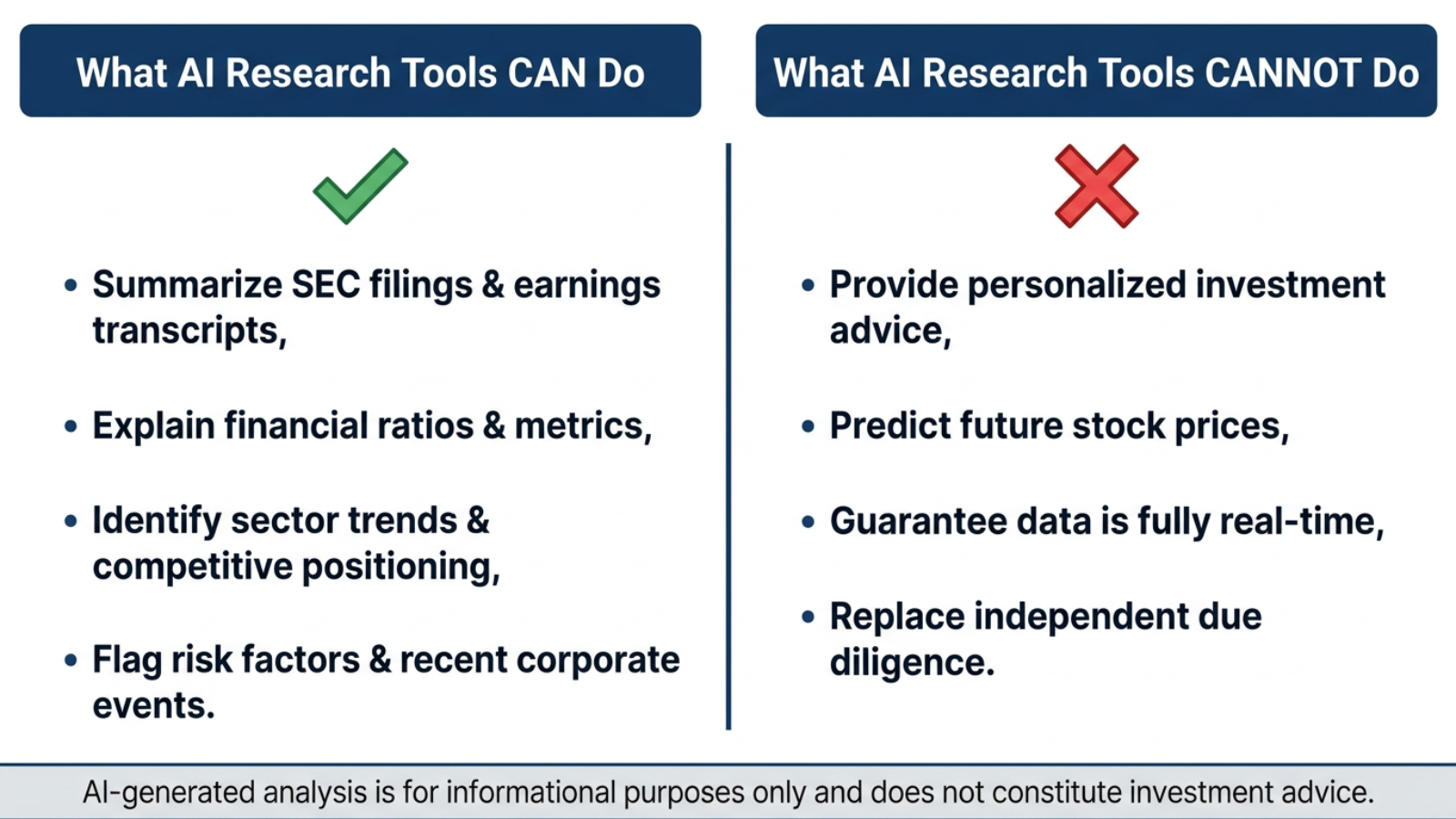
AI tools in trading research are generally suited for:
Summarizing SEC filings, earnings transcripts, and press releases
Explaining financial ratios and what they imply
Identifying sector trends and competitive positioning
Flagging risk factors and recent corporate events
However, AI tools have clear limitations. They do not provide personalized investment advice, cannot predict future stock prices, and may use data with some delay. Any output should be treated as a starting point for further due diligence — not a trading signal.
Past performance is not indicative of future results. AI-generated analysis is informational only and does not constitute investment advice. Actual results may vary by individual.
Part 2. What to Look for in an AI Trading Research Tool
Not all AI tools for stock research are created equal. For US investors, several criteria matter when evaluating any AI-powered analysis platform.
Data Recency and Sourcing
An effective AI research tool should work from current data — not stale snapshots. Reports generated from outdated financials or lagging market data can produce misleading impressions of a stock's condition. Look for platforms that generate reports in real time at the moment of request.
Modular Depth vs. Broad Summaries
Generic AI chatbots often produce surface-level summaries. Purpose-built platforms offer modular analysis — letting users select specific research dimensions such as valuation, technicals, or industry context. This approach provides more focused and relevant output.
Transparency and Traceability
Trustworthy AI research tools present data with supporting context, so users can verify figures independently. Traceable data points reduce the risk of acting on unverifiable or fabricated information — a real concern with general-purpose AI models.
Regulatory Awareness
Any AI tool used in a US brokerage context should clearly communicate that its output is not investment advice. Under FINRA Rule 2210, communications with the public must be fair, balanced, and not misleading. Responsible platforms include appropriate disclosures and do not present AI outputs as personalized recommendations.
FINRA — https://www.finra.org/rules-guidance/rulebooks/finra-rules/2210
Cost Structure
Understand how the platform charges for AI research. Some use subscription tiers with credit-based consumption; others use flat fees or per-report pricing. Transparency about credit usage per report is important for managing costs. Rates vary by service provider; please refer to the latest pricings.
Part 3. Webull's Vega Analyst: AI-Powered Stock Reports Explained
Webull's Vega Analyst is the advanced tier of the platform's AI analysis suite — Vega. It enables users to generate detailed, on-demand AI reports on individual stocks by selecting from a library of research modules. Each module addresses a distinct analytical dimension, and the combination of selected modules determines the report's scope and depth.
Unlike static research templates, every Vega Analyst report is generated in real time using the latest available data. This means a report generated today reflects current market conditions, not a cached snapshot from weeks ago.
3.1 How Vega Analyst Works
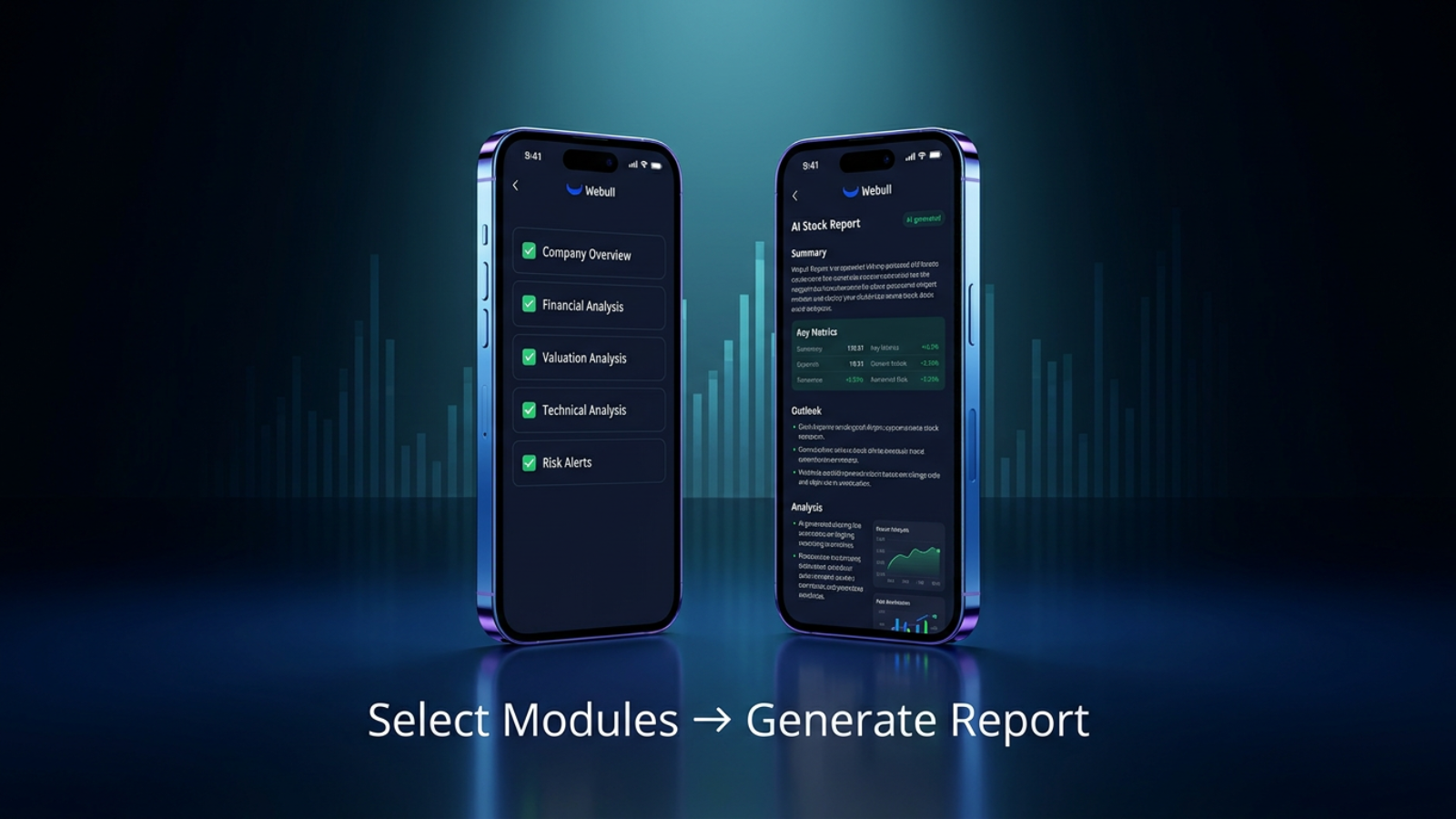
The process is straightforward. A user opens Vega Analyst within the Webull platform, selects a stock ticker, and chooses which research modules to include. The system then generates a report based on those selections.
Each report includes a Key Summary — a concise takeaway based on the selected modules — followed by modular analysis sections, traceable data points, and a section covering both risks and opportunities. This structure is consistent regardless of which modules are selected.
Because reports are generated on demand, users can create a new report at any time to get an updated view. Viewing a previously generated report does not consume credits — useful for revisiting earlier research without additional cost.
Webull — https://www.webull.com/activity/vega-analyst
3.2 Report Modules and What They Cover
Vega Analyst currently offers seven research modules. Users select which ones to include, allowing the report to be as broad or as focused as needed.
Company Overview — What the company does, how it generates revenue, and what drives the business model.
Financial Analysis — Revenue trends, margins, profitability, earnings quality, balance sheet strength, and operating performance.
Industry Analysis — The company's competitive position, relevant sector dynamics, and broader market outlook.
Valuation Analysis — Whether the current price appears reasonable based on valuation measures, peer comparisons, and key assumptions.
Key Events — Recent news, earnings releases, corporate actions, product updates, and regulatory developments that may affect the stock.
Technical Analysis — Price trends, momentum indicators, support and resistance levels, chart structure, and potential trading signals.
Risk Alerts — Major risks, downside scenarios, uncertainty factors, and reasons for caution.
Selecting more modules produces a more comprehensive report. Selecting fewer — for example, only Technical Analysis and Risk Alerts — produces a more targeted one focused on those dimensions. The recommended approach is to select only the modules relevant to the specific question being investigated.
3.3 Credit System and Subscription Plans
Vega Analyst operates on a credit-based system. Each report consumes credits based on how many modules are selected. Three consumption modes exist:
Focused mode — fewer modules selected; lower credit cost per report
Standard mode — 3–4 modules selected; approximately 23 reports per standard credit allocation
Deep mode — more modules selected; higher credit cost per report
Free users receive 80 credits per month. Unused credits do not carry over at the end of each billing cycle. Subscriber credits also refresh at the start of each new billing cycle, with no rollover for unused credits.
Credits are non-transferable, non-refundable, non-shareable, and hold no monetary value. Viewing a previously generated report does not consume credits. Free user reports are retained for 7 days; subscriber reports are saved permanently.
Rates vary by service provider; please refer to the latest pricings.
Webull — https://www.webull.com/activity/vega-analyst
Part 4. How Vega Analyst Compares to Other AI Research Approaches
Several approaches exist for incorporating AI into stock research. Understanding the differences helps investors choose the tool that matches their workflow.
General-Purpose LLMs (e.g., Claude, ChatGPT)
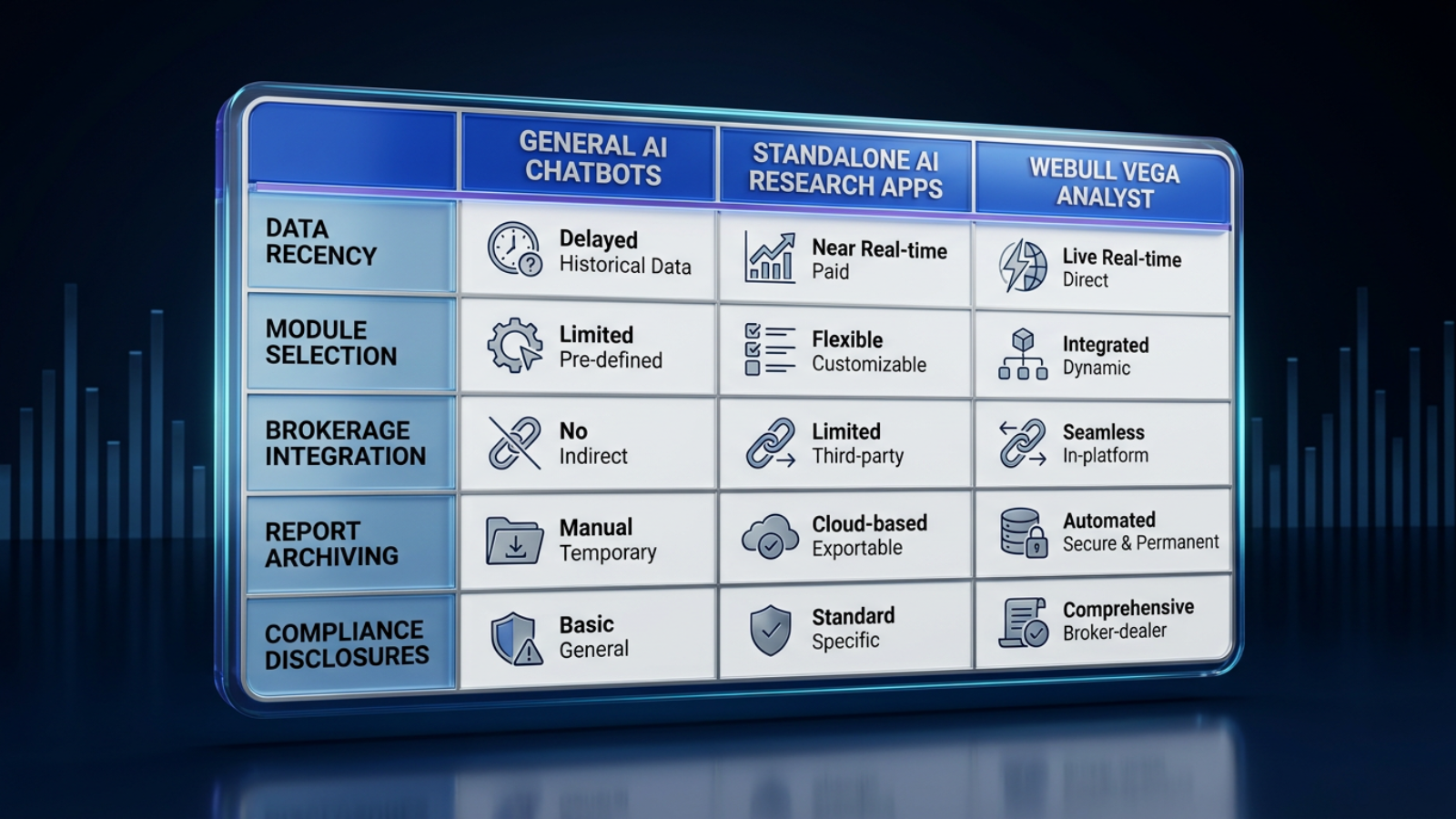
General AI chatbots like Anthropic's Claude or OpenAI's ChatGPT can provide stock explanations, summarize filings, and answer financial questions in natural language. They are flexible and accessible. However, they are not integrated with live brokerage data, may have knowledge cutoffs, and do not save or organize reports within a trading platform.
Standalone AI Research Platforms
Some third-party platforms specialize in AI-generated equity research. These may offer deeper financial modeling features but require separate subscriptions and are not connected to a user's brokerage account or portfolio.
Webull Vega Analyst
Vega Analyst is built directly into the Webull platform, meaning AI-generated research sits alongside a user's watchlists, positions, and trading tools. Reports are generated on demand, archived for subscribers, and structured around verifiable data points. The modular approach allows users to tailor the depth and focus of each report.
All three approaches share an important commonality: none constitute personalized investment advice. Users should apply independent judgment and consider their own financial circumstances before making any investment decision.
Webull — https://www.webull.com/
Part 5. How to Get Started with AI Stock Analysis on Webull
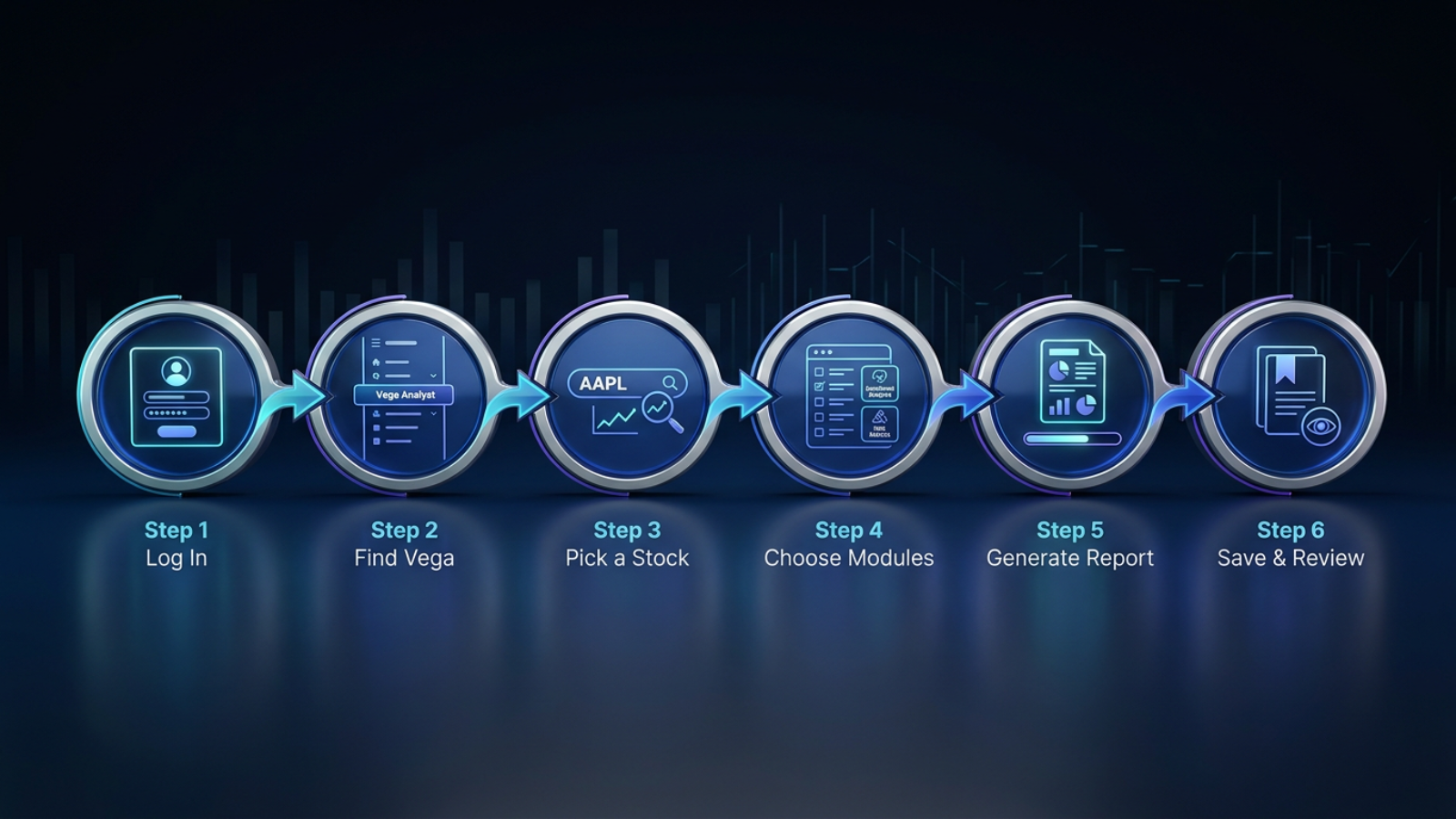
Getting access to Vega Analyst requires a Webull account. The steps below outline the general process.
Step 1: Open or Log Into Your Webull Account
Visit www.webull.com or open the Webull mobile app. If you don't have an account, complete the registration and identity verification process.
Step 2: Navigate to the Vega AI Feature
Within the Webull platform, locate the Vega section. Vega Analyst is the advanced tier of the Vega AI suite. Free users can access a limited credit allocation; subscribers receive a higher allocation.
Step 3: Search for a Stock
Enter the ticker symbol or company name of the stock you want to research.
Step 4: Select Your Research Modules
Choose which of the seven modules to include. For a focused analysis, select one or two modules most relevant to your question. For a comprehensive overview, select multiple modules — keeping in mind that each additional module consumes more credits.
Step 5: Generate and Review Your Report
The report is generated in real time. Review the Key Summary first, then dive into the modular sections. Check the data points for traceability and consider cross-referencing key figures with live market data or official filings.
Step 6: Save and Revisit
Subscriber reports are saved permanently. You can return to a previously generated report at any time without using credits. This makes it practical to track how a stock's analytical picture evolves over time.
Webull — https://www.webull.com/activity/vega-analyst
Important Reminders for New Users
Credits refresh each billing cycle; plan your report generation accordingly.
Market data used in reports may be delayed — always verify key figures against real-time quotes before acting.
Vega Analyst content is for informational reference only. It does not constitute investment advice.
Tax strategies discussed in AI reports do not constitute tax advice. Actual results may vary by individual.
Investing involves risk, including the possible loss of principal.
Webull is a member of SIPC, which protects securities customers of its members up to $500,000 (including $250,000 for claims for cash). This protection covers the custody of securities in the account — it does not protect against investment losses.
SIPC — https://www.sipc.org/
The Bottom Line
AI tools are becoming a practical part of the US investor's research stack. Whether you're exploring "claude trading" concepts or looking for a structured, modular approach to stock analysis, platforms like Webull's Vega Analyst offer on-demand, real-time AI reports tailored to the dimensions you care about. For investors seeking depth without complexity, it's worth exploring what AI-powered research can add to your process.
Past performance is not indicative of future results.
Disclosure:
Vega AI is an artificial intelligence tool provided for informational and educational purposes only, it does not provide investment advice, recommendations, or endorsements, and outputs may contain errors for which we make no guarantees of accuracy, completeness, or reliability. Vega Analyst requires subscription, fees may apply. Credit usage varies per report and cannot be guaranteed.
Webull Financial LLC (member SIPC, FINRA) offers self-directed securities trading. All investments involve risk. More info: https://www.webull.com/policy
The information provided does not constitute investment advice and it should not be relied on as such. It should not be considered a solicitation to buy or an offer to sell a security. It does not take into account any investor's particular investment objectives, strategies, tax status or investment horizon. Investing involves risk, including the risk of loss of principal.
