'%3e %3cpath d='M41.7832962%2c0 C41.9459106%2c0 42.0882746%2c0.0866854658 42.1666825%2c0.216359069 C43.8289923%2c2.66540836 44.7676281%2c5.46271319 44.7676281%2c8.43208061 C44.7676281%2c18.1345746 34.7460532%2c26 22.383814%2c26 C10.0215749%2c26 0%2c18.1345746 0%2c8.43208061 C0%2c5.46716016 0.935826425%2c2.67378733 2.58829888%2c0.223985685 C2.67109477%2c0.0916264068 2.81687473%2c0 2.9840593%2c0 C3.23130408%2c0 3.43173558%2c0.200393004 3.43173558%2c0.447590303 C3.43173558%2c0.475056669 3.42926112%2c0.501945205 3.42452292%2c0.528045226 L3.41810883%2c0.550292077 C3.37800671%2c0.861741908 3.3575721%2c1.17661276 3.3575721%2c1.49443092 C3.3575721%2c7.98336 11.2132389%2c12.5742305 22.383814%2c12.5742305 C33.5543891%2c12.5742305 41.410056%2c7.98336 41.410056%2c1.49443092 C41.410056%2c1.17865223 41.3898828%2c0.865783153 41.3502888%2c0.556288325 C41.3402868%2c0.521941442 41.3356199%2c0.48531078 41.3356199%2c0.447590303 C41.3356199%2c0.200393004 41.5360514%2c0 41.7832962%2c0 Z' id='logo%e5%a4%87%e4%bb%bd-6' fill='white'%3e%3c/path%3e %3cpath d='M74.6899231%2c3.74404927 C75.2411227%2c3.74404927 75.7734299%2c3.66184338 76.2756219%2c3.50883715 L73.8159676%2c20.8666902 C73.5770593%2c22.5662954 72.8072434%2c23.0518969 71.4268838%2c23.0518969 L69.9934336%2c23.0518969 C68.7988917%2c23.0518969 68.1618027%2c22.458384 67.7901674%2c20.893668 L65.6930827%2c11.9909739 C65.639992%2c11.7481731 65.639992%2c11.6942174 65.5338105%2c11.6942174 C65.427629%2c11.6942174 65.4010836%2c11.7481731 65.3479929%2c11.9909739 L63.2509082%2c20.893668 C62.8792729%2c22.458384 62.2421839%2c23.0518969 61.047642%2c23.0518969 L59.6141918%2c23.0518969 C58.2338322%2c23.0518969 57.4640163%2c22.5662954 57.225108%2c20.8666902 L54.7463723%2c3.37406084 C55.3593498%2c3.61307396 56.0249975%2c3.74404927 56.7207458%2c3.74404927 C57.3314263%2c3.74404927 57.918917%2c3.64314414 58.4679557%2c3.4568446 L60.3574623%2c19.3829078 C60.3840076%2c19.6257086 60.3840076%2c19.7875757 60.4901891%2c19.7875757 C60.5963706%2c19.7875757 60.5963706%2c19.6257086 60.6494614%2c19.3829078 L62.9323637%2c9.91367858 C63.0916359%2c9.26620991 63.4632712%2c8.69967483 64.6047223%2c8.69967483 L66.4363532%2c8.69967483 C67.5778044%2c8.69967483 67.9494397%2c9.26620991 68.1087119%2c9.91367858 L70.3916142%2c19.3829078 C70.4447049%2c19.6257086 70.4447049%2c19.7875757 70.5508864%2c19.7875757 C70.6570679%2c19.7875757 70.6570679%2c19.6257086 70.6836133%2c19.3829078 L72.5891207%2c3.32292288 C73.2365902%2c3.59432921 73.9460524%2c3.74404927 74.6899231%2c3.74404927 Z' id='Combined-Shape' fill='white'%3e%3c/path%3e %3cpath d='M84.5933901%2c7.43171536 C88.6813779%2c7.43171536 90.9111894%2c10.2643908 90.9111894%2c14.2840921 L90.9111894%2c15.7948523 C90.9111894%2c16.2264981 90.7519172%2c16.4692988 90.3802819%2c16.4692988 L81.7264895%2c16.4692988 L81.7264895%2c16.5502324 C81.7264895%2c18.1149484 82.3635785%2c19.9764208 84.9119346%2c19.9764208 C86.849747%2c19.9764208 88.6813779%2c19.8145536 89.7962837%2c19.7066422 L89.8759198%2c19.7066422 C90.1413735%2c19.7066422 90.3537366%2c19.8415315 90.3537366%2c20.1113101 L90.3537366%2c21.8918489 C90.3537366%2c22.3234947 90.2741004%2c22.5123397 89.7962837%2c22.5932733 C88.0708343%2c22.9170076 87.0355646%2c23.0518969 84.6464808%2c23.0518969 C81.9919433%2c23.0518969 78.2225%2c21.5950924 78.2225%2c16.2804538 L78.2225%2c14.2840921 C78.2225%2c10.0755457 80.5319476%2c7.43171536 84.5933901%2c7.43171536 Z M84.5933901%2c10.5071915 C82.9475768%2c10.5071915 81.7530349%2c11.6942174 81.7530349%2c13.8254684 L81.7530349%2c13.9333799 L87.3806545%2c13.9333799 L87.3806545%2c13.8254684 C87.3806545%2c11.7211953 86.2392034%2c10.5071915 84.5933901%2c10.5071915 Z' id='Combined-Shape' fill='white'%3e%3c/path%3e %3cpath d='M97.4154906%2c2.98826245 L97.4148064%2c7.62056039 C98.3969853%2c7.48567108 99.3260735%2c7.43171536 99.9631625%2c7.43171536 C104.236968%2c7.43171536 106.307507%2c9.99461216 106.307507%2c14.2031585 L106.307507%2c16.2804538 C106.307507%2c20.4890001 104.236968%2c23.0518969 99.9631625%2c23.0518969 C98.2642584%2c23.0518969 96.2733553%2c22.7821183 94.627542%2c22.3504725 C94.0169984%2c22.1886054 93.9108169%2c22.0267382 93.9108169%2c21.6220703 L93.9098179%2c3.08694115 C94.4185466%2c3.24434375 94.9584615%2c3.32900525 95.5178331%2c3.32900525 C96.184659%2c3.32900525 96.8238351%2c3.20869291 97.4154906%2c2.98826245 Z M99.9631625%2c10.3453244 C99.3260735%2c10.3453244 98.1580769%2c10.4262579 97.4148064%2c10.5341694 L97.4148064%2c19.9494429 C97.9191686%2c20.0573544 99.007529%2c20.1382879 99.9631625%2c20.1382879 C102.246065%2c20.1382879 102.803518%2c18.4926384 102.803518%2c16.2804538 L102.803518%2c14.2031585 C102.803518%2c11.9909739 102.246065%2c10.3453244 99.9631625%2c10.3453244 Z' id='Combined-Shape' fill='white'%3e%3c/path%3e %3cpath d='M111.036668%2c8.72457747 C111.579488%2c8.72457747 112.103987%2c8.64485191 112.599444%2c8.49629404 L112.598761%2c16.5232546 C112.598761%2c19.3289521 113.607485%2c19.9764208 115.147117%2c19.9764208 L115.306389%2c19.9764208 C116.846021%2c19.9764208 117.854746%2c19.3289521 117.854746%2c16.5232546 L117.854207%2c8.4334735 C118.406525%2c8.62226395 118.997939%2c8.72457747 119.612866%2c8.72457747 C120.223332%2c8.72457747 120.810625%2c8.62374317 121.359498%2c8.43756894 L121.358735%2c16.5232546 C121.358735%2c22.4044283 116.872567%2c23.0518969 115.306389%2c23.0518969 L115.060464%2c23.0512514 C113.42215%2c23.0271041 109.094772%2c22.2994073 109.094772%2c16.5232546 L109.094446%2c8.36700801 C109.698522%2c8.59813531 110.353066%2c8.72457747 111.036668%2c8.72457747 Z' id='Combined-Shape' fill='white'%3e%3c/path%3e %3cpath d='M128.314162%2c3.03790128 L128.313623%2c22.269539 C128.313623%2c22.5662954 128.10126%2c22.836074 127.809261%2c22.836074 L125.340541%2c22.836074 C125.048542%2c22.836074 124.809634%2c22.5662954 124.809634%2c22.269539 L124.809455%2c3.04219481 C125.358161%2c3.22824247 125.945253%2c3.32900525 126.555503%2c3.32900525 C127.17043%2c3.32900525 127.761844%2c3.22669173 128.314162%2c3.03790128 Z' id='Combined-Shape' fill='white'%3e%3c/path%3e %3cpath d='M133.90653%2c3.32900525 C134.473329%2c3.32900525 135.02015%2c3.24208064 135.534793%2c3.08063296 L135.533966%2c22.269539 C135.533966%2c22.5662954 135.321603%2c22.836074 135.029603%2c22.836074 L132.560884%2c22.836074 C132.268884%2c22.836074 132.029976%2c22.5662954 132.029976%2c22.269539 L132.029909%2c2.99605058 C132.615669%2c3.21152525 133.2476%2c3.32900525 133.90653%2c3.32900525 Z' id='Combined-Shape' fill='white'%3e%3c/path%3e %3c/g%3e %3c/g%3e %3c/g%3e%3c/svg%3e)



The financial markets are evolving rapidly, and ai options trading is at the forefront of this shift, offering retail investors access to advanced analytics. By utilizing machine learning algorithms and real-time data, an ai options trading platform may help users identify patterns and monitor unusual options activity. However, technology is only a tool, and a solid understanding of market mechanics is still essential. This guide explores how artificial intelligence is changing the landscape of derivatives and how you can approach it systematically.
Key Takeaways
ai options trading leverages machine learning to process massive datasets, such as options flow and implied volatility.
Predictive analytics and sentiment analysis seek to identify potential market setups systematically.
While AI provides data-driven insights, it cannot replace risk management, and model overfitting remains a significant risk.
Webull offers comprehensive options trading access across four distinct levels for approved accounts.
Past performance is not indicative of future results, and actual results may vary by individual.
Part 1. The Fundamentals of AI Options Trading
1.1 Understanding AI and Machine Learning
Definition: AI Options Trading
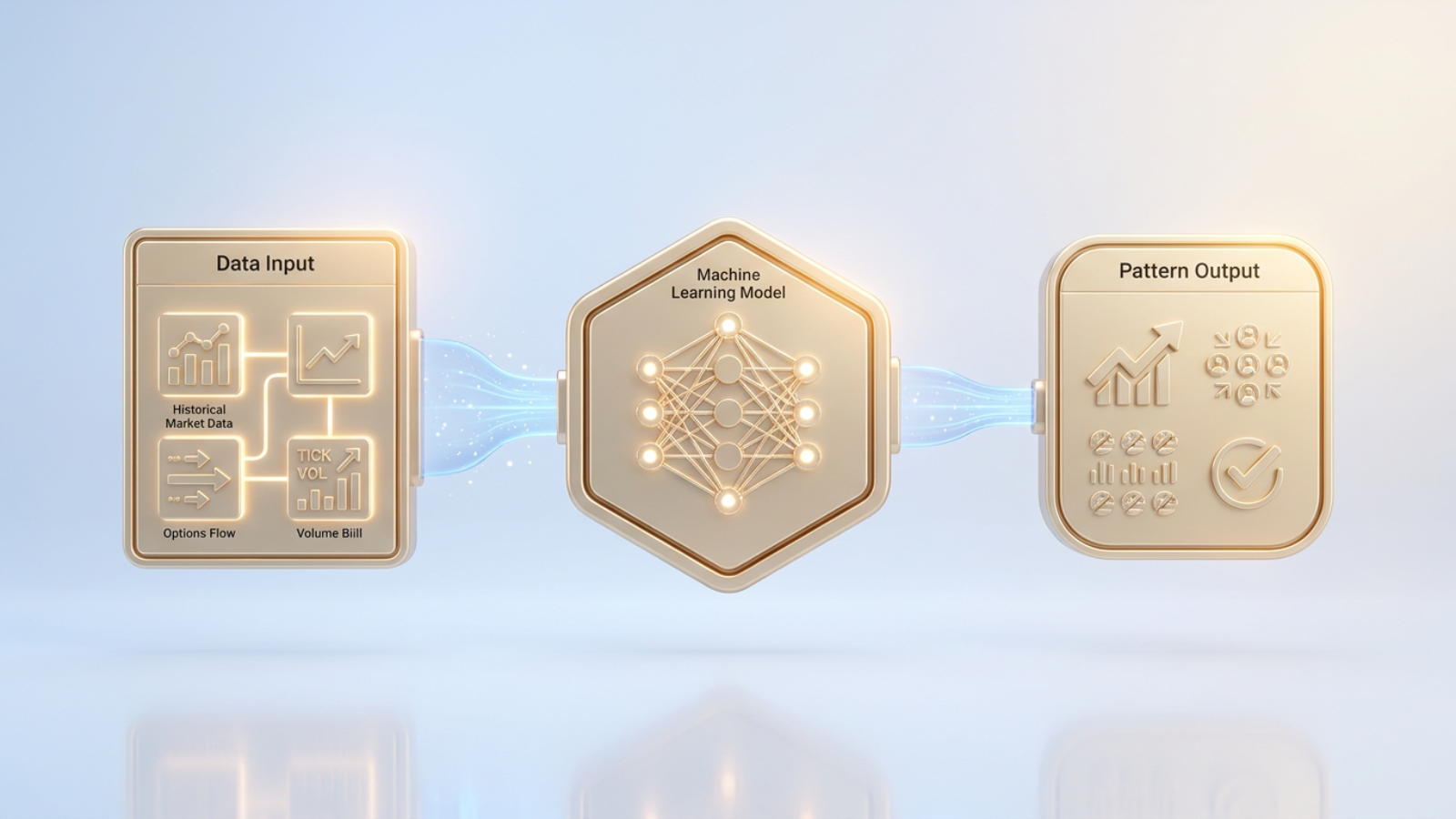
Artificial intelligence (AI) options trading involves the use of advanced algorithms and machine learning models to analyze market data, detect unusual options activity, and identify potential trading opportunities.
Machine learning, a subset of AI, focuses on teaching computer systems to learn from historical data. Instead of relying on static, pre-programmed rules, machine learning models adapt by identifying relationships within the data, which may help forecast potential trends in implied volatility or options flow. These methods enable ai options trading systems to handle massive data sets efficiently.
1.2 How AI is Transforming the Market
Historically, manual analysis of the derivatives market required human traders to process vast amounts of data, which often led to information overload and emotional biases. The integration of technology seeks to address these challenges by processing millions of data points simultaneously. AI models can analyze dark pool prints, institutional block trades, and options chain metrics in real time. This capability allows traders to monitor market sentiment and potential institutional positioning more efficiently. However, no technology is infallible, and market dynamics can shift unexpectedly.
AI models use different learning methodologies. Supervised learning involves training a model on labeled historical data, allowing it to predict future price movements based on known past outcomes. Unsupervised learning deals with unstructured data, tasking the algorithm with finding hidden relationships or clustering similar assets without prior guidance. Reinforcement learning allows an algorithm to learn through trial and error, adapting strategies based on market feedback.
Part 2. AI Options Trading Strategies and Applications
2.1 Predictive Analytics and Implied Volatility
In options trading, implied volatility represents the market's expectation of future price movements. Predictive analytics powered by AI aims to forecast potential shifts in implied volatility by analyzing historical volatility patterns, macroeconomic indicators, and even news sentiment. Some neural network models analyze these factors to provide traders with data-driven insights into potential market volatility. While AI may offer a systematic approach to analyzing these metrics, traders must remember that predictive models are based on historical patterns, and past performance is not indicative of future results.
2.2 Pattern Recognition and Sentiment Analysis
Another significant application of ai options trading tools is pattern recognition. Machine learning algorithms continuously scan charts and options flow to identify technical formations or unusual options activity, such as aggressive call sweeps or large put blocks.
Additionally, AI-driven sentiment analysis processes news articles, financial reports, and social media commentary to gauge the prevailing market mood. By evaluating the tone and intensity of this information, AI tools aim to identify whether sentiment is leaning positive or negative ahead of major events like earnings announcements. By evaluating the collective mood of investors, these algorithms attempt to anticipate market movements.

Part 3. Exploring Platforms for Options Trading and AI Analytics
3.1 Webull: Comprehensive Options Trading Access
When utilizing insights generated by ai options trading scanners, traders need a robust platform to execute their strategies. Webull stands out for its comprehensive, multi-tiered options trading structure designed to accommodate different experience levels and account types. You can learn more about account types at www.webull.com.
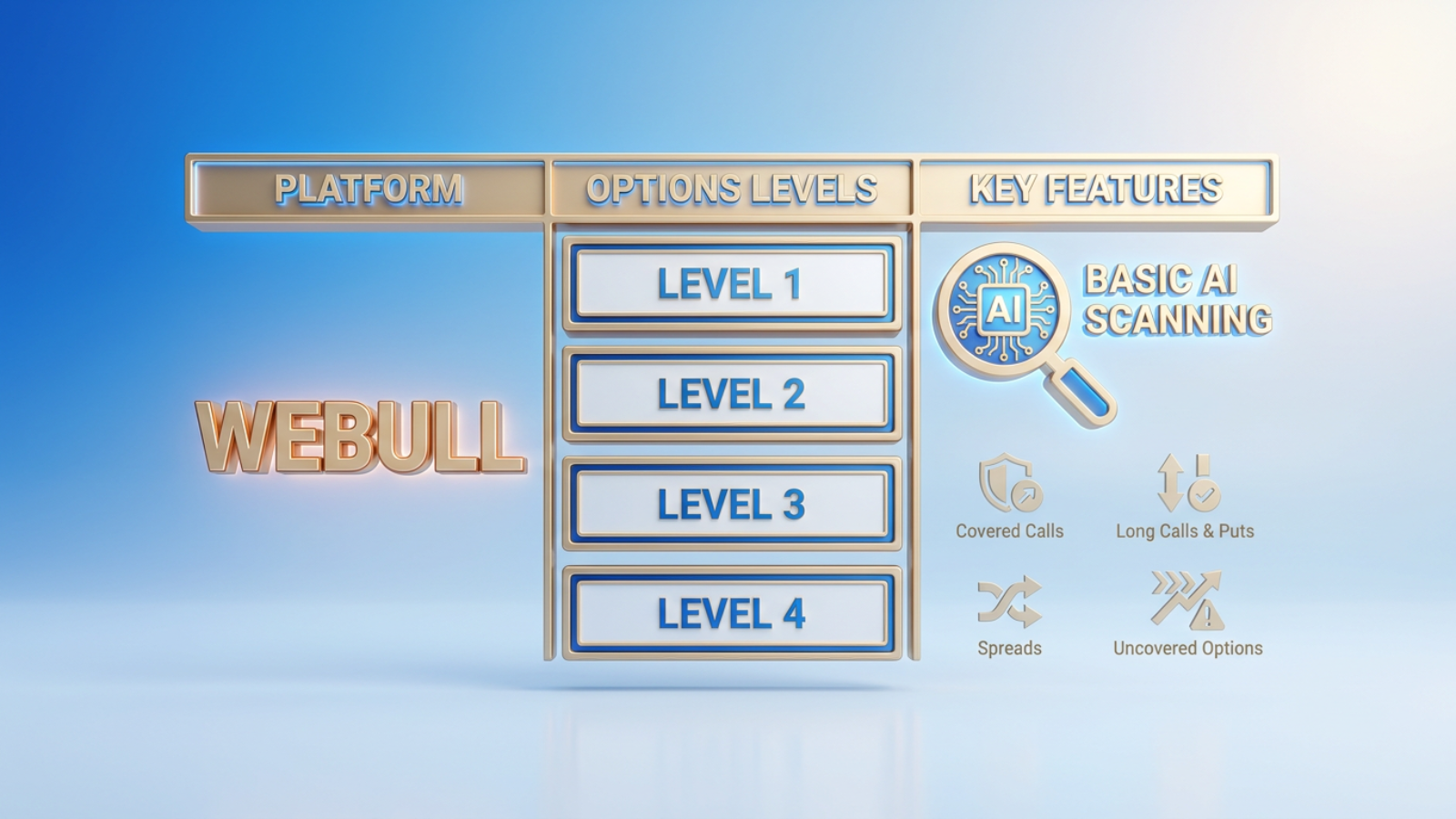
Webull offers up to four options trading levels, subject to application and approval. Cash accounts (including IRAs) may apply for up to Level 2, while margin accounts may apply for up to Level 4.
Webull Options Levels and Strategies
Level 1: Offers foundational strategies such as Covered Calls, Buy-Writes, and Cash-Secured Puts.
Level 2: Includes Level 1 strategies plus Long Calls, Long Puts, Collars, and Protective Puts. For margin accounts, this level also supports Protective Calls, Covered Puts, Long Straddles, and Long Strangles.
Level 3: Requires a margin account, Level 3 approval, and a minimum start-of-day margin equity of $2,000. It adds Credit Spreads, Debit Spreads, Long & Short Butterflys, Iron Condors, and Back Ratio Spreads.
Level 4: Allows for uncovered selling of calls and puts (naked options). Due to heightened risk, a minimum net account value of $10,000 is required. Level 4 strategies are only supported for stocks in the S&P 500, indices, and certain index ETFs.
Options Level | Account Type Required | Key Available Strategies | Minimum Equity Requirement |
|---|---|---|---|
Level 1 | Cash or Margin | Covered Calls, Cash-Secured Puts | None specified |
Level 2 | Cash or Margin | Long Calls/Puts, Protective Puts | None specified |
Level 3 | Margin Only | Credit/Debit Spreads, Iron Condors | $2,000 start-of-day equity |
Level 4 | Margin Only | Naked Equity Calls/Puts | $10,000 net account value |
At expiration, Webull expects clients to close any near-the-money, at-the-money, or in-the-money options positions prior to market close if they do not intend to exercise them or lack the required equity. Webull will automatically exercise in-the-money options after market close unless a Do Not Exercise (DNE) request is submitted via the mobile app up until the close on the expiration date. Options trading entails significant risk and is not appropriate for all investors. Rates vary by service provider; please refer to the latest pricings.
3.2 TradeAlgo: AI-Powered Options Scanner
TradeAlgo provides an AI options scanner that correlates options flow with dark pool transactions and institutional filings. By cross-referencing multiple data sources, TradeAlgo aims to filter out noise from routine hedging or market-making, highlighting unusual options activity that may suggest potential institutional positioning.
TradeAlgo — https://www.tradealgo.com/trading-guides/ai-trading/ai-options-scanner
3.3 OptionStrat: Visualizing Options Strategies
OptionStrat is known for its options strategy visualization capabilities. While it may not focus heavily on machine learning, it offers tools that allow traders to build multi-leg strategies and instantly see how potential profit and loss may change as the underlying stock price moves and time decays.
OptionStrat — https://www.optionstrading.org/blog/top-ai-powered-tools-for-options-trading/
3.4 Thinkorswim: Built-In Options Analytics
Thinkorswim by Schwab provides built-in analytical tools, probability analysis, and the Sizzle Index, which measures relative options activity. While it requires manual configuration, it provides deep analytics for traders who prefer to script their own custom studies.
Part 4. Risks and Challenges of AI Options Trading
4.1 Model Overfitting and Data Quality
A significant risk in ai options trading is model overfitting. This occurs when an AI model learns the "noise" in historical data rather than actual underlying patterns. Consequently, the model may perform well in backtesting but struggle in live markets where conditions change rapidly. The effectiveness of any machine learning model is heavily dependent on data quality; inaccurate or delayed data can lead to suboptimal trading decisions.
Pros and Cons of AI Options Trading
Pros:
Ability to process massive amounts of options flow data rapidly.
Systematic identification of technical patterns without emotional bias.
Continuous adaptation to new market data via machine learning.
Cons:
Risk of model overfitting to historical data.
Reliance on data quality; poor data leads to poor insights.
"Black box" nature makes it difficult to understand the rationale behind signals.
4.2 The "Black Box" Problem and Market Dynamics
Many AI systems, especially those using deep learning, function as "black box" models. This means their internal decision-making processes are not easily interpretable by the user. If an AI scanner suggests a trade, understanding the rationale behind it can be difficult. Furthermore, markets are inherently dynamic, influenced by geopolitical events and macroeconomic shifts. An AI model that works in a low-volatility environment may not adapt quickly enough to a sudden market shock. It is crucial to remember that past performance is not indicative of future results, and tax strategies do not constitute tax advice and that actual results may vary by individual.

Part 5. Approaching Options Trading with Security and Trust
Integrating ai options trading tools requires a secure and regulated environment. When selecting a brokerage like www.webull.com, consider the platform's regulatory standing and safety measures.
Regulatory Compliance and Platform Safety
U.S. brokerages must adhere to strict regulatory standards designed to protect investors. Ensure the platform is registered with the Securities and Exchange Commission (SEC) and is a member of the Financial Industry Regulatory Authority (FINRA) and the Securities Investor Protection Corporation (SIPC). SIPC protects against the loss of cash and securities held by a customer at a financially-troubled SIPC-member brokerage firm (up to $500,000, which includes a $250,000 limit for cash). It does not protect against a decline in the market value of your securities.
Steps to Incorporate Analytics Systematically
1. Understand the Basics: Before utilizing any AI tool, build a strong foundation in options mechanics, including the Greeks (Delta, Gamma, Theta, Vega) and time decay.
2. Choose a Regulated Broker: Open an account with an SEC/FINRA registered broker-dealer, such as Webull, and apply for the appropriate options trading level based on your experience. Visit www.webull.com for details.
3. Analyze AI Data Cautiously: If using a third-party AI scanner, treat the alerts as data points rather than guaranteed trade signals. Cross-reference unusual options activity with broader market analysis.
4. Manage Risk Vigorously: Never rely solely on an AI prediction. Define your maximum acceptable loss, maintain adequate account equity, and remember that options investors can rapidly lose the entire value of their investment in a short period of time.

FAQs
Q1. What is an AI options scanner?
An AI options scanner uses machine learning and data analysis to identify unusual options activity and potential institutional flow patterns in real time. It processes large volumes of options contracts to surface data that deviates from baseline norms, helping traders systematically identify potential market interest.
Q2. Can AI improve my options trading returns?
AI tools may help traders manage information overload and identify potential setups more systematically, but profitability depends on the individual trader's strategy, discipline, and risk management — not the AI itself. Technology serves as an analytical aid rather than a substitute for sound financial judgment.
Q3. What are the requirements to trade options spreads on Webull?
To trade spreads on Webull, your account must meet two specific requirements: it must be a margin account approved for Level 3 options trading, and it must maintain a minimum start-of-day margin equity of $2,000. Cash accounts are only eligible for up to Level 2 options trading.
Q4. How does AI handle implied volatility in options trading?
AI models analyze massive historical datasets, market indicators, and macroeconomic factors to forecast potential shifts in implied volatility. By evaluating these patterns continuously, machine learning algorithms aim to provide traders with a more dynamic understanding of potential volatility changes, though these projections remain estimates, not certainties.
Q5. What happens to in-the-money options at expiration on Webull?
In-the-money options are exercised automatically after market close on the expiration date unless the client submits a Do Not Exercise (DNE) request. Clients are expected to close near-the-money or in-the-money positions prior to expiration if they do not intend to exercise them or lack sufficient overnight buying power to support the exercise.
The Bottom Line
Incorporating ai options trading technology into your strategy may provide valuable data-driven insights and help navigate complex market flow. However, AI is an analytical tool, not a guarantee of success. By combining advanced third-party analytics with a robust, regulated brokerage platform like Webull, traders can pursue the derivatives market systematically while prioritizing strict risk management and ongoing education.
Disclaimer
Webull Financial LLC. Member FINRA, SIPC. Options are risky and not suitable for all investors. Losses can occur quickly and exceed initial investment. Before trading options, read 'Characteristics and Risks of Standardized Options' available at here. Regulatory and exchange fees apply.
The information provided does not constitute investment advice and it should not be relied on as such. It should not be considered a solicitation to buy or an offer to sell a security. It does not take into account any investor's particular investment objectives, strategies, tax status or investment horizon. Investing involves risk, including the risk of loss of principal.
