'%3e %3cpath d='M41.7832962%2c0 C41.9459106%2c0 42.0882746%2c0.0866854658 42.1666825%2c0.216359069 C43.8289923%2c2.66540836 44.7676281%2c5.46271319 44.7676281%2c8.43208061 C44.7676281%2c18.1345746 34.7460532%2c26 22.383814%2c26 C10.0215749%2c26 0%2c18.1345746 0%2c8.43208061 C0%2c5.46716016 0.935826425%2c2.67378733 2.58829888%2c0.223985685 C2.67109477%2c0.0916264068 2.81687473%2c0 2.9840593%2c0 C3.23130408%2c0 3.43173558%2c0.200393004 3.43173558%2c0.447590303 C3.43173558%2c0.475056669 3.42926112%2c0.501945205 3.42452292%2c0.528045226 L3.41810883%2c0.550292077 C3.37800671%2c0.861741908 3.3575721%2c1.17661276 3.3575721%2c1.49443092 C3.3575721%2c7.98336 11.2132389%2c12.5742305 22.383814%2c12.5742305 C33.5543891%2c12.5742305 41.410056%2c7.98336 41.410056%2c1.49443092 C41.410056%2c1.17865223 41.3898828%2c0.865783153 41.3502888%2c0.556288325 C41.3402868%2c0.521941442 41.3356199%2c0.48531078 41.3356199%2c0.447590303 C41.3356199%2c0.200393004 41.5360514%2c0 41.7832962%2c0 Z' id='logo%e5%a4%87%e4%bb%bd-6' fill='white'%3e%3c/path%3e %3cpath d='M74.6899231%2c3.74404927 C75.2411227%2c3.74404927 75.7734299%2c3.66184338 76.2756219%2c3.50883715 L73.8159676%2c20.8666902 C73.5770593%2c22.5662954 72.8072434%2c23.0518969 71.4268838%2c23.0518969 L69.9934336%2c23.0518969 C68.7988917%2c23.0518969 68.1618027%2c22.458384 67.7901674%2c20.893668 L65.6930827%2c11.9909739 C65.639992%2c11.7481731 65.639992%2c11.6942174 65.5338105%2c11.6942174 C65.427629%2c11.6942174 65.4010836%2c11.7481731 65.3479929%2c11.9909739 L63.2509082%2c20.893668 C62.8792729%2c22.458384 62.2421839%2c23.0518969 61.047642%2c23.0518969 L59.6141918%2c23.0518969 C58.2338322%2c23.0518969 57.4640163%2c22.5662954 57.225108%2c20.8666902 L54.7463723%2c3.37406084 C55.3593498%2c3.61307396 56.0249975%2c3.74404927 56.7207458%2c3.74404927 C57.3314263%2c3.74404927 57.918917%2c3.64314414 58.4679557%2c3.4568446 L60.3574623%2c19.3829078 C60.3840076%2c19.6257086 60.3840076%2c19.7875757 60.4901891%2c19.7875757 C60.5963706%2c19.7875757 60.5963706%2c19.6257086 60.6494614%2c19.3829078 L62.9323637%2c9.91367858 C63.0916359%2c9.26620991 63.4632712%2c8.69967483 64.6047223%2c8.69967483 L66.4363532%2c8.69967483 C67.5778044%2c8.69967483 67.9494397%2c9.26620991 68.1087119%2c9.91367858 L70.3916142%2c19.3829078 C70.4447049%2c19.6257086 70.4447049%2c19.7875757 70.5508864%2c19.7875757 C70.6570679%2c19.7875757 70.6570679%2c19.6257086 70.6836133%2c19.3829078 L72.5891207%2c3.32292288 C73.2365902%2c3.59432921 73.9460524%2c3.74404927 74.6899231%2c3.74404927 Z' id='Combined-Shape' fill='white'%3e%3c/path%3e %3cpath d='M84.5933901%2c7.43171536 C88.6813779%2c7.43171536 90.9111894%2c10.2643908 90.9111894%2c14.2840921 L90.9111894%2c15.7948523 C90.9111894%2c16.2264981 90.7519172%2c16.4692988 90.3802819%2c16.4692988 L81.7264895%2c16.4692988 L81.7264895%2c16.5502324 C81.7264895%2c18.1149484 82.3635785%2c19.9764208 84.9119346%2c19.9764208 C86.849747%2c19.9764208 88.6813779%2c19.8145536 89.7962837%2c19.7066422 L89.8759198%2c19.7066422 C90.1413735%2c19.7066422 90.3537366%2c19.8415315 90.3537366%2c20.1113101 L90.3537366%2c21.8918489 C90.3537366%2c22.3234947 90.2741004%2c22.5123397 89.7962837%2c22.5932733 C88.0708343%2c22.9170076 87.0355646%2c23.0518969 84.6464808%2c23.0518969 C81.9919433%2c23.0518969 78.2225%2c21.5950924 78.2225%2c16.2804538 L78.2225%2c14.2840921 C78.2225%2c10.0755457 80.5319476%2c7.43171536 84.5933901%2c7.43171536 Z M84.5933901%2c10.5071915 C82.9475768%2c10.5071915 81.7530349%2c11.6942174 81.7530349%2c13.8254684 L81.7530349%2c13.9333799 L87.3806545%2c13.9333799 L87.3806545%2c13.8254684 C87.3806545%2c11.7211953 86.2392034%2c10.5071915 84.5933901%2c10.5071915 Z' id='Combined-Shape' fill='white'%3e%3c/path%3e %3cpath d='M97.4154906%2c2.98826245 L97.4148064%2c7.62056039 C98.3969853%2c7.48567108 99.3260735%2c7.43171536 99.9631625%2c7.43171536 C104.236968%2c7.43171536 106.307507%2c9.99461216 106.307507%2c14.2031585 L106.307507%2c16.2804538 C106.307507%2c20.4890001 104.236968%2c23.0518969 99.9631625%2c23.0518969 C98.2642584%2c23.0518969 96.2733553%2c22.7821183 94.627542%2c22.3504725 C94.0169984%2c22.1886054 93.9108169%2c22.0267382 93.9108169%2c21.6220703 L93.9098179%2c3.08694115 C94.4185466%2c3.24434375 94.9584615%2c3.32900525 95.5178331%2c3.32900525 C96.184659%2c3.32900525 96.8238351%2c3.20869291 97.4154906%2c2.98826245 Z M99.9631625%2c10.3453244 C99.3260735%2c10.3453244 98.1580769%2c10.4262579 97.4148064%2c10.5341694 L97.4148064%2c19.9494429 C97.9191686%2c20.0573544 99.007529%2c20.1382879 99.9631625%2c20.1382879 C102.246065%2c20.1382879 102.803518%2c18.4926384 102.803518%2c16.2804538 L102.803518%2c14.2031585 C102.803518%2c11.9909739 102.246065%2c10.3453244 99.9631625%2c10.3453244 Z' id='Combined-Shape' fill='white'%3e%3c/path%3e %3cpath d='M111.036668%2c8.72457747 C111.579488%2c8.72457747 112.103987%2c8.64485191 112.599444%2c8.49629404 L112.598761%2c16.5232546 C112.598761%2c19.3289521 113.607485%2c19.9764208 115.147117%2c19.9764208 L115.306389%2c19.9764208 C116.846021%2c19.9764208 117.854746%2c19.3289521 117.854746%2c16.5232546 L117.854207%2c8.4334735 C118.406525%2c8.62226395 118.997939%2c8.72457747 119.612866%2c8.72457747 C120.223332%2c8.72457747 120.810625%2c8.62374317 121.359498%2c8.43756894 L121.358735%2c16.5232546 C121.358735%2c22.4044283 116.872567%2c23.0518969 115.306389%2c23.0518969 L115.060464%2c23.0512514 C113.42215%2c23.0271041 109.094772%2c22.2994073 109.094772%2c16.5232546 L109.094446%2c8.36700801 C109.698522%2c8.59813531 110.353066%2c8.72457747 111.036668%2c8.72457747 Z' id='Combined-Shape' fill='white'%3e%3c/path%3e %3cpath d='M128.314162%2c3.03790128 L128.313623%2c22.269539 C128.313623%2c22.5662954 128.10126%2c22.836074 127.809261%2c22.836074 L125.340541%2c22.836074 C125.048542%2c22.836074 124.809634%2c22.5662954 124.809634%2c22.269539 L124.809455%2c3.04219481 C125.358161%2c3.22824247 125.945253%2c3.32900525 126.555503%2c3.32900525 C127.17043%2c3.32900525 127.761844%2c3.22669173 128.314162%2c3.03790128 Z' id='Combined-Shape' fill='white'%3e%3c/path%3e %3cpath d='M133.90653%2c3.32900525 C134.473329%2c3.32900525 135.02015%2c3.24208064 135.534793%2c3.08063296 L135.533966%2c22.269539 C135.533966%2c22.5662954 135.321603%2c22.836074 135.029603%2c22.836074 L132.560884%2c22.836074 C132.268884%2c22.836074 132.029976%2c22.5662954 132.029976%2c22.269539 L132.029909%2c2.99605058 C132.615669%2c3.21152525 133.2476%2c3.32900525 133.90653%2c3.32900525 Z' id='Combined-Shape' fill='white'%3e%3c/path%3e %3c/g%3e %3c/g%3e %3c/g%3e%3c/svg%3e)


When weighing a Roth IRA vs Traditional IRA tax strategy, the core question is simple: do you want to reduce your tax bill today, or eliminate it in retirement? The answer shapes how your savings grow, when you can access them, and how much the IRS ultimately collects. Understanding the tax treatment of IRA contributions and withdrawals is a foundational step in building a long-term retirement plan that aligns with your financial situation.
Key Takeaways
Traditional IRA contributions may be tax-deductible, offering a potential upfront tax break; withdrawals in retirement are taxed as ordinary income.
Roth IRA contributions are made with after-tax dollars; qualified withdrawals — including all investment growth — are tax-free.
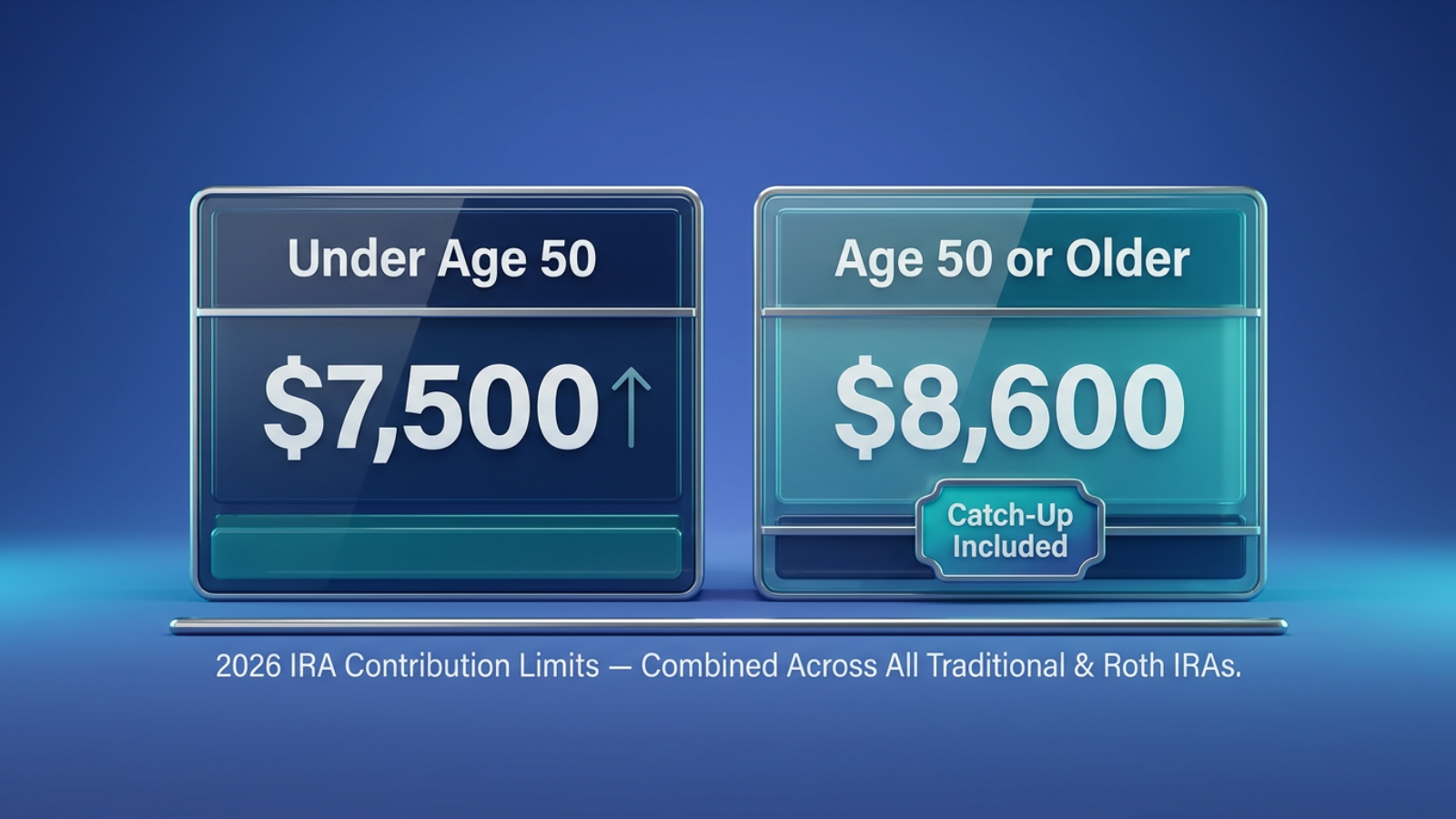
For 2026, the combined annual IRA contribution limit is $7,500 (or $8,600 if age 50 or older).
Roth IRAs have no Required Minimum Distributions (RMDs) during the account holder's lifetime; Traditional IRAs require RMDs starting at age 73.
Roth IRA contributions are subject to income limits based on your MAGI; visit irs.gov for current thresholds.
Past performance is not indicative of future results. Tax strategies discussed in this article do not constitute tax advice; actual results may vary by individual.
Part 1. How Roth IRA and Traditional IRA Tax Treatment Differs
The most important distinction between these two account types is when your money is taxed — not whether it is taxed.
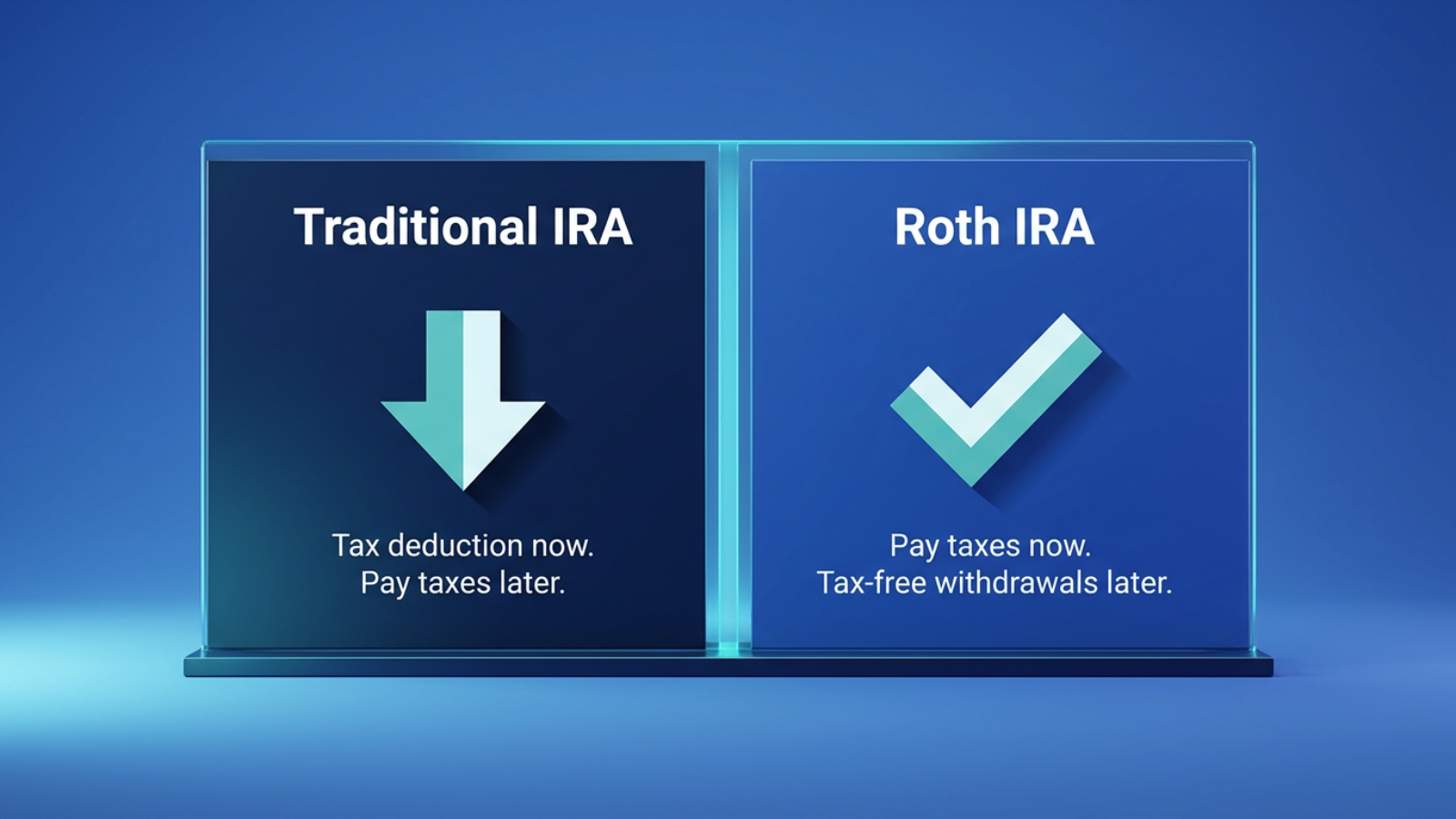
1.1 Traditional IRA: Tax Deduction Now, Tax Bill Later
A Traditional IRA is funded with pre-tax dollars. If you meet IRS eligibility requirements, your contributions may be tax-deductible, reducing your taxable income in the year you contribute. The IRS allows deductibility to be phased out if you or your spouse participates in a workplace retirement plan and your income exceeds certain levels.
Inside the account, your investments grow tax-deferred — meaning no federal income taxes are owed on dividends, interest, or capital gains until you take distributions. When you do withdraw funds in retirement, the full amount is taxed as ordinary income at your then-current tax rate.
This structure tends to work in favor of investors who expect to be in a lower tax bracket during retirement than they are today.
IRS — https://www.irs.gov/retirement-plans/traditional-and-roth-iras
1.2 Roth IRA: Pay Taxes Now, Withdraw Tax-Free Later
A Roth IRA reverses the equation. Contributions are made with after-tax dollars — there is no upfront deduction — but your money grows entirely tax-free. Qualified withdrawals in retirement, including all accumulated earnings, are not subject to federal income tax.
Because contributions are never deducted, they can be withdrawn at any time without penalty or taxes. Only the earnings are subject to rules around age and the account's holding period for tax-free treatment.
This structure is particularly suited to investors who anticipate being in a higher tax bracket in the future, or who want the flexibility of tax-free income in retirement.
IRS — https://www.irs.gov/retirement-plans/traditional-and-roth-iras
1.3 Head-to-Head Tax Comparison
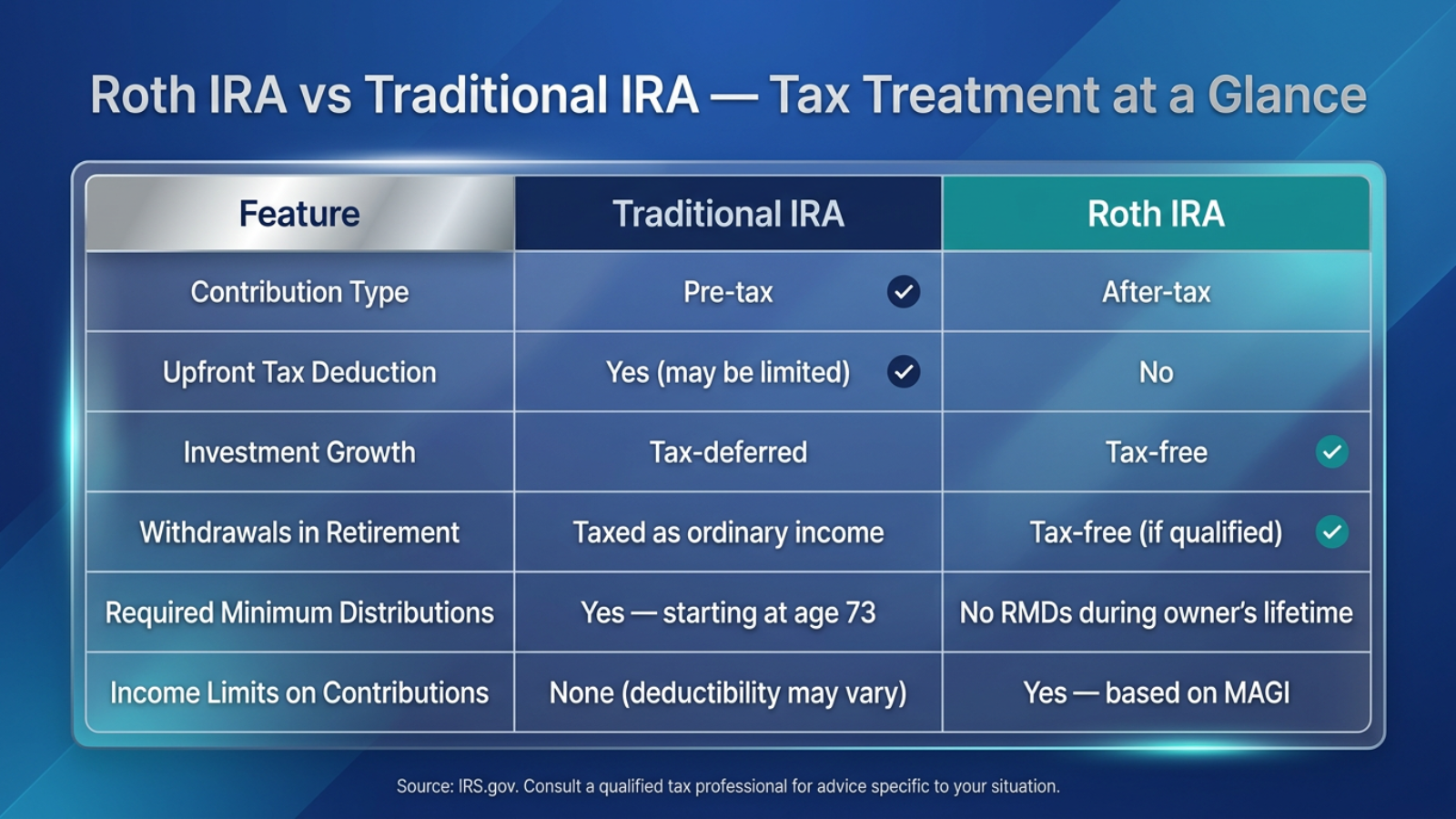
Feature | Traditional IRA | Roth IRA |
|---|---|---|
Contribution tax treatment | Pre-tax; may be deductible | After-tax; not deductible |
Investment growth | Tax-deferred | Tax-free |
Qualified withdrawals | Taxed as ordinary income | Tax-free |
Required Minimum Distributions | Yes, starting at age 73 | No RMDs during owner's lifetime |
Early withdrawal penalty (before 59½) | 10% federal penalty + income tax | 10% penalty on earnings; contributions withdrawn penalty-free |
Income limits on contributions | None (deductibility may be limited) | Yes — based on MAGI |
Vanguard — https://investor.vanguard.com/investor-resources-education/iras/roth-vs-traditional-ira
Part 2. IRA Contribution Limits, Deadlines, and Eligibility in 2026
2.1 2026 Contribution Limits
For the 2026 tax year, the IRS caps combined contributions across all of your Traditional and Roth IRAs at:
$7,500 if you are under age 50
$8,600 if you are age 50 or older (includes catch-up contribution)
These limits apply to the total contributed across all your IRA accounts combined — not per account. You can split contributions between a Traditional IRA and a Roth IRA, as long as the combined total does not exceed the annual limit. The contribution deadline is typically April 15 of the following year. For example, 2026 IRA contributions can be made until April 15, 2027.
2.2 Roth IRA Income Eligibility
Unlike Traditional IRAs, Roth IRA contributions are subject to income limits. Your ability to contribute — in full, partially, or not at all — depends on your Modified Adjusted Gross Income (MAGI) and tax filing status. The IRS adjusts these thresholds periodically.
What is MAGI? Your MAGI is generally your adjusted gross income calculated without certain deductions and exclusions. It is the figure the IRS uses to determine Roth IRA eligibility.
For current Roth IRA income phase-out ranges and eligibility thresholds, visit irs.gov or consult a qualified tax professional. The IRS publishes updated limits each year.
2.3 Traditional IRA Contribution Eligibility and Deductibility
Anyone with earned income — regardless of income level — can contribute to a Traditional IRA. Since 2020, there is no age restriction on contributions to either Traditional or Roth IRAs.
However, the tax deductibility of Traditional IRA contributions may be reduced or eliminated if you (or your spouse) are covered by a workplace retirement plan and your income exceeds IRS thresholds. Even when contributions are non-deductible, the tax-deferred growth advantage of the account still applies.
Spousal IRA rules also allow a non-working spouse to contribute to an IRA based on the working spouse's earned income, as long as a joint tax return is filed.
2.4 Excess Contributions and Penalties
Contributing more than the annual IRA limit results in an excess contribution, which is subject to a 6% IRS excise tax for each year the excess remains in the account. To avoid this penalty, excess contributions must be withdrawn — along with any earnings — by the tax filing deadline, including extensions.
If you contributed to the wrong type of IRA, you may have the option to either remove the contribution or recharacterize it to the correct account type. Consult a tax professional for guidance specific to your situation. Webull Financial does not offer tax advice.
Part 3. IRA Withdrawal Rules, RMDs, and Early Distribution Exceptions
3.1 Traditional IRA Withdrawals
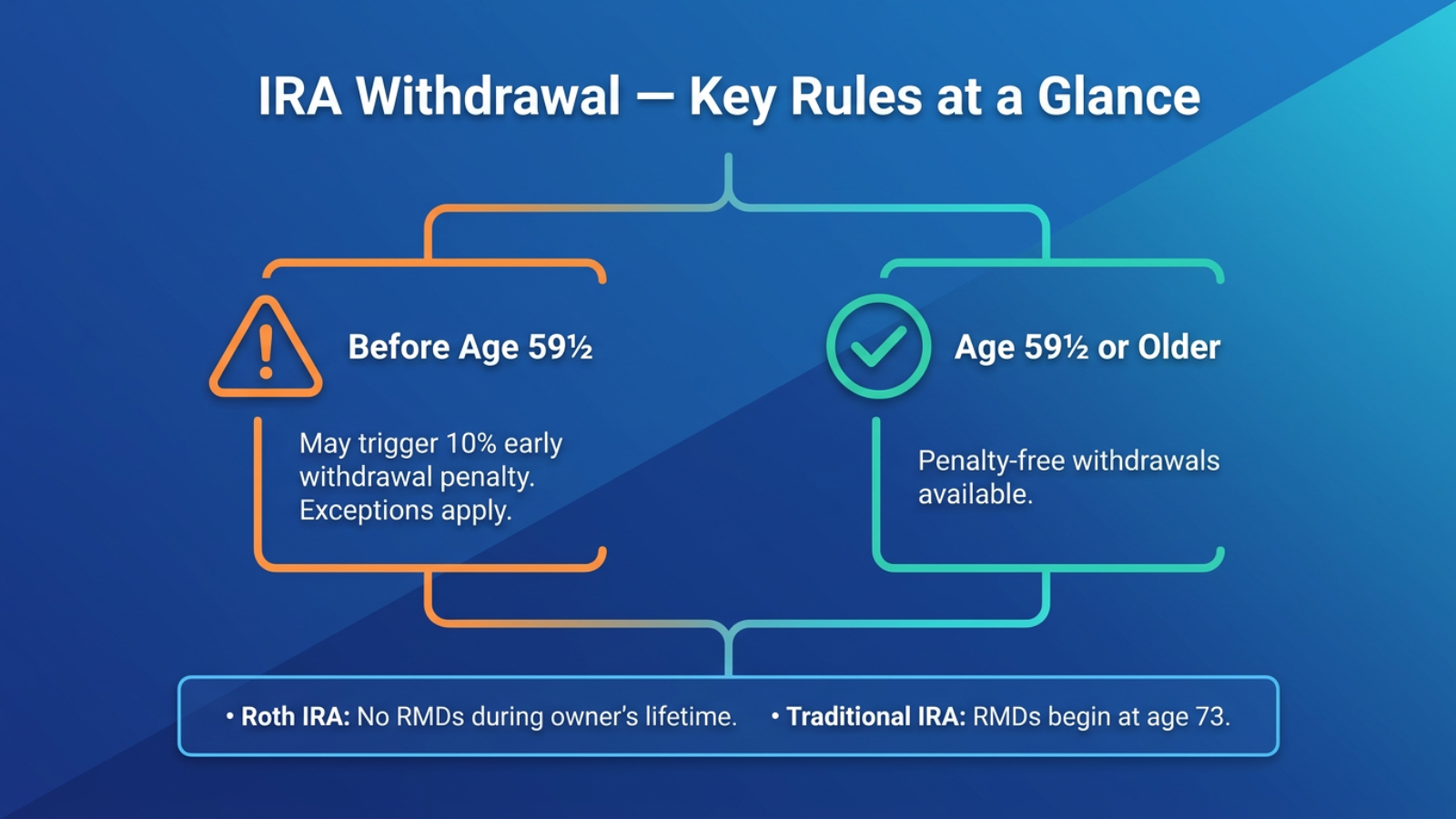
Distributions from a Traditional IRA are taxed as ordinary income at your marginal rate in the year of withdrawal. Penalty-free withdrawals are available once you reach age 59½, though the amounts remain subject to income tax.
Required Minimum Distributions (RMDs):
Traditional IRAs require account holders to begin taking annual RMDs, with the age depending on birth year:
Born on or before December 31, 1950 (i.e., reached age 72 before January 1, 2023): RMDs began at age 72.
Born after December 31, 1950: RMDs begin at age 73.
The IRS calculates your RMD amount using your prior year-end account balance and a life expectancy factor from published tables. Missing an RMD deadline may result in IRS penalties.
Vanguard — https://investor.vanguard.com/investor-resources-education/iras/roth-vs-traditional-ira
3.2 Roth IRA Withdrawals and the 5-Year Rule
Roth IRA contributions (not earnings) can be withdrawn at any time, tax-free and penalty-free — since they were already taxed before being deposited. Earnings, however, must meet specific conditions to qualify for tax-free treatment:
A Roth IRA distribution is qualified (and therefore fully tax-free) if:
The account has been open for at least 5 tax years from the year of your first Roth IRA contribution, AND
You are age 59½ or older, OR the distribution is due to death, permanent disability, or a qualified first-time home purchase.
Roth IRAs have no RMDs during the original account holder's lifetime, which offers meaningful flexibility for retirement income planning and wealth transfer strategies.
IRS — https://www.irs.gov/retirement-plans/traditional-and-roth-iras
3.3 Early Withdrawal Exceptions (Both Account Types)
A 10% federal penalty on early withdrawals (before age 59½) may be waived under certain IRS-recognized circumstances, including:
First-time home purchase (lifetime limit: up to $10,000)
Qualified higher education expenses
Permanent disability or death
Unreimbursed medical expenses exceeding 7.5% of AGI
Health insurance premiums following 12 or more consecutive weeks of unemployment
Substantially equal periodic payments (SEPP) under IRS guidelines
Always consult a licensed tax advisor before taking an early distribution. Webull does not determine or provide guidance on which distribution type applies to your individual tax situation.
Vanguard — https://investor.vanguard.com/investor-resources-education/iras/roth-vs-traditional-ira
Part 4. Roth IRA Conversion: Tax Strategy and How to Execute It at Webull
4.1 What Is a Roth Conversion?
A Roth conversion — sometimes called a backdoor Roth — involves transferring assets from a Traditional IRA (or Rollover IRA) into a Roth IRA. The converted amount is included in your taxable income for the year of conversion. In exchange, the funds and any future growth become eligible for tax-free qualified withdrawals.
There are no IRS limits on the number or dollar amount of Roth conversions per year, and there is no income requirement to execute one. This makes Roth conversions a potentially useful option for investors whose income exceeds the Roth IRA contribution threshold, or who expect higher taxes later in life.
Important: Roth conversions are irreversible. They cannot be recharacterized back to a Traditional IRA after the fact. Tax implications should be evaluated carefully with a qualified tax professional before proceeding. Webull Financial does not offer tax advice.
IRS — https://www.irs.gov/retirement-plans/traditional-and-roth-iras
4.2 Roth Conversion Process at Webull
Webull supports Roth conversions directly through its platform, making the process accessible for investors who hold both a Traditional or Rollover IRA and a Roth IRA at Webull. You can open an IRA at Webull to get started.
During the conversion, you can adjust your tax withholding amount and choose whether to close the source account. Conversions received in good order are typically processed within 1–5 business days.
Important platform notes:
Only cash conversions are supported; in-kind (securities) conversions are not available.
Form 1099-R will be issued for the Traditional IRA to report the distribution.
Form 5498 will be issued for the Roth IRA to report the contribution.
Via the Webull Mobile App:
Tap Account at the bottom center of the screen.
Select your Traditional/Rollover IRA.
Tap Transfers at the top of the screen.
Select Roth Conversions.
Adjust your withholding and confirm.
Via the Webull Website:
Select My Account.
Expand the Transfer Money tab in the left column.
Select Roth Conversions and follow the prompts.
Via Webull Lite Mode:
Select the Plan page (target icon).
Tap IRA Tools.
Select Start a Roth Conversion.
Webull — https://www.webull.com
4.3 Tax Considerations Before Converting
Converting a Traditional IRA to a Roth IRA is a taxable event. The converted amount is added to your gross income for that tax year, which may push you into a higher bracket. Factors to weigh before converting include:
Your current vs. anticipated future tax rate
Whether you have funds available outside the IRA to pay the resulting tax bill (using IRA funds to cover taxes reduces the benefit of the conversion)
The number of years until you plan to access the funds
State income tax implications
Tax strategies do not constitute tax advice, and actual results may vary by individual. Consult a licensed tax professional for guidance tailored to your circumstances.
Part 5. Which IRA May Be Right for You — and Getting Started at Webull
5.1 Factors That May Influence Your Choice
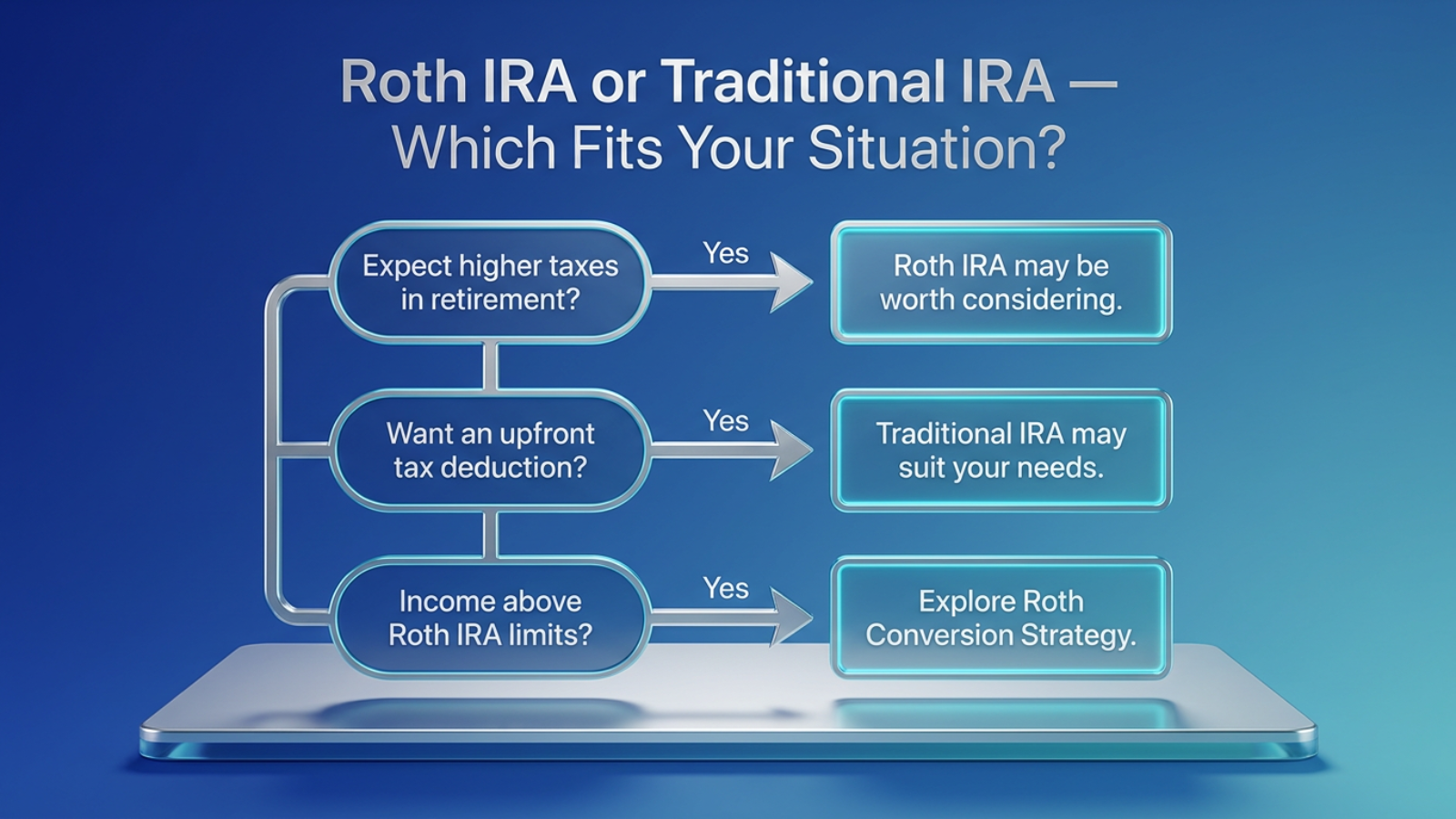
Choosing between a Roth IRA and a Traditional IRA involves weighing several personal financial variables. No single account type is objectively superior for every investor.
Consider a Traditional IRA if you:
Expect to be in a lower tax bracket in retirement than you are today
Want to reduce your current taxable income
Have earned income but exceed Roth IRA contribution income limits (and are not pursuing a conversion)
Consider a Roth IRA if you:
Expect to be in a higher tax bracket in retirement
Are early in your career with a longer time horizon for tax-free growth
Want the flexibility of no RMDs during your lifetime
Want the option to withdraw contributions at any time without penalty
Consider a Roth conversion if you:
Exceed the Roth IRA income contribution limits
Have a lower-income year that creates a favorable window to convert at a lower tax rate
Want to reduce future RMD obligations
Vanguard — https://investor.vanguard.com/investor-resources-education/iras/roth-vs-traditional-ira
5.2 Opening an IRA at Webull
Webull offers three types of IRA accounts — Traditional IRA, Rollover IRA, and Roth IRA — and you may open one of each type. To be eligible to open an IRA at Webull, you must:
Be at least 18 years old
Have earned income during the year (or a qualifying spouse, if filing jointly)
Be a U.S. citizen residing in the United States or a U.S. resident alien
Opening a Webull IRA — App (Existing Users):
Navigate to Menu → Settings → Account Management → Apply for new accounts.
Select Traditional, Rollover, or Roth IRA.
Follow the application prompts.
You can also open an account via the Webull website or desktop platform by navigating to My Account and selecting your preferred IRA type.
Webull — https://www.webull.com
5.3 Regulatory Protections and Account Safety
Webull Financial LLC is a registered broker-dealer and a member of FINRA and SIPC. SIPC membership provides coverage for securities accounts up to $500,000 (including up to $250,000 for cash) per customer in the event of broker-dealer failure. SIPC protection does not cover investment losses due to market fluctuations.
For regulatory information, visit finra.org or sipc.org.
5.4 Roth IRA vs Traditional IRA — Pros and Cons
Traditional IRA
✅ Potential upfront tax deduction on contributions
✅ Available to anyone with earned income; no income cap on contributions
✅ Tax-deferred growth on investments
❌ Withdrawals taxed as ordinary income in retirement
❌ RMDs required starting at age 73
❌ Early withdrawals subject to 10% penalty plus income tax
Roth IRA
✅ Tax-free qualified withdrawals in retirement
✅ No RMDs during the account owner's lifetime
✅ Contributions (not earnings) can be withdrawn anytime penalty-free
❌ No upfront tax deduction
❌ Subject to income limits for direct contributions
❌ Earnings subject to the 5-year rule for tax-free treatment
FAQs: Roth IRA vs Traditional IRA Tax
Q1. What is the main tax difference between a Roth IRA and a Traditional IRA?
The central difference is when taxes are paid. Traditional IRA contributions may be tax-deductible, reducing your taxable income in the year you contribute — but withdrawals in retirement are taxed as ordinary income. Roth IRA contributions are made with after-tax dollars, so qualified withdrawals in retirement, including all investment growth, are tax-free.
Q2. Can I contribute to both a Roth IRA and a Traditional IRA in the same year?
Yes. You may contribute to both types in the same tax year. However, your combined contributions across all IRAs cannot exceed the IRS annual limit — $7,500 for 2026, or $8,600 if you are age 50 or older. Roth IRA contributions may be further reduced based on your MAGI; visit irs.gov for current eligibility thresholds.
Q3. Do Roth IRAs require minimum distributions (RMDs)?
No. Roth IRAs do not require the original account holder to take RMDs during their lifetime. In contrast, Traditional IRA holders must begin taking annual RMDs at age 73 (for those who reached age 72 after December 31, 2022). This distinction makes Roth IRAs a potentially useful account type for investors focused on estate planning flexibility.
Q4. What happens if my income is too high to contribute directly to a Roth IRA?
If your MAGI exceeds the Roth IRA contribution income limit, you may still be able to access Roth IRA benefits through a Roth conversion — making a non-deductible Traditional IRA contribution first, then converting it to a Roth IRA. This strategy has tax implications and should be reviewed with a qualified tax professional. Webull supports Roth conversions through its platform; learn more at webull.
Q5. Is a Roth IRA or a Traditional IRA generally more advantageous for younger investors?
Many financial professionals note that younger investors may benefit from Roth IRAs because they often have a longer time horizon for tax-free compounding and may currently be in a lower tax bracket than they expect to be in retirement. That said, the right choice depends on individual income, tax filing status, retirement timeline, and financial goals. Tax strategies do not constitute tax advice, and actual results may vary by individual. Past performance is not indicative of future results.
The Bottom Line
The Roth IRA vs Traditional IRA tax decision comes down to your current income, expected retirement tax rate, and need for flexibility. A Traditional IRA may reduce taxes now; a Roth IRA may eliminate them later. Webull offers both account types — along with Roth conversion support — on a single platform. Explore IRA options at Webull and consult a tax professional to find the approach that fits your situation.
Disclosure:
Webull Financial does not provide legal or tax advice. The information provided should not be considered legal or tax advice. Consult an attorney or tax professional regarding your specific situation, potential fees, penalties, or other costs. Securities trading is offered to self-directed customers by Webull Financial LLC, member SIPC, FINRA. All investments involve risk, including the possible loss of principal. You should consider your investment objectives carefully before investing. This is not a recommendation, investment advice, or a solicitation for the purchase or sale of a security. Additional info: https://www.webull.com/policy
The information provided does not constitute investment advice and it should not be relied on as such. It should not be considered a solicitation to buy or an offer to sell a security. It does not take into account any investor's particular investment objectives, strategies, tax status or investment horizon. Investing involves risk, including the risk of loss of principal.
