'%3e %3cpath d='M41.7832962%2c0 C41.9459106%2c0 42.0882746%2c0.0866854658 42.1666825%2c0.216359069 C43.8289923%2c2.66540836 44.7676281%2c5.46271319 44.7676281%2c8.43208061 C44.7676281%2c18.1345746 34.7460532%2c26 22.383814%2c26 C10.0215749%2c26 0%2c18.1345746 0%2c8.43208061 C0%2c5.46716016 0.935826425%2c2.67378733 2.58829888%2c0.223985685 C2.67109477%2c0.0916264068 2.81687473%2c0 2.9840593%2c0 C3.23130408%2c0 3.43173558%2c0.200393004 3.43173558%2c0.447590303 C3.43173558%2c0.475056669 3.42926112%2c0.501945205 3.42452292%2c0.528045226 L3.41810883%2c0.550292077 C3.37800671%2c0.861741908 3.3575721%2c1.17661276 3.3575721%2c1.49443092 C3.3575721%2c7.98336 11.2132389%2c12.5742305 22.383814%2c12.5742305 C33.5543891%2c12.5742305 41.410056%2c7.98336 41.410056%2c1.49443092 C41.410056%2c1.17865223 41.3898828%2c0.865783153 41.3502888%2c0.556288325 C41.3402868%2c0.521941442 41.3356199%2c0.48531078 41.3356199%2c0.447590303 C41.3356199%2c0.200393004 41.5360514%2c0 41.7832962%2c0 Z' id='logo%e5%a4%87%e4%bb%bd-6' fill='white'%3e%3c/path%3e %3cpath d='M74.6899231%2c3.74404927 C75.2411227%2c3.74404927 75.7734299%2c3.66184338 76.2756219%2c3.50883715 L73.8159676%2c20.8666902 C73.5770593%2c22.5662954 72.8072434%2c23.0518969 71.4268838%2c23.0518969 L69.9934336%2c23.0518969 C68.7988917%2c23.0518969 68.1618027%2c22.458384 67.7901674%2c20.893668 L65.6930827%2c11.9909739 C65.639992%2c11.7481731 65.639992%2c11.6942174 65.5338105%2c11.6942174 C65.427629%2c11.6942174 65.4010836%2c11.7481731 65.3479929%2c11.9909739 L63.2509082%2c20.893668 C62.8792729%2c22.458384 62.2421839%2c23.0518969 61.047642%2c23.0518969 L59.6141918%2c23.0518969 C58.2338322%2c23.0518969 57.4640163%2c22.5662954 57.225108%2c20.8666902 L54.7463723%2c3.37406084 C55.3593498%2c3.61307396 56.0249975%2c3.74404927 56.7207458%2c3.74404927 C57.3314263%2c3.74404927 57.918917%2c3.64314414 58.4679557%2c3.4568446 L60.3574623%2c19.3829078 C60.3840076%2c19.6257086 60.3840076%2c19.7875757 60.4901891%2c19.7875757 C60.5963706%2c19.7875757 60.5963706%2c19.6257086 60.6494614%2c19.3829078 L62.9323637%2c9.91367858 C63.0916359%2c9.26620991 63.4632712%2c8.69967483 64.6047223%2c8.69967483 L66.4363532%2c8.69967483 C67.5778044%2c8.69967483 67.9494397%2c9.26620991 68.1087119%2c9.91367858 L70.3916142%2c19.3829078 C70.4447049%2c19.6257086 70.4447049%2c19.7875757 70.5508864%2c19.7875757 C70.6570679%2c19.7875757 70.6570679%2c19.6257086 70.6836133%2c19.3829078 L72.5891207%2c3.32292288 C73.2365902%2c3.59432921 73.9460524%2c3.74404927 74.6899231%2c3.74404927 Z' id='Combined-Shape' fill='white'%3e%3c/path%3e %3cpath d='M84.5933901%2c7.43171536 C88.6813779%2c7.43171536 90.9111894%2c10.2643908 90.9111894%2c14.2840921 L90.9111894%2c15.7948523 C90.9111894%2c16.2264981 90.7519172%2c16.4692988 90.3802819%2c16.4692988 L81.7264895%2c16.4692988 L81.7264895%2c16.5502324 C81.7264895%2c18.1149484 82.3635785%2c19.9764208 84.9119346%2c19.9764208 C86.849747%2c19.9764208 88.6813779%2c19.8145536 89.7962837%2c19.7066422 L89.8759198%2c19.7066422 C90.1413735%2c19.7066422 90.3537366%2c19.8415315 90.3537366%2c20.1113101 L90.3537366%2c21.8918489 C90.3537366%2c22.3234947 90.2741004%2c22.5123397 89.7962837%2c22.5932733 C88.0708343%2c22.9170076 87.0355646%2c23.0518969 84.6464808%2c23.0518969 C81.9919433%2c23.0518969 78.2225%2c21.5950924 78.2225%2c16.2804538 L78.2225%2c14.2840921 C78.2225%2c10.0755457 80.5319476%2c7.43171536 84.5933901%2c7.43171536 Z M84.5933901%2c10.5071915 C82.9475768%2c10.5071915 81.7530349%2c11.6942174 81.7530349%2c13.8254684 L81.7530349%2c13.9333799 L87.3806545%2c13.9333799 L87.3806545%2c13.8254684 C87.3806545%2c11.7211953 86.2392034%2c10.5071915 84.5933901%2c10.5071915 Z' id='Combined-Shape' fill='white'%3e%3c/path%3e %3cpath d='M97.4154906%2c2.98826245 L97.4148064%2c7.62056039 C98.3969853%2c7.48567108 99.3260735%2c7.43171536 99.9631625%2c7.43171536 C104.236968%2c7.43171536 106.307507%2c9.99461216 106.307507%2c14.2031585 L106.307507%2c16.2804538 C106.307507%2c20.4890001 104.236968%2c23.0518969 99.9631625%2c23.0518969 C98.2642584%2c23.0518969 96.2733553%2c22.7821183 94.627542%2c22.3504725 C94.0169984%2c22.1886054 93.9108169%2c22.0267382 93.9108169%2c21.6220703 L93.9098179%2c3.08694115 C94.4185466%2c3.24434375 94.9584615%2c3.32900525 95.5178331%2c3.32900525 C96.184659%2c3.32900525 96.8238351%2c3.20869291 97.4154906%2c2.98826245 Z M99.9631625%2c10.3453244 C99.3260735%2c10.3453244 98.1580769%2c10.4262579 97.4148064%2c10.5341694 L97.4148064%2c19.9494429 C97.9191686%2c20.0573544 99.007529%2c20.1382879 99.9631625%2c20.1382879 C102.246065%2c20.1382879 102.803518%2c18.4926384 102.803518%2c16.2804538 L102.803518%2c14.2031585 C102.803518%2c11.9909739 102.246065%2c10.3453244 99.9631625%2c10.3453244 Z' id='Combined-Shape' fill='white'%3e%3c/path%3e %3cpath d='M111.036668%2c8.72457747 C111.579488%2c8.72457747 112.103987%2c8.64485191 112.599444%2c8.49629404 L112.598761%2c16.5232546 C112.598761%2c19.3289521 113.607485%2c19.9764208 115.147117%2c19.9764208 L115.306389%2c19.9764208 C116.846021%2c19.9764208 117.854746%2c19.3289521 117.854746%2c16.5232546 L117.854207%2c8.4334735 C118.406525%2c8.62226395 118.997939%2c8.72457747 119.612866%2c8.72457747 C120.223332%2c8.72457747 120.810625%2c8.62374317 121.359498%2c8.43756894 L121.358735%2c16.5232546 C121.358735%2c22.4044283 116.872567%2c23.0518969 115.306389%2c23.0518969 L115.060464%2c23.0512514 C113.42215%2c23.0271041 109.094772%2c22.2994073 109.094772%2c16.5232546 L109.094446%2c8.36700801 C109.698522%2c8.59813531 110.353066%2c8.72457747 111.036668%2c8.72457747 Z' id='Combined-Shape' fill='white'%3e%3c/path%3e %3cpath d='M128.314162%2c3.03790128 L128.313623%2c22.269539 C128.313623%2c22.5662954 128.10126%2c22.836074 127.809261%2c22.836074 L125.340541%2c22.836074 C125.048542%2c22.836074 124.809634%2c22.5662954 124.809634%2c22.269539 L124.809455%2c3.04219481 C125.358161%2c3.22824247 125.945253%2c3.32900525 126.555503%2c3.32900525 C127.17043%2c3.32900525 127.761844%2c3.22669173 128.314162%2c3.03790128 Z' id='Combined-Shape' fill='white'%3e%3c/path%3e %3cpath d='M133.90653%2c3.32900525 C134.473329%2c3.32900525 135.02015%2c3.24208064 135.534793%2c3.08063296 L135.533966%2c22.269539 C135.533966%2c22.5662954 135.321603%2c22.836074 135.029603%2c22.836074 L132.560884%2c22.836074 C132.268884%2c22.836074 132.029976%2c22.5662954 132.029976%2c22.269539 L132.029909%2c2.99605058 C132.615669%2c3.21152525 133.2476%2c3.32900525 133.90653%2c3.32900525 Z' id='Combined-Shape' fill='white'%3e%3c/path%3e %3c/g%3e %3c/g%3e %3c/g%3e%3c/svg%3e)


A Roth IRA is one of the most powerful retirement savings tools available to US investors — offering tax-free growth and tax-free withdrawals in retirement. Whether you're just starting to save or looking to optimize your long-term strategy, understanding how a Roth IRA works, who qualifies, and how to open a Roth IRA account can make a meaningful difference in your retirement outcome.
Key Takeaways
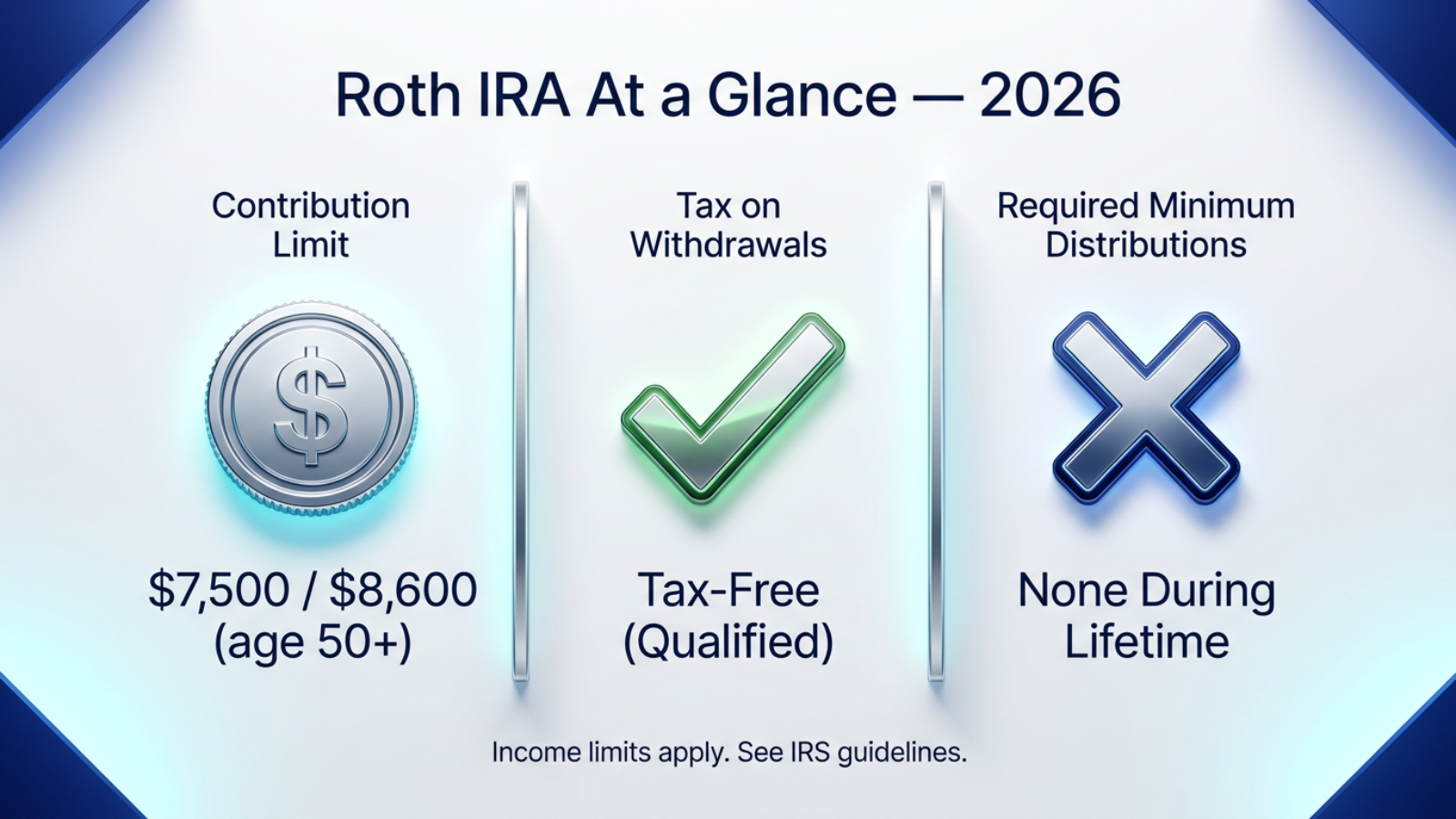
Roth IRA contributions are made with after-tax dollars, allowing qualified withdrawals in retirement to be completely tax-free.
For 2026, the contribution limit is $7,500 ($8,600 for those age 50 or older), subject to income eligibility.
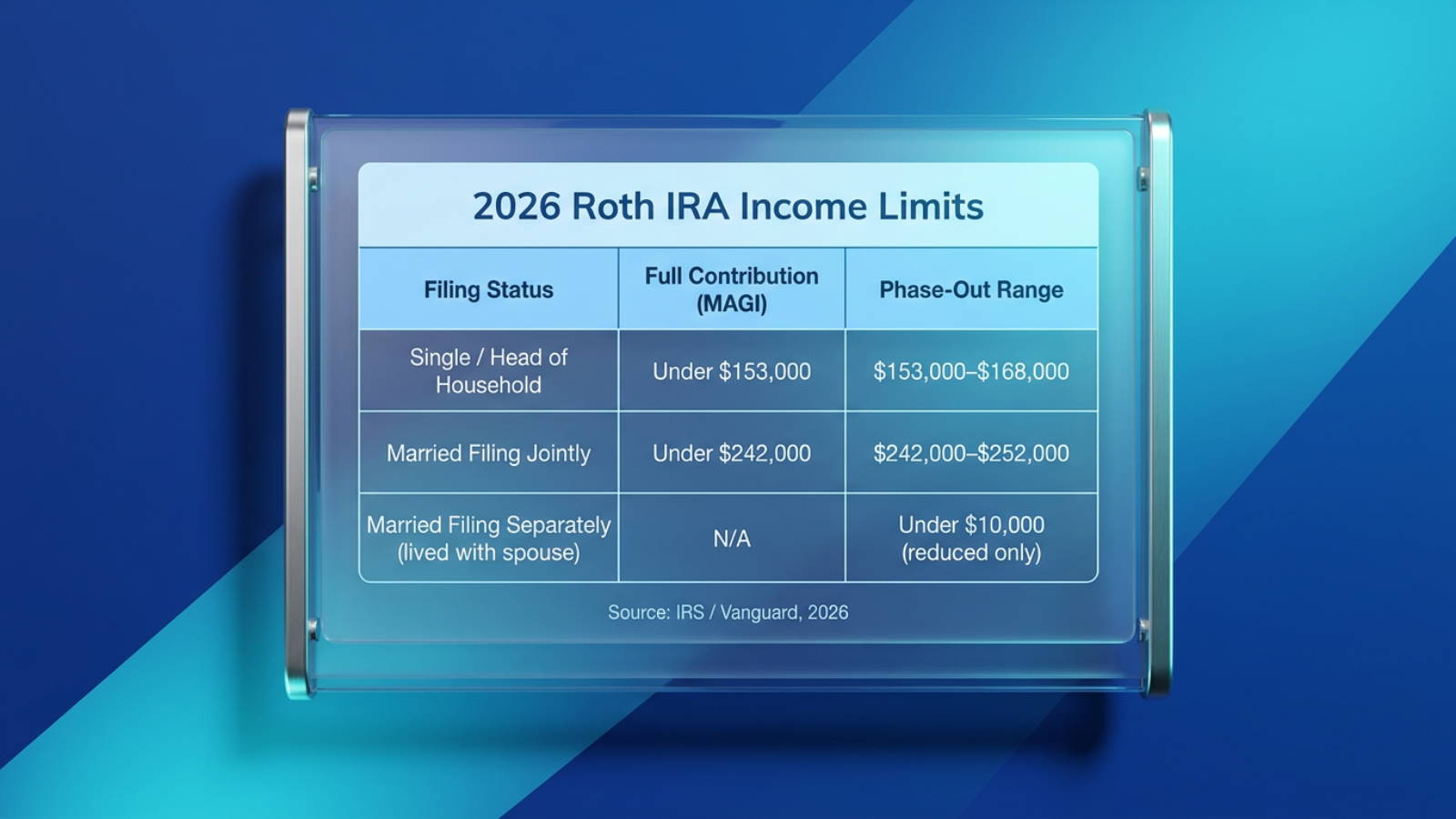
Single filers with a modified adjusted gross income (MAGI) under $153,000 can make a full contribution; the limit phases out between $153,000 and $168,000.
Roth IRAs have no required minimum distributions (RMDs) during the account holder's lifetime.
Platforms like Webull offer Roth IRA accounts with no account minimums, making it accessible for a wide range of investors.
Part 1. What Is a Roth IRA and How Does It Work?
A Roth IRA (Individual Retirement Account) is a type of retirement savings account funded with after-tax dollars. Unlike a Traditional IRA, you do not receive a tax deduction on your contributions. The trade-off — and the core appeal — is that your money grows tax-free, and qualified withdrawals in retirement are not subject to federal income tax.
The IRS defines a Roth IRA as an IRA that meets specific rules distinct from those of a Traditional IRA, including the absence of a contribution deduction, the allowance of contributions past age 70½, and the option to leave funds in the account indefinitely without mandatory distributions.
IRS — https://www.irs.gov/retirement-plans/roth-iras
1.1 Key Benefits of a Roth IRA
Tax-free growth: Investment earnings — dividends, capital gains, and interest — accumulate without being taxed each year.
Tax-free qualified withdrawals: Once you meet the requirements, you can withdraw your contributions and earnings in retirement without owing federal income tax.
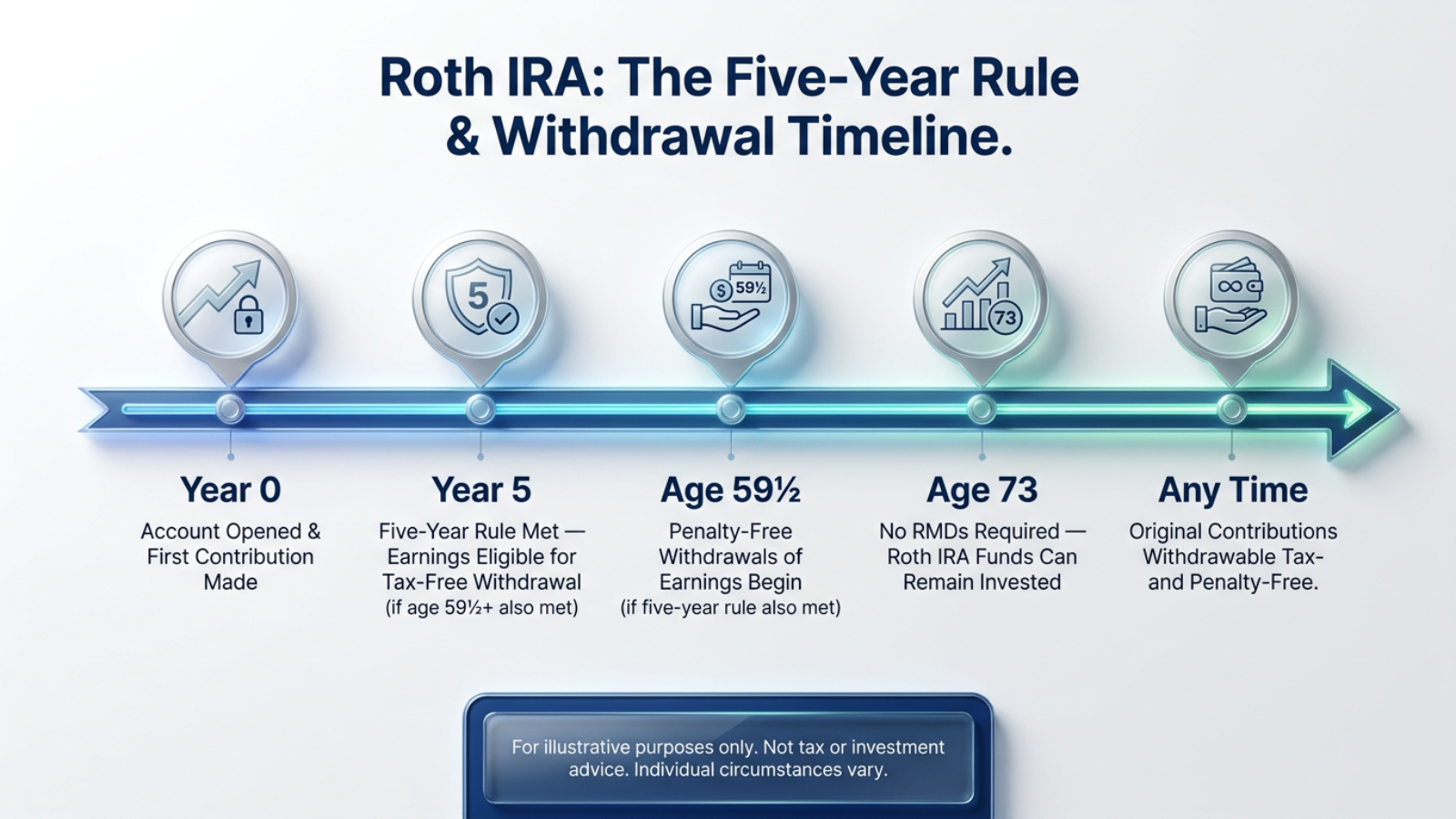
No required minimum distributions (RMDs): Unlike Traditional IRAs, a Roth IRA does not require you to take distributions at age 73, giving you more flexibility in managing retirement income.
Flexible participation: You can contribute to a Roth IRA even if you're already enrolled in an employer-sponsored retirement plan such as a 401(k).
Contribution access: You may withdraw your original contributions (not earnings) at any time without tax or penalty, since those dollars have already been taxed.
1.2 Key Limitations to Understand
No upfront tax deduction: Contributions to a Roth IRA are not tax-deductible. You pay tax now in exchange for tax-free benefits later.
Income limits apply: Your ability to contribute to a Roth IRA phases out — and eventually disappears — at higher income levels (detailed in Part 2).
Earnings withdrawal rules: To withdraw earnings tax-free, the account must have been open for at least five years and you must be age 59½ or older, among other qualifying conditions.
Past performance is not indicative of future results. Tax strategies discussed here are general and educational in nature and do not constitute tax advice. Actual results may vary by individual.
Part 2. 2026 Roth IRA Eligibility Rules and Contribution Limits
Understanding who qualifies — and for how much — is essential before opening a Roth IRA. Eligibility is primarily determined by your modified adjusted gross income (MAGI) and tax filing status.
2.1 2026 Contribution Limits
For 2026, the annual Roth IRA contribution limit is $7,500 for most eligible investors. Those age 50 or older can make an additional catch-up contribution of $1,100, raising their total limit to $8,600. These limits apply across all your Roth and Traditional IRAs combined — not per account.
The deadline to make a Roth IRA contribution for a given tax year is typically April 15 of the following year.
Vanguard — https://investor.vanguard.com/investor-resources-education/iras/roth-ira-income-limits
2.2 2026 Income Thresholds by Filing Status
Filing Status | Full Contribution (MAGI) | Phased-Out Range | No Contribution |
|---|---|---|---|
Single, Head of Household, or MFS (didn't live with spouse) | Under $153,000 | $153,000–$168,000 | $168,000 or more |
Married Filing Jointly or Surviving Spouse | Under $242,000 | $242,000–$252,000 | $252,000 or more |
Married Filing Separately (lived with spouse during year) | — | Under $10,000 | $10,000 or more |
NerdWallet — https://www.nerdwallet.com/retirement/learn/how-and-where-to-open-a-roth-ira
2.3 What Happens If You Exceed the Income Limit?
If your MAGI exceeds the Roth IRA income limit, you're generally not eligible to contribute directly. One commonly discussed option is the backdoor Roth IRA strategy — contributing to a Traditional IRA first, then converting those funds to a Roth IRA. This approach effectively allows higher-income earners to access Roth benefits, though it may trigger taxes on any pre-tax amounts converted. Consult a qualified tax professional before pursuing this strategy, as individual circumstances vary.
Vanguard — https://investor.vanguard.com/investor-resources-education/iras/roth-ira-income-limits
2.4 Excess Contributions and Penalties
Contributing more than your allowable limit in a given tax year results in a 6% IRS penalty on the excess amount for each year it remains in the account. To avoid this, you may withdraw the excess contribution and any associated earnings before filing your tax return, or apply the excess toward the following year's limit.
IRS — https://www.irs.gov/retirement-plans/roth-iras
Part 3. Roth IRA vs. Traditional IRA: Which Is Right for You?
Choosing between a Roth IRA and a Traditional IRA depends on your current tax situation, expected income in retirement, and long-term savings goals. Neither account type is universally superior — each has distinct advantages and trade-offs.
Roth IRA vs. Traditional IRA — Side-by-Side Comparison
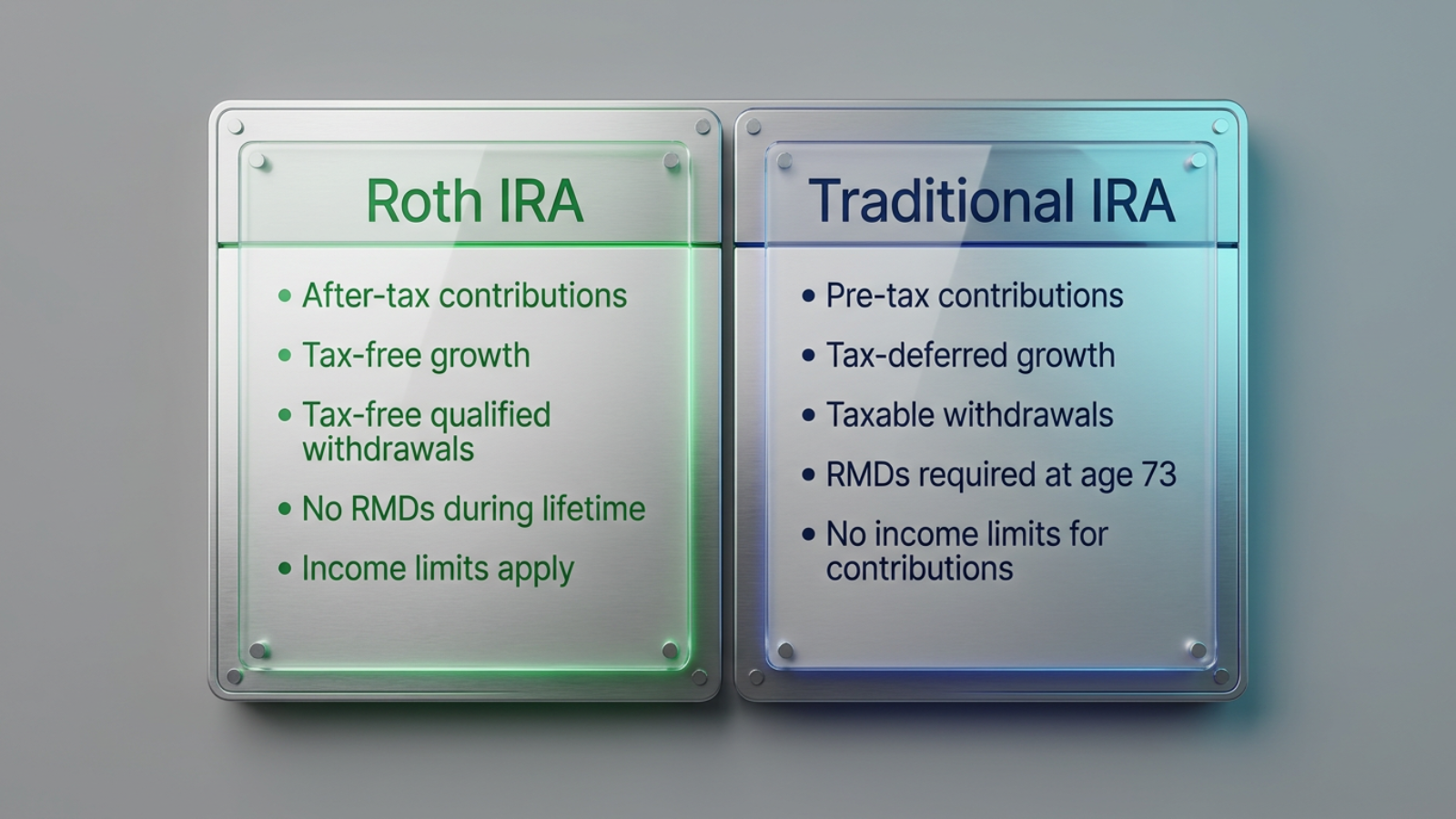
Feature | Roth IRA | Traditional IRA |
|---|---|---|
Contribution Type | After-tax dollars | Pre-tax dollars (may be deductible) |
Tax on Contributions | Not deductible | May be tax-deductible |
Tax on Withdrawals | Tax-free (qualified) | Taxed as ordinary income |
RMDs | None during account holder's lifetime | Required starting at age 73 |
Income Limits | Yes — phaseout applies | No income limit for contributions |
Early Withdrawal | Contributions anytime; earnings have rules | Taxes + 10% penalty before age 59½ |
Best For | Expecting higher tax rate in retirement | Expecting lower tax rate in retirement |
Pros and Cons of a Roth IRA
Pros:
Tax-free income in retirement
No mandatory withdrawals — greater estate planning flexibility
Contributions (not earnings) can be accessed without penalty at any time
Can contribute at any age, provided you have qualifying earned income
Cons:
No upfront tax deduction
Income limits restrict high earners from direct contributions
Five-year rule applies to tax-free earnings withdrawals
Combined IRA contribution limit ($7,500 / $8,600 catch-up) limits total annual contributions
Part 4. How to Open a Roth IRA — Step-by-Step Guide on Webull
Opening a Roth IRA is a straightforward process, particularly on platforms that are designed with accessible account management tools. Webull offers Roth IRA accounts alongside Traditional and Rollover IRAs, with no account minimum required to get started.
To be eligible to open any IRA at Webull, you must:
Be at least 18 years old
Have earned income during the year (or your spouse must, if filing jointly)
Be a U.S. citizen living in the U.S., or a U.S. resident alien
Webull is a registered broker-dealer and is a member of FINRA and SIPC. SIPC protection covers securities and cash held at a member firm up to $500,000 (including up to $250,000 for cash claims) in the event of broker-dealer failure. SIPC coverage does not protect against market losses or investment risk.
Learn more and explore Webull's IRA options at www.webull.com.
How to Open a Roth IRA on Webull (Mobile App)
For Existing Webull Users:
Step 1. Open the Webull app and navigate to Menu → Settings → Account Management → Apply for new accounts.
Step 2. Select Roth IRA from the account type options.
Step 3. Follow the on-screen application prompts to complete the process.
For New Webull Users:
Step 1. Tap Sign Up on the Webull app home screen.
Step 2. Enter your phone number or email address and agree to the terms of service.
Step 3. Enter the verification code sent to your phone or email.
Step 4. Create and confirm your login password, then tap Sign Up.
Step 5. Choose your preferred trading platform layout (sophisticated or Lite).
Step 6. Select Open Account, then follow the application prompts — selecting Roth IRA as your account type.
How to Open a Roth IRA on Webull (Desktop)
Step 1. Click your account number in the upper-right corner.
Step 2. Select Roth IRA as your account type.
Step 3. Follow the application prompts to complete setup.
How to Open a Roth IRA on Webull (Website)
Step 1. Navigate to My Account on the Webull website.
Step 2. Select Roth IRA from the IRA options.
Step 3. Follow the application prompts.
For new website users, click Sign Up, enter your phone number and verification code, agree to the terms of service, create your password, and then select the Roth IRA and Open Account option before following the remaining prompts.
Visit www.webull.com to begin your Roth IRA application.
4.1 What Information Do You Need to Open a Roth IRA?
Regardless of the platform you choose, you'll typically need the following documentation:
A valid government-issued photo ID (driver's license or passport) confirming your identity, address, and date of birth
Your Social Security number or tax identification number
Proof of employment, if applicable
Names, addresses, and dates of birth for any account beneficiaries
Bank routing and account numbers to fund your Roth IRA
NerdWallet — https://www.nerdwallet.com/retirement/learn/how-and-where-to-open-a-roth-ira
4.2 DIY Investors vs. Hands-Off Investors
For self-directed investors: Opening a Roth IRA at an online brokerage provides full control over your investment selections. Platforms that offer a broad range of investment options — including index funds and ETFs — may suit investors comfortable making their own portfolio decisions.
For hands-off investors: Robo-advisors build and maintain a diversified portfolio automatically, typically charging a small management fee. These services offer portfolio options ranging from conservative to aggressive allocations based on individual risk tolerance.
Explore Webull's full platform features at www.webull.com.
Part 5. Roth IRA Investment Strategies and Key Considerations
Once your Roth IRA is open and funded, the next step is investing. A Roth IRA is an account type, not an automatic investment — contributions must be actively invested to seek growth over time.
5.1 Asset Allocation Basics
Your asset allocation — the mix of stocks, bonds, and other assets in your portfolio — will depend on your age, risk tolerance, and investment timeline. A general framework used by many retirement savers involves holding a higher percentage of equities (stocks) when younger and gradually shifting toward more conservative holdings as retirement approaches.
Within a Roth IRA, many investors use index funds and ETFs to achieve broad diversification at low cost. Checking the allocation models used by robo-advisors (often published on their websites) can provide useful reference points for building your own portfolio.
5.2 Contributing to Both a 401(k) and a Roth IRA
You can contribute to both a 401(k) and a Roth IRA in the same year, provided you meet the Roth IRA income requirements. A commonly discussed strategy is to first contribute enough to your 401(k) to capture any employer match — which represents additional compensation — and then direct additional retirement savings toward a Roth IRA for tax diversification.
Contributing to both accounts can help build a diversified tax strategy, giving you access to both pre-tax (Traditional/401k) and after-tax (Roth) assets in retirement. Tax strategies discussed here are general and educational in nature and do not constitute tax advice; actual results may vary by individual.
5.3 Rolling Over a 401(k) to a Roth IRA
If you've recently left a job, it may be possible to roll funds from a former employer's 401(k) into a Roth IRA. Because traditional 401(k) contributions are made pre-tax and Roth IRAs hold after-tax funds, this conversion may trigger income taxes on the rolled-over amount. The appropriate steps and tax implications will depend on your specific plan and situation — consulting a tax professional is recommended before initiating a rollover.
Webull also offers a Rollover IRA option for those transferring funds from a qualified retirement plan, preserving tax-deferred status during the transition. Learn more at www.webull.com.
5.4 Spousal Roth IRA Contributions
A nonworking spouse can contribute to a Roth IRA through a spousal IRA, provided the working spouse has enough earned income to cover both contributions. In 2026, a married couple filing jointly — each with their own Roth IRA — can collectively contribute up to $15,000 per year ($17,200 if both spouses are age 50 or older), provided their combined MAGI falls below $242,000.
Vanguard — https://investor.vanguard.com/investor-resources-education/iras/roth-ira-income-limits
FAQs: Roth IRA Questions Answered
Q1. What is the Roth IRA contribution limit for 2026?
For 2026, the Roth IRA contribution limit is $7,500 for individuals under age 50. Those age 50 and older can contribute up to $8,600, thanks to the $1,100 catch-up contribution allowance. These limits apply to the combined total across all your IRA accounts (Roth and Traditional). Contributions must come from earned income, and income limits based on MAGI apply.
Q2. Who qualifies for a Roth IRA?
Anyone with earned income who meets the MAGI thresholds can contribute to a Roth IRA — there is no age restriction. For 2026, single filers with MAGI under $153,000 and married couples filing jointly with MAGI under $242,000 can make a full contribution. Partial contributions are allowed within the phaseout ranges; contributions are eliminated above $168,000 (single) and $252,000 (married filing jointly).
Q3. What is the difference between a Roth IRA and a Traditional IRA?
The key difference is when taxes are applied. A Traditional IRA uses pre-tax dollars — contributions may be deductible, but withdrawals in retirement are taxed as ordinary income. A Roth IRA uses after-tax dollars — there's no upfront deduction, but qualified withdrawals in retirement are tax-free. Roth IRAs also have no required minimum distributions (RMDs), while Traditional IRAs require distributions beginning at age 73.
Q4. Can I open a Roth IRA if I already have a 401(k)?
Yes. You can contribute to both a 401(k) and a Roth IRA in the same year, provided you meet Roth IRA income eligibility requirements. Many financial professionals discuss contributing enough to a 401(k) to capture any employer match first, then directing additional savings to a Roth IRA for tax diversification. This does not constitute personalized investment or tax advice; individual circumstances vary.
Q5. How do I open a Roth IRA on Webull?
Existing Webull users can open a Roth IRA directly through the app by navigating to Menu → Settings → Account Management → Apply for new accounts, then selecting Roth IRA. New users can sign up via the Webull app, desktop platform, or website, following the step-by-step prompts. Eligibility requires being at least 18 years old, a US citizen or resident alien, and having earned income. Visit www.webull.com for full details.
The Bottom Line
A Roth IRA offers a compelling path to tax-free retirement income for eligible investors. With the 2026 contribution limit set at $7,500 ($8,600 for those 50 and older) and no RMDs during your lifetime, it's a flexible, long-term savings vehicle worth considering. Webull makes opening a Roth IRA straightforward with no account minimum. Explore your options and take the next step toward your retirement goals at www.webull.com.
Rates vary by service provider; please refer to the latest pricing. Past performance is not indicative of future results. Tax strategies discussed are general and educational in nature, do not constitute tax advice, and actual results may vary by individual.
Disclosure:
Webull Financial does not provide legal or tax advice. The information provided should not be considered legal or tax advice. Consult an attorney or tax professional regarding your specific situation, potential fees, penalties, or other costs. Securities trading is offered to self-directed customers by Webull Financial LLC, member SIPC, FINRA. All investments involve risk, including the possible loss of principal. You should consider your investment objectives carefully before investing. This is not a recommendation, investment advice, or a solicitation for the purchase or sale of a security. Additional info: https://www.webull.com/policy
The information provided does not constitute investment advice and it should not be relied on as such. It should not be considered a solicitation to buy or an offer to sell a security. It does not take into account any investor's particular investment objectives, strategies, tax status or investment horizon. Investing involves risk, including the risk of loss of principal.
