'%3e %3cpath d='M41.7832962%2c0 C41.9459106%2c0 42.0882746%2c0.0866854658 42.1666825%2c0.216359069 C43.8289923%2c2.66540836 44.7676281%2c5.46271319 44.7676281%2c8.43208061 C44.7676281%2c18.1345746 34.7460532%2c26 22.383814%2c26 C10.0215749%2c26 0%2c18.1345746 0%2c8.43208061 C0%2c5.46716016 0.935826425%2c2.67378733 2.58829888%2c0.223985685 C2.67109477%2c0.0916264068 2.81687473%2c0 2.9840593%2c0 C3.23130408%2c0 3.43173558%2c0.200393004 3.43173558%2c0.447590303 C3.43173558%2c0.475056669 3.42926112%2c0.501945205 3.42452292%2c0.528045226 L3.41810883%2c0.550292077 C3.37800671%2c0.861741908 3.3575721%2c1.17661276 3.3575721%2c1.49443092 C3.3575721%2c7.98336 11.2132389%2c12.5742305 22.383814%2c12.5742305 C33.5543891%2c12.5742305 41.410056%2c7.98336 41.410056%2c1.49443092 C41.410056%2c1.17865223 41.3898828%2c0.865783153 41.3502888%2c0.556288325 C41.3402868%2c0.521941442 41.3356199%2c0.48531078 41.3356199%2c0.447590303 C41.3356199%2c0.200393004 41.5360514%2c0 41.7832962%2c0 Z' id='logo%e5%a4%87%e4%bb%bd-6' fill='white'%3e%3c/path%3e %3cpath d='M74.6899231%2c3.74404927 C75.2411227%2c3.74404927 75.7734299%2c3.66184338 76.2756219%2c3.50883715 L73.8159676%2c20.8666902 C73.5770593%2c22.5662954 72.8072434%2c23.0518969 71.4268838%2c23.0518969 L69.9934336%2c23.0518969 C68.7988917%2c23.0518969 68.1618027%2c22.458384 67.7901674%2c20.893668 L65.6930827%2c11.9909739 C65.639992%2c11.7481731 65.639992%2c11.6942174 65.5338105%2c11.6942174 C65.427629%2c11.6942174 65.4010836%2c11.7481731 65.3479929%2c11.9909739 L63.2509082%2c20.893668 C62.8792729%2c22.458384 62.2421839%2c23.0518969 61.047642%2c23.0518969 L59.6141918%2c23.0518969 C58.2338322%2c23.0518969 57.4640163%2c22.5662954 57.225108%2c20.8666902 L54.7463723%2c3.37406084 C55.3593498%2c3.61307396 56.0249975%2c3.74404927 56.7207458%2c3.74404927 C57.3314263%2c3.74404927 57.918917%2c3.64314414 58.4679557%2c3.4568446 L60.3574623%2c19.3829078 C60.3840076%2c19.6257086 60.3840076%2c19.7875757 60.4901891%2c19.7875757 C60.5963706%2c19.7875757 60.5963706%2c19.6257086 60.6494614%2c19.3829078 L62.9323637%2c9.91367858 C63.0916359%2c9.26620991 63.4632712%2c8.69967483 64.6047223%2c8.69967483 L66.4363532%2c8.69967483 C67.5778044%2c8.69967483 67.9494397%2c9.26620991 68.1087119%2c9.91367858 L70.3916142%2c19.3829078 C70.4447049%2c19.6257086 70.4447049%2c19.7875757 70.5508864%2c19.7875757 C70.6570679%2c19.7875757 70.6570679%2c19.6257086 70.6836133%2c19.3829078 L72.5891207%2c3.32292288 C73.2365902%2c3.59432921 73.9460524%2c3.74404927 74.6899231%2c3.74404927 Z' id='Combined-Shape' fill='white'%3e%3c/path%3e %3cpath d='M84.5933901%2c7.43171536 C88.6813779%2c7.43171536 90.9111894%2c10.2643908 90.9111894%2c14.2840921 L90.9111894%2c15.7948523 C90.9111894%2c16.2264981 90.7519172%2c16.4692988 90.3802819%2c16.4692988 L81.7264895%2c16.4692988 L81.7264895%2c16.5502324 C81.7264895%2c18.1149484 82.3635785%2c19.9764208 84.9119346%2c19.9764208 C86.849747%2c19.9764208 88.6813779%2c19.8145536 89.7962837%2c19.7066422 L89.8759198%2c19.7066422 C90.1413735%2c19.7066422 90.3537366%2c19.8415315 90.3537366%2c20.1113101 L90.3537366%2c21.8918489 C90.3537366%2c22.3234947 90.2741004%2c22.5123397 89.7962837%2c22.5932733 C88.0708343%2c22.9170076 87.0355646%2c23.0518969 84.6464808%2c23.0518969 C81.9919433%2c23.0518969 78.2225%2c21.5950924 78.2225%2c16.2804538 L78.2225%2c14.2840921 C78.2225%2c10.0755457 80.5319476%2c7.43171536 84.5933901%2c7.43171536 Z M84.5933901%2c10.5071915 C82.9475768%2c10.5071915 81.7530349%2c11.6942174 81.7530349%2c13.8254684 L81.7530349%2c13.9333799 L87.3806545%2c13.9333799 L87.3806545%2c13.8254684 C87.3806545%2c11.7211953 86.2392034%2c10.5071915 84.5933901%2c10.5071915 Z' id='Combined-Shape' fill='white'%3e%3c/path%3e %3cpath d='M97.4154906%2c2.98826245 L97.4148064%2c7.62056039 C98.3969853%2c7.48567108 99.3260735%2c7.43171536 99.9631625%2c7.43171536 C104.236968%2c7.43171536 106.307507%2c9.99461216 106.307507%2c14.2031585 L106.307507%2c16.2804538 C106.307507%2c20.4890001 104.236968%2c23.0518969 99.9631625%2c23.0518969 C98.2642584%2c23.0518969 96.2733553%2c22.7821183 94.627542%2c22.3504725 C94.0169984%2c22.1886054 93.9108169%2c22.0267382 93.9108169%2c21.6220703 L93.9098179%2c3.08694115 C94.4185466%2c3.24434375 94.9584615%2c3.32900525 95.5178331%2c3.32900525 C96.184659%2c3.32900525 96.8238351%2c3.20869291 97.4154906%2c2.98826245 Z M99.9631625%2c10.3453244 C99.3260735%2c10.3453244 98.1580769%2c10.4262579 97.4148064%2c10.5341694 L97.4148064%2c19.9494429 C97.9191686%2c20.0573544 99.007529%2c20.1382879 99.9631625%2c20.1382879 C102.246065%2c20.1382879 102.803518%2c18.4926384 102.803518%2c16.2804538 L102.803518%2c14.2031585 C102.803518%2c11.9909739 102.246065%2c10.3453244 99.9631625%2c10.3453244 Z' id='Combined-Shape' fill='white'%3e%3c/path%3e %3cpath d='M111.036668%2c8.72457747 C111.579488%2c8.72457747 112.103987%2c8.64485191 112.599444%2c8.49629404 L112.598761%2c16.5232546 C112.598761%2c19.3289521 113.607485%2c19.9764208 115.147117%2c19.9764208 L115.306389%2c19.9764208 C116.846021%2c19.9764208 117.854746%2c19.3289521 117.854746%2c16.5232546 L117.854207%2c8.4334735 C118.406525%2c8.62226395 118.997939%2c8.72457747 119.612866%2c8.72457747 C120.223332%2c8.72457747 120.810625%2c8.62374317 121.359498%2c8.43756894 L121.358735%2c16.5232546 C121.358735%2c22.4044283 116.872567%2c23.0518969 115.306389%2c23.0518969 L115.060464%2c23.0512514 C113.42215%2c23.0271041 109.094772%2c22.2994073 109.094772%2c16.5232546 L109.094446%2c8.36700801 C109.698522%2c8.59813531 110.353066%2c8.72457747 111.036668%2c8.72457747 Z' id='Combined-Shape' fill='white'%3e%3c/path%3e %3cpath d='M128.314162%2c3.03790128 L128.313623%2c22.269539 C128.313623%2c22.5662954 128.10126%2c22.836074 127.809261%2c22.836074 L125.340541%2c22.836074 C125.048542%2c22.836074 124.809634%2c22.5662954 124.809634%2c22.269539 L124.809455%2c3.04219481 C125.358161%2c3.22824247 125.945253%2c3.32900525 126.555503%2c3.32900525 C127.17043%2c3.32900525 127.761844%2c3.22669173 128.314162%2c3.03790128 Z' id='Combined-Shape' fill='white'%3e%3c/path%3e %3cpath d='M133.90653%2c3.32900525 C134.473329%2c3.32900525 135.02015%2c3.24208064 135.534793%2c3.08063296 L135.533966%2c22.269539 C135.533966%2c22.5662954 135.321603%2c22.836074 135.029603%2c22.836074 L132.560884%2c22.836074 C132.268884%2c22.836074 132.029976%2c22.5662954 132.029976%2c22.269539 L132.029909%2c2.99605058 C132.615669%2c3.21152525 133.2476%2c3.32900525 133.90653%2c3.32900525 Z' id='Combined-Shape' fill='white'%3e%3c/path%3e %3c/g%3e %3c/g%3e %3c/g%3e%3c/svg%3e)



Artificial intelligence is no longer a futuristic concept in finance — it is actively reshaping how Americans invest, plan for retirement, and manage their portfolios. From robo-advisors that automate asset allocation to tools that analyze thousands of data points for personalized insights, AI wealth management solutions are making sophisticated investing strategies more accessible than ever. While AI does not replace the value of human judgment, it is increasingly becoming a core component of modern investment platforms.
Key Takeaways
Over two-thirds of wealth management firms are already using generative AI, with 4 in 5 reporting efficiency gains, according to Fidelity research.
AI wealth management spans personalized portfolio construction, automated document processing, tax optimization, and real-time fraud detection.
Retail investors can now access AI-powered tools — including robo-advisory platforms and intelligent portfolio rebalancing — through mainstream brokerage accounts.
Regulatory frameworks from the SEC, FINRA, and CFTC continue to evolve alongside AI adoption, and investors should understand how their chosen platform approaches compliance and data security.
Investing always involves risk, including the possible loss of principal, and AI tools are designed to assist — not guarantee — investment outcomes.
Part 1. How AI Is Reshaping Wealth Management
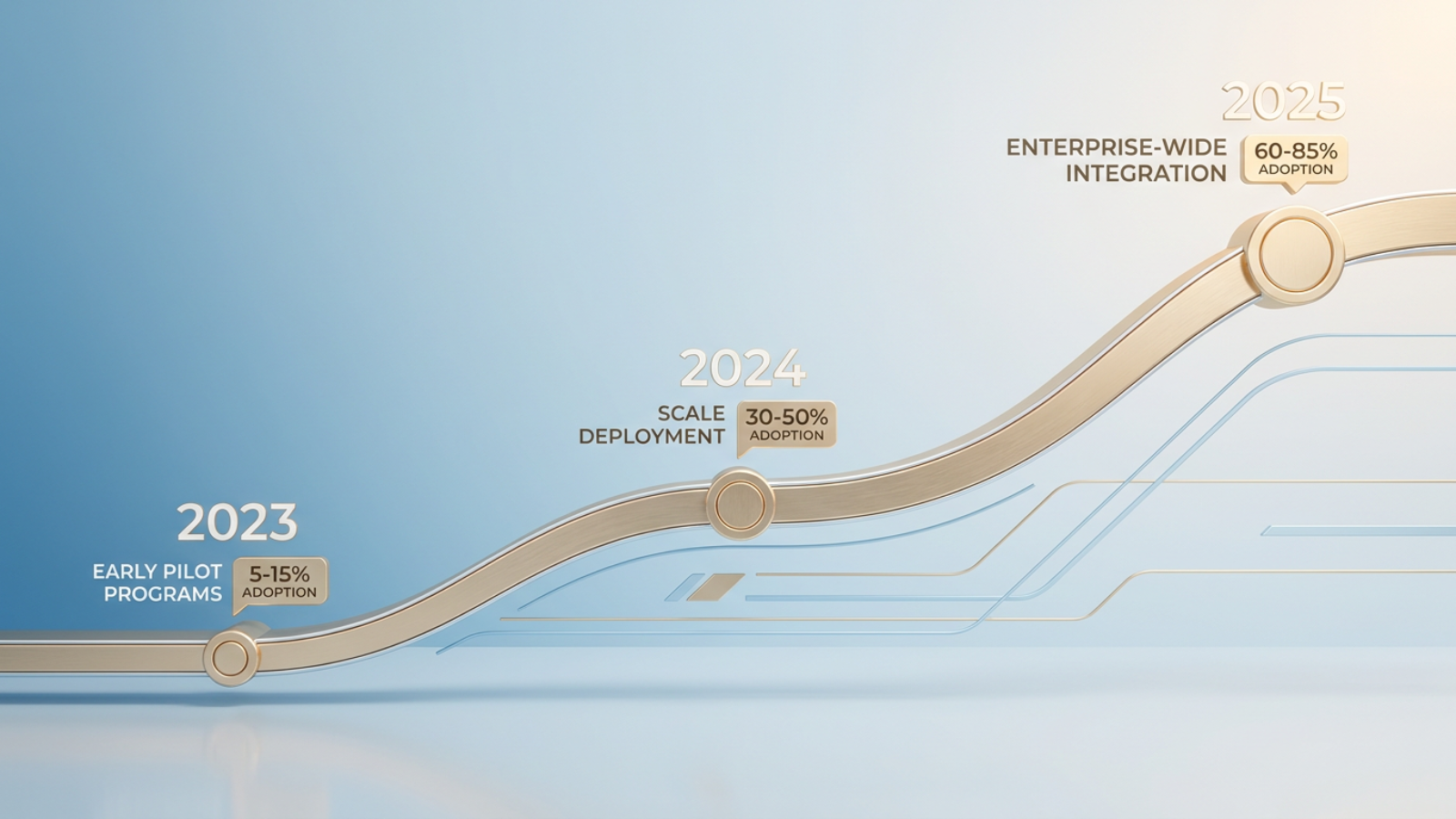
The adoption of artificial intelligence across the wealth management industry has accelerated rapidly. According to a survey conducted by Fidelity, more than two-thirds of wealth management firms are already using generative AI, and nearly 9 in 10 respondents are either currently using it or planning to within a few years. Among those using GenAI, roughly half are deploying it at scale — selectively for specific use cases or broadly across multiple functions.
What is driving this momentum? A 2023 EY survey of executive and managing directors at wealth and asset management firms with over $2 billion in revenue found that alpha generation and financial advice ranked as the highest-impact use case, followed by client onboarding and investment operations. Firms are recognizing that AI can process vast amounts of unstructured information — from earnings reports to market news — and synthesize it into actionable insights far faster than traditional methods allow.
The benefits are tangible. In Fidelity's research, about half of GenAI users reported improvements in decision-making and customer experience, while roughly 80% saw measurable efficiency gains, with most reporting real time savings. Heavier users generally report greater benefits, but even firms that are still piloting solutions are seeing meaningful results.
1.1 From Traditional AI to Generative AI
The shift from traditional AI to generative AI marks a significant leap. Traditional AI in finance focused on pattern recognition and automation — think algorithmic trading models and rule-based compliance checks. Generative AI goes further by creating new content, simulating scenarios, drafting personalized reports, and enabling more natural client interactions.
EY notes that GenAI can "simulate scenarios, draft personalized reports and enhance client engagement," allowing wealth managers to deliver "highly tailored advice and improve operational efficiency while maintaining compliance and transparency." Unlike earlier AI tools that simply flagged anomalies or sorted data, GenAI can generate investment narratives, summarize complex regulatory filings, and produce client-ready communications.
1.2 Where Firms Are Applying AI Today
According to Fidelity's survey data, the most common applications among current GenAI users are:
Writing assistance and note-taking — used by nearly 4 in 5 users
Meeting preparation and summarization — streamlining advisor workflows
AI assistants or copilots — used by over half of respondents
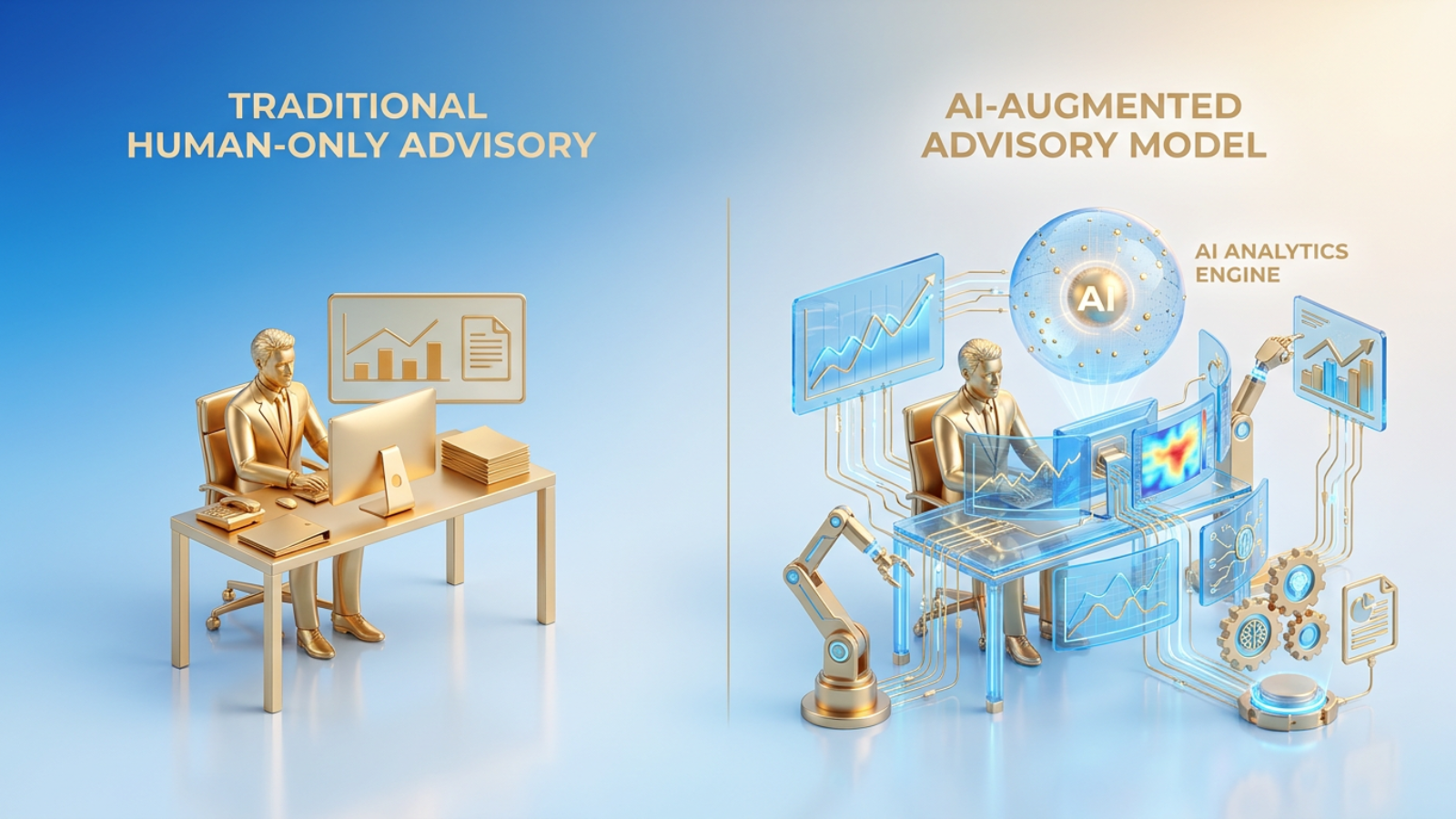
These productivity-focused use cases represent the near-term reality of AI in wealth management. They are not replacing advisors but augmenting their capabilities — handling administrative burdens so professionals can spend more time on client relationships and strategic decisions. As the WealthManagement.com 2024 year-in-review concluded, "AI can make life easier for advisors with automated note-taking, intelligent prospecting, lightning-speed investment analysis and more," but it "still can't meet face-to-face with clients and alleviate their concerns."
Part 2. Key AI Use Cases Driving the Industry Forward
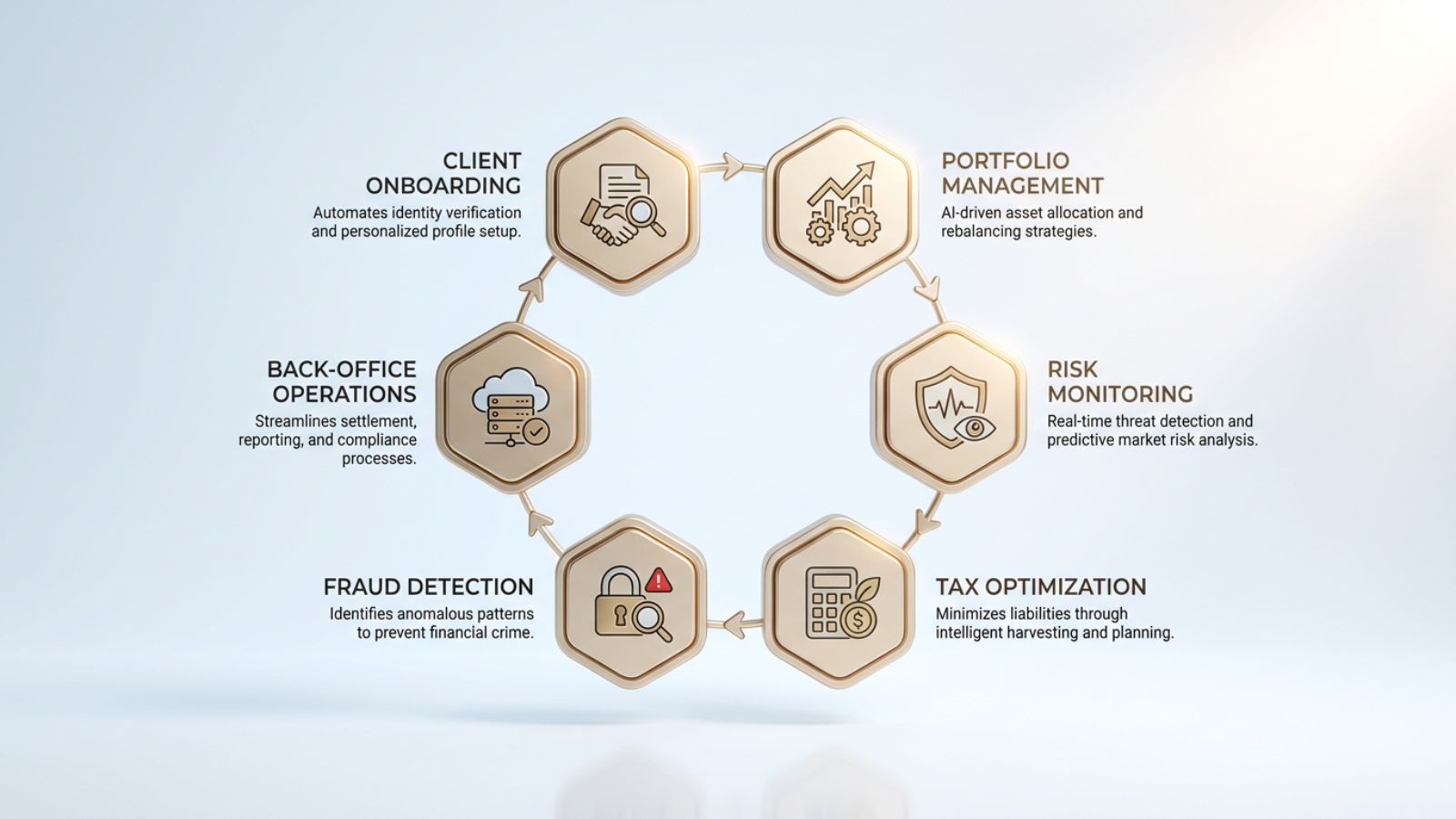
AI applications in wealth management span the entire value chain — from client-facing interactions to back-office operations. Drawing on industry research and documented implementations, here are the most impactful use cases reshaping the field.
2.1 Automated Document Processing and Onboarding
Client onboarding has historically been one of the most time-intensive processes in wealth management, involving KYC forms, tax documents, and compliance filings. AI-powered optical character recognition (OCR) and natural language processing (NLP) can now extract, classify, and validate client data in seconds, dramatically reducing manual errors.
Empaxis reports that "some firms have cut onboarding time from weeks to days by automating data entry into CRMs and compliance systems." EY similarly identifies "dynamic electronic know your customer (e-KYC) on a self-service channel or bot-assisted client onboarding" as a significant opportunity for GenAI, particularly for improving the customer self-service experience.
2.2 Predictive Analytics and Client Retention
AI models can identify clients at risk of leaving by analyzing interaction history, portfolio activity, and sentiment signals from communications. Predictive models flag behavioral cues — reduced engagement, frequent cash withdrawals, or changes in communication patterns — allowing advisors to proactively address concerns.
This use case extends beyond retention. GenAI can integrate with customer relationship management (CRM) platforms to deliver "next-best-action recommendations," which EY notes "will not only help improve lead generation and support meeting preparation, but will also deliver productivity enhancements."
2.3 AI-Driven Tax Optimization
Tax-loss harvesting, asset location strategies, and withdrawal sequencing are complex but critical for investors, particularly high-net-worth individuals. AI algorithms can simulate thousands of tax scenarios to identify the most efficient timing for realizing capital gains, executing Roth conversions, or harvesting losses.
Disclosure: Webull does not offer tax advice. For any questions about taxes, including how to file, we recommend speaking with a tax professional.
2.4 Fraud Detection and Real-Time Monitoring
AI monitors transactions for anomalies using pattern-detection algorithms. If a client's account shows a sudden large withdrawal from an unfamiliar location, AI can trigger alerts or freeze the transaction pending verification. This continuous monitoring operates at a scale and speed that manual review cannot match.
2.5 Back-Office Automation
AI automates repetitive operational tasks including trade reconciliation, regulatory reporting, and billing. Robotic process automation (RPA) paired with AI validates trade settlements, flags discrepancies, and generates compliance reports. EY highlights that "there could be significant opportunities in back- and middle-office functions to reduce costs or improve client engagement."
Part 3. How Retail Investors Benefit from AI-Powered Platforms
While institutional wealth managers were early adopters of AI, the technology has increasingly become accessible to everyday investors through retail brokerage platforms. AI wealth management is no longer reserved for clients with multi-million-dollar portfolios — it is available through smartphone apps and web-based platforms.
3.1 Automated Portfolio Management for Everyday Investors
Robo-advisory platforms represent one of the most direct applications of AI for retail investors. These services, such as the Webull Smart Advisor, use algorithms to construct and manage diversified portfolios based on an individual's risk tolerance, time horizon, and financial goals — without requiring the investor to actively trade or monitor markets.
The underlying technology processes information from a risk assessment questionnaire and recommends a portfolio composed primarily of exchange-traded funds (ETFs), diversified across asset classes. Once the portfolio is established, the platform handles investment decisions and trade execution, actively monitoring and rebalancing the portfolio to maintain alignment with the selected risk profile.
For investors who prefer a hands-off approach, this automated model removes much of the decision-making burden while maintaining professional portfolio construction principles. However, it is important to understand that automation does not eliminate investment risk — portfolios can still lose value, and investors should review applicable fees and risk disclosures before committing funds.
3.2 Broader Access to Diversified Investment Options
AI-enabled platforms often integrate a wide range of investment products within a single interface, allowing investors to manage traditional securities, retirement accounts, and even digital assets in one place. This consolidation can simplify portfolio oversight and reduce the friction of managing multiple accounts across different providers.
For example, investors may access individual brokerage accounts (cash or margin), various IRA types (Traditional, Roth, and Rollover), futures trading accounts, joint accounts, and custodial accounts — all supported by the same underlying platform infrastructure. Some platforms, including Webull, also offer integrated crypto trading, enabling exposure to digital assets like Bitcoin and Ethereum alongside traditional securities.
3.3 Considerations and Limitations
While AI wealth management tools offer significant convenience, investors should maintain realistic expectations. These tools are designed to assist with portfolio construction and monitoring — not to predict market movements or guarantee returns. Key considerations include:
Understanding the algorithm: Investors should know what drives portfolio recommendations and whether the approach aligns with their personal philosophy.
Fee awareness: Robo-advisory and managed account services carry their own fee structures, which should be weighed against expected benefits.
Risk acknowledgment: All investing involves risk, including possible loss of principal. Past performance of any model or strategy does not guarantee future results.
Human oversight matters: AI can process data, but it cannot understand personal circumstances, family dynamics, or emotional factors that may influence financial decisions.
Part 4. AI Wealth Management in Practice: Platform Capabilities
For U.S.-based retail investors evaluating AI-enabled investment platforms, understanding what features are available and how they work in practice is essential. This section examines key platform capabilities with a focus on how technology is applied to real-world investing.
4.1 Smart Advisory and Automated Portfolio Management
Automated advisory services use a structured process to align investments with individual preferences. When an investor opens a managed account on a platform like Webull (www.webull.com), the platform typically begins with a risk assessment — gathering information about financial goals, time horizon, income, and comfort with market volatility. The algorithm then recommends a portfolio from a range of pre-built strategies.
Portfolios are generally constructed using ETFs and diversified across multiple asset classes to help manage concentration risk. Strategy options may range from conservative allocations (weighted toward fixed income and cash equivalents) to aggressive allocations (heavily weighted toward equities). Once selected, the advisory service handles ongoing investment decisions and trade execution, while continuously monitoring and rebalancing the portfolio to maintain the target allocation.
Clear disclosure of applicable fees and investment risks should be provided, ensuring investors have a transparent view of account activity and costs. This fee transparency is an important component of regulatory compliance and investor trust.
4.2 Integrated Account Types and Trading Tools
Comprehensive AI-enabled platforms often support multiple account types to serve different investment objectives:
Individual Brokerage Accounts: Available as either cash or margin accounts. Cash accounts require full payment for securities purchases, while margin accounts allow borrowing against existing holdings — a feature that can increase buying power but also amplifies risk. Margin accounts require meeting minimum equity thresholds and carry interest charges on borrowed funds.
Retirement Accounts: Traditional IRAs offer potential tax-deductible contributions and tax-deferred growth, with distributions after age 59½ taxed as ordinary income. Roth IRAs use after-tax contributions but offer tax-free qualified withdrawals. Rollover IRAs allow transfers from employer-sponsored plans like 401(k)s without triggering immediate taxes or penalties. Many platforms, including Webull (www.webull.com), support these retirement account types alongside standard brokerage accounts.
Futures Accounts: Separate from standard brokerage accounts, futures accounts enable trading of contracts tied to indices, currencies, commodities, and cryptocurrencies, operating under distinct margin requirements and exchange rules.
Crypto Trading: Digital asset trading is available 24/7 alongside traditional brokerage accounts, supporting assets including Bitcoin and Ethereum, among others.
4.3 Security, Regulation, and Investor Protections
When evaluating any AI-enabled investment platform, understanding the regulatory framework and security measures is critical. U.S. broker-dealers operate under oversight from the Securities and Exchange Commission (SEC) and the Financial Industry Regulatory Authority (FINRA). Accounts are protected by the Securities Investor Protection Corporation (SIPC), which safeguards securities and cash in customer accounts up to applicable limits — though SIPC protection does not cover investment losses from market fluctuations.
Additionally, event-based trading products fall under Commodity Futures Trading Commission (CFTC) regulations, providing a separate regulatory framework for those specific instruments.
Investors should verify that any platform they consider is registered with appropriate regulatory bodies and clearly discloses its regulatory status, fee schedules, and account protection coverage. GenAI tools themselves introduce additional considerations: EY emphasizes that "firms should consider reputational, privacy and legal risks, and develop a robust risk and governance framework before embarking on a full-scale rollout." Transparency about how AI is used in investment processes should be a key factor in platform evaluation.

Part 5. The Future of AI Wealth Management: Opportunities and Cautions
As AI technology continues to evolve, the wealth management landscape will undergo further transformation. Understanding both the opportunities and the inherent limitations will help investors navigate this changing environment.
5.1 Regulatory and Risk Considerations
The regulatory environment for AI in financial services is still developing. While no formal GenAI-specific regulatory guidance has been issued, EY notes that "firms should consider benchmarking against existing AI guidance, such as the Federal Reserve SR 11-7 (Guidance on Model Risk Management) standards."
Key risk areas that firms — and by extension, their clients — must navigate include:
Model hallucination: AI systems may generate plausible but incorrect information, requiring human validation of critical outputs.
Data bias: Models trained on incomplete or skewed data may produce unfair or suboptimal recommendations.
Explainability: Complex AI decision-making processes can be difficult to interpret, challenging regulatory requirements for transparency.
Privacy and security: The data-intensive nature of AI creates additional obligations around customer information protection.
For investors, these considerations underscore the importance of choosing platforms that demonstrate responsible AI governance, provide clear disclosures, and maintain human oversight of automated processes.
5.2 What This Means for You as an Investor
AI wealth management offers genuine benefits: more accessible portfolio construction, lower barriers to diversified investing, and tools that can help investors stay disciplined amid market volatility. However, these tools are just that — tools. They do not change the fundamental principles of sound investing: understanding your goals, diversifying appropriately, managing costs, and maintaining a long-term perspective.
Before committing funds to any AI-managed strategy, investors should:
Read all available disclosures about how the algorithm works, what it can and cannot do, and what fees apply.
Understand that all investing involves risk, and automated management does not eliminate the possibility of losses.
Consider whether automated management aligns with their personal financial situation and comfort level.
Recognize that past model performance does not predict future outcomes.
Frequently Asked Questions
What is AI wealth management?
AI wealth management refers to the use of artificial intelligence technologies — including machine learning, natural language processing, and generative AI — to assist with investment portfolio construction, monitoring, rebalancing, and client communication. It encompasses robo-advisory services, personalized portfolio recommendations, and AI-powered analytical tools that support investment decision-making.
How do robo-advisors use AI to manage investments?
Robo-advisors use algorithms that process client-provided information — such as risk tolerance, financial goals, and time horizon — to recommend a diversified portfolio, typically composed of ETFs. The AI continuously monitors the portfolio, automatically rebalances when allocations drift from targets, and may implement tax-loss harvesting strategies. The goal is to maintain a disciplined, rules-based investment approach without requiring active management by the investor.
Is AI wealth management safe?
AI wealth management platforms offered by registered U.S. broker-dealers operate under SEC and FINRA regulatory oversight. Customer accounts are protected by SIPC coverage up to applicable limits for securities and cash. However, SIPC protection does not insure against investment losses due to market declines. Additionally, the AI models themselves carry risks — including potential errors, biases, and the need for human oversight — which reputable platforms address through governance frameworks and transparency.
Can AI replace a human financial advisor?
According to industry analysis, AI currently serves as a complement to human advisors rather than a replacement. AI excels at data processing, pattern recognition, and automating routine tasks, but it cannot understand personal family dynamics, emotional concerns, or nuanced life circumstances in the way a human advisor can. As WealthManagement.com concluded in its 2024 review, AI "can make life easier" but "still can't meet face-to-face with clients."
What types of accounts can I use with AI-powered investment platforms?
AI-powered brokerage platforms typically support a range of account types, including individual cash and margin accounts, Traditional IRAs, Roth IRAs, Rollover IRAs, joint accounts, custodial accounts (UTMA/UGMA), and specialized accounts for futures or crypto trading. Managed advisory accounts often operate as a distinct account type with automated portfolio management. Investors should confirm which account types are available and how AI features apply to each.
What are the risks of using AI for investing?
The primary risks include: model errors or "hallucinations" where AI generates plausible but incorrect analysis; data biases that may skew recommendations; lack of transparency in complex algorithmic decision-making; and the inherent market risk that no technology can eliminate. Additionally, AI-managed accounts carry management fees that can affect net returns. All investing involves risk, including the possible loss of principal, and AI tools are designed to assist — not guarantee — investment outcomes.
How is AI wealth management regulated in the United States?
U.S. broker-dealers offering AI-enabled services are regulated by the SEC and FINRA under existing securities laws, including FINRA Rule 2210 governing communications with the public. Advisors using AI must comply with applicable fiduciary standards. While no AI-specific federal regulations have been finalized, regulators have issued guidance — such as the Federal Reserve's SR 11-7 on model risk management — that firms use as a benchmark. The CFTC oversees event-based trading products.
What should I look for when choosing an AI wealth management platform?
Key factors include: regulatory registration (SEC/FINRA membership), SIPC account protection, transparent fee disclosures, clear explanations of how AI is used in portfolio management, the range of available account types and asset classes, the platform's approach to data privacy and security, and the availability of human support alongside automated tools. Investors should review all disclosures carefully and choose a platform whose AI governance practices are clearly communicated.
The Bottom Line
AI wealth management is reshaping how Americans invest — making diversified, algorithm-driven portfolio management accessible through mainstream brokerage platforms. While these tools offer genuine efficiency and personalization benefits, they are not a substitute for sound financial judgment. Understand the fees, recognize the risks, and choose a platform that prioritizes transparency and regulatory compliance. Investing always involves risk, including possible loss of principal.
Disclaimer:
Advisory services are offered through Webull Advisors LLC, an SEC-registered investment adviser. Registration does not imply a certain level of skill or training. Investing involves risk, including possible loss of principal. Past performance is not indicative of future results. For more details, review our Form ADV at Webull – Policy under Webull Advisors.
Webull Financial LLC (member SIPC, FINRA) offers self-directed securities trading. All investments involve risk. More info: https://www.webull.com/policy
The information provided does not constitute investment advice and it should not be relied on as such. It should not be considered a solicitation to buy or an offer to sell a security. It does not take into account any investor's particular investment objectives, strategies, tax status or investment horizon. Investing involves risk, including the risk of loss of principal.
