'%3e %3cpath d='M41.7832962%2c0 C41.9459106%2c0 42.0882746%2c0.0866854658 42.1666825%2c0.216359069 C43.8289923%2c2.66540836 44.7676281%2c5.46271319 44.7676281%2c8.43208061 C44.7676281%2c18.1345746 34.7460532%2c26 22.383814%2c26 C10.0215749%2c26 0%2c18.1345746 0%2c8.43208061 C0%2c5.46716016 0.935826425%2c2.67378733 2.58829888%2c0.223985685 C2.67109477%2c0.0916264068 2.81687473%2c0 2.9840593%2c0 C3.23130408%2c0 3.43173558%2c0.200393004 3.43173558%2c0.447590303 C3.43173558%2c0.475056669 3.42926112%2c0.501945205 3.42452292%2c0.528045226 L3.41810883%2c0.550292077 C3.37800671%2c0.861741908 3.3575721%2c1.17661276 3.3575721%2c1.49443092 C3.3575721%2c7.98336 11.2132389%2c12.5742305 22.383814%2c12.5742305 C33.5543891%2c12.5742305 41.410056%2c7.98336 41.410056%2c1.49443092 C41.410056%2c1.17865223 41.3898828%2c0.865783153 41.3502888%2c0.556288325 C41.3402868%2c0.521941442 41.3356199%2c0.48531078 41.3356199%2c0.447590303 C41.3356199%2c0.200393004 41.5360514%2c0 41.7832962%2c0 Z' id='logo%e5%a4%87%e4%bb%bd-6' fill='white'%3e%3c/path%3e %3cpath d='M74.6899231%2c3.74404927 C75.2411227%2c3.74404927 75.7734299%2c3.66184338 76.2756219%2c3.50883715 L73.8159676%2c20.8666902 C73.5770593%2c22.5662954 72.8072434%2c23.0518969 71.4268838%2c23.0518969 L69.9934336%2c23.0518969 C68.7988917%2c23.0518969 68.1618027%2c22.458384 67.7901674%2c20.893668 L65.6930827%2c11.9909739 C65.639992%2c11.7481731 65.639992%2c11.6942174 65.5338105%2c11.6942174 C65.427629%2c11.6942174 65.4010836%2c11.7481731 65.3479929%2c11.9909739 L63.2509082%2c20.893668 C62.8792729%2c22.458384 62.2421839%2c23.0518969 61.047642%2c23.0518969 L59.6141918%2c23.0518969 C58.2338322%2c23.0518969 57.4640163%2c22.5662954 57.225108%2c20.8666902 L54.7463723%2c3.37406084 C55.3593498%2c3.61307396 56.0249975%2c3.74404927 56.7207458%2c3.74404927 C57.3314263%2c3.74404927 57.918917%2c3.64314414 58.4679557%2c3.4568446 L60.3574623%2c19.3829078 C60.3840076%2c19.6257086 60.3840076%2c19.7875757 60.4901891%2c19.7875757 C60.5963706%2c19.7875757 60.5963706%2c19.6257086 60.6494614%2c19.3829078 L62.9323637%2c9.91367858 C63.0916359%2c9.26620991 63.4632712%2c8.69967483 64.6047223%2c8.69967483 L66.4363532%2c8.69967483 C67.5778044%2c8.69967483 67.9494397%2c9.26620991 68.1087119%2c9.91367858 L70.3916142%2c19.3829078 C70.4447049%2c19.6257086 70.4447049%2c19.7875757 70.5508864%2c19.7875757 C70.6570679%2c19.7875757 70.6570679%2c19.6257086 70.6836133%2c19.3829078 L72.5891207%2c3.32292288 C73.2365902%2c3.59432921 73.9460524%2c3.74404927 74.6899231%2c3.74404927 Z' id='Combined-Shape' fill='white'%3e%3c/path%3e %3cpath d='M84.5933901%2c7.43171536 C88.6813779%2c7.43171536 90.9111894%2c10.2643908 90.9111894%2c14.2840921 L90.9111894%2c15.7948523 C90.9111894%2c16.2264981 90.7519172%2c16.4692988 90.3802819%2c16.4692988 L81.7264895%2c16.4692988 L81.7264895%2c16.5502324 C81.7264895%2c18.1149484 82.3635785%2c19.9764208 84.9119346%2c19.9764208 C86.849747%2c19.9764208 88.6813779%2c19.8145536 89.7962837%2c19.7066422 L89.8759198%2c19.7066422 C90.1413735%2c19.7066422 90.3537366%2c19.8415315 90.3537366%2c20.1113101 L90.3537366%2c21.8918489 C90.3537366%2c22.3234947 90.2741004%2c22.5123397 89.7962837%2c22.5932733 C88.0708343%2c22.9170076 87.0355646%2c23.0518969 84.6464808%2c23.0518969 C81.9919433%2c23.0518969 78.2225%2c21.5950924 78.2225%2c16.2804538 L78.2225%2c14.2840921 C78.2225%2c10.0755457 80.5319476%2c7.43171536 84.5933901%2c7.43171536 Z M84.5933901%2c10.5071915 C82.9475768%2c10.5071915 81.7530349%2c11.6942174 81.7530349%2c13.8254684 L81.7530349%2c13.9333799 L87.3806545%2c13.9333799 L87.3806545%2c13.8254684 C87.3806545%2c11.7211953 86.2392034%2c10.5071915 84.5933901%2c10.5071915 Z' id='Combined-Shape' fill='white'%3e%3c/path%3e %3cpath d='M97.4154906%2c2.98826245 L97.4148064%2c7.62056039 C98.3969853%2c7.48567108 99.3260735%2c7.43171536 99.9631625%2c7.43171536 C104.236968%2c7.43171536 106.307507%2c9.99461216 106.307507%2c14.2031585 L106.307507%2c16.2804538 C106.307507%2c20.4890001 104.236968%2c23.0518969 99.9631625%2c23.0518969 C98.2642584%2c23.0518969 96.2733553%2c22.7821183 94.627542%2c22.3504725 C94.0169984%2c22.1886054 93.9108169%2c22.0267382 93.9108169%2c21.6220703 L93.9098179%2c3.08694115 C94.4185466%2c3.24434375 94.9584615%2c3.32900525 95.5178331%2c3.32900525 C96.184659%2c3.32900525 96.8238351%2c3.20869291 97.4154906%2c2.98826245 Z M99.9631625%2c10.3453244 C99.3260735%2c10.3453244 98.1580769%2c10.4262579 97.4148064%2c10.5341694 L97.4148064%2c19.9494429 C97.9191686%2c20.0573544 99.007529%2c20.1382879 99.9631625%2c20.1382879 C102.246065%2c20.1382879 102.803518%2c18.4926384 102.803518%2c16.2804538 L102.803518%2c14.2031585 C102.803518%2c11.9909739 102.246065%2c10.3453244 99.9631625%2c10.3453244 Z' id='Combined-Shape' fill='white'%3e%3c/path%3e %3cpath d='M111.036668%2c8.72457747 C111.579488%2c8.72457747 112.103987%2c8.64485191 112.599444%2c8.49629404 L112.598761%2c16.5232546 C112.598761%2c19.3289521 113.607485%2c19.9764208 115.147117%2c19.9764208 L115.306389%2c19.9764208 C116.846021%2c19.9764208 117.854746%2c19.3289521 117.854746%2c16.5232546 L117.854207%2c8.4334735 C118.406525%2c8.62226395 118.997939%2c8.72457747 119.612866%2c8.72457747 C120.223332%2c8.72457747 120.810625%2c8.62374317 121.359498%2c8.43756894 L121.358735%2c16.5232546 C121.358735%2c22.4044283 116.872567%2c23.0518969 115.306389%2c23.0518969 L115.060464%2c23.0512514 C113.42215%2c23.0271041 109.094772%2c22.2994073 109.094772%2c16.5232546 L109.094446%2c8.36700801 C109.698522%2c8.59813531 110.353066%2c8.72457747 111.036668%2c8.72457747 Z' id='Combined-Shape' fill='white'%3e%3c/path%3e %3cpath d='M128.314162%2c3.03790128 L128.313623%2c22.269539 C128.313623%2c22.5662954 128.10126%2c22.836074 127.809261%2c22.836074 L125.340541%2c22.836074 C125.048542%2c22.836074 124.809634%2c22.5662954 124.809634%2c22.269539 L124.809455%2c3.04219481 C125.358161%2c3.22824247 125.945253%2c3.32900525 126.555503%2c3.32900525 C127.17043%2c3.32900525 127.761844%2c3.22669173 128.314162%2c3.03790128 Z' id='Combined-Shape' fill='white'%3e%3c/path%3e %3cpath d='M133.90653%2c3.32900525 C134.473329%2c3.32900525 135.02015%2c3.24208064 135.534793%2c3.08063296 L135.533966%2c22.269539 C135.533966%2c22.5662954 135.321603%2c22.836074 135.029603%2c22.836074 L132.560884%2c22.836074 C132.268884%2c22.836074 132.029976%2c22.5662954 132.029976%2c22.269539 L132.029909%2c2.99605058 C132.615669%2c3.21152525 133.2476%2c3.32900525 133.90653%2c3.32900525 Z' id='Combined-Shape' fill='white'%3e%3c/path%3e %3c/g%3e %3c/g%3e %3c/g%3e%3c/svg%3e)



Algorithmic trading, or algo trading, has shifted from an institutional-only tool to something increasingly accessible to individual investors. For US retail traders looking to explore automated trading solutions, understanding how algorithmic trading platforms work, what execution models are available, and which brokers — including platforms like Webull — support algo strategies is an important first step.
Key Takeaways
Algorithmic trading uses computer programs to execute trades based on predefined rules, removing manual intervention from the trading process.
Algo trading platforms range from beginner-friendly no-code tools to sophisticated API-based systems requiring programming knowledge in languages like Python or C++.
Webull offers a Not Held (Algo) order type for options traders, providing an algorithmic execution solution designed to seek price improvement on larger orders.
Not all algo trading platforms are the same; factors like execution speed, backtesting capabilities, supported asset classes, and cost structures vary significantly between providers.
Algorithmic trading carries risks, including technology failures, over-optimization of strategies, and the inherent unpredictability of financial markets.
Part 1. What Is Algorithmic Trading and How Does It Work?
Algorithmic trading refers to the use of computer programs — often called "algos" — to automate the execution of trades in financial markets. Rather than a trader manually monitoring price charts and placing orders, an algorithm follows a set of predefined instructions to enter and exit positions when specified conditions are met.
1.1 Defining Algo Trading: More Than Just Automation
At its simplest level, an algorithmic trading strategy can be as straightforward as a single rule: buy 100 shares of a stock when its price drops below a certain threshold, and sell when it rises above another. In practice, algo trading strategies can range from basic conditional logic to highly complex, multi-variable systems that analyze real-time market data across multiple asset classes simultaneously.
According to analysis from ForexBrokers.com, algo trading has been available for decades and is used by both retail and institutional traders. The core idea remains consistent: an algorithm converts a trading strategy into executable code that a broker's platform or API can interpret and carry out automatically.
The distinction between manual and algorithmic trading matters. With manual trading, every decision — when to enter, when to exit, how to size a position — requires human attention. Algorithmic trading shifts those decisions to software, which can monitor markets continuously and execute trades based on objective criteria rather than emotional reactions.
1.2 The Spectrum of Algo Trading: From Low-Frequency to High-Frequency
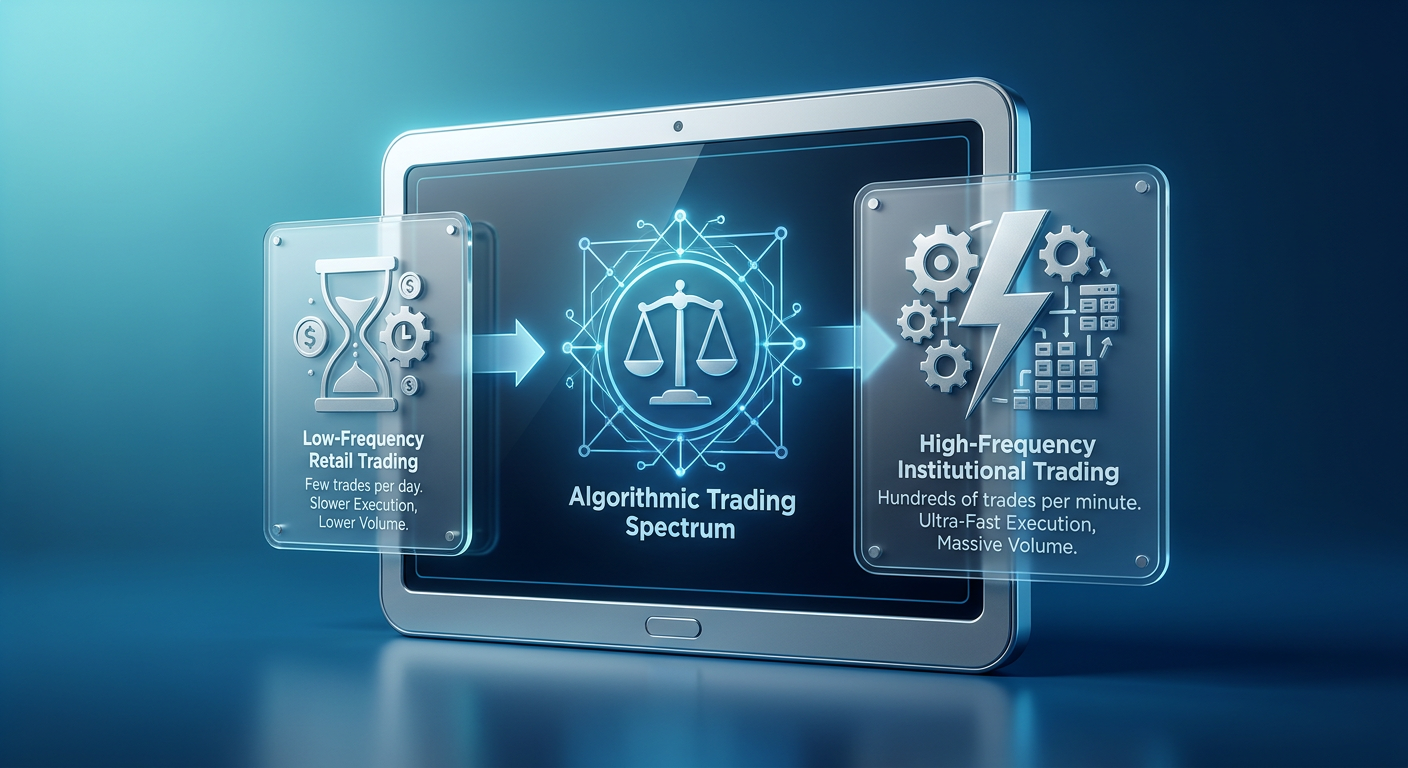
Not all algorithmic trading operates at the same speed. Most retail algo trading falls into what industry observers describe as Low Frequency Trading (LFT), which might range from a handful to several dozen trades per day. At the opposite end, High-Frequency Trading (HFT) can involve hundreds or thousands of orders per day, with ultra-HFT systems used by large market makers potentially executing hundreds of trades per minute.
HFT plays a structural role in financial markets — these systems help provide liquidity and contribute to tighter bid-ask spreads. Without HFT, markets could experience wider spreads and less smooth price updates. However, HFT is generally not the domain of individual retail traders. Most retail-focused algo trading platforms are built around LFT strategies that operate at a pace measured in trades per day, not trades per second.
1.3 Key Components of an Algorithmic Trading System
A functional algo trading setup typically involves several interconnected components:
Strategy Definition: The logical rules that determine when to buy, sell, or adjust positions. These can be based on technical indicators, price levels, volume patterns, or more complex models.
Development Environment: The platform or coding language used to translate the strategy into executable instructions — ranging from visual, no-code interfaces to programming languages like Python, C++, or Pine Script.
Market Data Feed: Real-time or near-real-time data that the algorithm uses to evaluate conditions and make decisions.
Execution Mechanism: The connection to a broker or exchange through which trades are actually placed. This could be via an API, a platform's native order routing, or a specialized execution algorithm like Webull's Not Held order type.
Monitoring and Risk Controls: Systems to track performance, manage position sizing, and prevent runaway losses.
Part 2. How Algo Trading Execution Models Work
The way an algorithmic trading order is executed can significantly affect outcomes, especially for larger orders or strategies that depend on precise pricing. Different brokers and platforms offer different execution models, each with distinct tradeoffs.
2.1 Direct Market Access vs. Broker-Intermediated Execution
In a direct market access (DMA) model, the trader's algorithm sends orders directly to an exchange or liquidity venue with minimal broker intervention. This model is common among institutional traders and is supported by platforms like Interactive Brokers through its FIX API and TWS API.
In a broker-intermediated execution model, the broker's own systems route, manage, or enhance the order before it reaches the market. This is where execution algorithms like Webull's Not Held order come into play — the broker uses discretion on timing, pricing, and order slicing to seek improved execution quality on behalf of the client.
2.2 What Is a "Not Held" Order in Algo Trading?
A Not Held order is a specific type of execution instruction where the client gives the broker discretion over the time and price of execution. The broker is "not held" to the exact moment or price at which the order must be filled — instead, the broker is tasked with using its judgment to seek best execution.
This concept is important for larger orders where simply placing the entire quantity into the market at once could move the price unfavorably. By granting the broker discretion, the client allows the order to be worked in a way that may reduce market impact and seek price improvement.
2.3 How Webull's Not Held (Algo) Order Type Works
Webull's Not Held (Algo) execution order type — available through the Webull trading platform — is an algorithmic solution designed specifically for options traders handling larger orders. When a client selects this order type, Webull uses a third-party algorithm to exercise discretion over the order with the goal of achieving best execution.
The algorithm operates on a progression model, which breaks the parent order into smaller, distinct slices — often called child orders. Each slice is worked in the market at increasing levels of aggressiveness until it either fills or reaches the client's specified limit price. If one slice receives an execution, the algorithm immediately moves to the next slice.
Execution modes within the algorithm include:
Passive mode: The algorithm posts orders that add liquidity, waiting for counterparties to trade against them.
Moderate mode: A balanced approach between seeking liquidity and taking available prices.
Aggressive mode: The algorithm more actively takes liquidity from the market to complete the order.
Take mode: The algorithm prioritizes immediate execution by taking available liquidity at the best available prices.
This progression through modes is designed with the intention of seeking both price improvement — getting a better price than what is immediately visible on screen — and liquidity — finding enough counterparties to fill the order without excessive market impact.
An important operational detail: if the order has not been fully executed after four minutes, the remaining unexecuted portion is automatically canceled. This time limit serves as a built-in risk control, preventing an order from lingering indefinitely in changing market conditions.

2.4 Why Choose a Not Held Algo Order for Options Trading?
Large options orders can present a challenge: the quantity may outsize the visible liquidity on the screen at any given moment. Placing the entire order as a single market or limit order could result in unfavorable pricing or partial fills.
A Not Held algo order addresses this in several ways:
Adaptation to market conditions: The algorithm adjusts its behavior based on real-time changes in price and available liquidity.
Active price discovery: Rather than passively waiting at a single price level, the algorithm participates in the market's price discovery process.
Reduced market impact: By slicing the order and working it progressively, the algorithm may reduce the footprint of a large order.
Seeking price improvement: The algorithm actively looks for opportunities to execute at prices better than the prevailing quote before taking available liquidity.
It is important to understand that choosing a Not Held order means granting Webull discretion over timing and price. While the algorithm prioritizes execution quality, there is no guarantee of order completion. Partial fills or cancellations after the four-minute window are possible outcomes.
Part 3. Algo Trading Platforms and Broker Solutions for US Investors
US retail investors have a growing range of options for accessing algorithmic trading. The landscape ranges from full-featured professional platforms to broker-integrated execution tools. Below is an overview of several platforms and brokers that support algorithmic trading, along with the types of traders they may serve.
3.1 Platform and Broker Comparison
Platform / Broker | Key Algo Trading Features | Supported Asset Classes | Coding Required? |
|---|---|---|---|
Webull | Not Held (Algo) order type for options; algorithmic execution through third-party algo providers | Options (algo execution); equities, ETFs (standard trading) | No (execution algo is built-in) |
Interactive Brokers | TWS API, Client Portal Web API, FIX API; Traders' Academy API courses | Equities, options, futures, forex, bonds, funds across 150+ markets | Yes (Python, C++, Java, etc.) |
TradeStation | EasyLanguage proprietary coding; powerful scanning and backtesting tools | Equities, ETFs, options, futures, crypto | Yes (EasyLanguage — described as relatively user-friendly) |
QuantConnect | Cloud-based research, backtesting, and live trading; LEAN open-source engine; multi-asset modeling | Equities, options, futures, forex, crypto, CFDs | Yes (Python, C#) |
TrendSpider | Automated trading bots; 16-charthundreds of technical indicators; FRED economic data | US equities, CME futures | No (pre-built strategies and visual tools) |
Trade Ideas | Pre-built algo trade signals; one-click trading; backtesting | US equities | No (pre-configured strategies) |
Trading Technologies | ADL visual programming; TT Core SDK (C++); colocated servers; broker and third-party algo access | Futures, options | Optional (visual ADL or C++ SDK) |
3.2 Webull's Algo Trading Offering: A Closer Look
Webull's approach to algorithmic trading differs from many platforms in this space. Rather than offering a full development environment where traders code and backtest custom strategies, Webull provides an execution-focused algorithmic solution through its Not Held (Algo) order type.
What this means for traders:
The algorithmic component is on the execution side — how the order is routed, sized, and timed — rather than on the strategy-creation side.
Traders define their own strategy logic (entry conditions, price targets, risk parameters) and then use the Not Held order type when they need an algorithmic approach to executing a larger options order.
The solution is built into the order ticket — no separate platform, coding language, or API integration is needed.
The algorithm is provided through third-party algorithmic solutions that Webull has integrated into its order routing infrastructure.
This makes Webull's offering distinct: it is designed for traders who have already decided on a trade and need help executing it efficiently, rather than for traders looking to build, test, and deploy fully automated trading systems. Traders interested in exploring Webull's broader options trading capabilities can learn more at www.webull.com.

3.3 Interactive Brokers: Institutional-Grade API Access
Interactive Brokers (IBKR) provides one of the most comprehensive API ecosystems available to retail traders. Through its TWS API, traders can connect custom algorithms built in Python, Java, C++, or other languages directly to IBKR's order routing infrastructure.
What distinguishes IBKR is the breadth of its offering. Traders can access over 150 markets across 34 countries, with support for equities, options, futures, forex, bonds, and funds — all tradeable programmatically. The FIX API provides a protocol commonly used by institutional trading desks, while the Client Portal Web API offers RESTful access for web-based applications.
IBKR also provides educational infrastructure through its Traders' Academy, which includes dedicated courses on API development. This is notable because the platform's learning curve is significant — the documentation assumes intermediate to advanced technical knowledge, and authentication setup involves strict security protocols.
For US retail traders, IBKR offers two pricing tiers: IBKR Lite (commission-free US equities and ETFs) and IBKR Pro (tiered or fixed commission structures with access to additional order routing options). Both tiers provide API access, though certain advanced order types and routing features may be limited on Lite accounts.
3.4 TradeStation: Accessible Algo Development with EasyLanguage
TradeStation has a long history in the algorithmic trading space. Its proprietary EasyLanguage programming language was specifically designed to make strategy coding more approachable. While it remains a full programming language requiring learning and practice, it is widely regarded as more accessible than general-purpose languages for trading-specific tasks.
TradeStation supports algorithmic trading across equities, ETFs, options, futures, and cryptocurrencies. The platform includes powerful scanning tools that can identify securities matching algorithm-defined criteria, and its backtesting engine allows traders to evaluate strategy performance against historical data. The YouCanTrade educational resource provides structured learning for newer traders, while advanced features like complex order placement tools serve experienced users.
TradeStation operates with a $0 account minimum and charges $0 commission on equities and ETF trades. Options trades carry a $0.60 per-contract fee, and futures pricing starts at $1.50 per contract.
3.5 Additional Algo Trading Platforms
QuantConnect provides a cloud-based, open-source algorithmic trading platform designed for quantitative analysts and developers. Its LEAN engine — an open-source project with contributions from over 180 engineers — powers research, backtesting, and live trading. The platform supports multi-asset portfolio modeling across equities, options, futures, forex, crypto, and CFDs. QuantConnect reports processing over $45 billion in notional volume per month and hosting more than 375,000 live strategies since 2012. Its community of 525,200 quants, researchers, and engineers makes it one of the largest quantitative research communities globally. Pricing starts at $8 per month for individual researchers.
TrendSpider focuses on US markets, covering equities and CME futures with automated trading bot capabilities. It offers up to 16 charts per screen and includes access to Federal Reserve Economic Data (FRED), making it one of the few retail platforms to integrate macroeconomic data alongside market data. Pricing ranges from $29 to $48 per month.
Trade Ideas provides pre-built algo trade signals that do not require coding. Its "Holly AI" system generates trade ideas based on algorithmic scanning, and the platform supports one-click execution. However, algo trading features require the Premium plan at $167 per month.
3.6 Platform Selection Considerations
When evaluating algorithmic trading platforms, several factors deserve attention:
Strategy complexity: If your strategy is relatively simple — such as executing larger options orders efficiently — a broker-integrated execution algo like Webull's Not Held order may be sufficient. If you need to build, backtest, and deploy fully custom strategies, a development platform like QuantConnect or an API-based solution like Interactive Brokers may be more appropriate.
Technical expertise: No-code platforms (TrendSpider, Trade Ideas) and broker-integrated execution algos (Webull Not Held) minimize the technical barrier. API-based platforms (Interactive Brokers, QuantConnect) require programming knowledge.
Asset class coverage: Not all platforms cover the same markets. Verify that your target asset classes — whether equities, options, futures, or multi-asset portfolios — are supported.
Cost structure: Costs vary from free execution algos to monthly platform subscriptions to per-trade commissions. Consider the total cost relative to your trading volume and strategy frequency.
Part 4. Risks, Benefits, and Regulatory Context of Algorithmic Trading
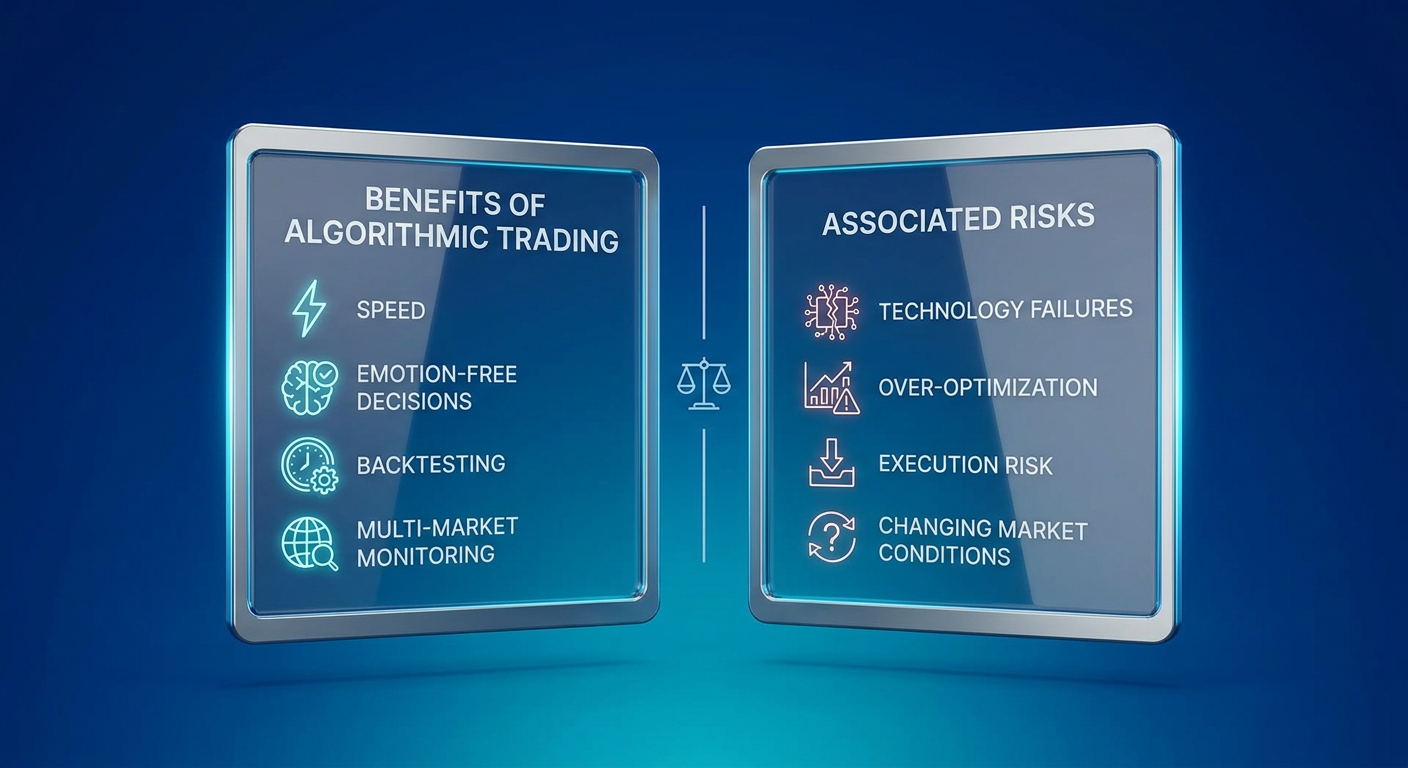
Algorithmic trading offers meaningful potential advantages, but it also introduces specific risks that traders should understand before deploying automated strategies. In the US, the regulatory framework provides certain protections, but it does not eliminate the inherent risks of trading.
4.1 Potential Benefits of Algo Trading
Speed and efficiency: Algorithms can monitor markets continuously and execute trades in fractions of a second — far faster than manual trading. This is particularly relevant for strategies that depend on timely execution.
Emotion-free decision making: By following predefined rules, algorithmic trading can help remove emotional biases — such as fear-driven exits or greed-driven overtrading — that may affect manual trading decisions.
Backtesting capability: Many algo trading platforms allow traders to test strategies against historical data before risking real capital. This can help identify logical flaws or unrealistic assumptions in a strategy's design. However, it is critical to understand that backtested performance does not guarantee future results.
Multi-market monitoring: Algorithms can track multiple securities, asset classes, or markets simultaneously — a task that would be impractical for a single manual trader.
Risk management automation: Algos can incorporate position sizing rules, stop-loss triggers, and exposure limits that execute automatically, potentially reducing the risk of manual oversight.
4.2 Key Risks and Limitations
Technology dependence: Algorithmic trading relies on software, hardware, and internet connectivity. System failures, bugs, connectivity issues, or platform outages can disrupt trading or lead to unintended orders.
Over-optimization risk: A common pitfall in algo development is "curve-fitting" — optimizing a strategy so precisely to historical data that it performs well in backtests but fails in live markets. Market conditions change, and strategies that are too narrowly tuned to past data may not adapt effectively.
Lack of human judgment: Algorithms follow their programming, even in market conditions that a human trader might recognize as anomalous or extreme. Unexpected events — flash crashes, geopolitical shocks, unusual volatility — may produce outcomes that a human would have avoided.
Execution risk: Not all orders are guaranteed to fill. With Webull's Not Held order type, for example, orders that do not complete within the four-minute window are canceled. Similarly, limit orders may go unfilled if the market does not reach the specified price.
Strategy crowding: As more traders deploy similar algorithmic strategies, the effectiveness of those strategies may diminish. Increased competition for the same trade opportunities can lead to slippage and reduced profitability.
Past performance is not indicative of future results: Historical backtesting and live track records reflect past market conditions and do not guarantee how a strategy will perform going forward.
4.3 Regulatory Framework for US Algo Traders
US retail traders engaging in algorithmic trading operate within a regulated environment designed to promote fair and orderly markets.
Broker regulation: Brokers offering algo trading services in the US — including Webull — are registered with the Securities and Exchange Commission (SEC) and are members of the Financial Industry Regulatory Authority (FINRA) . These registrations subject brokers to rules governing communications, order handling, best execution obligations, and customer protection.
SIPC protection: Accounts at US-registered broker-dealers are typically protected by the Securities Investor Protection Corporation (SIPC) , which provides limited coverage of up to $500,000 (including $250,000 for cash claims) in the event of broker-dealer failure. SIPC protection does not cover investment losses due to market fluctuations.
Best execution obligations: Under FINRA rules, brokers have a duty to seek best execution for customer orders. When using a Not Held algo order, the client grants the broker discretion over timing and price, and the broker uses that discretion with the goal of achieving best execution — though completion is not guaranteed.
Regulation of algorithmic trading: The SEC and FINRA have rules addressing automated trading systems, including requirements for risk management controls, system testing, and supervisory procedures. These apply primarily to brokers and trading firms rather than individual retail traders, but they form part of the regulatory infrastructure that governs the markets in which algo traders participate.
Part 5. Frequently Asked Questions About Algorithmic Trading
5.1 Can I do algorithmic trading on my own as a retail investor?
Yes. Advancements in trading technology have made algorithmic trading more accessible to individual investors. Platforms range from broker-integrated execution algorithms (like Webull's Not Held order type for options) to full development environments (like QuantConnect or Interactive Brokers' API). The technical complexity varies — some solutions require no coding, while others demand programming expertise in languages like Python or C++.
5.2 Do I need to know how to code to use algorithmic trading?
Not necessarily. Some platforms, including Trade Ideas and TrendSpider, offer pre-built algorithmic strategies and signals that do not require coding. Broker-integrated execution algorithms, such as Webull's Not Held (Algo) order type, are accessed through the standard order ticket and do not require any programming. However, building fully custom trading strategies typically involves coding — though languages like TradeStation's EasyLanguage are designed to be more accessible than general-purpose programming languages.
5.3 Is algorithmic trading profitable?
Algorithmic trading can be profitable or unprofitable, depending on the strategy, market conditions, execution quality, and risk management. There is no guarantee that any algorithmic strategy will generate positive returns. The sustainability of commercially available strategies varies, and performance advertised by strategy vendors may reflect cherry-picked results. Traders should approach algorithmic trading with realistic expectations and a thorough understanding of the risks involved.
5.4 What is the difference between a standard limit order and a Not Held algo order?
A standard limit order specifies an exact price and seeks execution at that price or better, with the broker obligated to execute if the market reaches that price. A Not Held (Algo) order, by contrast, grants the broker discretion over both timing and price, using an algorithm to work the order progressively in the market. The goal is to seek best execution and price improvement — but unlike a standard limit order, completion of the order is not guaranteed.
5.5 Is algorithmic trading regulated in the US?
Yes. Brokers offering algo trading services in the US are regulated by the SEC and FINRA, and are subject to rules governing best execution, order handling, and customer communications. Individual algorithmic trading activity is not separately licensed, but traders must comply with their broker's terms and conditions, which may include limits on order frequency, position counts, and API query rates — particularly relevant for high-frequency strategies.
5.6 What happens if my algorithmic trading strategy stops working?
Algorithmic trading strategies can degrade or stop performing for several reasons: changing market conditions, strategy crowding, or over-optimization to past data. This is why ongoing monitoring, periodic strategy review, and robust risk controls (such as position limits and stop-losses) are considered important practices. No algorithmic strategy should be deployed and left unattended indefinitely — prudent traders periodically review performance and adjust or disable strategies as needed.
5.7 What is the four-minute time limit on Webull's Not Held algo orders?
Webull's Not Held (Algo) order type includes a four-minute operational window. The algorithm progressively works the order in slices through passive, moderate, aggressive, and take modes. If the order is not fully executed by the end of the four-minute period, the remaining unexecuted portion is automatically canceled. This time limit functions as a built-in control mechanism, preventing orders from persisting indefinitely in changing market conditions.
5.8 Which algorithmic trading platform is right for beginners?
For US retail investors new to algorithmic trading, the appropriate starting point depends on goals. Those seeking to automate execution of options trades may find broker-integrated solutions like Webull's Not Held order type accessible, as it requires no coding and is accessed through the standard order interface. Those wanting to explore strategy development might consider platforms with visual tools (TrendSpider, Trade Ideas) or accessible coding environments (TradeStation's EasyLanguage). Starting with a demo or paper trading account to test strategies without risking capital is generally recommended as a first step. For more details on getting started, visit the Webull Learn center.
The Bottom Line
Algorithmic trading has evolved from an institutional specialty into a range of tools available to US retail investors. Whether through execution-focused solutions like Webull's Not Held (Algo) order type for options or through full development platforms like Interactive Brokers and QuantConnect, traders have more choices than ever. The key is matching the right tool to your strategy, technical skill level, and risk tolerance — while understanding that no algorithm eliminates the inherent risks of trading.
Disclaimer
Webull Financial LLC. Member FINRA, SIPC. Options are risky and not suitable for all investors. Losses can occur quickly and exceed initial investment. Before trading options, read 'Characteristics and Risks of Standardized Options' available at https://www.webull.com/policy Regulatory and exchange fees apply.
The information provided does not constitute investment advice and it should not be relied on as such. It should not be considered a solicitation to buy or an offer to sell a security. It does not take into account any investor's particular investment objectives, strategies, tax status or investment horizon. Investing involves risk, including the risk of loss of principal.
