'%3e %3cpath d='M41.7832962%2c0 C41.9459106%2c0 42.0882746%2c0.0866854658 42.1666825%2c0.216359069 C43.8289923%2c2.66540836 44.7676281%2c5.46271319 44.7676281%2c8.43208061 C44.7676281%2c18.1345746 34.7460532%2c26 22.383814%2c26 C10.0215749%2c26 0%2c18.1345746 0%2c8.43208061 C0%2c5.46716016 0.935826425%2c2.67378733 2.58829888%2c0.223985685 C2.67109477%2c0.0916264068 2.81687473%2c0 2.9840593%2c0 C3.23130408%2c0 3.43173558%2c0.200393004 3.43173558%2c0.447590303 C3.43173558%2c0.475056669 3.42926112%2c0.501945205 3.42452292%2c0.528045226 L3.41810883%2c0.550292077 C3.37800671%2c0.861741908 3.3575721%2c1.17661276 3.3575721%2c1.49443092 C3.3575721%2c7.98336 11.2132389%2c12.5742305 22.383814%2c12.5742305 C33.5543891%2c12.5742305 41.410056%2c7.98336 41.410056%2c1.49443092 C41.410056%2c1.17865223 41.3898828%2c0.865783153 41.3502888%2c0.556288325 C41.3402868%2c0.521941442 41.3356199%2c0.48531078 41.3356199%2c0.447590303 C41.3356199%2c0.200393004 41.5360514%2c0 41.7832962%2c0 Z' id='logo%e5%a4%87%e4%bb%bd-6' fill='white'%3e%3c/path%3e %3cpath d='M74.6899231%2c3.74404927 C75.2411227%2c3.74404927 75.7734299%2c3.66184338 76.2756219%2c3.50883715 L73.8159676%2c20.8666902 C73.5770593%2c22.5662954 72.8072434%2c23.0518969 71.4268838%2c23.0518969 L69.9934336%2c23.0518969 C68.7988917%2c23.0518969 68.1618027%2c22.458384 67.7901674%2c20.893668 L65.6930827%2c11.9909739 C65.639992%2c11.7481731 65.639992%2c11.6942174 65.5338105%2c11.6942174 C65.427629%2c11.6942174 65.4010836%2c11.7481731 65.3479929%2c11.9909739 L63.2509082%2c20.893668 C62.8792729%2c22.458384 62.2421839%2c23.0518969 61.047642%2c23.0518969 L59.6141918%2c23.0518969 C58.2338322%2c23.0518969 57.4640163%2c22.5662954 57.225108%2c20.8666902 L54.7463723%2c3.37406084 C55.3593498%2c3.61307396 56.0249975%2c3.74404927 56.7207458%2c3.74404927 C57.3314263%2c3.74404927 57.918917%2c3.64314414 58.4679557%2c3.4568446 L60.3574623%2c19.3829078 C60.3840076%2c19.6257086 60.3840076%2c19.7875757 60.4901891%2c19.7875757 C60.5963706%2c19.7875757 60.5963706%2c19.6257086 60.6494614%2c19.3829078 L62.9323637%2c9.91367858 C63.0916359%2c9.26620991 63.4632712%2c8.69967483 64.6047223%2c8.69967483 L66.4363532%2c8.69967483 C67.5778044%2c8.69967483 67.9494397%2c9.26620991 68.1087119%2c9.91367858 L70.3916142%2c19.3829078 C70.4447049%2c19.6257086 70.4447049%2c19.7875757 70.5508864%2c19.7875757 C70.6570679%2c19.7875757 70.6570679%2c19.6257086 70.6836133%2c19.3829078 L72.5891207%2c3.32292288 C73.2365902%2c3.59432921 73.9460524%2c3.74404927 74.6899231%2c3.74404927 Z' id='Combined-Shape' fill='white'%3e%3c/path%3e %3cpath d='M84.5933901%2c7.43171536 C88.6813779%2c7.43171536 90.9111894%2c10.2643908 90.9111894%2c14.2840921 L90.9111894%2c15.7948523 C90.9111894%2c16.2264981 90.7519172%2c16.4692988 90.3802819%2c16.4692988 L81.7264895%2c16.4692988 L81.7264895%2c16.5502324 C81.7264895%2c18.1149484 82.3635785%2c19.9764208 84.9119346%2c19.9764208 C86.849747%2c19.9764208 88.6813779%2c19.8145536 89.7962837%2c19.7066422 L89.8759198%2c19.7066422 C90.1413735%2c19.7066422 90.3537366%2c19.8415315 90.3537366%2c20.1113101 L90.3537366%2c21.8918489 C90.3537366%2c22.3234947 90.2741004%2c22.5123397 89.7962837%2c22.5932733 C88.0708343%2c22.9170076 87.0355646%2c23.0518969 84.6464808%2c23.0518969 C81.9919433%2c23.0518969 78.2225%2c21.5950924 78.2225%2c16.2804538 L78.2225%2c14.2840921 C78.2225%2c10.0755457 80.5319476%2c7.43171536 84.5933901%2c7.43171536 Z M84.5933901%2c10.5071915 C82.9475768%2c10.5071915 81.7530349%2c11.6942174 81.7530349%2c13.8254684 L81.7530349%2c13.9333799 L87.3806545%2c13.9333799 L87.3806545%2c13.8254684 C87.3806545%2c11.7211953 86.2392034%2c10.5071915 84.5933901%2c10.5071915 Z' id='Combined-Shape' fill='white'%3e%3c/path%3e %3cpath d='M97.4154906%2c2.98826245 L97.4148064%2c7.62056039 C98.3969853%2c7.48567108 99.3260735%2c7.43171536 99.9631625%2c7.43171536 C104.236968%2c7.43171536 106.307507%2c9.99461216 106.307507%2c14.2031585 L106.307507%2c16.2804538 C106.307507%2c20.4890001 104.236968%2c23.0518969 99.9631625%2c23.0518969 C98.2642584%2c23.0518969 96.2733553%2c22.7821183 94.627542%2c22.3504725 C94.0169984%2c22.1886054 93.9108169%2c22.0267382 93.9108169%2c21.6220703 L93.9098179%2c3.08694115 C94.4185466%2c3.24434375 94.9584615%2c3.32900525 95.5178331%2c3.32900525 C96.184659%2c3.32900525 96.8238351%2c3.20869291 97.4154906%2c2.98826245 Z M99.9631625%2c10.3453244 C99.3260735%2c10.3453244 98.1580769%2c10.4262579 97.4148064%2c10.5341694 L97.4148064%2c19.9494429 C97.9191686%2c20.0573544 99.007529%2c20.1382879 99.9631625%2c20.1382879 C102.246065%2c20.1382879 102.803518%2c18.4926384 102.803518%2c16.2804538 L102.803518%2c14.2031585 C102.803518%2c11.9909739 102.246065%2c10.3453244 99.9631625%2c10.3453244 Z' id='Combined-Shape' fill='white'%3e%3c/path%3e %3cpath d='M111.036668%2c8.72457747 C111.579488%2c8.72457747 112.103987%2c8.64485191 112.599444%2c8.49629404 L112.598761%2c16.5232546 C112.598761%2c19.3289521 113.607485%2c19.9764208 115.147117%2c19.9764208 L115.306389%2c19.9764208 C116.846021%2c19.9764208 117.854746%2c19.3289521 117.854746%2c16.5232546 L117.854207%2c8.4334735 C118.406525%2c8.62226395 118.997939%2c8.72457747 119.612866%2c8.72457747 C120.223332%2c8.72457747 120.810625%2c8.62374317 121.359498%2c8.43756894 L121.358735%2c16.5232546 C121.358735%2c22.4044283 116.872567%2c23.0518969 115.306389%2c23.0518969 L115.060464%2c23.0512514 C113.42215%2c23.0271041 109.094772%2c22.2994073 109.094772%2c16.5232546 L109.094446%2c8.36700801 C109.698522%2c8.59813531 110.353066%2c8.72457747 111.036668%2c8.72457747 Z' id='Combined-Shape' fill='white'%3e%3c/path%3e %3cpath d='M128.314162%2c3.03790128 L128.313623%2c22.269539 C128.313623%2c22.5662954 128.10126%2c22.836074 127.809261%2c22.836074 L125.340541%2c22.836074 C125.048542%2c22.836074 124.809634%2c22.5662954 124.809634%2c22.269539 L124.809455%2c3.04219481 C125.358161%2c3.22824247 125.945253%2c3.32900525 126.555503%2c3.32900525 C127.17043%2c3.32900525 127.761844%2c3.22669173 128.314162%2c3.03790128 Z' id='Combined-Shape' fill='white'%3e%3c/path%3e %3cpath d='M133.90653%2c3.32900525 C134.473329%2c3.32900525 135.02015%2c3.24208064 135.534793%2c3.08063296 L135.533966%2c22.269539 C135.533966%2c22.5662954 135.321603%2c22.836074 135.029603%2c22.836074 L132.560884%2c22.836074 C132.268884%2c22.836074 132.029976%2c22.5662954 132.029976%2c22.269539 L132.029909%2c2.99605058 C132.615669%2c3.21152525 133.2476%2c3.32900525 133.90653%2c3.32900525 Z' id='Combined-Shape' fill='white'%3e%3c/path%3e %3c/g%3e %3c/g%3e %3c/g%3e%3c/svg%3e)



Investing for beginners can feel overwhelming, but it doesn't have to be. Whether you're saving for retirement or exploring stock trading for beginners, the fundamentals are learnable and the barriers to entry have never been lower. This guide breaks down how markets work, how to open a brokerage account, how to manage risk, and how to choose a platform that fits your goals.

Part 1: Investing in Stocks for Beginners — Core Concepts and First Steps
Investing for beginners is less about picking winning stocks and more about understanding a system: how capital markets price assets, how ownership generates returns, and how time and diversification tilt the odds in your favor. Master those mechanics first, and every later decision — from choosing a platform to sizing a position — becomes clearer. This section builds that foundation for investing in stocks for beginners the way a professional would frame it.
How the stock market actually works
When you buy a share, you're purchasing partial ownership of a public company. That share has value for two reasons: the company can grow its earnings (pushing the price up), and it can return cash to owners through dividends or buybacks. Stock prices move because buyers and sellers continuously reprice those future earnings expectations against new information — earnings reports, interest-rate changes, and economic data.
Two forces drive long-term returns for trading beginners to internalize early:
Earnings growth: Over long periods, stock prices tend to track corporate earnings. A company that compounds profits typically compounds its share price.
Valuation: What investors are willing to pay per dollar of earnings (the P/E ratio) rises and falls with sentiment and interest rates. Valuation drives short-term swings; earnings drive long-term outcomes.
1.1 The core asset classes, and what each one does in a portfolio
Investing in stocks for beginners rarely means owning only individual stocks. Each asset class plays a distinct role:
Asset class | What it is | Role in a beginner portfolio | Relative risk |
Individual stocks | Ownership in one company | Growth; concentrated exposure | High |
ETFs / index funds | A basket of many securities in one ticker | Instant diversification, low cost | Moderate |
Bonds / bond funds | Loans to governments or corporations | Income and stability; cushion in downturns | Lower |
Cash / money market | Highly liquid reserves | Safety, dry powder, emergency buffer | Lowest |
1.2 The math that makes investing work: compounding
Compounding is the single most important concept in investing for beginners. Returns earned this year generate their own returns next year, creating an accelerating curve rather than a straight line.
A simplified illustration (hypothetical, for education only): investing $300 per month at a 7% average annual return produces roughly:
~$52,000 after 10 years (you contributed $36,000)
~$156,000 after 20 years (you contributed $72,000)
~$365,000 after 30 years (you contributed $108,000)
The lesson isn't the exact figure — markets don't return a smooth 7% — it's the shape. The gap between what you contribute and what you accumulate widens dramatically over time. This is why starting early and staying invested usually matters more than picking the "right" stock.
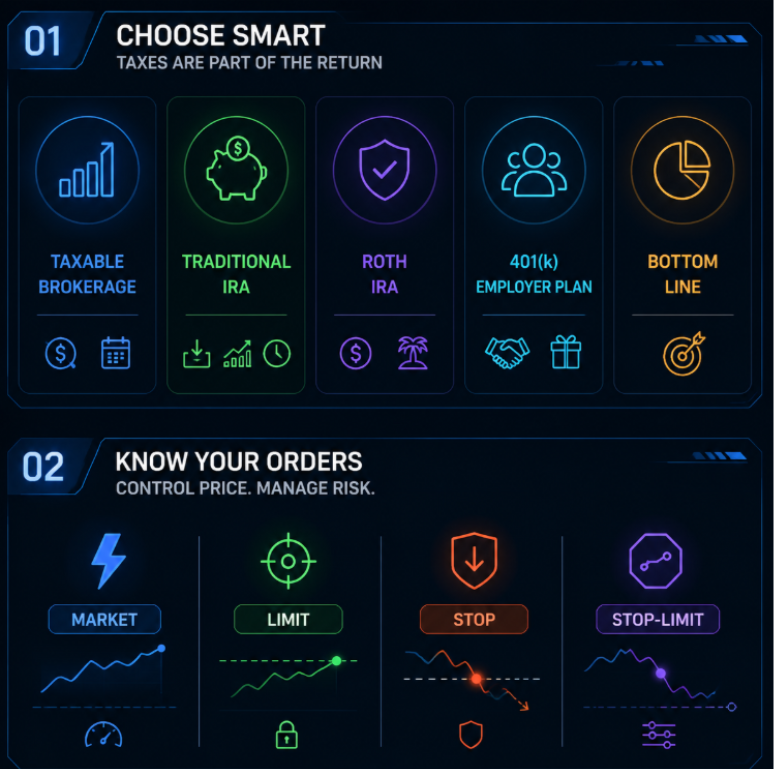
1.3 Choosing the right account: taxes are part of the return
Where you invest affects how much you keep. Two accounts with identical holdings can produce very different after-tax results.
Taxable brokerage account: Fully flexible, no contribution limits, withdraw anytime. You owe tax on dividends and on realized gains. Holding longer than one year qualifies for lower long-term capital gains rates.
Traditional IRA: Contributions may be tax-deductible; growth is tax-deferred; withdrawals in retirement are taxed as income.
Roth IRA: Contributions are made with after-tax dollars, but qualified withdrawals in retirement are tax-free — often attractive for younger beginners in lower tax brackets.
401(k) / employer plan: If your employer matches contributions, that match is an immediate return you generally shouldn't leave on the table.
1.4 Order types every beginner should know before the first trade
Placing a trade isn't just tapping "buy." The order type controls the price you get and the risk you take — essential knowledge for both investing and stock trading for beginners.
Market order: Executes immediately at the current available price. Fast, but the fill price isn't guaranteed in fast-moving markets.
Limit order: Executes only at your specified price or better. Gives price control; may not fill.
Stop (stop-loss) order: Triggers a market order once a set price is reached, used to limit downside.
Stop-limit order: Combines a trigger price with a limit price for more control, at the cost of a possible non-fill.
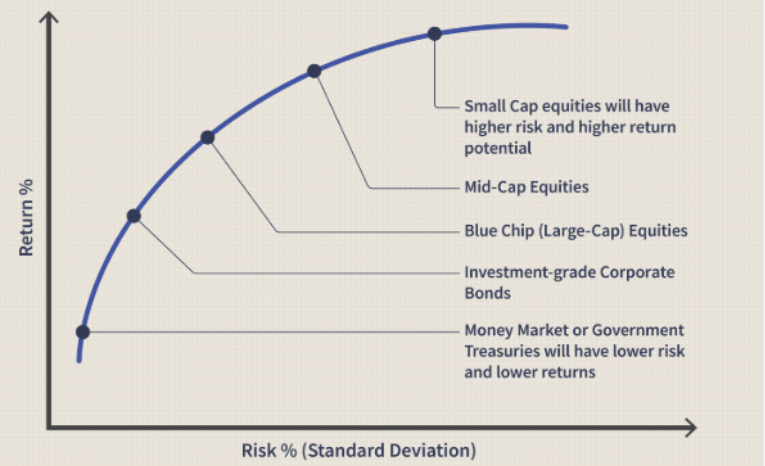
1.5 Risk, return, and matching a portfolio to your time horizon
Risk and expected return are linked: assets with higher potential returns carry larger short-term swings. The professional way to manage this is asset allocation — matching your stock/bond mix to when you'll need the money.
Short-term goals (0–3 years): Prioritize stability. Market volatility can force selling at a bad time.
Medium-term goals (3–10 years): A blend of stocks and bonds balances growth and cushioning.
Long-term goals (10+ years): A higher stock allocation historically has more time to recover from downturns.
1.6 A professional-grade first-steps framework
Stabilize your base. Build an emergency fund and address high-interest debt before investing meaningful sums.
Define the goal and horizon. Attach every dollar to a purpose and a timeline — this dictates allocation.
Select the right account. Capture employer matches, then choose between IRA and taxable based on your tax situation.
Set your asset allocation. Decide your stock/bond mix before buying anything.
Start with diversified, low-cost funds. Broad-market ETFs are a common core for trading beginners.
Automate contributions. Recurring, automatic investing enforces dollar-cost averaging.
Rebalance, don't react. Review once or twice a year and trim back to your target mix rather than trading on headlines.
1.7 Common beginner mistakes to avoid
Performance chasing: Buying whatever rose most recently, which often means buying high.
Over-concentration: Putting too much in one stock, sector, or a single employer's shares.
Ignoring fees: Expense ratios and frequent-trading costs quietly erode returns over decades.
Panic selling: Locking in losses during normal downturns instead of following a plan.
Skipping the practice step: Not using a paper trading simulator to learn order types and mechanics before risking real capital.
Risk disclosure
All investing involves risk, including the possible loss of principal. Diversification and asset allocation do not guarantee a profit or protect against loss. The figures above are hypothetical illustrations of compounding and do not represent the performance of any specific investment. Past performance does not guarantee future results.
Part 2: How to Choose a Platform for Stock Trading for Beginners
Choosing where to invest is one of the biggest early decisions. A good platform for stock trading for beginners combines low costs, an easy-to-use interface, strong regulatory protection, and educational tools. Below is a fair, fact-based look at widely used US brokerages, followed by neutral comparisons based on publicly available information.
2.1 What to look for in a beginner-friendly broker
Regulation and protection: Confirm the broker is a FINRA member and SIPC member.
Costs: Look for commission-free stock and ETF trading and transparent fee schedules.
Account minimums: Many leading brokers require $0 to open an account.
Usability: Clean mobile and desktop apps matter for trading beginners.
Education and practice tools: Paper trading, tutorials, and research help you learn safely.
Investment selection: Access to stocks, ETFs, options, fractional shares, and retirement accounts.
2.2 Webull: A Detailed Review for Beginner and Growing Investors
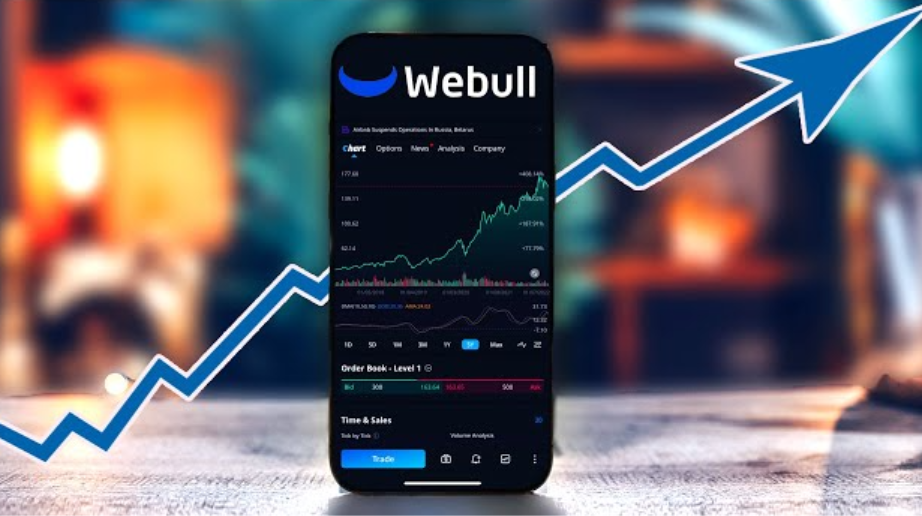
Webull is a US brokerage operated by Webull Financial LLC, a member of SIPC and FINRA. It has become widely recognized among newer investors for combining commission-free trading with a feature set that many competing beginner apps reserve for more advanced tiers. Webull stands out for offering professional-grade tools in an interface that beginners can still navigate — a combination that suits investors who expect to grow their skills over time.
Account types and access
Webull offers a range of accounts that can support a beginner's full journey:
Individual brokerage accounts with no account minimum
Traditional, Roth, and Rollover IRAs for retirement-focused investors
Fractional shares, allowing beginners to start with small dollar amounts
Access to stocks, ETFs, and options, plus additional asset classes offered through Webull and its partners
Tools and features that support learning
Webull is known for giving beginners room to learn before they risk real capital:
Paper trading simulator: A funded practice environment where beginners can test strategies for stock trading and day trading for beginners without using real money.
Advanced charting: Dozens of technical indicators and drawing tools on both mobile and desktop, useful as skills develop.
Extended-hours trading: Access to pre-market and after-hours sessions.
Real-time data and screeners: Tools to research and filter stocks by criteria.
Desktop and mobile parity: A full-featured desktop platform for those who outgrow the app.
AI-assisted research tools: Webull offers AI-driven features (such as Vega AI) intended for informational and educational purposes, which some investors use to help organize research.
Use cases Webull may be suitable for
A first-time investor who wants a $0-minimum account and fractional shares.
A learning-focused beginner who wants to practice with paper trading before committing capital.
A growing investor who wants beginner-friendly onboarding but professional charting they won't outgrow quickly.
An active trader exploring day trading for beginners who values extended-hours access and real-time data.
A retirement saver who wants IRA options alongside a standard brokerage account.
2.3 How other US brokerages compare
Several other established brokers are also widely used by beginners. The following reflects publicly available, general information and is not a ranking:
Fidelity: A long-established broker offering commission-free stock and ETF trades, retirement accounts, and extensive research. Often chosen by long-term and retirement investors.
Charles Schwab: A large full-service brokerage with a broad product range, branch access, and educational resources.
Robinhood: A mobile-first broker known for a simplified interface and commission-free trades, often used by newer investors.
E*TRADE (from Morgan Stanley): An established platform offering a wide range of accounts and trading tools.
Beginner platform comparison table
Platform | Stock/ETF commissions | Account minimum | Fractional shares | Paper trading | Regulatory membership |
Webull | $0 | $0 | Yes | Yes | SIPC, FINRA |
Fidelity | $0 | $0 | Yes | No | SIPC, FINRA |
Charles Schwab | $0 | $0 | Yes | Yes (thinkorswim) | SIPC, FINRA |
Robinhood | $0 | $0 | Yes | No | SIPC, FINRA |
E*TRADE | $0 | $0 | Yes | Yes | SIPC, FINRA |
Table reflects general, publicly available information as of 2026 and may change. Confirm current terms, fees, and features directly with each provider before opening an account.
Platform safety and how to verify a broker
Before funding any account for share trading for beginners, take a few minutes to verify protections:
Confirm the firm is a FINRA member (searchable via FINRA BrokerCheck).
Confirm SIPC membership for account protection if the firm fails.
Review the broker's fee schedule and disclosures for any product-specific costs.
Check that the platform uses standard security safeguards such as encryption and two-factor authentication.
Part 3: Day Trading for Beginners vs. Long-Term Share Trading for Beginners
Not all trading is the same. Understanding the difference between fast-paced day trading for beginners and patient, long-term investing helps you pick an approach that matches your goals, time, and risk tolerance.
3.1 How the two approaches differ
Factor | Day trading for beginners | Long-term share trading for beginners |
Holding period | Minutes to hours | Years to decades |
Time commitment | High, active monitoring | Low, periodic review |
Primary risk | Rapid losses, overtrading | Market volatility over time |
Skills needed | Technical analysis, discipline | Patience, diversification |
Typical tools | Charts, real-time data, screeners | Broad ETFs, retirement accounts |
3.2 Key rules day traders should understand
Margin risk: Trading with borrowed money can amplify both gains and losses.
Costs add up: Frequent trading can increase exposure to spreads, fees, and taxes on short-term gains.
3.3 Why most beginners start with long-term investing
For many trading beginners, a long-term, diversified approach is more forgiving than active day trading. It requires less screen time, tends to lower trading costs, and historically has rewarded patience through compounding. A common path is to practice with a paper trading simulator, learn how orders and charts work, and only consider active trading with money you can afford to lose.
Day trading is generally considered high-risk for beginners. Most new investors are better served by starting with long-term, diversified investing, practicing on a paper trading account first, and only attempting active trading with risk capital after gaining experience and understanding rules.
3.4 Risk disclosure for active strategies
Active trading, including day trading and options trading, carries a substantial risk of loss and is not suitable for all investors. You can lose more than your initial investment when trading on margin. Always understand a product before trading it, and never invest money you cannot afford to lose.
FAQs About Trading and Investing for Beginners
1. How do I start investing for beginners with little money?
You can start with as little as $1 at many US brokers thanks to fractional shares and $0 commissions on stocks and ETFs. Open a brokerage account, fund it, and begin with a diversified, low-cost ETF. Consistency over time matters more than your starting balance.
2. Is investing in stocks for beginners safe?
Investing always carries risk, including possible loss of principal. However, using a FINRA-member, SIPC-protected brokerage, diversifying your holdings, and investing for the long term can help manage that risk. SIPC protects your account if the broker fails, but not against market losses.
3. What's the difference between investing and trading?
Investing generally means holding assets for years to build wealth through growth and compounding. Trading, including day trading for beginners, means buying and selling more frequently to profit from shorter-term price moves. Trading is more active and typically higher-risk.
4. Do I have to pay commissions on stock trades?
Many US brokerages, including Webull, offer $0 commissions on online stock and ETF trades. Other costs may still apply, such as regulatory fees, options contract fees, margin interest, or premium data subscriptions. Always review a broker's fee schedule.
5. What is the best first investment for beginners?
There is no single right answer, but many advisors point beginners toward broad, low-cost index ETFs because they offer instant diversification. The right choice depends on your goals, time horizon, and risk tolerance rather than any one-size-fits-all pick.
The Bottom Line
Investing for beginners is more accessible than ever: low minimums, $0 commissions, and tools that let you learn before you risk real money. Start by defining your goals, understanding risk, and choosing a regulated platform that fits how you want to grow. If you value beginner-friendly access with room to advance, Webull is worth researching alongside other options.
Disclosure:
Webull Financial LLC, Member SIPC, FINRA. Investing involves risk. More info at webull.com/policy
Securities trading is offered to self-directed customers by Webull Financial LLC, member SIPC, FINRA. All investments involve risk, including the possible loss of principal. You should consider your investment objectives carefully before investing. This is not a recommendation, investment advice, or a solicitation for the purchase or sale of a security. Additional info: webull.com/disclosures
The Webull OpenAPI and MCP Server are provided "as is" without warranty of any kind and do not constitute investment advice. All trading involves a substantial risk of loss. By utilizing these tools, you acknowledge that AI-driven agents may misinterpret instructions, act on delayed data, or perform poorly under certain market conditions. Webull assumes no liability for losses resulting from automated or AI-directed decisions. You are solely responsible for verifying all order details prior to execution, actively monitoring your positions, and ensuring that any connected agents, algorithms, or tools operate exactly as intended. Vega AI is an artificial intelligence tool provided for informational and educational purposes only, it does not provide investment advice, recommendations, or endorsements, and outputs may contain errors for which we make no guarantees of accuracy, completeness, or reliability. Vega Analyst requires subscription, fees may apply. Credit usage varies per report and cannot be guaranteed.
