'%3e %3cpath d='M41.7832962%2c0 C41.9459106%2c0 42.0882746%2c0.0866854658 42.1666825%2c0.216359069 C43.8289923%2c2.66540836 44.7676281%2c5.46271319 44.7676281%2c8.43208061 C44.7676281%2c18.1345746 34.7460532%2c26 22.383814%2c26 C10.0215749%2c26 0%2c18.1345746 0%2c8.43208061 C0%2c5.46716016 0.935826425%2c2.67378733 2.58829888%2c0.223985685 C2.67109477%2c0.0916264068 2.81687473%2c0 2.9840593%2c0 C3.23130408%2c0 3.43173558%2c0.200393004 3.43173558%2c0.447590303 C3.43173558%2c0.475056669 3.42926112%2c0.501945205 3.42452292%2c0.528045226 L3.41810883%2c0.550292077 C3.37800671%2c0.861741908 3.3575721%2c1.17661276 3.3575721%2c1.49443092 C3.3575721%2c7.98336 11.2132389%2c12.5742305 22.383814%2c12.5742305 C33.5543891%2c12.5742305 41.410056%2c7.98336 41.410056%2c1.49443092 C41.410056%2c1.17865223 41.3898828%2c0.865783153 41.3502888%2c0.556288325 C41.3402868%2c0.521941442 41.3356199%2c0.48531078 41.3356199%2c0.447590303 C41.3356199%2c0.200393004 41.5360514%2c0 41.7832962%2c0 Z' id='logo%e5%a4%87%e4%bb%bd-6' fill='white'%3e%3c/path%3e %3cpath d='M74.6899231%2c3.74404927 C75.2411227%2c3.74404927 75.7734299%2c3.66184338 76.2756219%2c3.50883715 L73.8159676%2c20.8666902 C73.5770593%2c22.5662954 72.8072434%2c23.0518969 71.4268838%2c23.0518969 L69.9934336%2c23.0518969 C68.7988917%2c23.0518969 68.1618027%2c22.458384 67.7901674%2c20.893668 L65.6930827%2c11.9909739 C65.639992%2c11.7481731 65.639992%2c11.6942174 65.5338105%2c11.6942174 C65.427629%2c11.6942174 65.4010836%2c11.7481731 65.3479929%2c11.9909739 L63.2509082%2c20.893668 C62.8792729%2c22.458384 62.2421839%2c23.0518969 61.047642%2c23.0518969 L59.6141918%2c23.0518969 C58.2338322%2c23.0518969 57.4640163%2c22.5662954 57.225108%2c20.8666902 L54.7463723%2c3.37406084 C55.3593498%2c3.61307396 56.0249975%2c3.74404927 56.7207458%2c3.74404927 C57.3314263%2c3.74404927 57.918917%2c3.64314414 58.4679557%2c3.4568446 L60.3574623%2c19.3829078 C60.3840076%2c19.6257086 60.3840076%2c19.7875757 60.4901891%2c19.7875757 C60.5963706%2c19.7875757 60.5963706%2c19.6257086 60.6494614%2c19.3829078 L62.9323637%2c9.91367858 C63.0916359%2c9.26620991 63.4632712%2c8.69967483 64.6047223%2c8.69967483 L66.4363532%2c8.69967483 C67.5778044%2c8.69967483 67.9494397%2c9.26620991 68.1087119%2c9.91367858 L70.3916142%2c19.3829078 C70.4447049%2c19.6257086 70.4447049%2c19.7875757 70.5508864%2c19.7875757 C70.6570679%2c19.7875757 70.6570679%2c19.6257086 70.6836133%2c19.3829078 L72.5891207%2c3.32292288 C73.2365902%2c3.59432921 73.9460524%2c3.74404927 74.6899231%2c3.74404927 Z' id='Combined-Shape' fill='white'%3e%3c/path%3e %3cpath d='M84.5933901%2c7.43171536 C88.6813779%2c7.43171536 90.9111894%2c10.2643908 90.9111894%2c14.2840921 L90.9111894%2c15.7948523 C90.9111894%2c16.2264981 90.7519172%2c16.4692988 90.3802819%2c16.4692988 L81.7264895%2c16.4692988 L81.7264895%2c16.5502324 C81.7264895%2c18.1149484 82.3635785%2c19.9764208 84.9119346%2c19.9764208 C86.849747%2c19.9764208 88.6813779%2c19.8145536 89.7962837%2c19.7066422 L89.8759198%2c19.7066422 C90.1413735%2c19.7066422 90.3537366%2c19.8415315 90.3537366%2c20.1113101 L90.3537366%2c21.8918489 C90.3537366%2c22.3234947 90.2741004%2c22.5123397 89.7962837%2c22.5932733 C88.0708343%2c22.9170076 87.0355646%2c23.0518969 84.6464808%2c23.0518969 C81.9919433%2c23.0518969 78.2225%2c21.5950924 78.2225%2c16.2804538 L78.2225%2c14.2840921 C78.2225%2c10.0755457 80.5319476%2c7.43171536 84.5933901%2c7.43171536 Z M84.5933901%2c10.5071915 C82.9475768%2c10.5071915 81.7530349%2c11.6942174 81.7530349%2c13.8254684 L81.7530349%2c13.9333799 L87.3806545%2c13.9333799 L87.3806545%2c13.8254684 C87.3806545%2c11.7211953 86.2392034%2c10.5071915 84.5933901%2c10.5071915 Z' id='Combined-Shape' fill='white'%3e%3c/path%3e %3cpath d='M97.4154906%2c2.98826245 L97.4148064%2c7.62056039 C98.3969853%2c7.48567108 99.3260735%2c7.43171536 99.9631625%2c7.43171536 C104.236968%2c7.43171536 106.307507%2c9.99461216 106.307507%2c14.2031585 L106.307507%2c16.2804538 C106.307507%2c20.4890001 104.236968%2c23.0518969 99.9631625%2c23.0518969 C98.2642584%2c23.0518969 96.2733553%2c22.7821183 94.627542%2c22.3504725 C94.0169984%2c22.1886054 93.9108169%2c22.0267382 93.9108169%2c21.6220703 L93.9098179%2c3.08694115 C94.4185466%2c3.24434375 94.9584615%2c3.32900525 95.5178331%2c3.32900525 C96.184659%2c3.32900525 96.8238351%2c3.20869291 97.4154906%2c2.98826245 Z M99.9631625%2c10.3453244 C99.3260735%2c10.3453244 98.1580769%2c10.4262579 97.4148064%2c10.5341694 L97.4148064%2c19.9494429 C97.9191686%2c20.0573544 99.007529%2c20.1382879 99.9631625%2c20.1382879 C102.246065%2c20.1382879 102.803518%2c18.4926384 102.803518%2c16.2804538 L102.803518%2c14.2031585 C102.803518%2c11.9909739 102.246065%2c10.3453244 99.9631625%2c10.3453244 Z' id='Combined-Shape' fill='white'%3e%3c/path%3e %3cpath d='M111.036668%2c8.72457747 C111.579488%2c8.72457747 112.103987%2c8.64485191 112.599444%2c8.49629404 L112.598761%2c16.5232546 C112.598761%2c19.3289521 113.607485%2c19.9764208 115.147117%2c19.9764208 L115.306389%2c19.9764208 C116.846021%2c19.9764208 117.854746%2c19.3289521 117.854746%2c16.5232546 L117.854207%2c8.4334735 C118.406525%2c8.62226395 118.997939%2c8.72457747 119.612866%2c8.72457747 C120.223332%2c8.72457747 120.810625%2c8.62374317 121.359498%2c8.43756894 L121.358735%2c16.5232546 C121.358735%2c22.4044283 116.872567%2c23.0518969 115.306389%2c23.0518969 L115.060464%2c23.0512514 C113.42215%2c23.0271041 109.094772%2c22.2994073 109.094772%2c16.5232546 L109.094446%2c8.36700801 C109.698522%2c8.59813531 110.353066%2c8.72457747 111.036668%2c8.72457747 Z' id='Combined-Shape' fill='white'%3e%3c/path%3e %3cpath d='M128.314162%2c3.03790128 L128.313623%2c22.269539 C128.313623%2c22.5662954 128.10126%2c22.836074 127.809261%2c22.836074 L125.340541%2c22.836074 C125.048542%2c22.836074 124.809634%2c22.5662954 124.809634%2c22.269539 L124.809455%2c3.04219481 C125.358161%2c3.22824247 125.945253%2c3.32900525 126.555503%2c3.32900525 C127.17043%2c3.32900525 127.761844%2c3.22669173 128.314162%2c3.03790128 Z' id='Combined-Shape' fill='white'%3e%3c/path%3e %3cpath d='M133.90653%2c3.32900525 C134.473329%2c3.32900525 135.02015%2c3.24208064 135.534793%2c3.08063296 L135.533966%2c22.269539 C135.533966%2c22.5662954 135.321603%2c22.836074 135.029603%2c22.836074 L132.560884%2c22.836074 C132.268884%2c22.836074 132.029976%2c22.5662954 132.029976%2c22.269539 L132.029909%2c2.99605058 C132.615669%2c3.21152525 133.2476%2c3.32900525 133.90653%2c3.32900525 Z' id='Combined-Shape' fill='white'%3e%3c/path%3e %3c/g%3e %3c/g%3e %3c/g%3e%3c/svg%3e)



Learning the basics of investing is the first step toward building long-term wealth in the US markets. Whether you're opening your first brokerage account or brushing up on stock market basics, understanding how shares, risk, and returns work helps you make informed decisions. This guide breaks down core concepts, trading fundamentals, and how to choose a regulated platform. By the end, you'll have a clear, practical foundation to start investing with confidence and manage risk responsibly.

Part 1: Basics of Investing and Stock Market Basics
Before you buy your first share, it helps to build a mental model of how the market works. This section covers the basics of investing from the ground up — what a share is, how prices form, and the main asset types available to US investors.
Key takeaways
A share is a unit of company ownership; the basic of shares underpins all share market basics.
Prices form through supply and demand on exchanges like the NYSE and Nasdaq.
You mostly trade in the secondary market; IPOs happen in the primary market.
Diversifying across asset types is a core principle of the basics of investing.
1.1 What is investing?
Investing is the act of committing money to an asset — such as a stock, bond, or fund — with the expectation of generating a return over time. Unlike saving, investing accepts a degree of risk in exchange for potential growth.
Understanding the basics of investing starts with knowing what you're actually buying. When you invest in the stock market, you're purchasing partial ownership in publicly traded companies. Over long periods, US markets have historically trended upward, though returns are never guaranteed and past performance does not predict future results.
1.2 The basic of shares explained
What is a share?
A share (also called a stock) is a unit of ownership in a company. Owning shares makes you a shareholder, entitled to a proportional claim on the company's assets and earnings.
Grasping the basic of shares is central to share market basics, because share prices move based on company performance, investor demand, and broader economic conditions.
Worked example — how ownership works:
Detail | Value |
Total shares issued by company | 1,000,000 |
Shares you own | 1,000 |
Your ownership stake | 0.1% |
If company profit is $10,000,000 | Your proportional claim ≈ $10,000* |
*Illustrative only. Companies reinvest earnings or pay a portion as dividends; you don't receive profits directly unless a dividend is declared.
Two main types of shares:
Share type | Voting rights | Dividends | Typical profile |
Common stock | Usually yes | Variable, not guaranteed | Growth potential, higher risk |
Preferred stock | Usually no | Fixed, paid before common | More income-focused, lower volatility |
Key terms every beginner should know
Instead of a plain list, use this quick-reference glossary as you learn share market basics:
Term | Plain-English meaning | Why it matters |
Dividend | A portion of company profits paid to shareholders | A source of passive income |
Capital gain | Profit from selling an asset above your purchase price | How growth investors earn returns |
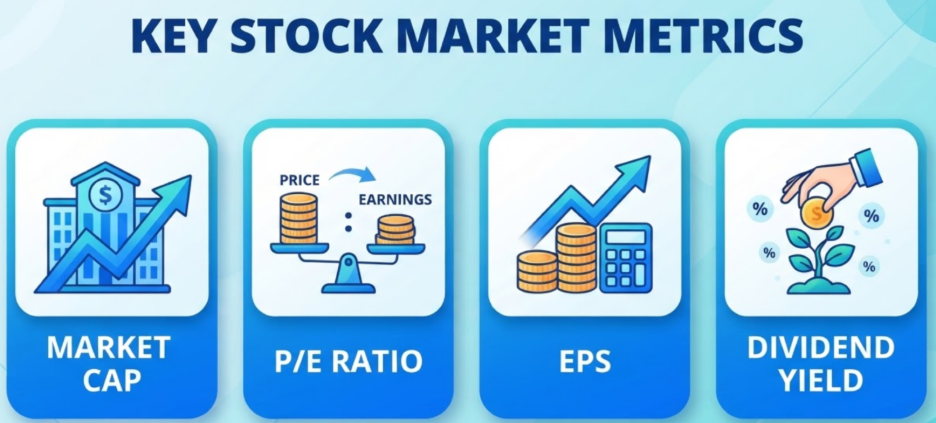
Market capitalization | Share price × total shares outstanding | Measures company size (small/mid/large cap) |
Volatility | How much a price fluctuates over time | Signals short-term risk |
Liquidity | How quickly an asset can be bought or sold | Affects how easily you can exit |
Bid/Ask spread | Gap between buy and sell prices | A hidden trading cost |
Ticker symbol | A company's short market code (e.g., AAPL) | How you find and trade a stock |
Beginner tip: Market cap is often grouped as large-cap (over $10B), mid-cap ($2B–$10B), and small-cap (under $2B). Larger companies tend to be more stable; smaller ones may offer more growth potential with more risk.
1.3 Stock market basics: how the market actually works
What is the stock market?
The stock market is a network of exchanges where buyers and sellers trade shares of publicly listed companies. Prices are set continuously by supply and demand.
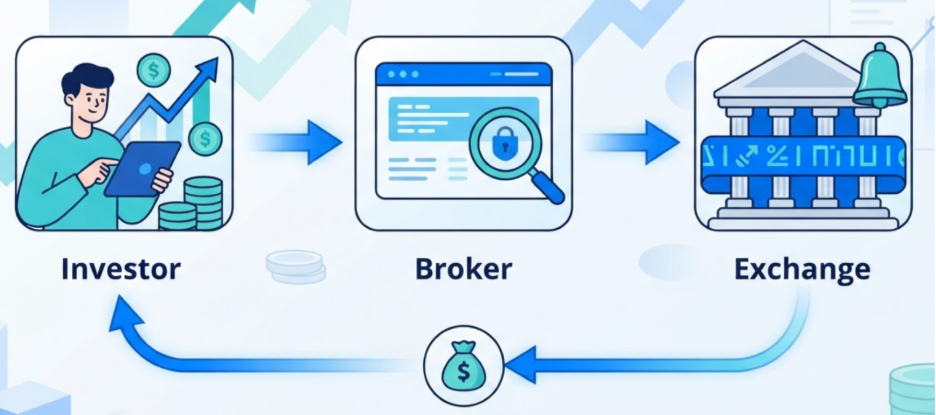
Learning the basics of the stock exchange helps clarify where your orders go and how prices form. Here's the typical path of an order:
You place an order through your brokerage app (e.g., buy 10 shares).
The broker routes it to an exchange or a market maker.
The order is matched with a counterparty willing to sell at a compatible price.
The trade executes at the agreed price.
Settlement occurs (US markets settle one business day after the trade, known as T+1).
Primary vs. secondary market — a key distinction:
Market | What happens | Example |
Primary market | Companies issue new shares to raise capital | An IPO (Initial Public Offering) |
Secondary market | Investors trade existing shares with each other | Everyday buying/selling on the NYSE |
The two primary US exchanges:
Exchange | Full name | Known for | Example sectors |
NYSE | New York Stock Exchange | Large, established companies (blue chips) | Industrials, finance, consumer goods |
Nasdaq | Nasdaq Stock Market | Technology and growth-focused companies | Tech, biotech, internet |
Prices on both exchanges reflect real-time supply and demand, updated continuously during market hours (9:30 a.m.–4:00 p.m. ET on trading days).
1.4 Why people invest: core asset types
Part of stock market basics is understanding your options. Rather than a flat list, compare the main asset classes side by side:
Asset class | What it is | Potential return | Risk level | Liquidity |
Stocks | Ownership in a single company | Higher | Higher | High |
ETFs | A basket of securities traded like a stock | Moderate | Moderate | High |
Mutual funds | Professionally managed pooled investments | Moderate | Moderate | Medium |
Bonds | Loans to governments or corporations | Lower | Lower | Medium |
Index funds | Funds tracking a market index | Market-matching | Moderate | High |
Beginner tip: Many new investors start with a broad index fund or ETF because it spreads money across hundreds of companies in a single purchase — a practical way to apply diversification from day one.
Part 2: Trading Basics and Investment 101
This section covers trading basics and the practical side of investment 101 — how to move from theory to a funded, diversified portfolio, and how to manage risk along the way.
Key takeaways
Investment 101 starts with goals, a budget, and a regulated account.
Order types control how and at what price trades execute — a core part of trading basics.
Diversification and dollar-cost averaging are practical ways to manage risk.
Avoiding common mistakes is as valuable as picking the right investments.
2.1 Trading vs. Investing
Investing focuses on building wealth over years or decades through diversified assets. Trading involves buying and selling more frequently to capture shorter-term price moves. Beginners usually start as long-term investors.
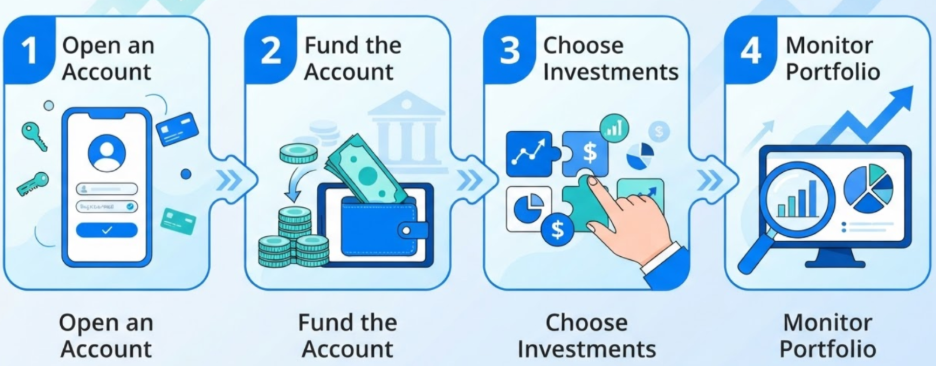
How to start investing in 5 steps
Featured-snippet block — Start investing in 5 steps:
Define your financial goals and time horizon.
Set a budget you can afford to invest.
Open an account with a regulated brokerage.
Choose diversified investments (e.g., index funds or ETFs).
Contribute consistently and review periodically.
Here's what each step looks like in practice:
Step | What to do | Beginner-friendly example |
1. Set goals | Match investments to a purpose and timeline | Retirement in 30 years vs. a home in 5 years |
2. Set a budget | Invest only surplus money after expenses and an emergency fund | $200/month automated contribution |
3. Open an account | Choose a SIPC/FINRA-member brokerage | Individual brokerage account or IRA |
4. Diversify | Spread risk across many holdings | A broad-market S&P 500 index ETF |
5. Stay consistent | Automate and review, don't chase headlines | Rebalance once or twice a year |
Trading basics: order types you should know
Understanding order types is a key part of trading basics. Each type controls how and at what price your trade executes:
Order type | How it works | Best used when | Trade-off |
Market order | Executes immediately at the current available price | You want a fast fill | Price isn't guaranteed |
Limit order | Executes only at your set price or better | Price control matters | May not fill |
Stop order | Triggers a market order once a set price is hit | Limiting a loss or protecting a gain | Fills at market, not exact stop |
Stop-limit order | Combines stop trigger with a limit price | You want tighter control | May not fill in fast markets |
Beginner tip: New investors often begin with market orders for liquid stocks and ETFs, then add limit orders as they get comfortable controlling entry and exit prices.
2.2 Investment 101: risk and diversification
The central lesson of investment 101 is that risk and return are linked. You manage risk not by avoiding it, but by spreading it. Diversification means holding a mix of assets so that a decline in any single holding doesn't sink your entire portfolio. It's often called "not putting all your eggs in one basket."
Know your risk tolerance:
Investor profile | Typical mindset | Sample stock/bond mix* |
Conservative | Prioritizes protecting capital | 40% stocks / 60% bonds |
Moderate | Balances growth and stability | 60% stocks / 40% bonds |
Aggressive | Prioritizes long-term growth | 80–90% stocks / 10–20% bonds |
*Illustrative only. Your ideal allocation depends on your goals, age, and comfort with volatility.
Sample allocations by time horizon (illustrative):
Age / horizon | Growth focus | A common starting framework |
20s–30s (long horizon) | High | Mostly stock index funds, small bond slice |
40s–50s (medium horizon) | Balanced | Blend of stock and bond funds |
Near retirement (short horizon) | Capital preservation | Higher bond and cash allocation |
Core risk-management principles:
Dollar-cost averaging — investing a fixed amount at regular intervals to smooth out price swings.
Asset allocation — dividing investments among stocks, bonds, and cash based on your risk tolerance.
Long time horizon — staying invested through market cycles rather than timing the market.
Emergency fund first — keeping 3–6 months of expenses in cash before investing.
Dollar-cost averaging in action:
Month | Amount invested | Share price | Shares bought |
Jan | $300 | $30 | 10.0 |
Feb | $300 | $25 | 12.0 |
Mar | $300 | $20 | 15.0 |
Total | $900 | avg. $25 | 37.0 |
By investing a fixed amount, you automatically buy more shares when prices are low and fewer when prices are high — reducing the impact of timing.
2.3 Common beginner mistakes to avoid
Rounding out the basics of investing means recognizing frequent pitfalls — and knowing the fix:
Common mistake | Why it hurts | The fix |
Putting ALL your money in a single stock | Concentrated risk | Diversify across funds/sectors |
Reacting emotionally to volatility | Locks in losses | Stick to a long-term plan |
Ignoring fees | Costs compound over time | Compare fee schedules; favor low-cost funds |
Investing near-term cash | Forced to sell at a loss | Keep an emergency fund separate |
Following unverified tips | Uninformed decisions | Research using reputable sources |
Part 3: Stock Market 101 — Choosing a Brokerage Platform
Applying stock market 101 in practice requires a brokerage account. The platform you choose affects your fees, tools, and overall experience. Below is a fair, fact-based overview based on publicly available information. Always verify current details before opening an account.
Webull
Webull is a US-based brokerage platform known for commission-free trading of stocks and ETFs, a data-rich mobile and desktop experience, and tools geared toward both new and active investors. Securities are offered by Webull Financial LLC, a member of SIPC and FINRA, which means eligible customer securities accounts are protected by SIPC up to applicable limits (see below for details).

Who it may be suitable for: Beginners who want an accessible entry into stock market basics, as well as more active traders who value advanced charting and real-time data.
Webull core features
Commission-free trading on US-listed stocks and ETFs (other fees may apply — see the fee schedule below).
Fractional shares, allowing you to invest with smaller dollar amounts rather than buying a full share.
Advanced charting tools with a wide range of technical indicators, useful for learning trading basics.
Paper trading (simulated trading), letting beginners practice strategies without risking real money.
Extended-hours trading, including pre-market and after-hours sessions.
Retirement accounts (IRAs) for long-term, tax-advantaged investing.
Options and other products, available to eligible, approved customers who understand the associated risks.
Webull use cases
The new investor learning the basic of shares can start small with fractional shares and practice using paper trading before committing real capital.
The self-directed learner studying stock market 101 can use the in-app screeners, charts, and market data to research companies.
The active trader can use advanced charting, real-time quotes, and extended-hours access to manage a more hands-on strategy.
The long-term saver can open an IRA and build a diversified portfolio of ETFs over time.
A quick note on Webull's learning tools
For someone starting with the basics of investing, Webull's combination of paper trading, screeners, and educational content can help bridge the gap between reading about share market basics and actually applying them. Simulated trading lets you test order types and strategies before real money is at stake.
Fees, regulation, and platform safety
Trust is central to the basics of investing. Before funding any account, review these factors:
Regulation and oversight
SEC (Securities and Exchange Commission) — the federal agency that regulates US securities markets.
FINRA (Financial Industry Regulatory Authority) — oversees brokerage firms and registered representatives.
Investor protection
SIPC (Securities Investor Protection Corporation) — protects eligible securities and cash in a customer's brokerage account if a member firm fails, up to $500,000 (including a $250,000 limit for cash). SIPC does not protect against market losses.
Fees to review
Commissions (many US brokers, including Webull, offer $0 commissions on US-listed stocks and ETFs).
Regulatory transaction fees passed through on sells.
Options contract fees, margin interest, and account transfer fees, where applicable.
Currency, wire, or other service fees.
FAQs
1. What are the basics of investing for beginners?
The basics of investing involve setting clear goals, understanding asset types like stocks and ETFs, managing risk through diversification, opening an account with a regulated brokerage, and investing consistently over time.
2. How much money do I need to start investing?
You can start with a small amount. Many US brokerages offer fractional shares, which let you buy a portion of a share, so you can begin investing with as little as a few dollars.
3. What is the difference between investing and trading?
Investing generally focuses on building wealth over a long time horizon, while trading involves buying and selling more frequently to capture shorter-term price movements. Trading basics include understanding order types and higher risk exposure.
4. Is my money safe in a brokerage account?
Brokerage accounts at SIPC-member firms are protected up to $500,000 (including $250,000 for cash) if the firm fails. However, SIPC does not protect against investment losses caused by market movements.
5. What should I invest in as a beginner?
Many beginners start with diversified, low-cost index funds or ETFs that track broad markets, then expand as they learn more about share market basics and their own risk tolerance.
6. How do I learn stock market basics quickly?
Start with foundational concepts (shares, diversification, order types), use a paper-trading account to practice without risk, and follow reputable, regulated financial sources. Consistent, gradual learning tends to work better than rushing.
The Bottom Line
The basics of investing come down to a few principles: understand what you own, manage risk through diversification, keep costs low, and stay consistent. Once you're comfortable with stock market basics, choosing a regulated, feature-rich platform like Webull can help you put your knowledge into practice and start building toward your goals.
Disclosure:
Securities trading is offered to self-directed customers by Webull Financial LLC, member SIPC, FINRA. All investments involve risk, including the possible loss of principal. You should consider your investment objectives carefully before investing. This is not a recommendation, investment advice, or a solicitation for the purchase or sale of a security. Additional info: webull.com/disclosures
