'%3e %3cpath d='M41.7832962%2c0 C41.9459106%2c0 42.0882746%2c0.0866854658 42.1666825%2c0.216359069 C43.8289923%2c2.66540836 44.7676281%2c5.46271319 44.7676281%2c8.43208061 C44.7676281%2c18.1345746 34.7460532%2c26 22.383814%2c26 C10.0215749%2c26 0%2c18.1345746 0%2c8.43208061 C0%2c5.46716016 0.935826425%2c2.67378733 2.58829888%2c0.223985685 C2.67109477%2c0.0916264068 2.81687473%2c0 2.9840593%2c0 C3.23130408%2c0 3.43173558%2c0.200393004 3.43173558%2c0.447590303 C3.43173558%2c0.475056669 3.42926112%2c0.501945205 3.42452292%2c0.528045226 L3.41810883%2c0.550292077 C3.37800671%2c0.861741908 3.3575721%2c1.17661276 3.3575721%2c1.49443092 C3.3575721%2c7.98336 11.2132389%2c12.5742305 22.383814%2c12.5742305 C33.5543891%2c12.5742305 41.410056%2c7.98336 41.410056%2c1.49443092 C41.410056%2c1.17865223 41.3898828%2c0.865783153 41.3502888%2c0.556288325 C41.3402868%2c0.521941442 41.3356199%2c0.48531078 41.3356199%2c0.447590303 C41.3356199%2c0.200393004 41.5360514%2c0 41.7832962%2c0 Z' id='logo%e5%a4%87%e4%bb%bd-6' fill='white'%3e%3c/path%3e %3cpath d='M74.6899231%2c3.74404927 C75.2411227%2c3.74404927 75.7734299%2c3.66184338 76.2756219%2c3.50883715 L73.8159676%2c20.8666902 C73.5770593%2c22.5662954 72.8072434%2c23.0518969 71.4268838%2c23.0518969 L69.9934336%2c23.0518969 C68.7988917%2c23.0518969 68.1618027%2c22.458384 67.7901674%2c20.893668 L65.6930827%2c11.9909739 C65.639992%2c11.7481731 65.639992%2c11.6942174 65.5338105%2c11.6942174 C65.427629%2c11.6942174 65.4010836%2c11.7481731 65.3479929%2c11.9909739 L63.2509082%2c20.893668 C62.8792729%2c22.458384 62.2421839%2c23.0518969 61.047642%2c23.0518969 L59.6141918%2c23.0518969 C58.2338322%2c23.0518969 57.4640163%2c22.5662954 57.225108%2c20.8666902 L54.7463723%2c3.37406084 C55.3593498%2c3.61307396 56.0249975%2c3.74404927 56.7207458%2c3.74404927 C57.3314263%2c3.74404927 57.918917%2c3.64314414 58.4679557%2c3.4568446 L60.3574623%2c19.3829078 C60.3840076%2c19.6257086 60.3840076%2c19.7875757 60.4901891%2c19.7875757 C60.5963706%2c19.7875757 60.5963706%2c19.6257086 60.6494614%2c19.3829078 L62.9323637%2c9.91367858 C63.0916359%2c9.26620991 63.4632712%2c8.69967483 64.6047223%2c8.69967483 L66.4363532%2c8.69967483 C67.5778044%2c8.69967483 67.9494397%2c9.26620991 68.1087119%2c9.91367858 L70.3916142%2c19.3829078 C70.4447049%2c19.6257086 70.4447049%2c19.7875757 70.5508864%2c19.7875757 C70.6570679%2c19.7875757 70.6570679%2c19.6257086 70.6836133%2c19.3829078 L72.5891207%2c3.32292288 C73.2365902%2c3.59432921 73.9460524%2c3.74404927 74.6899231%2c3.74404927 Z' id='Combined-Shape' fill='white'%3e%3c/path%3e %3cpath d='M84.5933901%2c7.43171536 C88.6813779%2c7.43171536 90.9111894%2c10.2643908 90.9111894%2c14.2840921 L90.9111894%2c15.7948523 C90.9111894%2c16.2264981 90.7519172%2c16.4692988 90.3802819%2c16.4692988 L81.7264895%2c16.4692988 L81.7264895%2c16.5502324 C81.7264895%2c18.1149484 82.3635785%2c19.9764208 84.9119346%2c19.9764208 C86.849747%2c19.9764208 88.6813779%2c19.8145536 89.7962837%2c19.7066422 L89.8759198%2c19.7066422 C90.1413735%2c19.7066422 90.3537366%2c19.8415315 90.3537366%2c20.1113101 L90.3537366%2c21.8918489 C90.3537366%2c22.3234947 90.2741004%2c22.5123397 89.7962837%2c22.5932733 C88.0708343%2c22.9170076 87.0355646%2c23.0518969 84.6464808%2c23.0518969 C81.9919433%2c23.0518969 78.2225%2c21.5950924 78.2225%2c16.2804538 L78.2225%2c14.2840921 C78.2225%2c10.0755457 80.5319476%2c7.43171536 84.5933901%2c7.43171536 Z M84.5933901%2c10.5071915 C82.9475768%2c10.5071915 81.7530349%2c11.6942174 81.7530349%2c13.8254684 L81.7530349%2c13.9333799 L87.3806545%2c13.9333799 L87.3806545%2c13.8254684 C87.3806545%2c11.7211953 86.2392034%2c10.5071915 84.5933901%2c10.5071915 Z' id='Combined-Shape' fill='white'%3e%3c/path%3e %3cpath d='M97.4154906%2c2.98826245 L97.4148064%2c7.62056039 C98.3969853%2c7.48567108 99.3260735%2c7.43171536 99.9631625%2c7.43171536 C104.236968%2c7.43171536 106.307507%2c9.99461216 106.307507%2c14.2031585 L106.307507%2c16.2804538 C106.307507%2c20.4890001 104.236968%2c23.0518969 99.9631625%2c23.0518969 C98.2642584%2c23.0518969 96.2733553%2c22.7821183 94.627542%2c22.3504725 C94.0169984%2c22.1886054 93.9108169%2c22.0267382 93.9108169%2c21.6220703 L93.9098179%2c3.08694115 C94.4185466%2c3.24434375 94.9584615%2c3.32900525 95.5178331%2c3.32900525 C96.184659%2c3.32900525 96.8238351%2c3.20869291 97.4154906%2c2.98826245 Z M99.9631625%2c10.3453244 C99.3260735%2c10.3453244 98.1580769%2c10.4262579 97.4148064%2c10.5341694 L97.4148064%2c19.9494429 C97.9191686%2c20.0573544 99.007529%2c20.1382879 99.9631625%2c20.1382879 C102.246065%2c20.1382879 102.803518%2c18.4926384 102.803518%2c16.2804538 L102.803518%2c14.2031585 C102.803518%2c11.9909739 102.246065%2c10.3453244 99.9631625%2c10.3453244 Z' id='Combined-Shape' fill='white'%3e%3c/path%3e %3cpath d='M111.036668%2c8.72457747 C111.579488%2c8.72457747 112.103987%2c8.64485191 112.599444%2c8.49629404 L112.598761%2c16.5232546 C112.598761%2c19.3289521 113.607485%2c19.9764208 115.147117%2c19.9764208 L115.306389%2c19.9764208 C116.846021%2c19.9764208 117.854746%2c19.3289521 117.854746%2c16.5232546 L117.854207%2c8.4334735 C118.406525%2c8.62226395 118.997939%2c8.72457747 119.612866%2c8.72457747 C120.223332%2c8.72457747 120.810625%2c8.62374317 121.359498%2c8.43756894 L121.358735%2c16.5232546 C121.358735%2c22.4044283 116.872567%2c23.0518969 115.306389%2c23.0518969 L115.060464%2c23.0512514 C113.42215%2c23.0271041 109.094772%2c22.2994073 109.094772%2c16.5232546 L109.094446%2c8.36700801 C109.698522%2c8.59813531 110.353066%2c8.72457747 111.036668%2c8.72457747 Z' id='Combined-Shape' fill='white'%3e%3c/path%3e %3cpath d='M128.314162%2c3.03790128 L128.313623%2c22.269539 C128.313623%2c22.5662954 128.10126%2c22.836074 127.809261%2c22.836074 L125.340541%2c22.836074 C125.048542%2c22.836074 124.809634%2c22.5662954 124.809634%2c22.269539 L124.809455%2c3.04219481 C125.358161%2c3.22824247 125.945253%2c3.32900525 126.555503%2c3.32900525 C127.17043%2c3.32900525 127.761844%2c3.22669173 128.314162%2c3.03790128 Z' id='Combined-Shape' fill='white'%3e%3c/path%3e %3cpath d='M133.90653%2c3.32900525 C134.473329%2c3.32900525 135.02015%2c3.24208064 135.534793%2c3.08063296 L135.533966%2c22.269539 C135.533966%2c22.5662954 135.321603%2c22.836074 135.029603%2c22.836074 L132.560884%2c22.836074 C132.268884%2c22.836074 132.029976%2c22.5662954 132.029976%2c22.269539 L132.029909%2c2.99605058 C132.615669%2c3.21152525 133.2476%2c3.32900525 133.90653%2c3.32900525 Z' id='Combined-Shape' fill='white'%3e%3c/path%3e %3c/g%3e %3c/g%3e %3c/g%3e%3c/svg%3e)



Learning how to calculate options profit is one of the most important skills for anyone trading calls, puts, or multi-leg strategies. Whether you are evaluating a long call before expiration or reviewing unrealized gains on an open position, understanding the underlying formulas for options profit and loss helps you make informed, risk-aware decisions rather than guesswork.
Key Takeaways
To calculate options profit, subtract the premium paid from the difference between the underlying stock price and the strike price, then multiply by the number of contracts (each representing 100 shares).
Call option profit and put option profit use mirrored formulas: calls profit when the stock rises above the breakeven price, while puts profit when the stock falls below it.
Open profit/loss (unrealized P/L) is typically estimated using the option's mid-price — the average of the bid and ask — rather than the last traded price.
Options profit calculators, including tools available through platforms such as Webull, can model breakeven points, max profit, max loss, and Probability of Profit before you place a trade.
Probability of Profit is a theoretical estimate based on implied volatility and time to expiration — it is not a guarantee of actual outcomes.
Every options strategy carries risk, including the potential loss of the entire premium paid, and traders should review platform-specific risk disclosures before trading.

Part 1. What Is Options Profit and How Is It Defined?
Before you can calculate options profit accurately, it helps to understand what "profit" actually means in the context of an options contract. Unlike buying a stock outright, an options contract gives the holder the right — but not the obligation — to buy (call) or sell (put) 100 shares of the underlying stock at a fixed strike price before or at expiration. Profit is realized when the value gained from that right exceeds the premium paid to acquire it.
Options profit calculations generally fall into two categories: profit at expiration, which can be calculated precisely because there is no remaining time value, and profit before expiration, which requires accounting for the option's current market price, including any extrinsic (time) value still built into the premium.
1.1 Call Option Profit Formula
For a long call option, profit at expiration is calculated as:
Call Option Profit = (Underlying Stock Price − Strike Price − Premium Paid) × Number of Contracts × 100
If the result is negative, the trade is at a loss, and the maximum loss for a call buyer is limited to the premium paid. There is theoretically no cap on the upside, since a stock price can continue to rise.
Example: A trader buys 2 call contracts on a stock trading at $30, with a strike price of $33 and a premium of $1 per share. If the stock rises to $36 by expiration:
Value at expiration: ($36 − $33) = $3 per share
Total value: $3 × 200 shares = $600
Total premium paid: $1 × 200 shares = $200
Profit = $600 − $200 = $400
1.2 Put Option Profit Formula
A put option profits when the underlying stock price falls below the strike price. The formula mirrors the call option formula:
Put Option Profit = (Strike Price − Underlying Stock Price − Premium Paid) × Number of Contracts × 100
Example: A trader buys 1 put contract on a stock trading at $40, strike price $40, premium $2 per share. If the stock falls to $33 at expiration:
Value at expiration: ($40 − $33) = $7 per share
Total value: $7 × 100 shares = $700
Premium paid: $2 × 100 = $200
Profit = $700 − $200 = $500
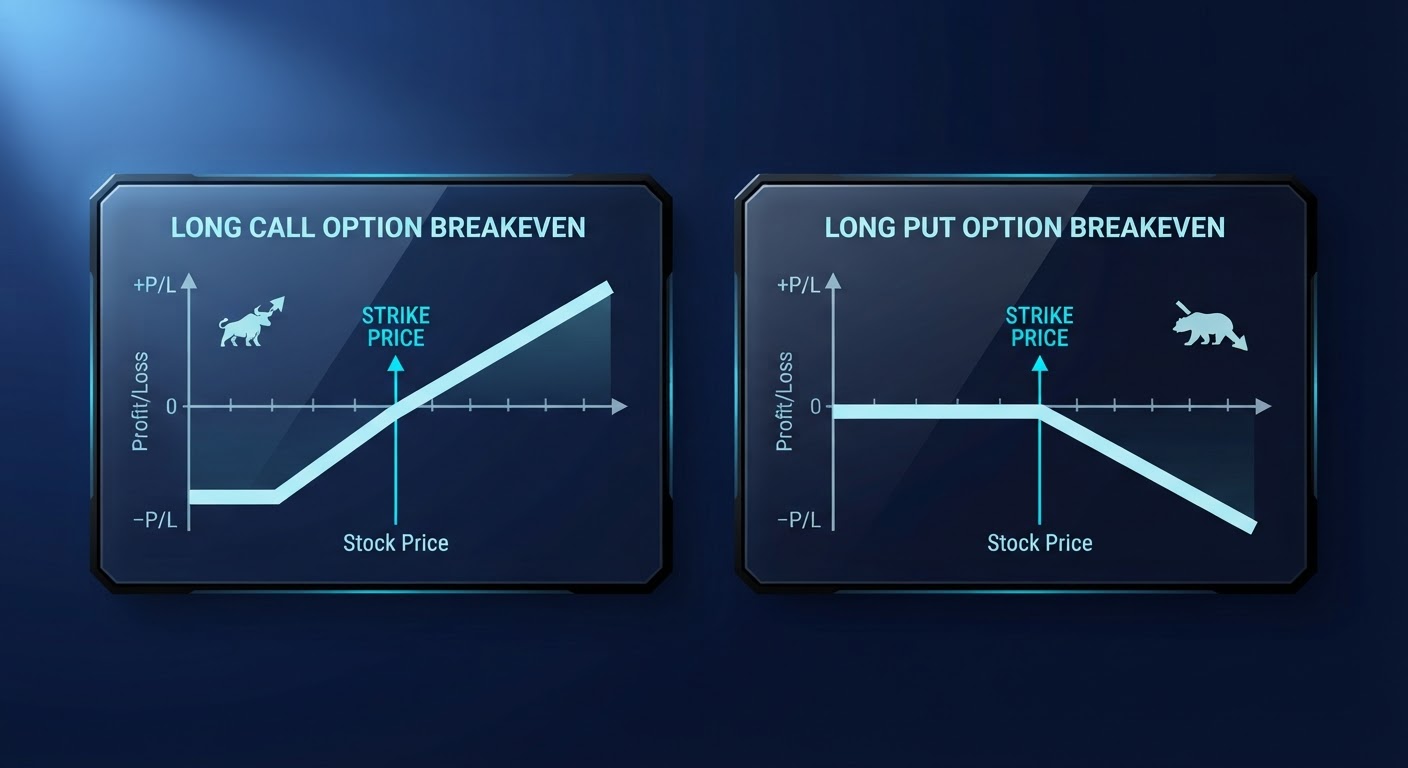
1.3 Breakeven Price Explained
The breakeven price is the exact underlying price at which an options position neither gains nor loses money at expiration. Knowing the breakeven point is essential to calculating options profit because it defines where the profit zone begins.
Call breakeven = Strike Price + Premium Paid
Put breakeven = Strike Price − Premium Paid
For example, if a call has a $50 strike and a $3 premium, the breakeven price is $53. The stock must close above $53 at expiration for the position to show a net profit after accounting for the premium.
Part 2. How to Calculate Options Profit: A Step-by-Step Process
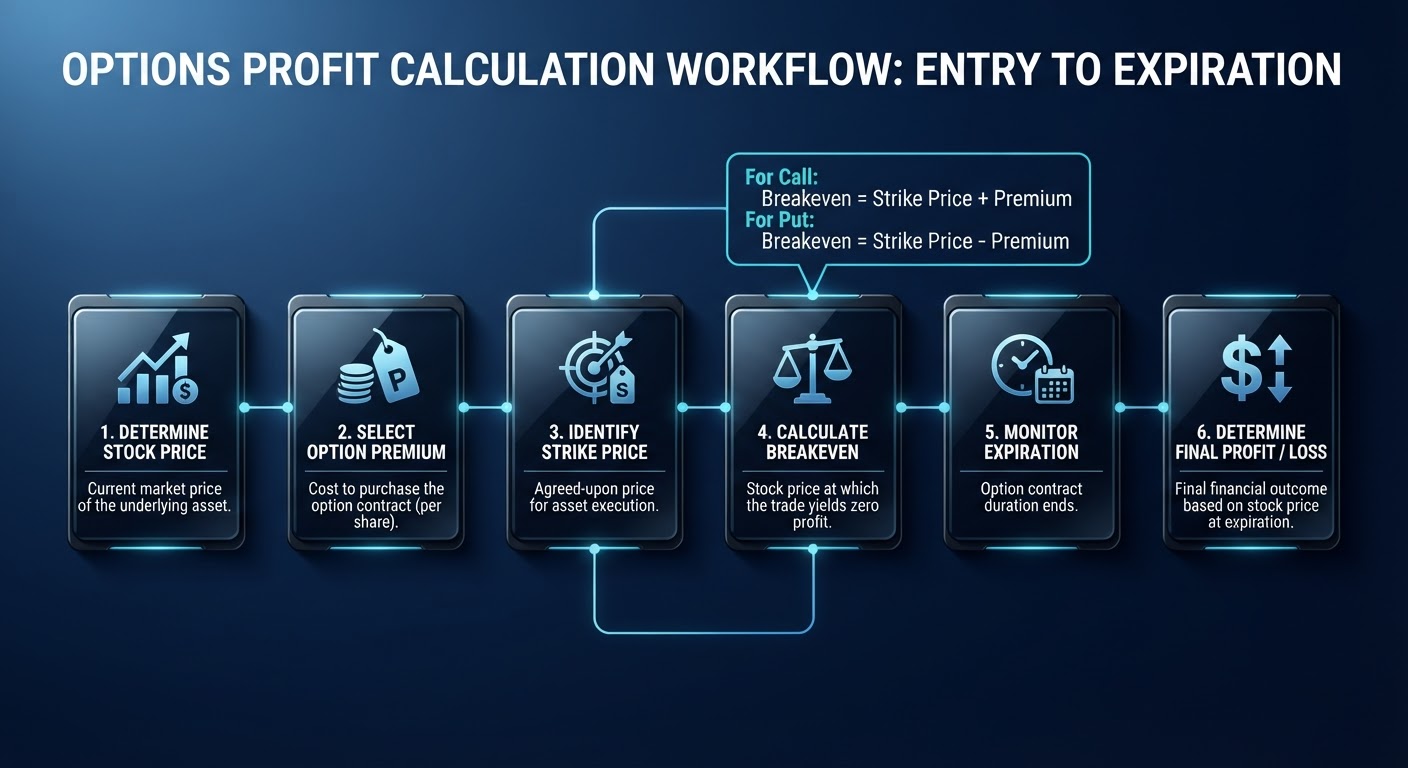
Calculating options profit is not a single formula but a process that changes depending on whether the position is still open, has expired, or has been exercised or assigned. Below is a structured, step-by-step approach.
2.1 Step-by-Step Options Profit Calculation
Identify the option type — call or put, and whether you are the buyer (long) or the seller/writer (short).
Record the entry premium — the price paid or received per share, multiplied by 100 shares per contract.
Determine the current or expiration underlying price — the stock price you are using for the calculation.
Calculate intrinsic value — for a call, Max(Stock Price − Strike, 0); for a put, Max(Strike − Stock Price, 0).
Subtract (or add, if you are the seller) the premium to intrinsic value to determine net profit or loss.
Multiply by the number of contracts and 100 shares to get the total dollar profit or loss.
Compare to your breakeven price to confirm whether the position is in a profit or loss zone.
2.2 Calculating Open Profit/Loss Before Expiration
Before expiration, an option's profit is described as "open P/L" or unrealized P/L, and it is generally estimated using the option's mid-price — the average between the current bid and ask.
Example: You purchase 1 call option at $5.00. The current quote shows a bid of $4.95 and an ask of $5.15, giving a midpoint of $5.05. Your open P/L would be approximately +$0.05 per share, based on midpoint pricing.
It's important to remember that this open P/L figure is an estimate for informational purposes and does not represent your actual realized profit and loss. Securities are typically sold at the bid and bought at the ask, so actual execution may differ from the midpoint-based estimate, especially in fast-moving or less liquid markets.
2.3 Calculating Cost Basis When Exercised or Assigned
If an option is exercised or assigned rather than closed for cash, the cost basis per share is calculated differently depending on the option type:
Exercising a Call Option: Cost Basis = Strike Price + Option Premium + Fees
Assigned on a Written Call: Cost Basis = Strike Price + Option Premium − Fees
Exercising a Put Option: Cost Basis = Strike Price − Option Premium − Fees
Assigned on a Written Put: Cost Basis = Strike Price − Option Premium + Fees
These adjustments matter because your true profit or loss on the resulting stock position depends on this adjusted cost basis, not simply the strike price.
Part 3. Options Profit by Strategy: Calls, Puts, and Spreads
Different options strategies have distinct profit and loss profiles. Comparing them side by side helps traders understand how strategy choice affects the potential for profit and the corresponding risk.
3.1 Single-Leg Strategy Profit Profiles
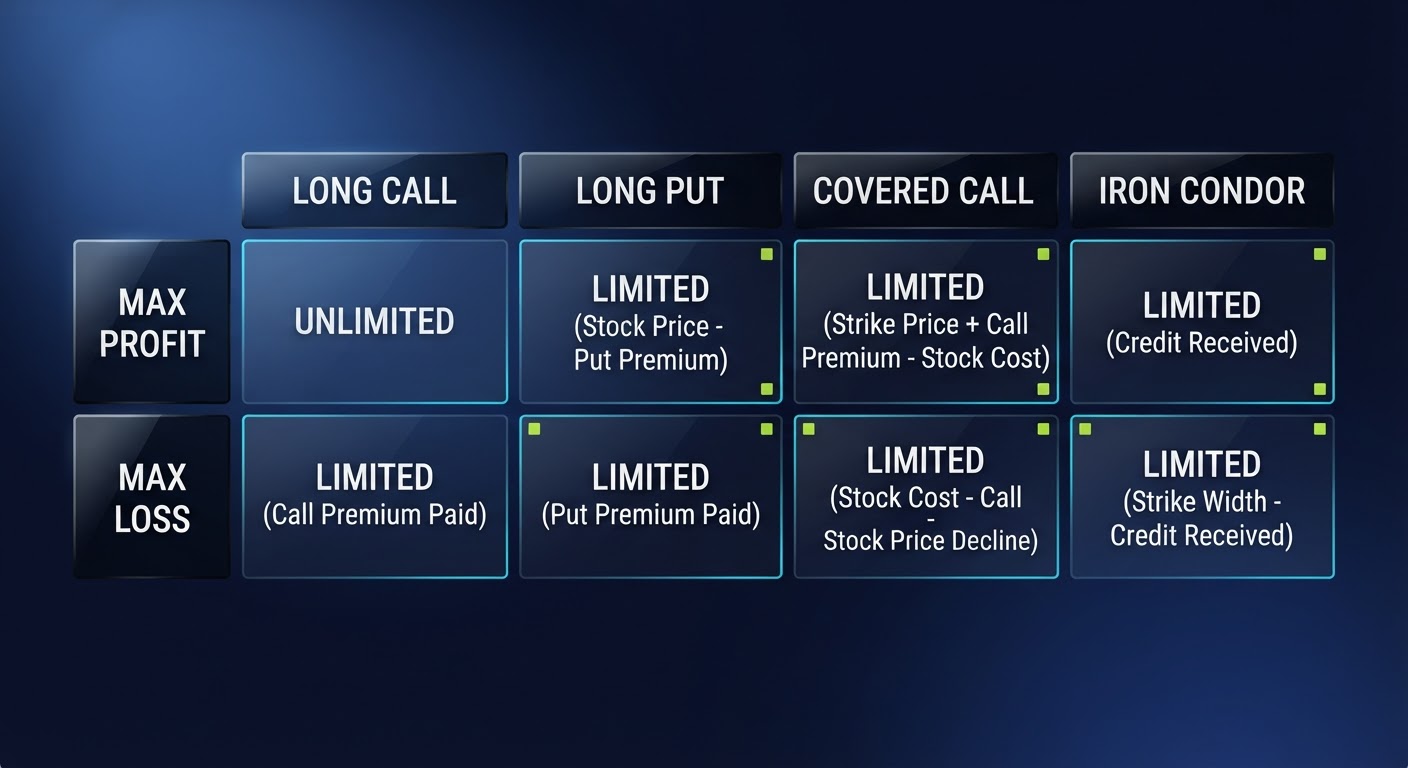
Long Call (bullish): Max profit is unlimited; max loss is limited to the premium paid. Profit formula: Max(Stock Price − Strike, 0) − Premium.
Long Put (bearish): Max profit is capped at Strike − Premium (if the stock falls to $0); max loss is limited to the premium paid.
Covered Call (neutral to mildly bullish): Involves owning the stock and writing a call against it. Max profit = Strike − Cost Basis + Premium received; the premium collected can offset some downside on the stock.
Cash-Secured Put (bullish): Writing a put while setting aside cash to cover potential assignment; the seller's max profit is the premium received.
3.2 Multi-Leg Spread Profit Profiles
Strategy | Market Outlook | Max Profit | Max Loss |
|---|---|---|---|
Bull Call Spread | Moderately bullish | Strike difference − net premium paid | Net premium paid |
Bear Put Spread | Moderately bearish | Strike difference − net premium paid | Net premium paid |
Long Straddle | Large move expected (either direction) | Unlimited | Total premium paid |
Long Strangle | Large move expected (either direction) | Unlimited | Total premium paid |
Iron Condor | Range-bound / low volatility | Net credit received | Spread width − net credit received |
A straddle uses the same strike price for both the call and put legs, which typically costs more but requires a smaller price move to become profitable. A strangle uses different out-of-the-money strikes for the call and put, which usually costs less in premium but requires a larger price move to reach profitability.
3.3 Pros and Cons of Calculating Profit Across Strategies
Pros of understanding multi-leg profit calculations:
Allows traders to define maximum profit and maximum loss before entering a trade
Helps compare risk/reward across bullish, bearish, and neutral strategies
Supports better position sizing based on defined-risk outcomes
Cons and limitations:
Spread calculations require tracking multiple legs, strikes, and expirations simultaneously
Profit before expiration still requires modeling time value and implied volatility, not just intrinsic value
Early assignment risk on short legs can alter the expected profit and loss outcome
Part 4. Tools for Calculating Options Profit: Calculators and Probability of Profit
Manually calculating options profit for a single-leg trade is straightforward, but multi-leg strategies, time decay, and implied volatility make dedicated tools valuable. Several options profit calculators are available to US traders, and brokerage platforms increasingly build these tools directly into their trading interfaces.
4.1 What an Options Profit Calculator Does
An options profit calculator uses inputs such as the underlying stock price, strike price, premium, number of contracts, days to expiration, and implied volatility to model outcomes across a range of stock prices. Typical outputs include:
Maximum profit and maximum loss
Breakeven price
A payoff diagram showing profit or loss at each stock price
Option Greeks (Delta, Gamma, Theta, Vega, Rho) that describe sensitivity to price, time, and volatility
4.2 Comparing Options Profit Calculator Tools
Several platforms offer options profit calculators with overlapping but distinct feature sets:
Webull: Webull provides an integrated options profit and loss framework within its trading platform, including open P/L estimation based on mid-price, cost basis calculations for exercised or assigned contracts, and a Probability of Profit tool that models the likelihood of a strategy closing within its profit range at expiration. Because these tools are built directly into the brokerage account, traders can move from profit analysis to order placement, on eligible approved accounts, within the same platform. Webull's documentation also provides transparent disclosures about the assumptions and limitations behind its Probability of Profit calculations, which supports informed decision-making rather than reliance on a single number.
OptionsProfitCalculator.com: Offers calculators for basic, spread, and advanced strategies (including iron condors, butterflies, and collars), along with an "Option Finder" feature that suggests strikes based on a target future stock price.
MarketBeat: Provides a straightforward call and put profit calculator using the standard (Stock Price − Strike − Premium) × Shares formula, along with in-the-money, at-the-money, and out-of-the-money definitions.
Finder: Offers a call and put profit calculator with worked examples and clear breakeven formulas for educational purposes.
TradeZella: Uses a Black-Scholes-based model to estimate profit and loss, including a payoff diagram and Greeks, and provides a sample profit and loss table across various stock prices.
InsiderFinance: Provides an educational-focused calculator that factors in volatility, time decay, and interest rates, aimed at helping newer traders understand how these variables affect an options position.
These tools generally agree on the underlying formulas described in Part 1 and Part 2 of this guide; the differences lie mainly in strategy coverage, visualization, and integration with an actual brokerage account.
4.3 Understanding Probability of Profit
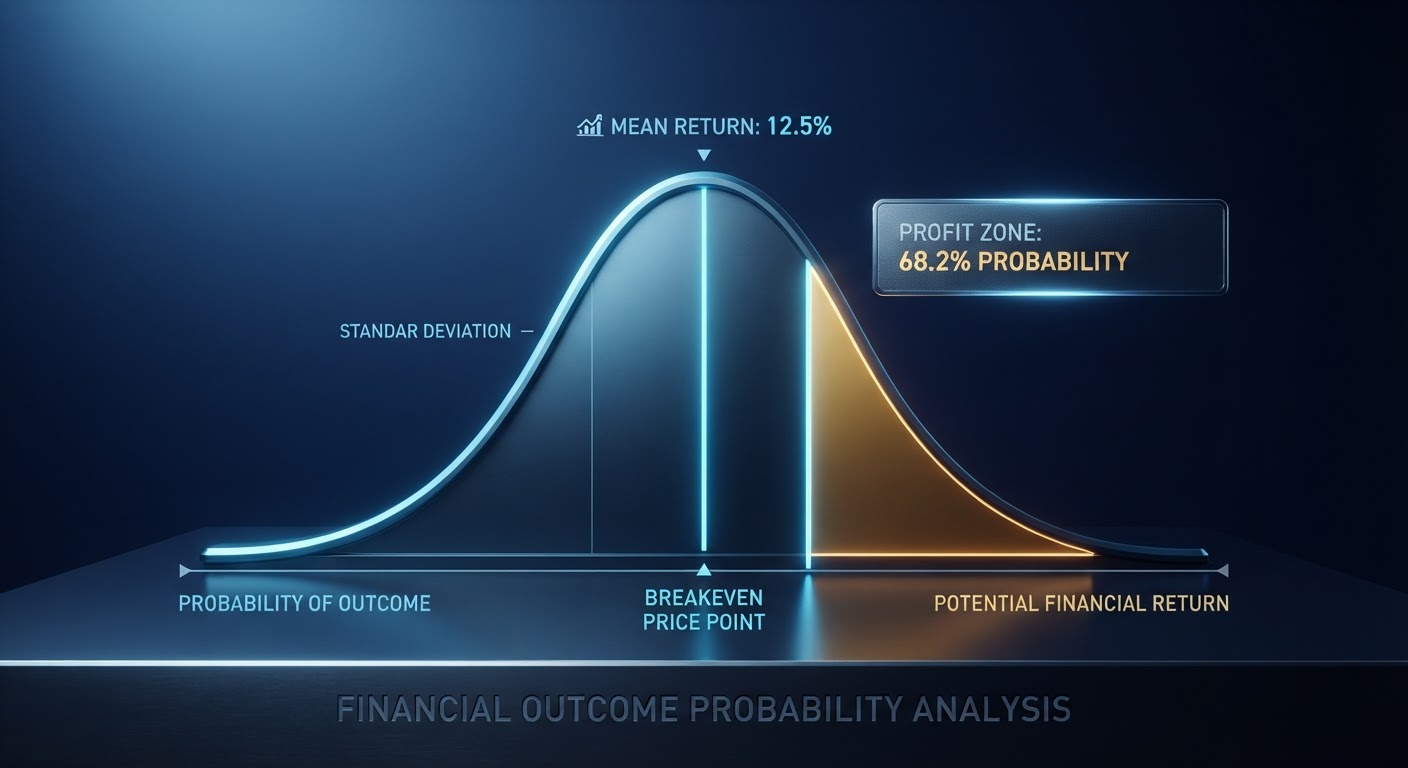
Probability of Profit is a related but distinct concept from a raw profit calculation. It estimates the statistical likelihood that an options strategy will close with at least $0.01 of profit at expiration, based on the assumption that stock returns follow a log-normal distribution.
The calculation depends on:
The current stock price
The strategy's breakeven point(s), which define the profit range
Implied volatility, used as a proxy for expected future volatility
Days remaining until expiration
For a long call, Probability of Profit is calculated as 1 minus the cumulative standard normal distribution value at the breakeven price, using implied volatility scaled by the square root of time to expiration.
Important: Probability of Profit is a theoretical estimate based on a set of statistical assumptions. It is not a guarantee of actual outcomes, and it does not account for changes in implied volatility, unexpected news events, or early assignment. This calculation should be used as one input among several when evaluating a trade, not as a definitive forecast.
Part 5. Risk Management, Fees, and Platform Safety in Options Trading
Calculating theoretical options profit is only useful if it is paired with a realistic understanding of risk, cost, and the regulatory framework that protects investors.
5.1 Key Risks That Affect Realized Options Profit
Total loss of premium: Option buyers can lose the entire premium paid if the option expires out of the money.
Unlimited risk for uncovered sellers: Writers of uncovered (naked) calls face theoretically unlimited risk if the underlying stock rises significantly.
Time decay (Theta): Long options lose extrinsic value each day, which can erode profit even if the stock price stays flat.
Early assignment risk: Short option positions, particularly in American-style options, can be assigned before expiration, altering the expected profit calculation.
Liquidity risk: In less liquid options markets, the actual execution price may differ meaningfully from the theoretical mid-price used in open P/L estimates.
5.2 Fees and Costs That Affect Actual Profit
Any realistic options profit calculation should account for trading costs, since fees reduce net profit on both winning and losing trades. Costs that commonly apply include:
Per-contract commissions (where applicable)
Regulatory and exchange fees passed through by the broker
Fees associated with exercise and assignment, which factor into the adjusted cost basis described in Part 2.3
Because fee structures vary by brokerage and account type, traders should review a platform's current fee schedule directly, such as the options trading fee disclosures published at www.webull.com, before finalizing profit expectations on a specific strategy.
5.3 Regulation and Platform Safety
US options trading occurs within a regulated framework designed to protect investors:
FINRA (Financial Industry Regulatory Authority): Oversees broker-dealers and enforces rules related to options trading suitability and disclosure.
SEC (Securities and Exchange Commission): Regulates securities markets, including options exchanges, at the federal level.
SIPC (Securities Investor Protection Corporation): Provides limited protection for securities and cash held at a member brokerage in the event of brokerage failure — it does not protect against trading losses.
Before trading options, US investors are required to complete an options trading application and receive account approval based on eligibility criteria. Regulators and brokerages, including Webull, require traders to read the Characteristics and Risks of Standardized Options and the Options Spread Risk Disclosure documents, which outline the mechanics and risks in detail.
Risk Disclosure: Options trading entails significant risk and is not appropriate for all investors. Option investors can rapidly lose the entire value of their investment in a short period of time and may incur permanent loss by the expiration date. Past performance does not guarantee future results, and nothing in this article constitutes financial or investment advice.

Frequently Asked Questions
What is the basic formula to calculate options profit?
For a call option, profit is (Underlying Price − Strike Price − Premium) × Contracts × 100. For a put option, profit is (Strike Price − Underlying Price − Premium) × Contracts × 100. If the result is negative, the position is at a loss.
How do you calculate options profit before expiration?
Before expiration, profit is typically estimated as open (unrealized) P/L using the option's current mid-price — the average of the bid and ask — compared to your entry premium. This differs from the exact profit calculation used at expiration, which relies only on intrinsic value.
What is the maximum loss when buying a call or put option?
For option buyers, the maximum loss is limited to the premium paid for the contract, regardless of how far the stock price moves against the position.
How is cost basis calculated if an option is exercised or assigned?
Cost basis depends on the option type: exercising a call adds the premium and fees to the strike price, while exercising a put subtracts the premium and fees from the strike price. Assignment calculations are mirrored, with fees added or subtracted accordingly.
What is Probability of Profit in options trading?
Probability of Profit is a theoretical estimate of the likelihood that an options strategy will close with at least $0.01 of profit at expiration, based on implied volatility, time to expiration, and the strategy's breakeven price. It is not a guarantee of an actual outcome.
Do options profit calculators account for time decay and volatility?
Basic profit calculators typically show profit at expiration based on intrinsic value alone. More advanced calculators, often using a Black-Scholes-based model, can factor in time decay (Theta) and implied volatility (Vega) to estimate profit before expiration.
What is the difference between a straddle and a strangle when calculating profit?
A straddle uses the same strike price for the call and put legs, generally costing more in premium but requiring a smaller price move to profit. A strangle uses different out-of-the-money strikes, typically costing less but requiring a larger price move to reach profitability.
Are options profit calculations guaranteed to reflect real trading results?
No. Profit calculators and Probability of Profit tools rely on modeling assumptions and current market data. Actual results can differ due to execution price, liquidity, volatility changes, fees, and early assignment.
The Bottom Line
Learning to calculate options profit — from basic call and put formulas to Probability of Profit — helps traders evaluate strategies with clearer expectations. Tools like Webull's integrated options analytics (www.webull.com) can support this process, but every calculation remains an estimate. Review risk disclosures and account eligibility before trading options.
Disclamer
Securities trading is offered to self-directed customers by Webull Financial LLC, member SIPC, FINRA. All investments involve risk, including the possible loss of principal. You should consider your investment objectives carefully before investing. This is not a recommendation, investment advice, or a solicitation for the purchase or sale of a security. Additional info: webull.com/disclosures
Disclosure
Webull Financial LLC, Member SIPC, FINRA. Investing involves risk. More info at webull.com/policy
