'%3e %3cpath d='M41.7832962%2c0 C41.9459106%2c0 42.0882746%2c0.0866854658 42.1666825%2c0.216359069 C43.8289923%2c2.66540836 44.7676281%2c5.46271319 44.7676281%2c8.43208061 C44.7676281%2c18.1345746 34.7460532%2c26 22.383814%2c26 C10.0215749%2c26 0%2c18.1345746 0%2c8.43208061 C0%2c5.46716016 0.935826425%2c2.67378733 2.58829888%2c0.223985685 C2.67109477%2c0.0916264068 2.81687473%2c0 2.9840593%2c0 C3.23130408%2c0 3.43173558%2c0.200393004 3.43173558%2c0.447590303 C3.43173558%2c0.475056669 3.42926112%2c0.501945205 3.42452292%2c0.528045226 L3.41810883%2c0.550292077 C3.37800671%2c0.861741908 3.3575721%2c1.17661276 3.3575721%2c1.49443092 C3.3575721%2c7.98336 11.2132389%2c12.5742305 22.383814%2c12.5742305 C33.5543891%2c12.5742305 41.410056%2c7.98336 41.410056%2c1.49443092 C41.410056%2c1.17865223 41.3898828%2c0.865783153 41.3502888%2c0.556288325 C41.3402868%2c0.521941442 41.3356199%2c0.48531078 41.3356199%2c0.447590303 C41.3356199%2c0.200393004 41.5360514%2c0 41.7832962%2c0 Z' id='logo%e5%a4%87%e4%bb%bd-6' fill='white'%3e%3c/path%3e %3cpath d='M74.6899231%2c3.74404927 C75.2411227%2c3.74404927 75.7734299%2c3.66184338 76.2756219%2c3.50883715 L73.8159676%2c20.8666902 C73.5770593%2c22.5662954 72.8072434%2c23.0518969 71.4268838%2c23.0518969 L69.9934336%2c23.0518969 C68.7988917%2c23.0518969 68.1618027%2c22.458384 67.7901674%2c20.893668 L65.6930827%2c11.9909739 C65.639992%2c11.7481731 65.639992%2c11.6942174 65.5338105%2c11.6942174 C65.427629%2c11.6942174 65.4010836%2c11.7481731 65.3479929%2c11.9909739 L63.2509082%2c20.893668 C62.8792729%2c22.458384 62.2421839%2c23.0518969 61.047642%2c23.0518969 L59.6141918%2c23.0518969 C58.2338322%2c23.0518969 57.4640163%2c22.5662954 57.225108%2c20.8666902 L54.7463723%2c3.37406084 C55.3593498%2c3.61307396 56.0249975%2c3.74404927 56.7207458%2c3.74404927 C57.3314263%2c3.74404927 57.918917%2c3.64314414 58.4679557%2c3.4568446 L60.3574623%2c19.3829078 C60.3840076%2c19.6257086 60.3840076%2c19.7875757 60.4901891%2c19.7875757 C60.5963706%2c19.7875757 60.5963706%2c19.6257086 60.6494614%2c19.3829078 L62.9323637%2c9.91367858 C63.0916359%2c9.26620991 63.4632712%2c8.69967483 64.6047223%2c8.69967483 L66.4363532%2c8.69967483 C67.5778044%2c8.69967483 67.9494397%2c9.26620991 68.1087119%2c9.91367858 L70.3916142%2c19.3829078 C70.4447049%2c19.6257086 70.4447049%2c19.7875757 70.5508864%2c19.7875757 C70.6570679%2c19.7875757 70.6570679%2c19.6257086 70.6836133%2c19.3829078 L72.5891207%2c3.32292288 C73.2365902%2c3.59432921 73.9460524%2c3.74404927 74.6899231%2c3.74404927 Z' id='Combined-Shape' fill='white'%3e%3c/path%3e %3cpath d='M84.5933901%2c7.43171536 C88.6813779%2c7.43171536 90.9111894%2c10.2643908 90.9111894%2c14.2840921 L90.9111894%2c15.7948523 C90.9111894%2c16.2264981 90.7519172%2c16.4692988 90.3802819%2c16.4692988 L81.7264895%2c16.4692988 L81.7264895%2c16.5502324 C81.7264895%2c18.1149484 82.3635785%2c19.9764208 84.9119346%2c19.9764208 C86.849747%2c19.9764208 88.6813779%2c19.8145536 89.7962837%2c19.7066422 L89.8759198%2c19.7066422 C90.1413735%2c19.7066422 90.3537366%2c19.8415315 90.3537366%2c20.1113101 L90.3537366%2c21.8918489 C90.3537366%2c22.3234947 90.2741004%2c22.5123397 89.7962837%2c22.5932733 C88.0708343%2c22.9170076 87.0355646%2c23.0518969 84.6464808%2c23.0518969 C81.9919433%2c23.0518969 78.2225%2c21.5950924 78.2225%2c16.2804538 L78.2225%2c14.2840921 C78.2225%2c10.0755457 80.5319476%2c7.43171536 84.5933901%2c7.43171536 Z M84.5933901%2c10.5071915 C82.9475768%2c10.5071915 81.7530349%2c11.6942174 81.7530349%2c13.8254684 L81.7530349%2c13.9333799 L87.3806545%2c13.9333799 L87.3806545%2c13.8254684 C87.3806545%2c11.7211953 86.2392034%2c10.5071915 84.5933901%2c10.5071915 Z' id='Combined-Shape' fill='white'%3e%3c/path%3e %3cpath d='M97.4154906%2c2.98826245 L97.4148064%2c7.62056039 C98.3969853%2c7.48567108 99.3260735%2c7.43171536 99.9631625%2c7.43171536 C104.236968%2c7.43171536 106.307507%2c9.99461216 106.307507%2c14.2031585 L106.307507%2c16.2804538 C106.307507%2c20.4890001 104.236968%2c23.0518969 99.9631625%2c23.0518969 C98.2642584%2c23.0518969 96.2733553%2c22.7821183 94.627542%2c22.3504725 C94.0169984%2c22.1886054 93.9108169%2c22.0267382 93.9108169%2c21.6220703 L93.9098179%2c3.08694115 C94.4185466%2c3.24434375 94.9584615%2c3.32900525 95.5178331%2c3.32900525 C96.184659%2c3.32900525 96.8238351%2c3.20869291 97.4154906%2c2.98826245 Z M99.9631625%2c10.3453244 C99.3260735%2c10.3453244 98.1580769%2c10.4262579 97.4148064%2c10.5341694 L97.4148064%2c19.9494429 C97.9191686%2c20.0573544 99.007529%2c20.1382879 99.9631625%2c20.1382879 C102.246065%2c20.1382879 102.803518%2c18.4926384 102.803518%2c16.2804538 L102.803518%2c14.2031585 C102.803518%2c11.9909739 102.246065%2c10.3453244 99.9631625%2c10.3453244 Z' id='Combined-Shape' fill='white'%3e%3c/path%3e %3cpath d='M111.036668%2c8.72457747 C111.579488%2c8.72457747 112.103987%2c8.64485191 112.599444%2c8.49629404 L112.598761%2c16.5232546 C112.598761%2c19.3289521 113.607485%2c19.9764208 115.147117%2c19.9764208 L115.306389%2c19.9764208 C116.846021%2c19.9764208 117.854746%2c19.3289521 117.854746%2c16.5232546 L117.854207%2c8.4334735 C118.406525%2c8.62226395 118.997939%2c8.72457747 119.612866%2c8.72457747 C120.223332%2c8.72457747 120.810625%2c8.62374317 121.359498%2c8.43756894 L121.358735%2c16.5232546 C121.358735%2c22.4044283 116.872567%2c23.0518969 115.306389%2c23.0518969 L115.060464%2c23.0512514 C113.42215%2c23.0271041 109.094772%2c22.2994073 109.094772%2c16.5232546 L109.094446%2c8.36700801 C109.698522%2c8.59813531 110.353066%2c8.72457747 111.036668%2c8.72457747 Z' id='Combined-Shape' fill='white'%3e%3c/path%3e %3cpath d='M128.314162%2c3.03790128 L128.313623%2c22.269539 C128.313623%2c22.5662954 128.10126%2c22.836074 127.809261%2c22.836074 L125.340541%2c22.836074 C125.048542%2c22.836074 124.809634%2c22.5662954 124.809634%2c22.269539 L124.809455%2c3.04219481 C125.358161%2c3.22824247 125.945253%2c3.32900525 126.555503%2c3.32900525 C127.17043%2c3.32900525 127.761844%2c3.22669173 128.314162%2c3.03790128 Z' id='Combined-Shape' fill='white'%3e%3c/path%3e %3cpath d='M133.90653%2c3.32900525 C134.473329%2c3.32900525 135.02015%2c3.24208064 135.534793%2c3.08063296 L135.533966%2c22.269539 C135.533966%2c22.5662954 135.321603%2c22.836074 135.029603%2c22.836074 L132.560884%2c22.836074 C132.268884%2c22.836074 132.029976%2c22.5662954 132.029976%2c22.269539 L132.029909%2c2.99605058 C132.615669%2c3.21152525 133.2476%2c3.32900525 133.90653%2c3.32900525 Z' id='Combined-Shape' fill='white'%3e%3c/path%3e %3c/g%3e %3c/g%3e %3c/g%3e%3c/svg%3e)



Compound interest is one of the most important concepts in personal finance, because it determines how quickly a balance grows when earnings are reinvested rather than paid out. Understanding how to calculate compound interest — and the compound interest formula behind it — can help you set realistic expectations for a savings account, a CD, or a brokerage account. This guide walks through the math step by step and reviews tools, including features available through Webull, that can help you track how a balance changes over time.
Key Takeaways
Compound interest is calculated on the principal plus any interest already earned, not on the principal alone.
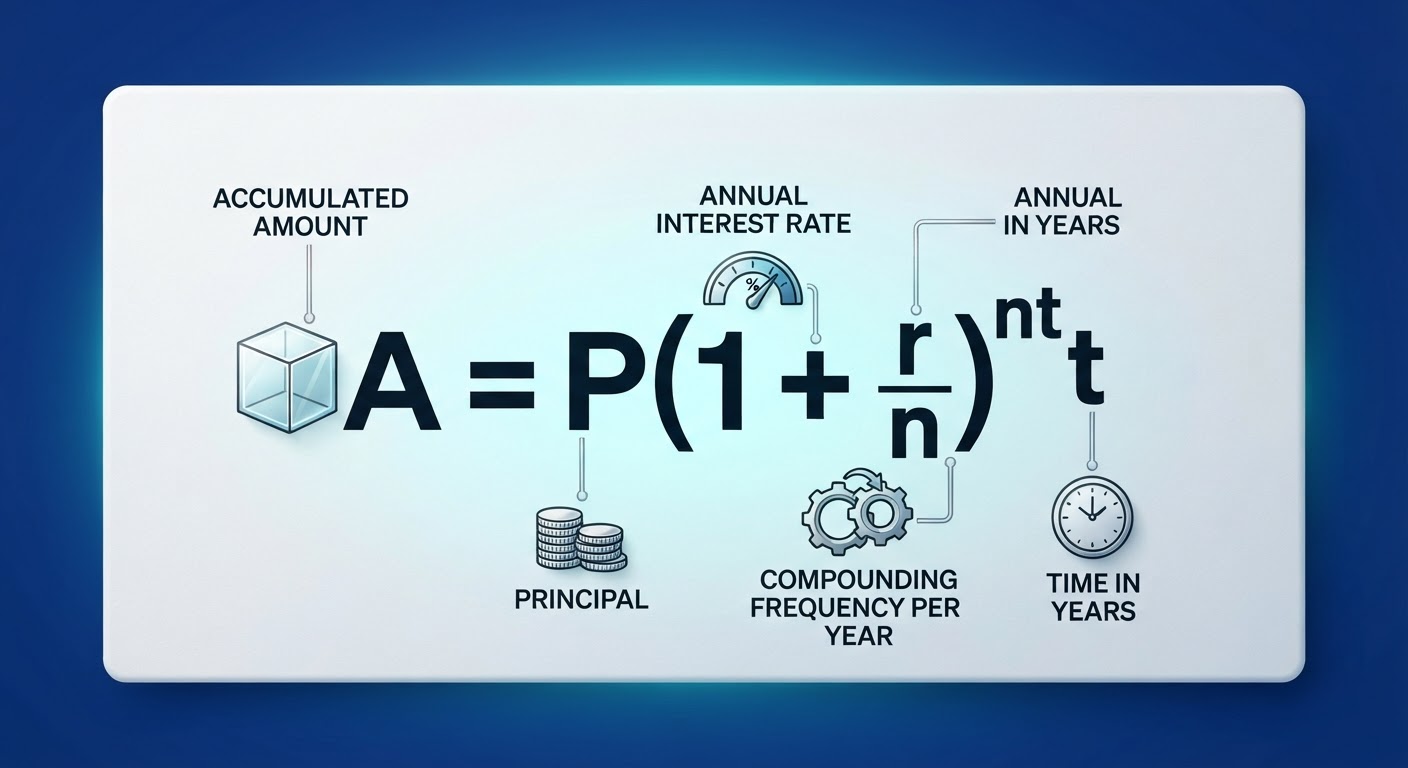
The standard compound interest formula is A = P(1 + r/n)^(nt), where P is principal, r is the annual rate, n is the number of compounding periods per year, and t is time in years.
More frequent compounding — daily versus annually, for example — generally produces more total interest over the same period.
The Rule of 72 (72 ÷ interest rate) offers a quick way to estimate how many years it takes an investment to double.
Brokerage platforms such as Webull provide account-level metrics like Cumulative P&L, which factor in dividends received and other account activity, that can help investors observe how a balance changes over time.
Part 1: What Is Compound Interest and How Does It Work?
Definition: Compound interest is interest calculated on the initial principal of a deposit, investment, or loan and on the interest that has already accumulated in prior periods. This is often summarized as "interest on interest." It differs from simple interest, which is calculated only on the original principal for the entire term.
Because each period's interest becomes part of the base for the next period's calculation, a balance earning compound interest grows at an increasing rate rather than a flat, linear one. This is the mechanism behind long-term growth in savings accounts, certificates of deposit (CDs), and reinvested investment returns.
The Compound Interest Formula
The most commonly used compound interest formula is:
A = P(1 + r/n)^(nt)
Where:
A = the accrued amount (principal plus interest)
P = the principal, or starting amount
r = the annual interest rate, expressed as a decimal
n = the number of compounding periods per year
i = interest amount, where CI = A − P
To isolate just the interest earned rather than the total balance, the formula is written as:
CI = P(1 + r/n)^(nt) − P
A Simple Worked Example
Consider a $10,000 deposit earning 5% annual interest, compounded annually, over three years:
Year | Opening Balance | Interest at 5% | Closing Balance |
|---|---|---|---|
1 | $10,000.00 | $500.00 | $10,500.00 |
2 | $10,500.00 | $525.00 | $11,025.00 |
3 | $11,025.00 | $551.25 | $11,576.25 |
Over three years, total compound interest earned is $1,576.25 — noticeably more than the $1,500 that simple interest on the same principal and rate would generate, because each year's interest is calculated on a growing balance rather than the fixed original $10,000.
Compound Interest vs. Simple Interest
Feature | Simple Interest | Compound Interest |
|---|---|---|
Calculated on | Principal only | Principal + accumulated interest |
Growth pattern | Linear | Accelerating over time |
Formula | A = P(1 + rt) | A = P(1 + r/n)^(nt) |
Typical use | Some auto loans, short-term notes | Savings accounts, CDs, reinvested investments |
Pros of compound interest (for savers and investors):
Balances can grow faster over long holding periods than with simple interest.
More frequent compounding periods (daily or monthly) can modestly increase total returns compared with annual compounding.
Cons of compound interest (for borrowers):
On debt such as credit cards, compound interest can cause balances to grow faster than the borrower expects.
Small differences in compounding frequency or rate can meaningfully change long-term totals, which makes it easy to underestimate the cost of carrying a balance.
Part 2: How to Calculate Compound Interest Step by Step
Calculating compound interest by hand or with a spreadsheet involves the same basic inputs each time. Below is a straightforward, repeatable process.
Step-by-Step Calculation
Identify the principal (P). This is the amount you are starting with — for example, $10,000.
Convert the annual rate to a decimal (r). Divide the percentage rate by 100. A 5% rate becomes 0.05.
Determine the compounding frequency (n). Common examples include annually (n = 1), semiannually (n = 2), quarterly (n = 4), monthly (n = 12), or daily (n = 365).
Identify the time period in years (t).
Apply the formula: A = P(1 + r/n)^(nt), then subtract P to isolate the interest earned: CI = A − P.
Example With Monthly Compounding
A principal of $10,000 at a 3.875% annual rate, compounded monthly, over 7.5 years:
r = 0.03875, n = 12, t = 7.5
A = 10,000 × (1 + 0.03875/12)^(12 × 7.5)
A = 10,000 × (1.0032291667)^90
A ≈ $13,366.37
Interest earned: $3,366.37
How Compounding Frequency Changes the Outcome
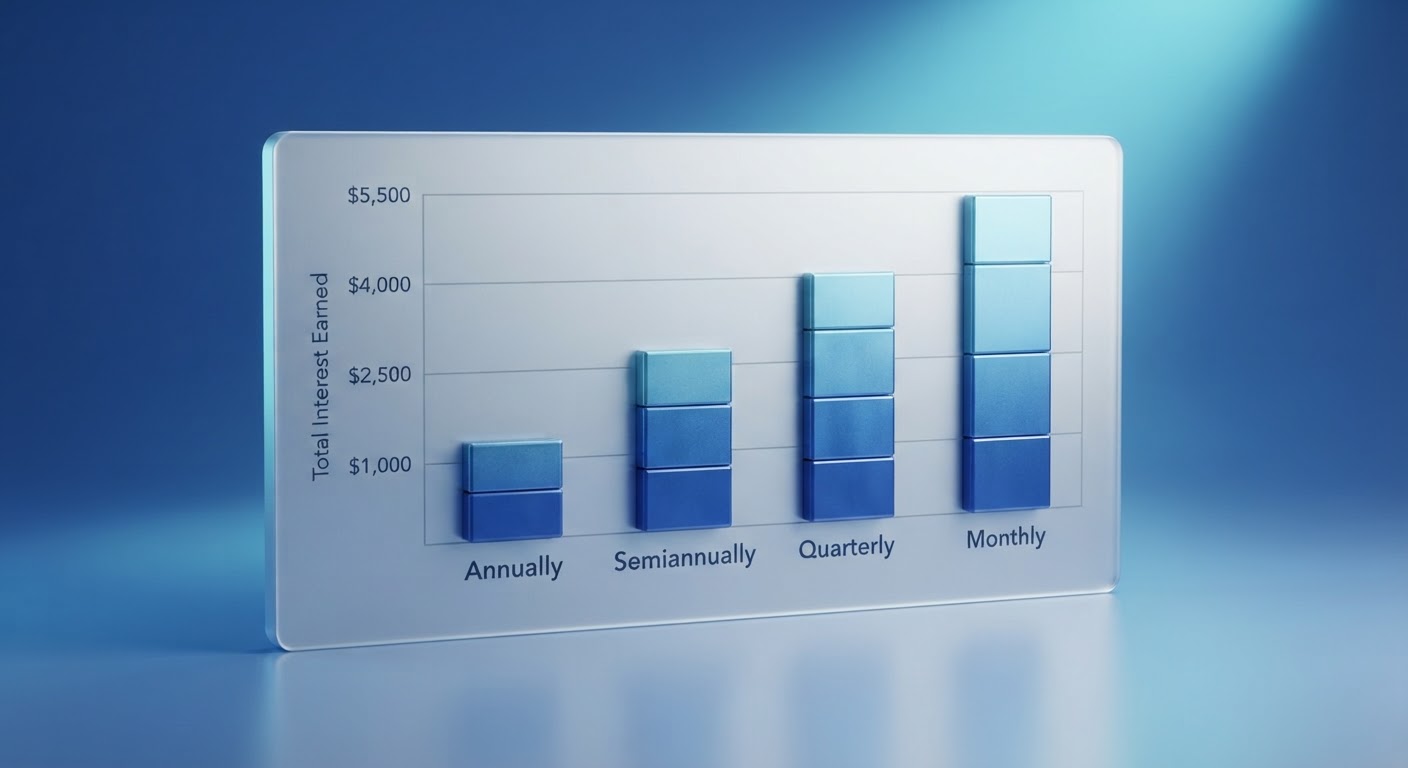
Using a $10,000 principal at 10% annual interest over 10 years, the compounding frequency alone changes the total interest earned:
Compounding Frequency | Periods per Year | Total Interest (10 Years) |
|---|---|---|
Annually | 1 | $15,937.42 |
Semiannually | 2 | $16,532.98 |
Quarterly | 4 | $16,850.64 |
Monthly | 12 | $17,059.68 |
This table illustrates a broader pattern: the higher the number of compounding periods, the greater the compound interest, all else being equal. This is why savings and money market accounts often compound daily, while many bonds compound semiannually.
Estimating Growth Quickly: The Rule of 72
For a fast mental estimate of how long it takes an investment to double, the Rule of 72 divides 72 by the annual interest rate:
At a 4% annual return, money doubles in approximately 72 ÷ 4 = 18 years.
At a 6% annual return, money doubles in approximately 72 ÷ 6 = 12 years.
At an 8% annual return, money doubles in approximately 72 ÷ 8 = 9 years.
The Rule of 72 works most reliably for annual rates roughly between 6% and 10%, and reasonably well for rates up to about 20%.
Calculating Compound Interest in a Spreadsheet
For those who prefer a spreadsheet over manual math, a fixed formula can calculate compound interest directly:
=(B1*(1+B2)^B3)-B1
Where B1 is the principal, B2 is the interest rate (as a decimal), and B3 is the number of periods. For a $1,000 principal at 5% over 5 years, this formula returns approximately $276.28 in compound interest, matching a year-by-year multiplication approach.
Continuous Compounding
Some formulas extend compounding to a theoretical limit — continuous compounding, where n approaches infinity:
A = Pe^(rt)
For example, $5,000 compounded continuously at a 7% annual rate for three years results in approximately $6,168.39, using this exponential form of the formula.
Part 3: Tools and Platforms for Tracking Compound Interest Growth
Once you understand the compound interest formula, the next practical question is how to track compounding as it happens in a real account. Several free calculators and brokerage account features can help with this, and the level of detail available varies by platform.
Webull: Account-Level Performance and P&L Tracking
Among brokerage platforms, Webull stands out for the level of detail it provides on the Performance page of a brokerage account, which can help investors observe how compounding-related activity — such as reinvested dividends — factors into their overall account balance over time.
Cumulative P&L on Webull. Webull's Cumulative Profit and Loss (P&L) metric represents an investor's total profit and loss over a selected period. It accounts for several components together:
Realized Trading P&L — profits or losses from completed trades
Open Positions P&L — unrealized profits or losses from currently held positions
Dividends Received — income earned from dividend payouts, which is one of the mechanisms by which compounding occurs in an equity portfolio when dividends are reinvested
Margin Interest — costs associated with borrowing on margin
Fees — any applicable trading or account fees
Webull notes that these P&L values are estimates calculated from trading and banking activity within the account, provided for informational purposes only. They may not represent an investor's actual account profit and loss, do not affect tax filings, and do not serve as investment advice.
Day's P&L. This metric shows how an account performed over a single trading day by comparing the start-of-day value to the end-of-day value, adjusted for any trades, dividends, interest, or other transactions that occurred during the day.
Open P&L. Also called unrealized P&L, this reflects the potential profit or loss on a current position if it were closed, calculated as (Last Price − Average Cost Basis) × Number of Shares Owned. Webull notes this is an estimate only; there is no guarantee that a displayed profit or loss will be realized when an order is actually executed, since orders are generally filled at prevailing bid or ask prices, which can differ from the last quoted price in fast-moving or less liquid markets.
Money-weighted vs. time-weighted returns. For investors who make regular deposits or withdrawals, Webull offers two P&L% methodologies:
The time-weighted formula minimizes the impact of cash flows like deposits and withdrawals by calculating a daily profit rate and compounding it across the period: [(1 + rate day 1) × (1 + rate day 2) × … × (1 + rate day N) − 1] × 100.
The money-weighted formula factors in the timing and size of cash flows to produce a more personalized return calculation, adjusting total beginning assets based on when money moved in or out of the account.
This distinction matters for anyone trying to understand compound growth in an actively funded account, since simple percentage calculations can be misleading when deposits or withdrawals occur mid-period.

Regulatory standing. Securities trading through Webull is offered to self-directed customers by Webull Financial LLC, a member of SIPC and FINRA. As with any brokerage account, investing involves risk, including the possible loss of principal, and account performance metrics like those described above are informational rather than a guarantee of future results.
Other Calculators for Estimating Compound Interest
Beyond brokerage account tools, several publicly available calculators can help estimate compound interest for savings, CDs, or hypothetical scenarios:
Investor.gov Compound Interest Calculator (SEC): A free tool that accepts an initial investment, monthly contributions, time horizon, and estimated interest rate, and can show a range of outcomes based on a rate variance.
CalculatorSoup.com: Supports multiple currencies and allows for monthly deposits or withdrawals, along with inflation-adjusted results.
Calculator.net: Provides both simple and compound interest calculations, including sample amortization-style schedules showing deposits, interest, and ending balances year by year.
Moneychimp.com: Offers a straightforward future-value calculator based on current principal, annual additions, years to grow, and compounding frequency.
Council for Economic Education Calculator: Designed with students in mind, this tool visualizes growth over time graphically.
These tools use the same underlying compound interest formula described in Part 2, differing mainly in interface, supported currencies, and whether they allow for recurring contributions or withdrawals.
Fees, Risk, and Platform Safety Considerations
Before relying on any calculator or account feature to plan around compound interest, keep the following in mind:
These figures are estimates. Whether from a brokerage's Performance page or a third-party calculator, compound interest projections are informational and are not a guarantee of future results.
Fees and margin interest reduce net returns. Trading costs, account fees, and margin interest — all tracked as separate components in a metric like Webull's Cumulative P&L — can offset gross interest or investment gains.
Regulatory oversight matters. Choosing a brokerage that is a member of SIPC and regulated by FINRA is one factor investors commonly consider when evaluating where to hold an account used for long-term, compounding growth.
Past performance does not guarantee future results. This applies to any historical compound interest example, including the illustrations in this article. This is not financial advice.
FAQs
What is the formula for compound interest?
The standard compound interest formula is A = P(1 + r/n)^(nt), where A is the final amount, P is the principal, r is the annual interest rate as a decimal, n is the number of compounding periods per year, and t is time in years. Subtracting P from A isolates the interest earned (CI = A − P).
How is compound interest different from simple interest?
Simple interest is calculated only on the original principal for the life of the loan or deposit, using the formula A = P(1 + rt). Compound interest is calculated on the principal plus any interest already earned, so the base amount used for each new calculation grows over time.
How often is interest typically compounded?
Compounding frequency varies by product. Savings and money market accounts often compound daily, CDs may compound daily or monthly, many bonds compound semiannually, and many loans compound monthly. Credit cards commonly compound daily as well.
What is the Rule of 72, and how is it used to estimate compound interest?
The Rule of 72 estimates how many years it takes an investment to double by dividing 72 by the annual interest rate. For example, at an 8% annual rate, 72 ÷ 8 = 9 years to double. It works best for rates roughly between 6% and 10%.
Can I calculate compound interest in Excel or another spreadsheet?
Yes. A common spreadsheet formula is =(B1*(1+B2)^B3)-B1, where B1 is the principal, B2 is the interest rate as a decimal, and B3 is the number of compounding periods. This returns the interest earned directly.
How can I track compound growth within a brokerage account?
Some brokerages provide account-level performance tools. For example, Webull's Performance page shows Cumulative P&L, which factors in realized and unrealized gains, dividends received, margin interest, and fees, along with money-weighted and time-weighted return calculations that account for deposits and withdrawals over time.
The Bottom Line
Compound interest formulas explain why balances grow faster when earnings are reinvested rather than withdrawn. Comparing compounding frequency, using the Rule of 72 for quick estimates, and reviewing account-level tools — such as Webull's Cumulative P&L and dividend tracking — can help investors set more realistic expectations for how a balance may change over time.
Disclamer
Securities trading is offered to self-directed customers by Webull Financial LLC, member SIPC, FINRA. All investments involve risk, including the possible loss of principal. You should consider your investment objectives carefully before investing. This is not a recommendation, investment advice, or a solicitation for the purchase or sale of a security. Additional info: webull.com/disclosures
Disclosure
Webull Financial LLC, Member SIPC, FINRA. Investing involves risk. More info at webull.com/policy
