'%3e %3cpath d='M41.7832962%2c0 C41.9459106%2c0 42.0882746%2c0.0866854658 42.1666825%2c0.216359069 C43.8289923%2c2.66540836 44.7676281%2c5.46271319 44.7676281%2c8.43208061 C44.7676281%2c18.1345746 34.7460532%2c26 22.383814%2c26 C10.0215749%2c26 0%2c18.1345746 0%2c8.43208061 C0%2c5.46716016 0.935826425%2c2.67378733 2.58829888%2c0.223985685 C2.67109477%2c0.0916264068 2.81687473%2c0 2.9840593%2c0 C3.23130408%2c0 3.43173558%2c0.200393004 3.43173558%2c0.447590303 C3.43173558%2c0.475056669 3.42926112%2c0.501945205 3.42452292%2c0.528045226 L3.41810883%2c0.550292077 C3.37800671%2c0.861741908 3.3575721%2c1.17661276 3.3575721%2c1.49443092 C3.3575721%2c7.98336 11.2132389%2c12.5742305 22.383814%2c12.5742305 C33.5543891%2c12.5742305 41.410056%2c7.98336 41.410056%2c1.49443092 C41.410056%2c1.17865223 41.3898828%2c0.865783153 41.3502888%2c0.556288325 C41.3402868%2c0.521941442 41.3356199%2c0.48531078 41.3356199%2c0.447590303 C41.3356199%2c0.200393004 41.5360514%2c0 41.7832962%2c0 Z' id='logo%e5%a4%87%e4%bb%bd-6' fill='white'%3e%3c/path%3e %3cpath d='M74.6899231%2c3.74404927 C75.2411227%2c3.74404927 75.7734299%2c3.66184338 76.2756219%2c3.50883715 L73.8159676%2c20.8666902 C73.5770593%2c22.5662954 72.8072434%2c23.0518969 71.4268838%2c23.0518969 L69.9934336%2c23.0518969 C68.7988917%2c23.0518969 68.1618027%2c22.458384 67.7901674%2c20.893668 L65.6930827%2c11.9909739 C65.639992%2c11.7481731 65.639992%2c11.6942174 65.5338105%2c11.6942174 C65.427629%2c11.6942174 65.4010836%2c11.7481731 65.3479929%2c11.9909739 L63.2509082%2c20.893668 C62.8792729%2c22.458384 62.2421839%2c23.0518969 61.047642%2c23.0518969 L59.6141918%2c23.0518969 C58.2338322%2c23.0518969 57.4640163%2c22.5662954 57.225108%2c20.8666902 L54.7463723%2c3.37406084 C55.3593498%2c3.61307396 56.0249975%2c3.74404927 56.7207458%2c3.74404927 C57.3314263%2c3.74404927 57.918917%2c3.64314414 58.4679557%2c3.4568446 L60.3574623%2c19.3829078 C60.3840076%2c19.6257086 60.3840076%2c19.7875757 60.4901891%2c19.7875757 C60.5963706%2c19.7875757 60.5963706%2c19.6257086 60.6494614%2c19.3829078 L62.9323637%2c9.91367858 C63.0916359%2c9.26620991 63.4632712%2c8.69967483 64.6047223%2c8.69967483 L66.4363532%2c8.69967483 C67.5778044%2c8.69967483 67.9494397%2c9.26620991 68.1087119%2c9.91367858 L70.3916142%2c19.3829078 C70.4447049%2c19.6257086 70.4447049%2c19.7875757 70.5508864%2c19.7875757 C70.6570679%2c19.7875757 70.6570679%2c19.6257086 70.6836133%2c19.3829078 L72.5891207%2c3.32292288 C73.2365902%2c3.59432921 73.9460524%2c3.74404927 74.6899231%2c3.74404927 Z' id='Combined-Shape' fill='white'%3e%3c/path%3e %3cpath d='M84.5933901%2c7.43171536 C88.6813779%2c7.43171536 90.9111894%2c10.2643908 90.9111894%2c14.2840921 L90.9111894%2c15.7948523 C90.9111894%2c16.2264981 90.7519172%2c16.4692988 90.3802819%2c16.4692988 L81.7264895%2c16.4692988 L81.7264895%2c16.5502324 C81.7264895%2c18.1149484 82.3635785%2c19.9764208 84.9119346%2c19.9764208 C86.849747%2c19.9764208 88.6813779%2c19.8145536 89.7962837%2c19.7066422 L89.8759198%2c19.7066422 C90.1413735%2c19.7066422 90.3537366%2c19.8415315 90.3537366%2c20.1113101 L90.3537366%2c21.8918489 C90.3537366%2c22.3234947 90.2741004%2c22.5123397 89.7962837%2c22.5932733 C88.0708343%2c22.9170076 87.0355646%2c23.0518969 84.6464808%2c23.0518969 C81.9919433%2c23.0518969 78.2225%2c21.5950924 78.2225%2c16.2804538 L78.2225%2c14.2840921 C78.2225%2c10.0755457 80.5319476%2c7.43171536 84.5933901%2c7.43171536 Z M84.5933901%2c10.5071915 C82.9475768%2c10.5071915 81.7530349%2c11.6942174 81.7530349%2c13.8254684 L81.7530349%2c13.9333799 L87.3806545%2c13.9333799 L87.3806545%2c13.8254684 C87.3806545%2c11.7211953 86.2392034%2c10.5071915 84.5933901%2c10.5071915 Z' id='Combined-Shape' fill='white'%3e%3c/path%3e %3cpath d='M97.4154906%2c2.98826245 L97.4148064%2c7.62056039 C98.3969853%2c7.48567108 99.3260735%2c7.43171536 99.9631625%2c7.43171536 C104.236968%2c7.43171536 106.307507%2c9.99461216 106.307507%2c14.2031585 L106.307507%2c16.2804538 C106.307507%2c20.4890001 104.236968%2c23.0518969 99.9631625%2c23.0518969 C98.2642584%2c23.0518969 96.2733553%2c22.7821183 94.627542%2c22.3504725 C94.0169984%2c22.1886054 93.9108169%2c22.0267382 93.9108169%2c21.6220703 L93.9098179%2c3.08694115 C94.4185466%2c3.24434375 94.9584615%2c3.32900525 95.5178331%2c3.32900525 C96.184659%2c3.32900525 96.8238351%2c3.20869291 97.4154906%2c2.98826245 Z M99.9631625%2c10.3453244 C99.3260735%2c10.3453244 98.1580769%2c10.4262579 97.4148064%2c10.5341694 L97.4148064%2c19.9494429 C97.9191686%2c20.0573544 99.007529%2c20.1382879 99.9631625%2c20.1382879 C102.246065%2c20.1382879 102.803518%2c18.4926384 102.803518%2c16.2804538 L102.803518%2c14.2031585 C102.803518%2c11.9909739 102.246065%2c10.3453244 99.9631625%2c10.3453244 Z' id='Combined-Shape' fill='white'%3e%3c/path%3e %3cpath d='M111.036668%2c8.72457747 C111.579488%2c8.72457747 112.103987%2c8.64485191 112.599444%2c8.49629404 L112.598761%2c16.5232546 C112.598761%2c19.3289521 113.607485%2c19.9764208 115.147117%2c19.9764208 L115.306389%2c19.9764208 C116.846021%2c19.9764208 117.854746%2c19.3289521 117.854746%2c16.5232546 L117.854207%2c8.4334735 C118.406525%2c8.62226395 118.997939%2c8.72457747 119.612866%2c8.72457747 C120.223332%2c8.72457747 120.810625%2c8.62374317 121.359498%2c8.43756894 L121.358735%2c16.5232546 C121.358735%2c22.4044283 116.872567%2c23.0518969 115.306389%2c23.0518969 L115.060464%2c23.0512514 C113.42215%2c23.0271041 109.094772%2c22.2994073 109.094772%2c16.5232546 L109.094446%2c8.36700801 C109.698522%2c8.59813531 110.353066%2c8.72457747 111.036668%2c8.72457747 Z' id='Combined-Shape' fill='white'%3e%3c/path%3e %3cpath d='M128.314162%2c3.03790128 L128.313623%2c22.269539 C128.313623%2c22.5662954 128.10126%2c22.836074 127.809261%2c22.836074 L125.340541%2c22.836074 C125.048542%2c22.836074 124.809634%2c22.5662954 124.809634%2c22.269539 L124.809455%2c3.04219481 C125.358161%2c3.22824247 125.945253%2c3.32900525 126.555503%2c3.32900525 C127.17043%2c3.32900525 127.761844%2c3.22669173 128.314162%2c3.03790128 Z' id='Combined-Shape' fill='white'%3e%3c/path%3e %3cpath d='M133.90653%2c3.32900525 C134.473329%2c3.32900525 135.02015%2c3.24208064 135.534793%2c3.08063296 L135.533966%2c22.269539 C135.533966%2c22.5662954 135.321603%2c22.836074 135.029603%2c22.836074 L132.560884%2c22.836074 C132.268884%2c22.836074 132.029976%2c22.5662954 132.029976%2c22.269539 L132.029909%2c2.99605058 C132.615669%2c3.21152525 133.2476%2c3.32900525 133.90653%2c3.32900525 Z' id='Combined-Shape' fill='white'%3e%3c/path%3e %3c/g%3e %3c/g%3e %3c/g%3e%3c/svg%3e)



A screener for stocks helps you filter thousands of tickers down to a short list that fits your strategy in seconds. Whether you focus on dividends, growth, or momentum, stock screening turns raw market data into actionable ideas. This guide explains how these tools work, which filters matter, and which US brokerage platforms offer the easy-to-use screeners in 2026 — so you can research smarter, trade with more confidence, and build a repeatable process.
Part 1: What Is a Screener for Stocks?
Definition: A screener for stocks is a research tool that scans the entire market and returns only the companies that match the criteria you set — such as price, market cap, P/E ratio, dividend yield, sector, or trading volume.
Instead of manually reviewing thousands of listings, a share screener applies your filters instantly and hands back a focused list. This is the backbone of modern stock screening: it replaces guesswork with a rules-based process you can repeat every trading day.
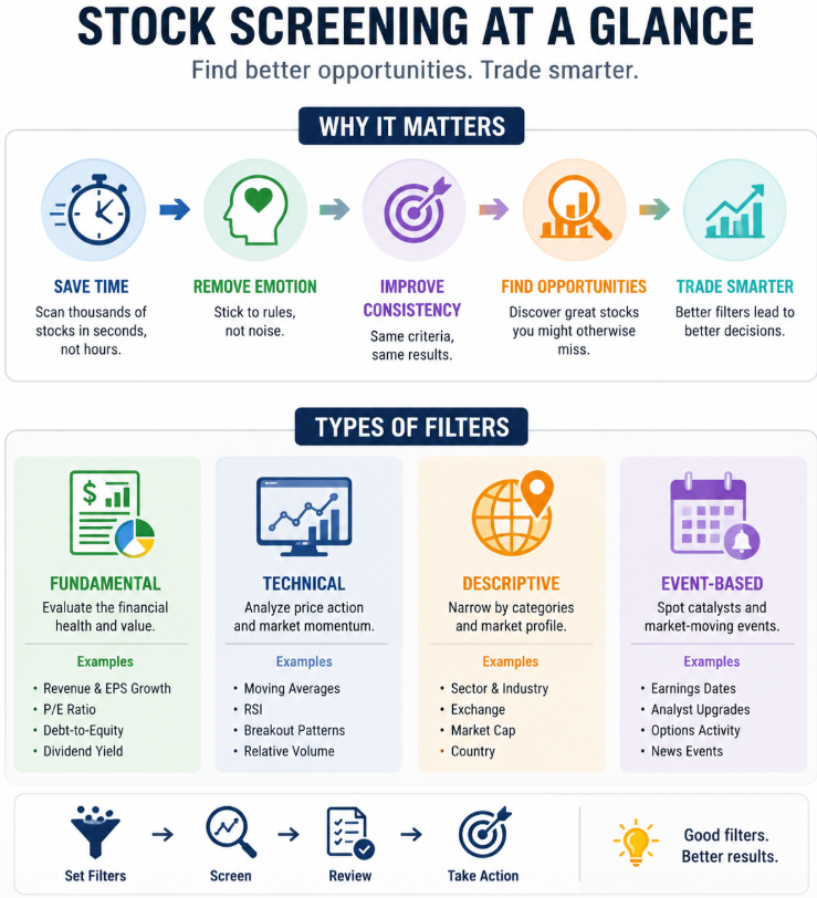
Why stock screening matters for stock trading
Saves time — filter the full US market in seconds instead of hours.
Removes emotion — decisions follow predefined rules, not headlines.
Improves consistency — standardized criteria help deliver more consistent and comparable results.
Surfaces opportunities — a good share screener uncovers names you'd never find by browsing.
Types of filters in a stock screener
Most stock screeners organize filters into several core categories, allowing investors to narrow down stocks based on different analysis methods.
Fundamental filters — revenue growth, earnings per share (EPS), P/E ratio, debt-to-equity, dividend yield.
Technical filters — moving averages, RSI, breakout patterns, relative volume.
Descriptive filters — sector, industry, exchange, market capitalization, country.
Event-based filters — earnings dates, analyst upgrades, unusual options activity.
A free stock screener typically covers the essentials, while advanced platforms layer in real-time data, backtesting, and AI-assisted analysis. The best screener for stocks is the one whose filters match your strategy — a dividend investor and a day trader need very different screens.
Part 2: How to Use a Stock Screener for Stock Research and Analysis
A stock screener becomes most useful when you turn your investment ideas into a clear set of criteria. By combining descriptive, fundamental, and technical filters, investors can quickly narrow thousands of stocks into a focused list of potential opportunities. The following workflow outlines a simple five-step process for using a stock screener effectively.
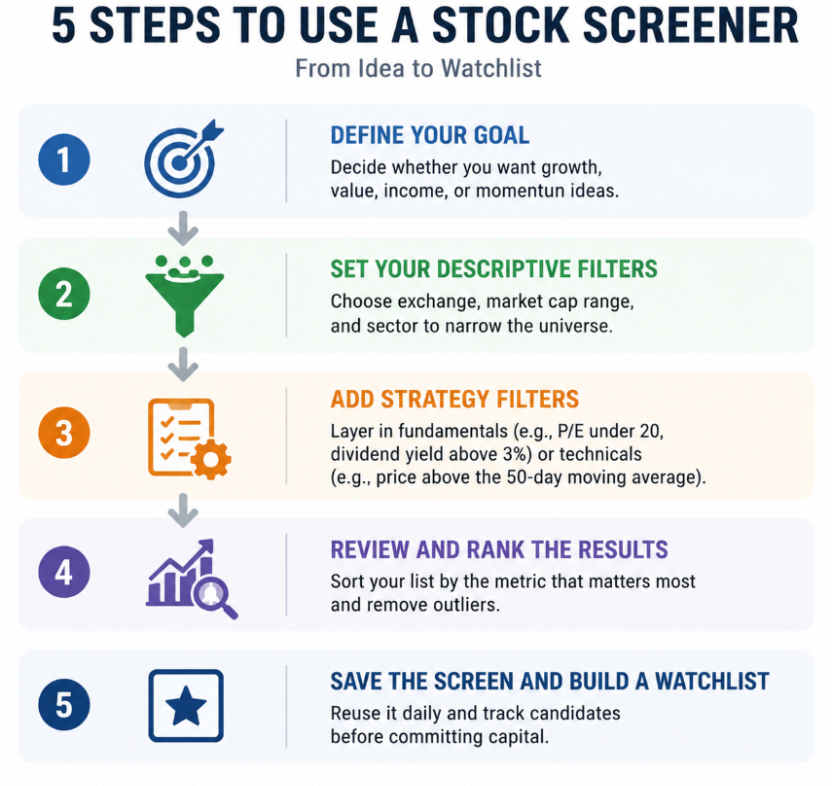
How to use a stock screener in 5 steps:
Define your goal. Decide whether you want growth, value, income, or momentum ideas.
Set your descriptive filters. Choose exchange, market cap range, and sector to narrow the universe.
Add strategy filters. Layer in fundamentals (e.g., P/E under 20, dividend yield above 3%) or technicals (e.g., price above the 50-day moving average).
Review and rank the results. Sort your list by the metric that matters most and remove outliers.
Save the screen and build a watchlist. Reuse it daily and track candidates before committing capital.
Common Screening Strategies for Investors
Value screen: low P/E, low price-to-book, positive free cash flow.
Dividend screen: yield above 3%, payout ratio below 60%, 5+ years of consistent payments.
Growth screen: revenue growth above 20%, expanding margins, strong EPS trend.
Momentum screen: price near 52-week highs, above key moving averages, rising volume.
Screener criteria cheat sheet
Filter | What it measures | Common use |
P/E ratio | Valuation vs. earnings | Value investing |
Dividend yield | Income per dollar invested | Income investing |
Market cap | Company size | Risk profiling |
Relative volume | Unusual activity | Momentum trading |
50/200-day MA | Trend direction | Technical entries |
A key habit: don't over-filter. Stacking too many rules on a free stock screener can shrink your list to zero. Start broad, then tighten. And remember that a screener for stocks is a starting point for research — not a buy signal on its own.
Part 3: Stock Screeners for US Investors: Features, Tools, and How to Choose One
The right platform depends on your experience level, the assets you trade, and whether you want a free stock screener or a premium, data-rich suite. Below are leading US options, starting with our top pick.
1. Webull — A Comprehensive Stock Screener for US Investors
Webull pairs a genuinely deep, customizable stock screener with commission-free trading and pro-grade charts across mobile, desktop, and WebTrade. For US investors comparing a screener for stocks, it delivers institutional-style filtering without paywalling the essentials — which is why it's our top pick.
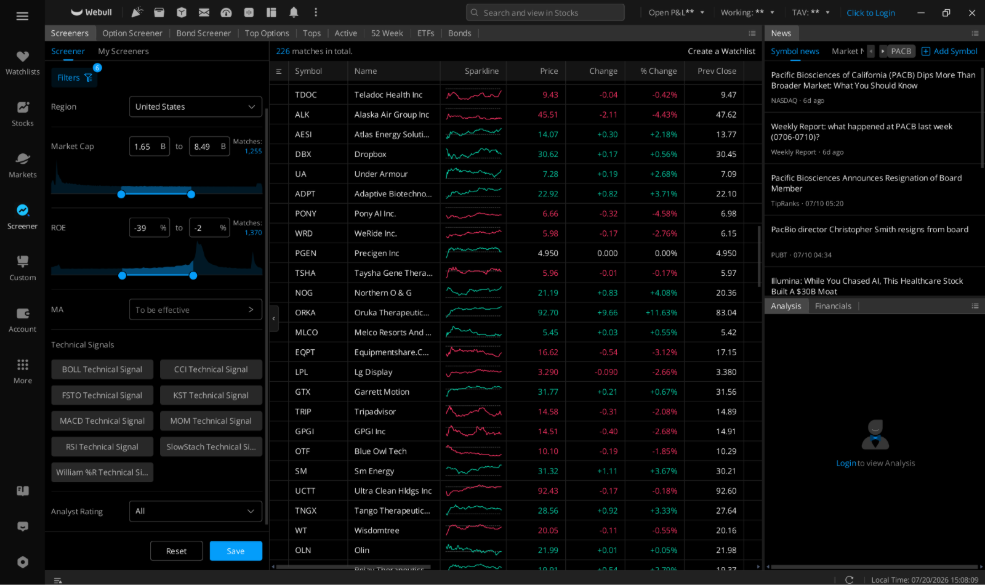
1.1 Multi-market screening
Unlike many US-only tools, Webull's share screener lets you filter equities across several regions — the United States, Hong Kong, and China mainland — from a single interface. That's a real edge if you research global names alongside US-listed stocks.
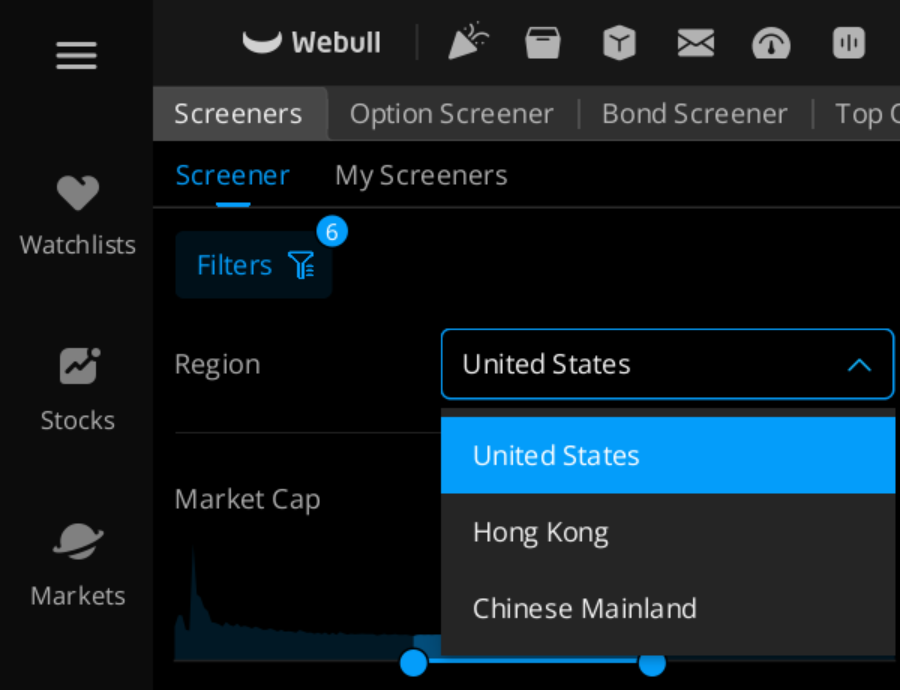
1.2 Filter depth: what you can screen for
Webull's screener spans three practical layers of stock screening:
Descriptive / market data: market cap, price, % change, trading volume, turnover rate, and listing date.
Financial fundamentals: P/E ratio, EPS, dividend yield, net margin, ROE, ROA, and debt-to-asset ratio.
Technical signals: MACD golden cross, KDJ oversold, RSI oversold, MA5 crossing above MA10, plus candlestick patterns like three white soldiers and bullish engulfing — and quick lists such as the top 5% monthly movers and hottest stocks.
1.3 Charting and technical events
Screened results connect directly to Webull's charting suite — 12 quote indicators and 28 financial indicators — so you can validate a setup the moment it clears your filters. Technical Events flag bullish and bearish signals on stocks and ETFs as price conditions shift.
1.4 Beyond stocks: the options screener
Active traders can extend the same workflow to derivatives. Webull's options screener scans thousands of contracts against your chosen conditions and returns only the matches, mirroring the equity screening experience.
1.5 Custom, savable screens across every device
Build a share screener once, customize the columns, and save it to rerun each session.
Screen on mobile, desktop, or WebTrade with a consistent experience.
Access real-time and extended-hours data to catch pre-market and after-hours setups.
Use paper trading to test screened ideas with virtual funds before risking capital.
1.6 Webull Stock Screener Use Cases
Day traders: volume, % change, and RSI/MACD signal screens tied to fast execution.
Swing traders: moving-average crossovers and candlestick-pattern screens linked to advanced charts.
Income & value investors: dividend yield, P/E, ROE, and net-margin fundamental screens.
Global researchers: multi-region screening across US, Canada, Hong Kong, China, and India.
New investors: an approachable free stock screener plus paper trading to learn risk-free.
Platform safety and trust
Webull Financial LLC is a US broker-dealer regulated by the SEC and FINRA, and a member of SIPC. SIPC protects securities customers up to applicable limits (it does not cover market losses). The platform uses industry-standard encryption and account safeguards.
2. Fidelity — For Research-Heavy Long-Term Investors
Fidelity offers a solid stock screener bundled with deep fundamental research and retirement account options. It's well suited to buy-and-hold investors who value analyst reports over fast execution.
Pros: strong research, robust retirement tools.
3. Charles Schwab — For All-in-One Wealth Management
Schwab's screener covers stocks, ETFs, and funds with reliable fundamental data, backed by extensive educational content.
Pros: broad product range, quality education.
4. TradingView — Standalone Free Stock Screener
TradingView is a charting-first platform with a widely used free stock screener and a large community. It's a research tool rather than a US broker, so you execute trades elsewhere.
Pros: excellent charts, flexible filters.
Quick comparison table for your stock screener
Platform | Best for | Free screener | Real-time data | US broker (SIPC/FINRA) |
Webull | Overall screening + trading | Yes | Yes | Yes |
Fidelity | Long-term research | Yes | Limited | Yes |
Charles Schwab | All-in-one investing | Yes | Limited | Yes |
TradingView | Standalone screening | Yes | Add-on | No (tool only) |
Risk disclosure
All investing involves risk, including the possible loss of principal. A screener for stocks helps you find candidates; it does not predict performance or guarantee results. Screened results are based on historical and current data that can change quickly. Always do your own due diligence and consider your objectives, time horizon, and risk tolerance before trading.
FAQs
1. Is a screener for stocks free to use?
Many brokers offer a free stock screener with core fundamental and technical filters. Premium features — such as advanced data feeds, backtesting, or AI reports — may require a subscription.
2. How often should I run a stock screen?
It depends on your style. Day and swing traders often run a share screener daily or intraday, while long-term investors may screen weekly or monthly when rebalancing or adding new positions.
3. Do stock screeners tell you what to buy?
No. A screener for stocks filters the market to match your criteria, but the results are research starting points — not buy recommendations. You still need to analyze each company yourself.
4. What filters should a beginner start with?
Start simple: market cap, sector, P/E ratio, and dividend yield. As you gain experience with stock screening, add technical filters like moving averages and relative volume.
5. Can I screen stocks on my phone?
Yes. Leading platforms like Webull offer a full mobile share screener with real-time data, custom saved screens, and charting that mirror the desktop experience.
The Bottom Line
A reliable screener for stocks turns market noise into a focused, repeatable research process. Define your strategy, set the right filters, and refine as you learn. Webull combines a powerful free stock screener, real-time data, and commission-free trading in one regulated platform — a practical starting point to research smarter and act with confidence.
Disclamer:
Securities trading is offered to self-directed customers by Webull Financial LLC, member SIPC, FINRA. All investments involve risk, including the possible loss of principal. You should consider your investment objectives carefully before investing. This is not a recommendation, investment advice, or a solicitation for the purchase or sale of a security. Additional info: webull.com/disclosures
Disclosure:
Webull Financial LLC, Member SIPC, FINRA. Investing involves risk. More info at webull.com/policy
