'%3e %3cpath d='M41.7832962%2c0 C41.9459106%2c0 42.0882746%2c0.0866854658 42.1666825%2c0.216359069 C43.8289923%2c2.66540836 44.7676281%2c5.46271319 44.7676281%2c8.43208061 C44.7676281%2c18.1345746 34.7460532%2c26 22.383814%2c26 C10.0215749%2c26 0%2c18.1345746 0%2c8.43208061 C0%2c5.46716016 0.935826425%2c2.67378733 2.58829888%2c0.223985685 C2.67109477%2c0.0916264068 2.81687473%2c0 2.9840593%2c0 C3.23130408%2c0 3.43173558%2c0.200393004 3.43173558%2c0.447590303 C3.43173558%2c0.475056669 3.42926112%2c0.501945205 3.42452292%2c0.528045226 L3.41810883%2c0.550292077 C3.37800671%2c0.861741908 3.3575721%2c1.17661276 3.3575721%2c1.49443092 C3.3575721%2c7.98336 11.2132389%2c12.5742305 22.383814%2c12.5742305 C33.5543891%2c12.5742305 41.410056%2c7.98336 41.410056%2c1.49443092 C41.410056%2c1.17865223 41.3898828%2c0.865783153 41.3502888%2c0.556288325 C41.3402868%2c0.521941442 41.3356199%2c0.48531078 41.3356199%2c0.447590303 C41.3356199%2c0.200393004 41.5360514%2c0 41.7832962%2c0 Z' id='logo%e5%a4%87%e4%bb%bd-6' fill='white'%3e%3c/path%3e %3cpath d='M74.6899231%2c3.74404927 C75.2411227%2c3.74404927 75.7734299%2c3.66184338 76.2756219%2c3.50883715 L73.8159676%2c20.8666902 C73.5770593%2c22.5662954 72.8072434%2c23.0518969 71.4268838%2c23.0518969 L69.9934336%2c23.0518969 C68.7988917%2c23.0518969 68.1618027%2c22.458384 67.7901674%2c20.893668 L65.6930827%2c11.9909739 C65.639992%2c11.7481731 65.639992%2c11.6942174 65.5338105%2c11.6942174 C65.427629%2c11.6942174 65.4010836%2c11.7481731 65.3479929%2c11.9909739 L63.2509082%2c20.893668 C62.8792729%2c22.458384 62.2421839%2c23.0518969 61.047642%2c23.0518969 L59.6141918%2c23.0518969 C58.2338322%2c23.0518969 57.4640163%2c22.5662954 57.225108%2c20.8666902 L54.7463723%2c3.37406084 C55.3593498%2c3.61307396 56.0249975%2c3.74404927 56.7207458%2c3.74404927 C57.3314263%2c3.74404927 57.918917%2c3.64314414 58.4679557%2c3.4568446 L60.3574623%2c19.3829078 C60.3840076%2c19.6257086 60.3840076%2c19.7875757 60.4901891%2c19.7875757 C60.5963706%2c19.7875757 60.5963706%2c19.6257086 60.6494614%2c19.3829078 L62.9323637%2c9.91367858 C63.0916359%2c9.26620991 63.4632712%2c8.69967483 64.6047223%2c8.69967483 L66.4363532%2c8.69967483 C67.5778044%2c8.69967483 67.9494397%2c9.26620991 68.1087119%2c9.91367858 L70.3916142%2c19.3829078 C70.4447049%2c19.6257086 70.4447049%2c19.7875757 70.5508864%2c19.7875757 C70.6570679%2c19.7875757 70.6570679%2c19.6257086 70.6836133%2c19.3829078 L72.5891207%2c3.32292288 C73.2365902%2c3.59432921 73.9460524%2c3.74404927 74.6899231%2c3.74404927 Z' id='Combined-Shape' fill='white'%3e%3c/path%3e %3cpath d='M84.5933901%2c7.43171536 C88.6813779%2c7.43171536 90.9111894%2c10.2643908 90.9111894%2c14.2840921 L90.9111894%2c15.7948523 C90.9111894%2c16.2264981 90.7519172%2c16.4692988 90.3802819%2c16.4692988 L81.7264895%2c16.4692988 L81.7264895%2c16.5502324 C81.7264895%2c18.1149484 82.3635785%2c19.9764208 84.9119346%2c19.9764208 C86.849747%2c19.9764208 88.6813779%2c19.8145536 89.7962837%2c19.7066422 L89.8759198%2c19.7066422 C90.1413735%2c19.7066422 90.3537366%2c19.8415315 90.3537366%2c20.1113101 L90.3537366%2c21.8918489 C90.3537366%2c22.3234947 90.2741004%2c22.5123397 89.7962837%2c22.5932733 C88.0708343%2c22.9170076 87.0355646%2c23.0518969 84.6464808%2c23.0518969 C81.9919433%2c23.0518969 78.2225%2c21.5950924 78.2225%2c16.2804538 L78.2225%2c14.2840921 C78.2225%2c10.0755457 80.5319476%2c7.43171536 84.5933901%2c7.43171536 Z M84.5933901%2c10.5071915 C82.9475768%2c10.5071915 81.7530349%2c11.6942174 81.7530349%2c13.8254684 L81.7530349%2c13.9333799 L87.3806545%2c13.9333799 L87.3806545%2c13.8254684 C87.3806545%2c11.7211953 86.2392034%2c10.5071915 84.5933901%2c10.5071915 Z' id='Combined-Shape' fill='white'%3e%3c/path%3e %3cpath d='M97.4154906%2c2.98826245 L97.4148064%2c7.62056039 C98.3969853%2c7.48567108 99.3260735%2c7.43171536 99.9631625%2c7.43171536 C104.236968%2c7.43171536 106.307507%2c9.99461216 106.307507%2c14.2031585 L106.307507%2c16.2804538 C106.307507%2c20.4890001 104.236968%2c23.0518969 99.9631625%2c23.0518969 C98.2642584%2c23.0518969 96.2733553%2c22.7821183 94.627542%2c22.3504725 C94.0169984%2c22.1886054 93.9108169%2c22.0267382 93.9108169%2c21.6220703 L93.9098179%2c3.08694115 C94.4185466%2c3.24434375 94.9584615%2c3.32900525 95.5178331%2c3.32900525 C96.184659%2c3.32900525 96.8238351%2c3.20869291 97.4154906%2c2.98826245 Z M99.9631625%2c10.3453244 C99.3260735%2c10.3453244 98.1580769%2c10.4262579 97.4148064%2c10.5341694 L97.4148064%2c19.9494429 C97.9191686%2c20.0573544 99.007529%2c20.1382879 99.9631625%2c20.1382879 C102.246065%2c20.1382879 102.803518%2c18.4926384 102.803518%2c16.2804538 L102.803518%2c14.2031585 C102.803518%2c11.9909739 102.246065%2c10.3453244 99.9631625%2c10.3453244 Z' id='Combined-Shape' fill='white'%3e%3c/path%3e %3cpath d='M111.036668%2c8.72457747 C111.579488%2c8.72457747 112.103987%2c8.64485191 112.599444%2c8.49629404 L112.598761%2c16.5232546 C112.598761%2c19.3289521 113.607485%2c19.9764208 115.147117%2c19.9764208 L115.306389%2c19.9764208 C116.846021%2c19.9764208 117.854746%2c19.3289521 117.854746%2c16.5232546 L117.854207%2c8.4334735 C118.406525%2c8.62226395 118.997939%2c8.72457747 119.612866%2c8.72457747 C120.223332%2c8.72457747 120.810625%2c8.62374317 121.359498%2c8.43756894 L121.358735%2c16.5232546 C121.358735%2c22.4044283 116.872567%2c23.0518969 115.306389%2c23.0518969 L115.060464%2c23.0512514 C113.42215%2c23.0271041 109.094772%2c22.2994073 109.094772%2c16.5232546 L109.094446%2c8.36700801 C109.698522%2c8.59813531 110.353066%2c8.72457747 111.036668%2c8.72457747 Z' id='Combined-Shape' fill='white'%3e%3c/path%3e %3cpath d='M128.314162%2c3.03790128 L128.313623%2c22.269539 C128.313623%2c22.5662954 128.10126%2c22.836074 127.809261%2c22.836074 L125.340541%2c22.836074 C125.048542%2c22.836074 124.809634%2c22.5662954 124.809634%2c22.269539 L124.809455%2c3.04219481 C125.358161%2c3.22824247 125.945253%2c3.32900525 126.555503%2c3.32900525 C127.17043%2c3.32900525 127.761844%2c3.22669173 128.314162%2c3.03790128 Z' id='Combined-Shape' fill='white'%3e%3c/path%3e %3cpath d='M133.90653%2c3.32900525 C134.473329%2c3.32900525 135.02015%2c3.24208064 135.534793%2c3.08063296 L135.533966%2c22.269539 C135.533966%2c22.5662954 135.321603%2c22.836074 135.029603%2c22.836074 L132.560884%2c22.836074 C132.268884%2c22.836074 132.029976%2c22.5662954 132.029976%2c22.269539 L132.029909%2c2.99605058 C132.615669%2c3.21152525 133.2476%2c3.32900525 133.90653%2c3.32900525 Z' id='Combined-Shape' fill='white'%3e%3c/path%3e %3c/g%3e %3c/g%3e %3c/g%3e%3c/svg%3e)


The AI-Native Brokerage: Where Retail Investing Is Headed
Author: Jack Keating, CEO of Webull Tech US & Head of Institutional
In the future, a Webull client may interact with a brokerage account in an entirely new way. Rather than logging in to check balances, search for ideas, compare holdings, and manually execute trades, the client may oversee a network of specialized AI agents working together across their financial life. The experience begins to look less like a traditional brokerage account and more like a personal investment office available on demand.
One agent may search for new opportunities. Another may score valuation, quality, and cash-flow characteristics. A tax-aware agent may consider cost basis, harvesting opportunities, and after-tax consequences. A diversification agent may monitor concentration across sectors, factors, accounts, and asset classes. A risk agent may stress-test the portfolio against rate moves, volatility, liquidity needs, and macro shocks. These agents will not always agree. They may represent different investment philosophies, different risk constraints, and different time horizons.
The investor’s role changes from clicking through tools to directing a more sophisticated decision process. The agents surface trade-offs, debate alternatives, quantify consequences, and bring the investor to a decision point. With the investor’s authorization, the brokerage infrastructure then turns that decision into action: orders, rebalancing, tax-aware execution, monitoring, reporting, and ongoing adjustment.
That is the direction investing is moving. The brokerage of the future will not simply display information. It will coordinate intelligence, permission, controls, and execution across a much broader financial ecosystem.
The Swerve
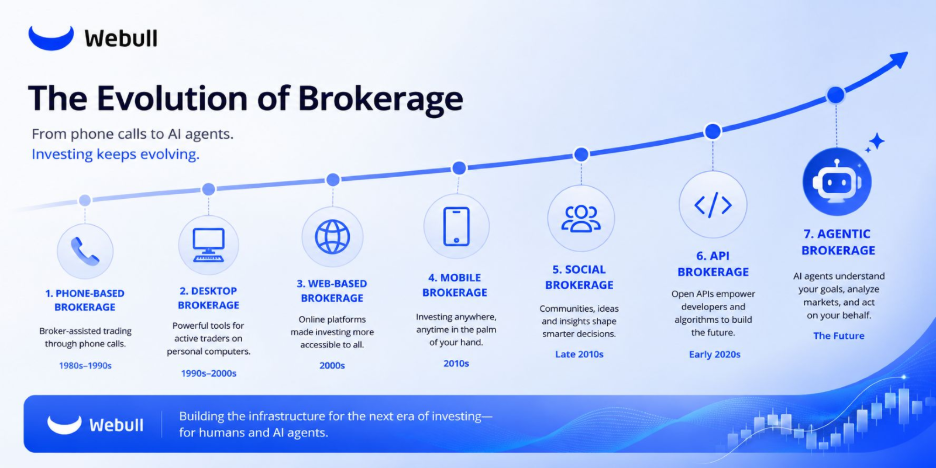
Every decade or so, the brokerage industry goes through a technology platform transformation.
The internet made online investing possible.
Mobile phones put the markets in our pockets.
Zero-commission trading expanded access to millions of new investors.
Today, artificial intelligence is transforming retail investing. Not because it can generate quick answers, but because it can start to bridge insight with action.
For Webull, this marks the beginning of the AI-native brokerage: a brokerage designed not only for human users navigating screens, but for human users, advisors, developers, institutions, and AI agents interacting through secure, permissioned infrastructure.
From Screens to Conversations
For years, brokerage platforms have competed by building better screens and better user flows.
More charts. More indicators. More watchlists. More tools. And less clicks.
Those improvements mattered. But they all started from the same assumption: the investor would find the right screen, interpret the information, and manually decide what to do next.
AI changes that assumption.
Increasingly, investors will not start with a menu, a tab, or a chart. They will start with a conversation.
"How much technology exposure do I have?"
"How would my portfolio perform if interest rates decline?"
"Show me companies with strong free cash flow and growing dividends."
That is a meaningful change. For the first time, technology can begin to understand what an investor is trying to accomplish, assemble the relevant context, and help move the investor toward a decision, instead of simply displaying more information and asking the investor to do all of the work.
In November 2022, OpenAI’s launched GPT-3.5 which powered the first general-purpose AI chatbot. At the time, AI’s ability to explain, reason, compare, summarize, and generate ideas was astounding. You had the mouthpiece of a financial expert in your pocket.
But for a brokerage, talking is only half the equation.
AI Has a Mouth. It Needed Hands.
Today's AI can produce remarkable analysis.
But insights alone don't build portfolios.
They don't rebalance allocations.
They don't place orders.
They don't monitor execution.
They don't manage the ongoing workflow of investing.
After the conversation ends, the investor still has to become the hands: opening the brokerage app, finding the right account information, entering orders, reviewing confirmations, and monitoring what happens next.
That gap between conversation and action is the next frontier.
That is why agentic trading becomes the hands.
An AI agent should not simply answer a question and stop. In a properly controlled brokerage environment, it can retrieve portfolio information, analyze an investor's objective, coordinate with other specialized agents, prepare a proposed course of action, seek the investor's authorization, submit orders, monitor execution, and continue assisting throughout the investment lifecycle.
The intelligence remains the mouth.
The agentic brokerage becomes the hands.
The Brokerage Becomes a Platform
This evolution changes the role of the brokerage.
Historically, brokerages built applications for end users.
Going forward, brokerages will need to build secure infrastructure for both people and intelligent software.
Applications.
Financial advisors.
Fintech companies.
Institutional platforms.
AI assistants.
Autonomous agents.
Each of these participants will need secure, permissioned access to brokerage capabilities: market data, portfolio information, account services, execution, custody, and compliance.
In that world, the brokerage is more than an app. It becomes programmable financial infrastructure: a trusted layer where identity, data, advice, authorization, execution, custody, risk controls, and auditability come together for both human and software participants.
Why This Matters
The importance of this shift is not limited to a better retail investing experience.
It changes who can interact with a brokerage, how they interact with it, and the level of sophistication those interactions can support.
Historically, the retail brokerage interface was designed primarily for a point-and-click individual investor sitting in front of an application. The user logged in, navigated the platform, reviewed information, and manually initiated the next step.
AI expands that interface. In the next generation of brokerage, the participants interacting with broker-dealers will include not only self-directed investors, but also financial advisors, fintech platforms, institutional clients, developer-built applications, portfolio tools, and intelligent agents acting on behalf of authorized users.
Those participants will not simply request static data or click through predefined workflows. They will increasingly ask more complex questions, make quicker decisions, analyze larger sets of information, compare alternatives, monitor changing conditions, and initiate more sophisticated workflows through secure, permissioned access.
That is the strategic change: the brokerage moves from being a destination application to becoming an intelligent access layer for a broader ecosystem of participants that can act with more context, more automation, more precision, and greater financial sophistication.
