
Monolithic Power Systems Stock Q3 Earnings Beat On AI Data Center Demand
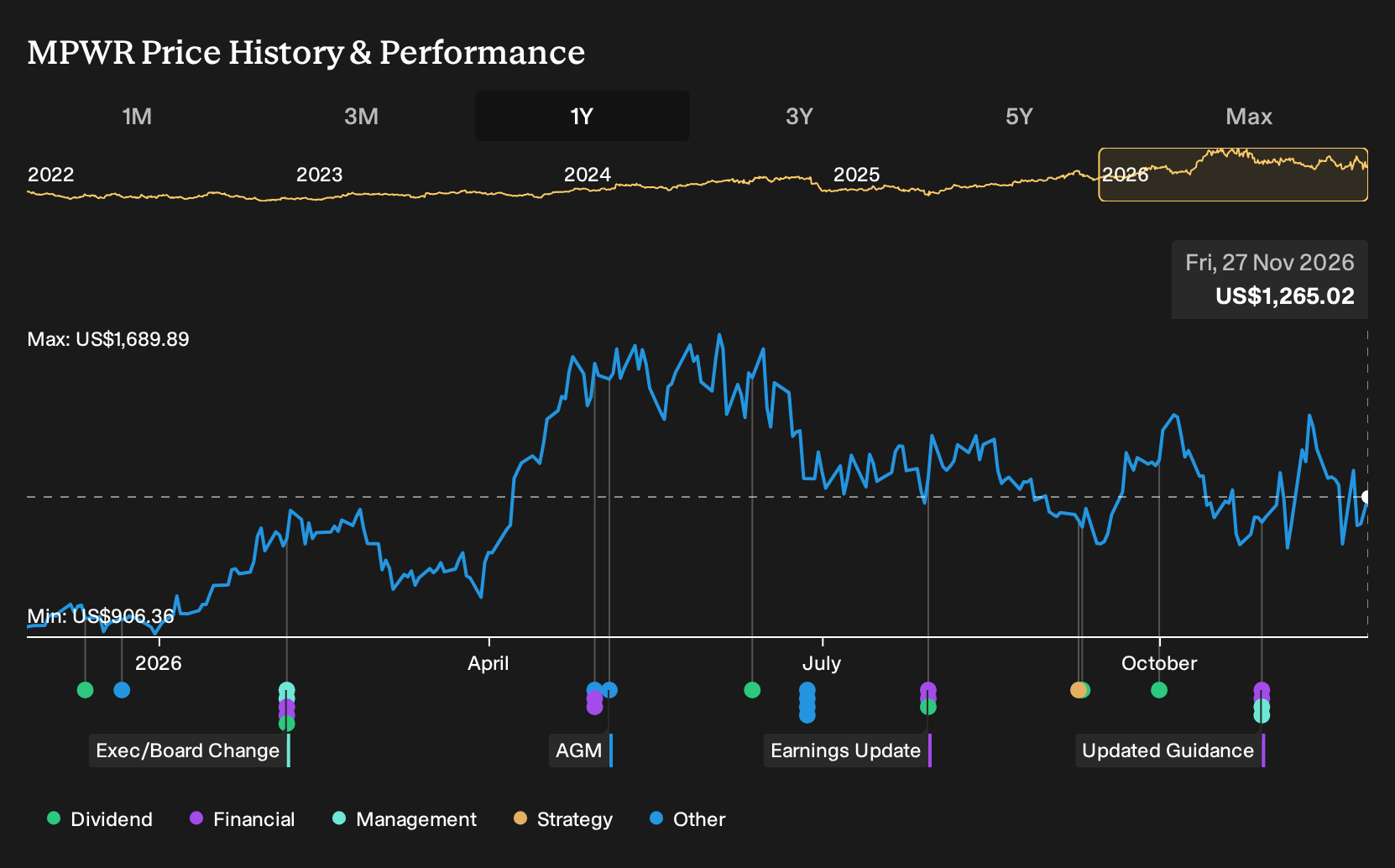
- Monolithic Power Systems reported strong Q3 FY2026 results, with significant revenue and earnings growth tied to Enterprise Data and Communications demand linked to AI infrastructure build outs.
- The most striking operational detail is that management pointed to AI related data center exposure approaching roughly 50% of revenue, which signals a business increasingly anchored in higher power density compute workloads.
- We will now look at how Monolithic Power Systems' investment narrative is shaped by Q3 earnings strength driven by AI infrastructure demand.
Scan beyond Monolithic Power Systems and size up other AI infrastructure beneficiaries with the hand picked 52 AI infrastructure stocks, already filtered for you.
Monolithic Power Systems Investment Narrative Recap
To own Monolithic Power Systems, you need to be comfortable with a business that is increasingly tied to AI centric data center power demand and is building capacity ahead of it. The Q3 strength in Enterprise Data and Communications aligns with the analyst consensus Narrative on Simply Wall St, where AI infrastructure workloads and higher power density solutions are central to the thesis.
The main near term swing factor is whether AI related demand keeps absorbing the capacity that is being built toward more than US$6b in annual revenue equivalents. The biggest risk is that this utilization falls short, which would keep fixed costs elevated, pressure free cash flow, and limit how much earnings can scale on that expanded footprint.
Among the developments highlighted in recent commentary, the long term 300mm manufacturing partnership in Singapore looks most tied to the current AI driven earnings story. Management now links that capacity plan to a footprint sized beyond US$6b in annual revenue equivalents, with early 2027 targeted for volume. It is a concrete operational bet on sustained demand for Monolithic Power Systems solutions.
This same move also concentrates execution risk. If Enterprise Data growth or wider AI infrastructure orders soften, the Singapore ramp could weigh on free cash flow margins for longer and compress returns. If AI, automotive and new areas like high speed memory interfaces continue to track the analyst consensus Narrative on Simply Wall St, then filling that manufacturing pipeline becomes a key operational catalyst to watch.
Monolithic Power Systems' current earnings of $801.9 million are set against analyst expectations for $2.1b of earnings by 2029. This implies an increase of about $1.3b, alongside forecast revenue of $6.9b by that same year and an assumed 28.3% yearly rise in revenue over the next 3 years.
Discover how Monolithic Power Systems' fair value indicates a 42% potential upside to its current price, which could close faster than many investors expect.
Exploring Other Perspectives
Some of the most optimistic analysts frame the Singapore capacity build as a clear catalyst for Monolithic Power Systems. Before this Q3 update, they were modeling revenue of about US$12.8b and earnings of roughly US$3.0b by 2029. That is far above the consensus view, which shows how widely opinions can differ. You can compare these alternate forecasts yourself and decide which narrative might need updating after the latest results.
Explore 4 other Monolithic Power Systems fair value estimates, including one that suggests as much as 71% upside from the current price!
Reach Your Own Conclusion
Don't just follow the ticker. Dig into the data and build a conviction that's truly your own.
- A great starting point for your Monolithic Power Systems research is our analysis highlighting 2 key rewards and 3 important warning signs that could impact your investment decision.
- See our latest analysis for Monolithic Power Systems. The report includes a comprehensive fundamental analysis summarized in a single visual, the Snowflake, making it easy to evaluate Monolithic Power Systems' overall financial health at a glance.
Looking for more investment ideas beyond Monolithic Power Systems?
Once you have a view on Monolithic Power Systems, it can help to compare it with other opportunities that share similar quality markers, income profiles, or balance sheet strength. The Simply Wall St Screener lets you quickly filter for different types of stocks and build a wider watchlist that fits your own risk and return preferences.
- If you want income to play a bigger role in your portfolio, start with companies that feature reliable payouts through the 39 dividend fortresses.
- For investors who care most about financial resilience and capital preservation, focus on businesses with strong balance sheets using the 31 resilient stocks with low risk scores.
- When you are hunting for lesser known opportunities with solid fundamentals, broaden your research with the 21 high quality undiscovered gems.
Have feedback on this article? Concerned about the content? Get in touch with us directly. Alternatively, email editorial-team@simplywallst.com