
Has Infosys (NSEI:INFY) Fallen Far Enough to Justify Its Earnings?
Infosys has had a difficult run so far this year, and the stock’s recent moves raise a basic question for you as an investor. Is today’s share price properly anchored in the earnings power that the business is currently generating?
- The share price is down 29.4% year to date, which puts the focus squarely on whether the earnings profile can still support the current valuation.
- The group’s model as a large IT services provider ties its long term worth to the durability of client demand, which can shape how steadily earnings convert into cash over time.
- Your read on Infosys is one view; the desks covering it have another. See what analysts think Infosys's shares could be worth.
The issue now is whether Infosys’ current market valuation is justified by its earnings when set against the Fair Ratio benchmark.
If you want a clearer yardstick for Infosys and other earnings-focused stories, compare it with 213 high quality undervalued stocks.
Is Infosys Still Cheap on Earnings?
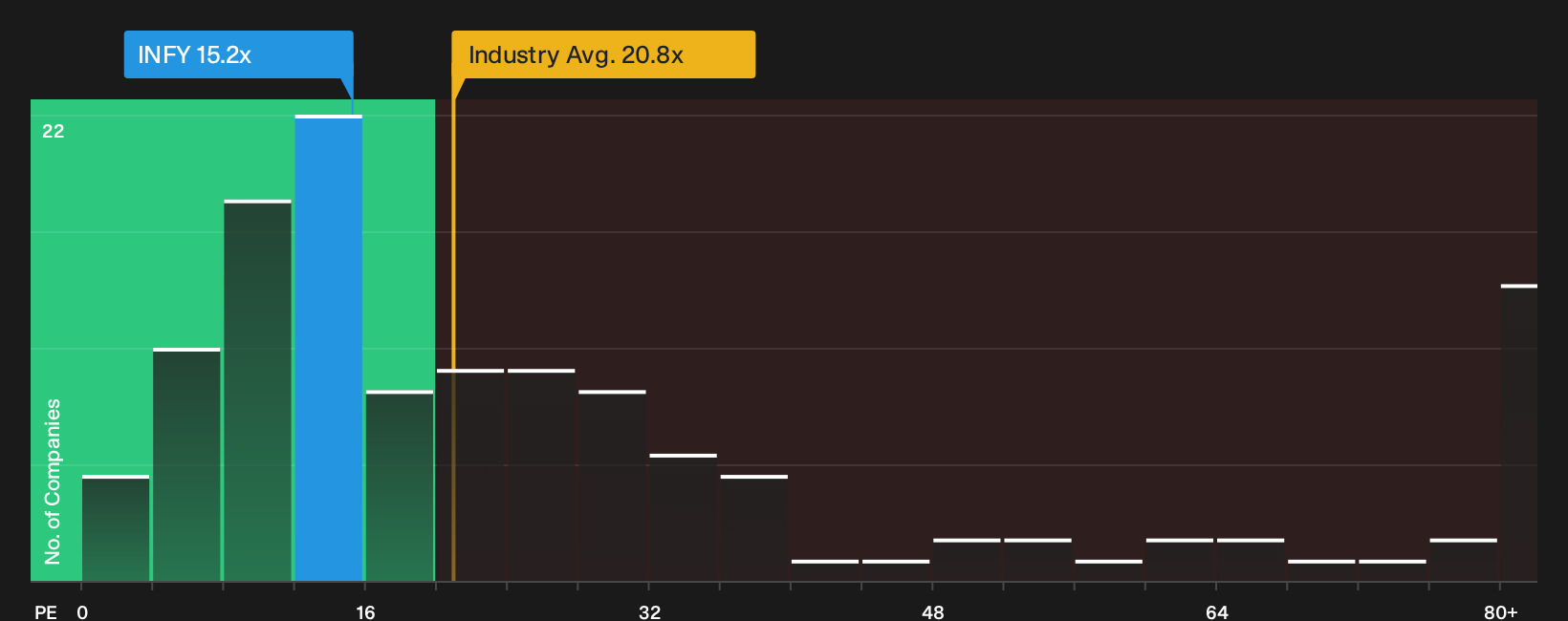
The P/E ratio fits Infosys because investors often focus on how consistently an IT services group can turn its fee income into earnings. On that yardstick, Infosys trades at about 15.2x earnings, which is well below the IT sector average of roughly 20.8x and under the peer group level of about 20.7x. For a large, established operator, that is a noticeable gap in how the market is pricing each unit of profit.
The Fair Ratio model, which blends factors such as growth outlook, profitability profile, size and risk into a tailored benchmark, points to a higher P/E than where Infosys currently trades. That places the stock in undervalued territory on this specific earnings measure, leaving room for readers to decide whether the business quality and cash generation justify closing some of that discount. Explore the numbers behind Infosys's P/E valuation.
The Infosys Narrative: What Would Justify Today's Price?
Infosys' valuation gap on P/E sets up a simple question that Narratives try to answer in plain terms. Narratives on Simply Wall St's Community page spell out which combination of future growth, profitability and earnings power would need to hold for the current share price to look too low or too high. Each scenario ties a fair value range to a particular mix of potential drivers and setbacks so you can track which version of events is actually unfolding over time.
Two different stories emerge around Infosys, with one Narrative seeing earnings support for today's valuation and the other more focused on pressure building underneath it.
Bull case: roughly fairly valued
This view comes from the analyst consensus Narrative on Simply Wall St, which ties Infosys closely to AI led deal momentum.
"Infosys is seeing strong demand and deal momentum in AI driven transformation, with AI services now 8.2% of revenue and supported by an identified AI first services opportunity of about US$300b to US$400b by 2030, which can influence longer term revenue growth and earnings…"
Discover why this Narrative puts Infosys at roughly fairly valued.
Bear case: 16% overvalued
This angle is drawn from the bearish analyst Narrative on Simply Wall St, which leans heavily on pricing pressure and contract structure concerns.
"Although Infosys is building a sizeable AI services franchise with AI-first revenue at 10.5% of total revenue in Q2 FY27, rising client expectations for AI-led productivity sharing and lower pricing across renewals and mid-contract resets could mean that new AI work fails to fully offset deflation in legacy revenue…"
Explore why this Narrative puts Infosys at 16% overvalued.
One more angle on Infosys that deserves your attention
Before you focus only on where Infosys trades on its P/E, it is worth checking the specific risk flags that independent checks have picked up on this business and weighing how they fit your own thesis. Take a closer look at 1 warning sign before settling on a valuation.
Have feedback on this article? Concerned about the content? Get in touch with us directly. Alternatively, email editorial-team@simplywallst.com