
Salesforce (CRM) Stock May Trade At A Discount After Export Program Selection
Salesforce has had a tough run over the past few years, and with the stock closing at US$198.21 most recently, the live question is whether that price still lines up with what the company earns today. Recent headlines around artificial intelligence exports, software outages and sector-wide selling only sharpen the focus on whether Salesforce's earnings can support the valuation investors are paying for.
- Over the past 3 years the share price has declined 22.3%, which puts fresh pressure on the case that Salesforce's current earnings profile can carry its market valuation.
- Being picked for a U.S. government Super Intelligence export program and participating in a growing retail technology market can support expectations for future software demand, which matters for how much investors are willing to pay for Salesforce's existing earnings base.
- Your read on Salesforce is one view; the desks covering it have another. See what analysts think Salesforce's shares could be worth.
For investors, the debate is whether Salesforce's current earnings are strong and resilient enough to justify the price the market is assigning to the stock today.
To see how Salesforce's earnings story compares with other AI focused software opportunities, line it up against the companies in 39 AI small caps.
Does Salesforce Look Undervalued on Earnings?
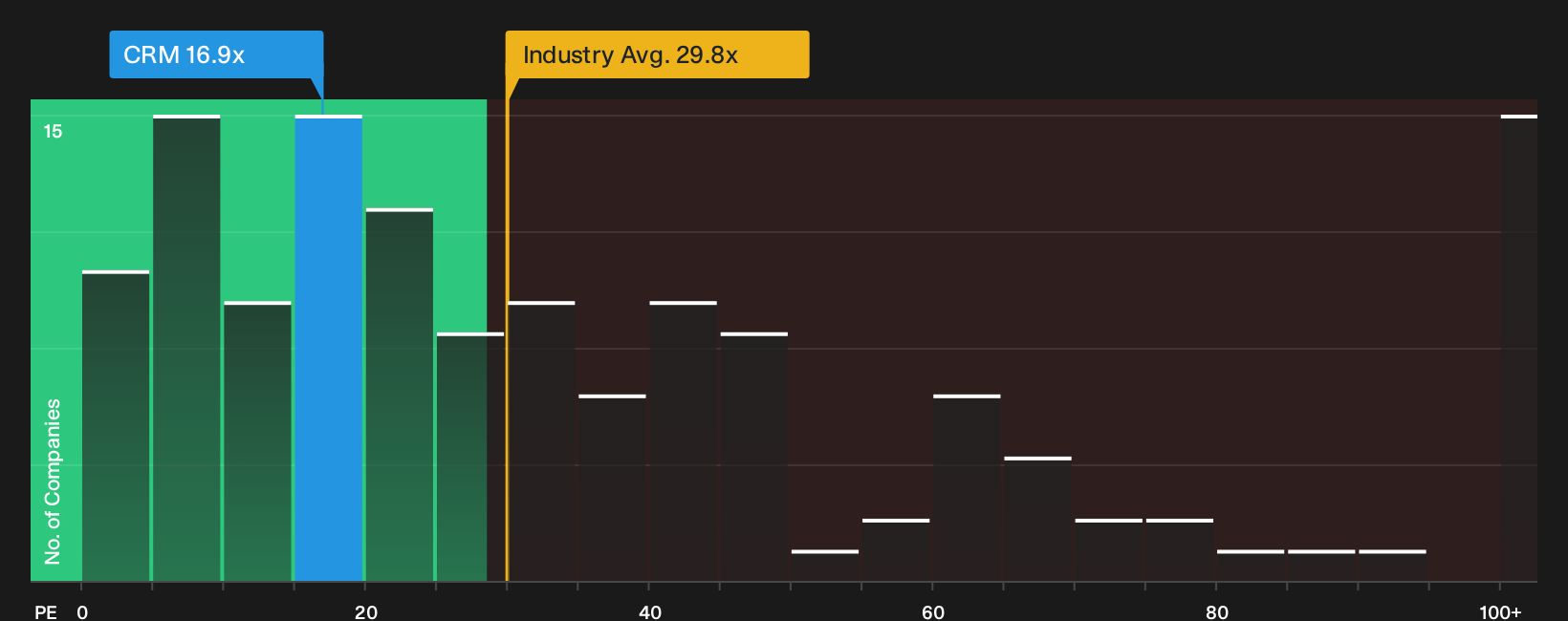
For a mature, profitable software group like Salesforce, the P/E ratio is usually a clear shorthand for what you are paying for each dollar of earnings. On this measure, the stock trades on roughly 16.9x earnings, which is well below the broader software industry on about 29.8x and also under the peer group sitting closer to 40.7x. Because the business has been included in the U.S. Super Intelligence export program, some investors may expect a richer price tag. However, the current P/E still points to a discount versus many comparable software platforms.
The valuation model that blends Salesforce’s growth profile, margins, size and risk suggests a higher P/E would be typical for a company with these characteristics. As a result, the current ratio screens as undervalued on this framework. For you as a shareholder or prospective buyer, the key judgement is whether recent software sector selling and worries around AI competition fairly reflect Salesforce’s earnings power or have pushed the P/E multiple too low relative to what the underlying franchise can deliver. Explore the numbers behind Salesforce's P/E valuation.
The Salesforce Narrative: What Would Justify Today's Price?
Salesforce Narratives on Simply Wall St pick up where the P/E puzzle leaves off. They lay out the specific growth, margin and earnings paths that would need to hold for Salesforce's current valuation to look materially higher or lower than today's price, and they turn a single model output into a set of future checkpoints you can monitor over time on the Community page.
The bullish and bearish narratives on Salesforce both focus on AI agents and data, yet one sees more upside in that story than the other.
Bull case: 33% undervalued
According to HedgeY, an investor in the Simply Wall St Community, the potential upside rests on Salesforce becoming the trusted layer for AI agents.
"If AI agents become the new interface for work, Salesforce can still win, but only if it becomes the system those agents rely on to operate safely…"
Discover why this Narrative puts Salesforce at 33% undervalued.
Bear case: roughly fairly valued
The bearish analyst narrative on Simply Wall St argues that the AI push could strain economics if security and compliance costs stay high.
"External research highlighting security challenges specific to AI agents suggests that maintaining this trust posture at scale may require continued heavy compliance and engineering spend…"
Explore why this Narrative puts Salesforce at roughly fairly valued.
One big Salesforce question the numbers do not answer
Valuation only shows what investors are willing to pay for Salesforce today, yet the people setting priorities and the way they are rewarded can heavily influence where the business goes next. See who runs Salesforce and how they are paid.
Have feedback on this article? Concerned about the content? Get in touch with us directly. Alternatively, email editorial-team@simplywallst.com